
Trophozites seen in blood?
Reading File
Searching for trophozoites seen in blood smear.
search_medical_text
trophozoites seen in blood smear parasites
Diagnosis and Management of Babesiosis
Page 8
search_medical_image
trophozoites blood smear malaria Babesia
Harrison's Principles of Internal Medicine, Twenty First Edition
Page 6474
GradeResponse
GradeResponse
Trophozoites Seen in Blood
Trophozoites are the feeding/active stage of certain protozoan parasites. When seen on a peripheral blood smear, the key organisms to consider are:
1. Plasmodium spp. (Malaria) — Most Important
All four species infect RBCs and show trophozoite stages on smear:
| Feature | P. falciparum | P. vivax | P. malariae | P. ovale |
|---|---|---|---|---|
| Trophozoite | Delicate ring forms; appliqué/accolé position; multiple rings/RBC | Amoeboid, large; Schüffner's dots | "Band form" trophozoite | Compact ring; Schüffner's dots |
| RBC size | Normal or smaller | Enlarged | Normal or smaller | Slightly enlarged |
| Special feature | Maurer's clefts; only rings + gametocytes in peripheral blood | Ziemann's stippling | "Band" shape | James's dots |
Key mnemonic: P. falciparum is the most dangerous — mature trophozoites sequester in capillaries, so only ring-form trophozoites are seen in peripheral blood (no mature schizonts unless very severe).
2. Babesia spp. — Second Most Important
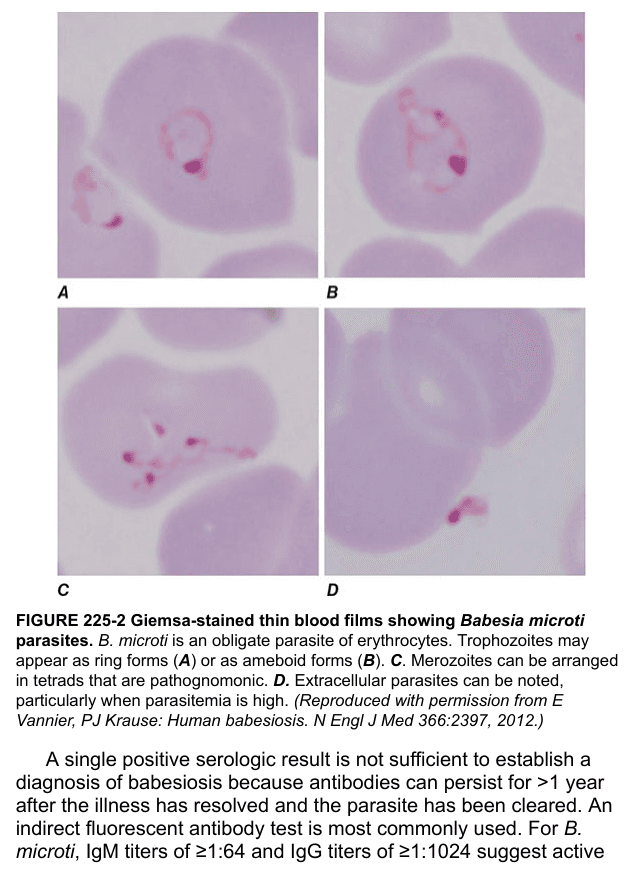
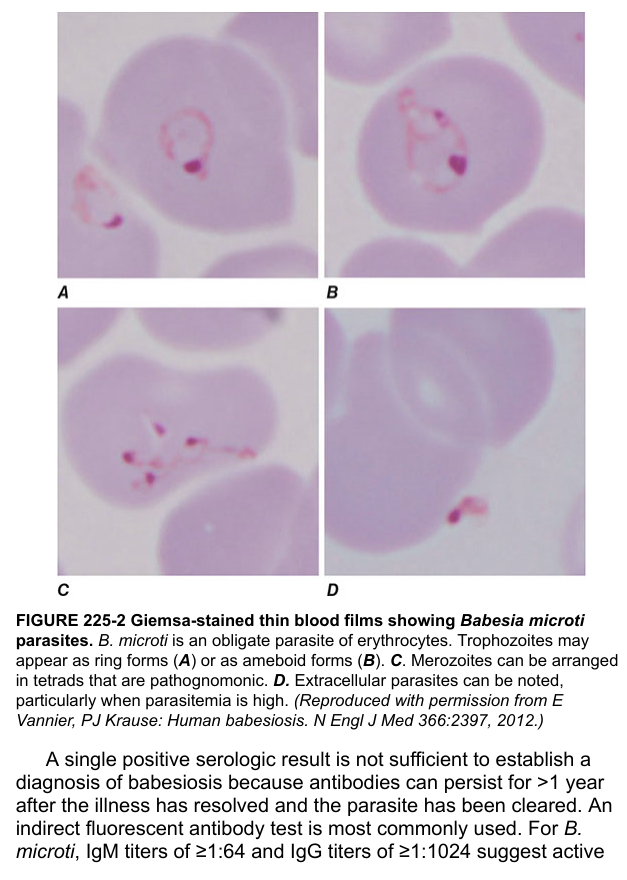
(Diagnosis and Management of Babesiosis, p. 8; Harrison's, p. 6474)
- Obligate intraerythrocytic parasites
- Trophozoites appear as:
- Ring forms (similar to P. falciparum — a major diagnostic pitfall)
- Ameboid forms
- Pathognomonic finding: Merozoites in tetrad (Maltese Cross) formation — seen OUTSIDE the RBC
- Extracellular parasites visible when parasitemia is high
- Key distinction from malaria: No hemozoin (malaria pigment), Maltese cross tetrad, extracellular forms
How to Differentiate on Smear
| Feature | Malaria (P. falciparum) | Babesia |
|---|---|---|
| Multiple rings/RBC | Yes | Yes |
| Appliqué position | Yes | No |
| Maltese cross | No | Yes (pathognomonic) |
| Extracellular forms | No | Yes (high parasitemia) |
| Malaria pigment (hemozoin) | Yes | No |
| Splenomegaly | Yes | Yes |
| Geography | Tropics | Northeastern USA, Europe |
Summary
- Trophozoites in blood = intraerythrocytic parasites → always think Malaria first, then Babesiosis
- The Maltese cross (tetrad form) on smear = Babesia until proven otherwise
- P. falciparum shows only ring-form trophozoites in peripheral blood (mature stages sequester)
- Thin and thick Giemsa-stained smears are the gold standard for diagnosis
This is a shared conversation. Sign in to Orris to start your own chat.