
Human hypothalamus physiology..
Reading File
The hypothalamus is the master integrating center of the brain - it regulates autonomic function, endocrine output, temperature, hunger, thirst, sleep, and circadian rhythms through its many distinct nuclei. It connects to the pituitary gland via the hypothalamo-hypophyseal tract and portal system, controlling both anterior and posterior pituitary hormone release.
Searching sources...
Finding Sources
Finding Sources
Finding Sources
Finding Sources
Good sources found. Now let me read the most relevant ones in parallel - Neuroscience: Exploring the Brain and Kaplan & Sadock's Psychiatry for hypothalamus physiology, plus search for physiology textbook content.
Reading File
Reading File
Finding Sources
Excellent - found Guyton and Hall, Adams & Victor's Neurology, Histology text, and Berek & Novak's. Let me now read the most authoritative physiology sources in parallel.
Reading File
Reading File
Reading File
Excellent content from three authoritative sources. Let me now get more from Guyton (the primary physiology text) focusing on hypothalamic nuclei and circadian/autonomic functions, plus fetch some key diagrams.
Finding Sources
Reading File
Loading Image
Now let me read the key Guyton section on vegetative/endocrine control of the hypothalamus - the most comprehensive physiology content.
Reading File
Reading File
Excellent - I now have a very rich picture from Guyton & Hall, Berek & Novak's, Histology, and Neuroscience texts. Let me fetch the key Guyton hypothalamus diagram and also read more of the vegetative functions section.
Loading Image
Reading File
I now have comprehensive, authoritative content from multiple sources. I have everything needed to compile a thorough response. Let me also fetch the Berek & Novak diagram showing the hypothalamic-pituitary axis.
Loading Image
Loading Image
I now have comprehensive, authoritative content from four major textbooks plus four high-quality diagrams. I have everything needed for a thorough response.
Human Hypothalamus Physiology
Overview
The hypothalamus is a small neural structure at the base of the brain, positioned above the optic chiasm and below the third ventricle, encapsulating the ventral portion of that ventricle. Despite constituting less than 1% of the brain's total mass, it is one of the most important control structures in the entire nervous system - serving as the central integrator of the limbic system, governing virtually all vegetative and endocrine functions of the body. - Guyton and Hall Textbook of Medical Physiology
Anatomy and Zonal Organization
The hypothalamus is divided anatomically into three mediolateral zones:
- Periventricular zone - immediately adjacent to the third ventricle; produces most of the hypophysiotropic hormones that regulate the anterior pituitary
- Medial zone - primarily neuronal cell bodies (the classical "nuclei")
- Lateral zone - primarily axonal pathways; important for thirst and hunger drives
These zones extend through three anteroposterior regions: preoptic/anterior, tuberal/middle, and posterior/mammillary.
The hypothalamic nuclei visible in coronal view:
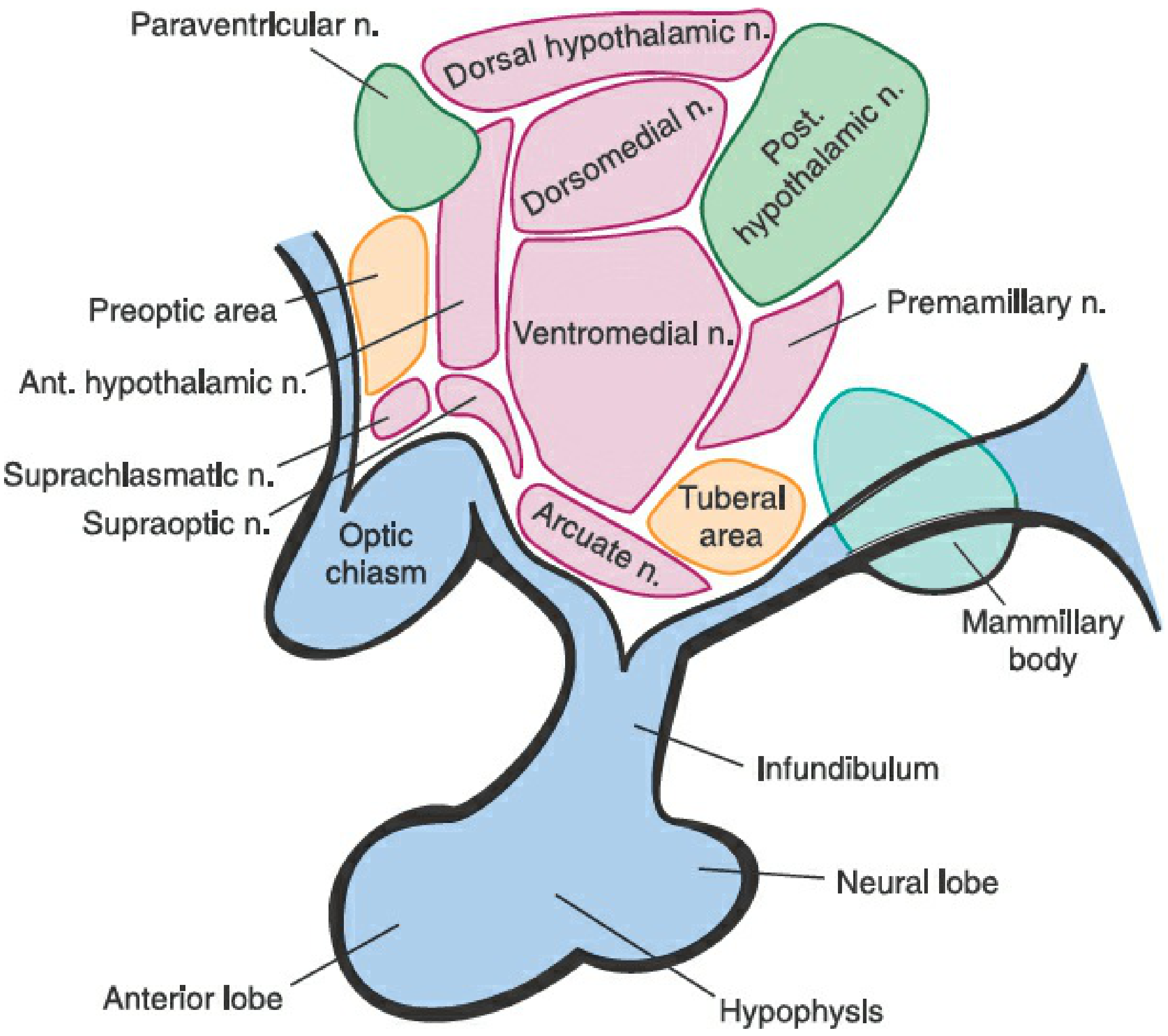
The hypothalamus is not isolated - it has extensive bidirectional interconnections with the limbic system (amygdala, hippocampus), thalamus, pons, and brain stem reticular formation. Many of these pathways form feedback loops. - Berek & Novak's Gynecology, p. 267
Key Nuclei and Their Functions
The following diagram from Guyton summarizes the functional map of hypothalamic nuclei:
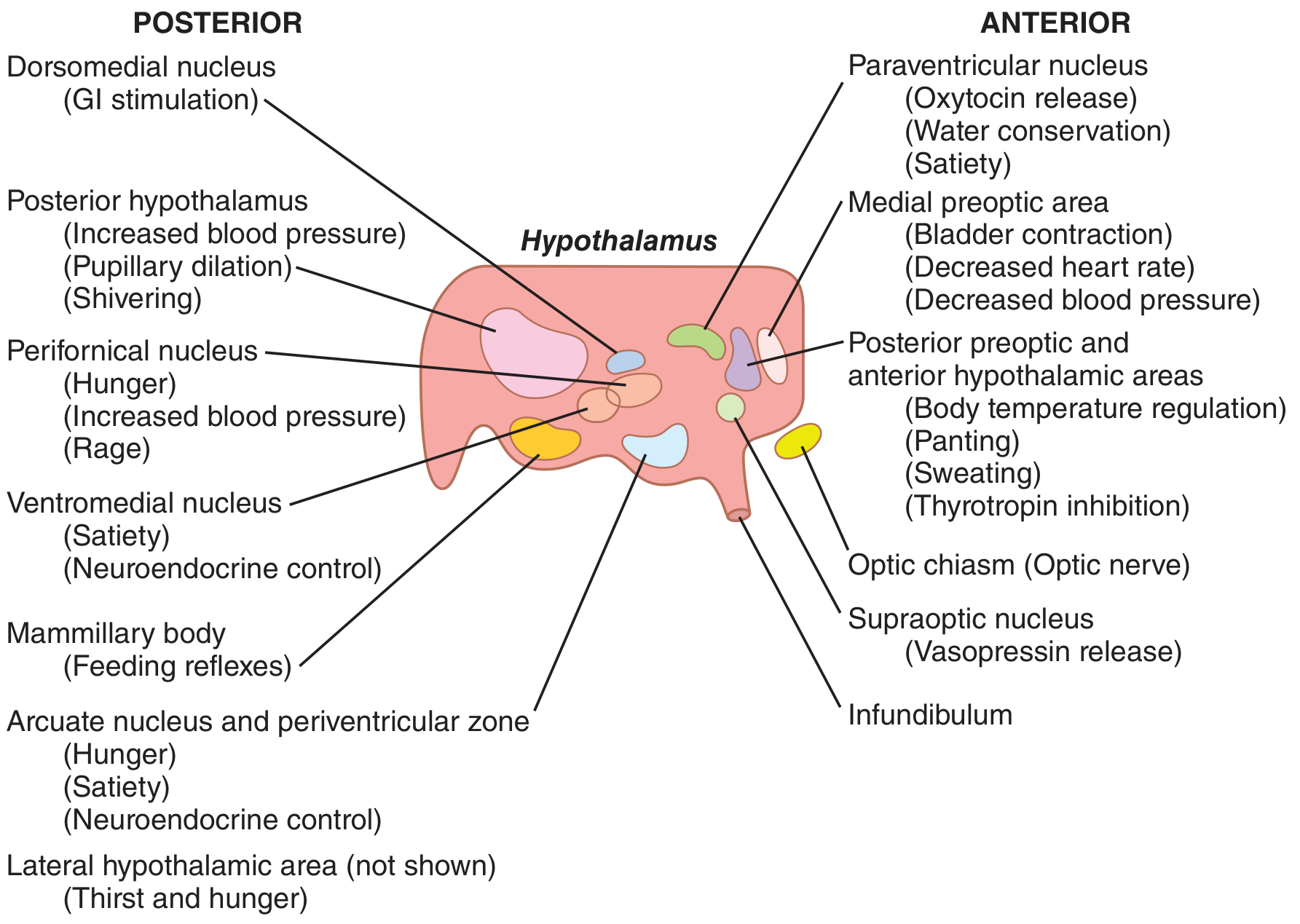
| Nucleus / Region | Primary Functions |
|---|---|
| Supraoptic nucleus | ADH (vasopressin) synthesis and release |
| Paraventricular nucleus | Oxytocin release, water conservation, satiety, CRH production |
| Preoptic area (anterior) | Body temperature regulation, panting, sweating; decreases HR and BP; bladder contraction |
| Arcuate nucleus | GHRH, somatostatin, dopamine; hunger/satiety signaling (NPY/AgRP and POMC neurons) |
| Ventromedial nucleus (VMH) | Satiety center; neuroendocrine control; bilateral destruction → obesity |
| Dorsomedial nucleus | GI tract stimulation |
| Perifornical nucleus | Hunger, increased BP, rage |
| Posterior hypothalamus | Increased BP, pupillary dilation, shivering; integrates temperature signals |
| Lateral hypothalamic area | Thirst and hunger drives; bilateral destruction → aphagia/adipsia |
| Mammillary bodies | Feeding reflexes (licking, swallowing); part of memory circuits |
| Suprachiasmatic nucleus (SCN) | Master circadian clock, entrains to light via retinohypothalamic tract |
- Guyton and Hall Textbook of Medical Physiology; Histology: A Text and Atlas
1. Endocrine Control - Hypothalamo-Pituitary Axis
This is the hypothalamus's most studied role. It exerts control over the anterior pituitary via the hypothalamo-hypophyseal portal system (not direct neural connections), and over the posterior pituitary via direct axonal projections.
Posterior Pituitary (Neurohypophysis)
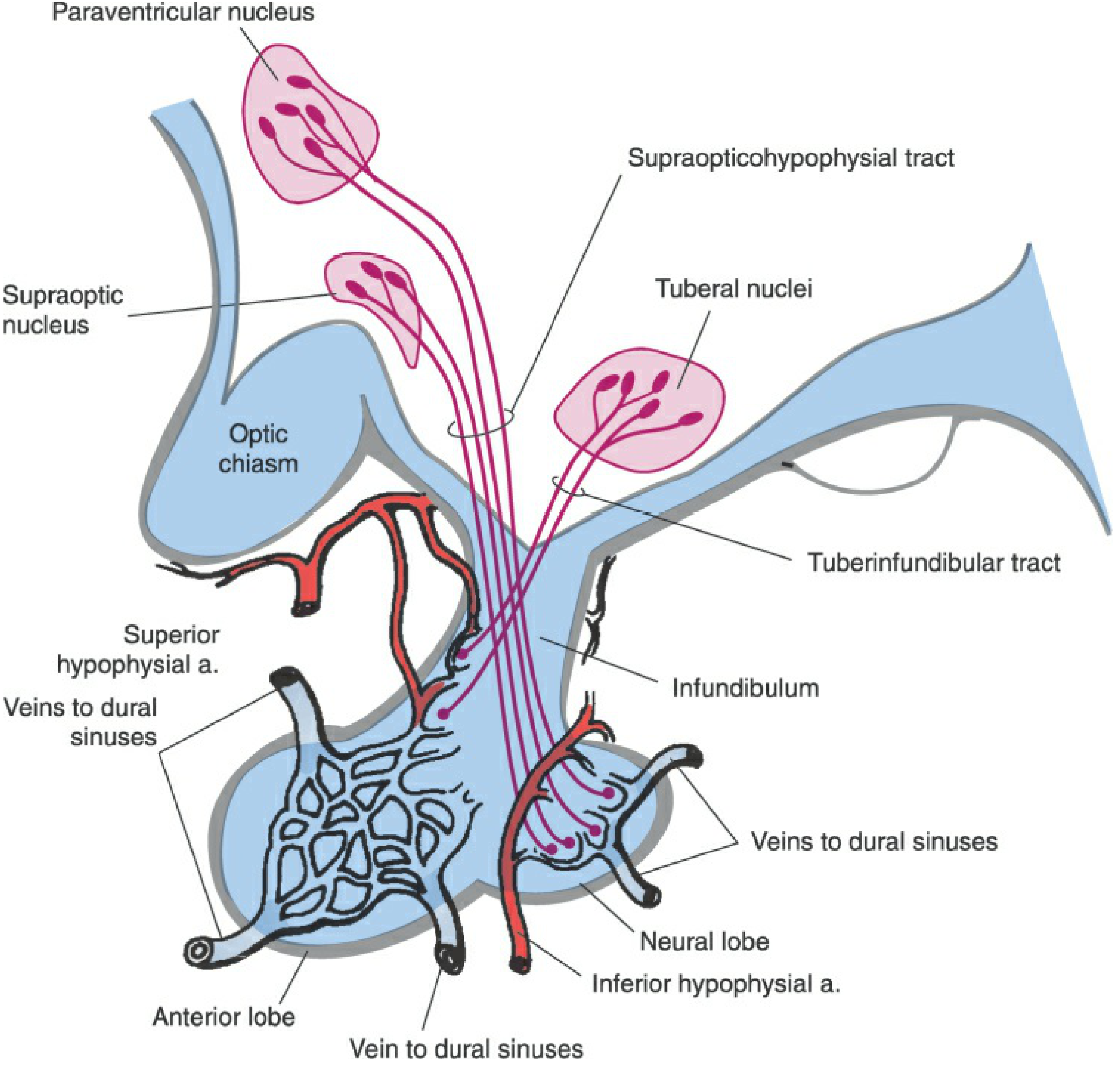
The posterior pituitary is a direct physical extension of the hypothalamus via the supraopticohypophyseal and paraventriculohypophyseal tracts. Two hormones are synthesized in hypothalamic cell bodies and transported along axons to be released in the posterior pituitary:
- ADH (vasopressin) - made in supraoptic nuclei; released in response to increased plasma osmolality or decreased blood volume; acts on renal collecting tubules/ducts to increase water reabsorption
- Oxytocin - made in paraventricular nuclei; stimulates uterine contractility during labor and milk ejection from breast alveoli in response to suckling
Anterior Pituitary (Adenohypophysis)
The adenohypophysis has no direct neural supply from the hypothalamus. Instead, hypothalamic neurons release hypophysiotropic hormones into capillaries at the median eminence (where there is no blood-brain barrier - fenestrated capillaries), and these hormones travel via the portal vessels down to the anterior pituitary.
Key hypothalamic releasing and inhibiting hormones:
| Hormone | Composition | Source Nucleus | Effect |
|---|---|---|---|
| GnRH | 10 amino acid decapeptide | Arcuate, ventromedial, paraventricular nuclei | Stimulates LH and FSH from gonadotropes |
| CRH | 41 AA polypeptide | Arcuate, periventricular, medial paraventricular | Stimulates ACTH from corticotropes; induces POMC gene expression |
| TRH | 3 AA (tripeptide) | Ventromedial, dorsal, paraventricular nuclei | Stimulates TSH and prolactin secretion |
| GHRH | 40 or 44 AA (two forms) | Arcuate nucleus | Stimulates GH secretion and gene expression |
| Somatostatin | 14 or 28 AA (two forms) | Periventricular, paraventricular, arcuate | Inhibits GH (from somatotropes) and TSH; inhibits pancreatic insulin |
| Dopamine | Catecholamine | Arcuate nucleus (tuberoinfundibular tract) | Inhibits prolactin from lactotropes |
- Histology: A Text and Atlas, Table 21.5
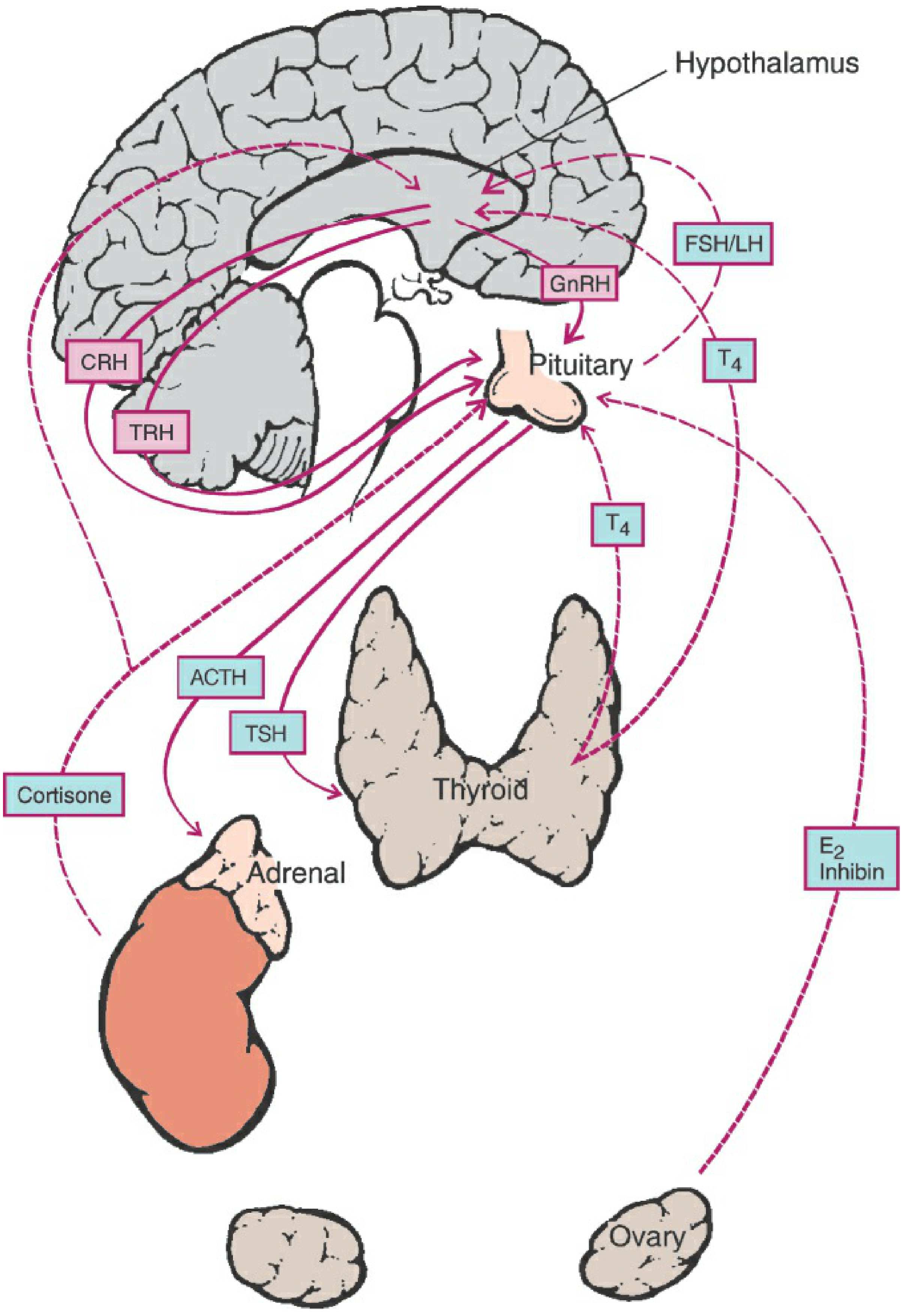
Feedback Loops
Multiple levels of feedback regulate hypothalamic output:
- Long-loop feedback - peripheral endocrine hormones (e.g., cortisol, estradiol, T4) circulate back and bind receptors in the hypothalamus, inhibiting further releasing hormone secretion
- Short-loop feedback - anterior pituitary hormones (e.g., LH) feed back to the hypothalamus
- Ultrashort-loop feedback - hypothalamic hormones feed back directly on the hypothalamus itself
2. Temperature Regulation
The hypothalamus acts as a thermostat, comparing core body temperature to a set point (~37.1°C).
When too hot (anterior/preoptic area activated):
- Vasodilation of skin blood vessels (up to 8x increase in heat transfer)
- Sweating (1°C rise above set point → 10x basal heat production removed by sweating)
- Inhibition of shivering and chemical thermogenesis
When too cold (posterior hypothalamus activated):
- Skin vasoconstriction (sympathetic stimulation from posterior hypothalamus)
- Piloerection (minimal in humans)
- Increased thermogenesis via shivering, sympathetic stimulation of brown adipose tissue, and TRH → TSH → thyroxine secretion
The posterior hypothalamus integrates both peripheral cold/heat signals from skin thermoreceptors AND central signals from the anterior hypothalamic-preoptic area. The final command for heat generation or dissipation is issued from the posterior hypothalamus, approximately at the level of the mammillary bodies. - Guyton and Hall, p. 897
3. Body Water and Osmotic Regulation
Two mechanisms maintain water balance:
- Thirst - lateral hypothalamic thirst center detects increased extracellular fluid osmolality → generates conscious desire to drink
- ADH release - supraoptic nuclei neurons act as osmoreceptors; when body fluids are too concentrated, ADH is released from posterior pituitary → kidneys reabsorb water without excreting electrolytes → osmolality returns to normal
This elegantly separates water regulation from electrolyte regulation. - Guyton and Hall, p. 735
4. Feeding Behavior and Energy Balance
The hypothalamus is the central hub of a distributed energy-regulatory network:
- Lateral hypothalamic area = "hunger center" - bilateral destruction causes aphagia and lethal starvation
- Ventromedial nuclei = "satiety center" - bilateral destruction → hyperphagia and severe obesity
In the arcuate nucleus (ARC), two key neuronal populations act in opposition:
- AgRP/NPY/GABA neurons - stimulated by ghrelin (hunger hormone), inhibited by leptin; project to the lateral hypothalamus (LHA) and stimulate eating (orexigenic)
- αMSH (POMC-derived) neurons - stimulated by leptin, inhibited by ghrelin; project to the paraventricular nucleus (PVN) and inhibit eating (anorexigenic)
These two ARC populations mutually inhibit each other. Their downstream targets - the PVN (expressing CRF, oxytocin, αMSH) and LHA (expressing orexin and MCH) - project widely throughout the brain to orchestrate feeding behavior. - Kaplan & Sadock's Comprehensive Textbook of Psychiatry, p. 803
5. Cardiovascular Regulation
- Posterior and lateral hypothalamus stimulation → increased arterial pressure + increased heart rate (via sympathetic centers in pons/medulla)
- Preoptic area stimulation → decreased heart rate + decreased blood pressure
- These effects are mediated through cardiovascular control centers in the reticular formation - Guyton and Hall, p. 734
6. Autonomic Nervous System Control
The hypothalamus is a major higher center of the ANS:
- Posterior hypothalamus - sympathetic outputs (fight/flight): increased BP, pupillary dilation, piloerection
- Anterior/preoptic hypothalamus - parasympathetic outputs (rest/digest): decreased HR and BP, increased GI motility, bladder contraction
The variety of responses achievable by stimulating slightly different portions of the hypothalamus is remarkable given its small size. Hess's classic experiments (1920s-30s) demonstrated that stimulation of different points could produce sniffing, panting, eating, fear, or rage behaviors - all of which represent integrated somatic + visceral + endocrine programs. - Neuroscience: Exploring the Brain, 5th Edition, p. 1665
7. Circadian Rhythms
The suprachiasmatic nucleus (SCN), located just above the optic chiasm, is the master circadian pacemaker. It receives light input via the retinohypothalamic tract and entrains ~24-hour rhythms in virtually all body systems: sleep-wake cycles, hormone secretion (ACTH, cortisol, GH, prolactin), body temperature, and metabolism. Destruction of the SCN abolishes circadian rhythmicity.
8. Behavioral and Emotional Expression
The posterior hypothalamus plays a role in aggression and rage expression. Classic experiments showed that removing the cerebral hemispheres in animals while leaving the posterior hypothalamus intact produced "sham rage" - exaggerated, non-directed aggressive responses to minor stimuli. This established the hypothalamus as a key executor of emotional behavior programs, normally under inhibitory cortical control. - Neuroscience: Exploring the Brain, 5th Edition, p. 1664
9. Reproductive Function
GnRH neurons in the arcuate nucleus are the key drivers of the reproductive axis. They fire in a pulsatile manner - pulse frequency and amplitude determine whether LH (rapid pulses) or FSH (slow pulses) is preferentially released. Continuous GnRH exposure (non-pulsatile) paradoxically downregulates gonadotropes, which is the principle behind GnRH agonists used clinically. GnRH neurons originate embryologically in the olfactory pit and migrate to the hypothalamus - failure of this migration causes Kallmann syndrome. - Berek & Novak's Gynecology, p. 265
Summary Table
| Function | Key Structure | Output |
|---|---|---|
| ADH release | Supraoptic nucleus | Posterior pituitary → kidneys |
| Oxytocin release | Paraventricular nucleus | Posterior pituitary → uterus/breast |
| Anterior pituitary control | Arcuate, periventricular, paraventricular nuclei | Portal vessels → anterior pituitary |
| Thermoregulation | Anterior/preoptic (heat) + Posterior (cold) | Autonomic + endocrine responses |
| Thirst | Lateral hypothalamus | Behavioral drinking |
| Hunger | Lateral hypothalamus + ARC | Orexigenic behavior |
| Satiety | VMH + ARC (αMSH neurons) + PVN | Anorexigenic behavior |
| Sympathetic output | Posterior + lateral hypothalamus | BP, HR, pupil dilation |
| Parasympathetic output | Preoptic/anterior hypothalamus | Bladder, GI, HR ↓ |
| Circadian rhythms | Suprachiasmatic nucleus | Sleep-wake, hormone cycles |
| Aggression/rage | Posterior hypothalamus | Behavioral programs |
| Reproductive axis | Arcuate nucleus (GnRH) | LH/FSH pulsatility |
Sources consulted:
- Guyton and Hall Textbook of Medical Physiology, 14th Ed.
- Histology: A Text and Atlas with Correlated Cell and Molecular Biology
- Berek & Novak's Gynecology
- Neuroscience: Exploring the Brain, 5th Edition
- Kaplan & Sadock's Comprehensive Textbook of Psychiatry
This is a shared conversation. Sign in to Orris to start your own chat.