
Gastric pouch
Reading File
The query "gastric pouch" is broad - it could mean the normal anatomical gastric pouch (e.g., the fundus air bubble on X-ray), or the surgically created gastric pouch in bariatric surgery (Roux-en-Y gastric bypass), or something else. Let me search both angles simultaneously.
Finding Sources
Finding Sources
Good - all results point to bariatric surgery context. Let me pull the key content from multiple sources simultaneously.
Reading File
Reading File
Reading File
I have rich content. Let me also read more from Schwartz's on pouch creation details and fetch the diagram image.
Reading File
Loading Image
I now have comprehensive information. Here is the full answer:
Gastric Pouch
The gastric pouch is the small remnant of proximal stomach created during Roux-en-Y Gastric Bypass (RYGB) - the gold-standard bariatric operation. It is the functional "new stomach" that receives food after surgery.
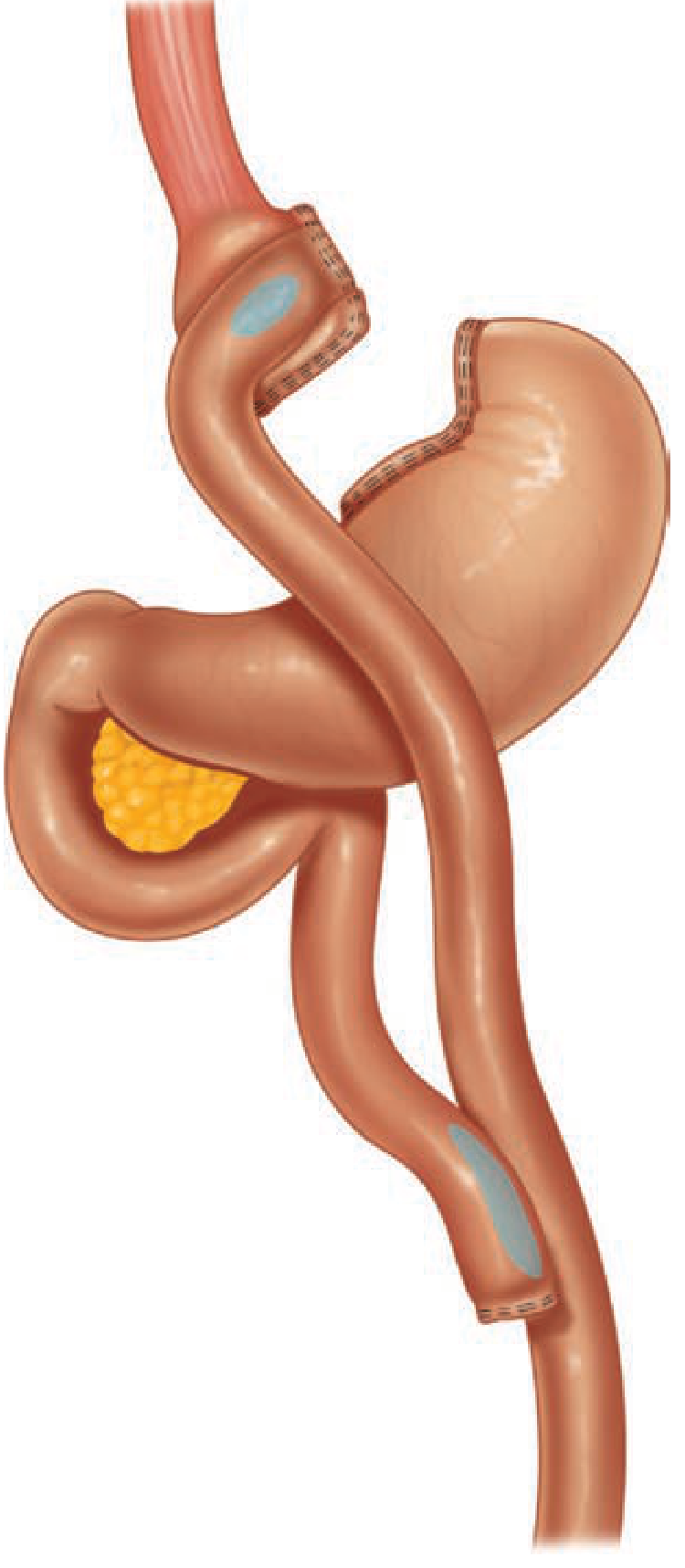
Definition and Size
- A small proximal gastric pouch is fashioned from the lesser curvature of the stomach - the least distensible part
- Target size: <20 mL (Schwartz's) to <30 cm³ (Yamada's) - roughly the size of an egg
- It is completely divided (transected) from the distal/remnant stomach - not merely stapled/partitioned - because incomplete transection leads to a high incidence of staple line breakdown
- The Roux (alimentary) limb of proximal jejunum is then anastomosed to this pouch via the gastrojejunal anastomosis
"Creating the proximal gastric pouch by totally dividing it from the distal stomach is superior to simply stapling and partitioning the stomach, since the latter is associated with a high incidence of staple line breakdown." - Schwartz's Principles of Surgery, 11th ed.
Why the Lesser Curvature?
The pouch is based on the lesser curvature for two critical reasons:
- It is the least distensible region of the stomach, preventing pouch dilation over time
- It maintains adequate restriction - a larger or fundus-based pouch may dilate, causing inadequate weight loss or weight regain
Construction Technique
- Dissection: The lesser omentum is divided, and a retrogastric window is created
- Stapling: A linear stapling device appropriate for stomach wall thickness is used. A horizontal firing 1 cm distal to the esophageal fat pad is made, followed by 2-3 vertical staple firings directed to the angle of His
- Result: A vertically oriented ~15 mL gastric pouch (Fischer's Mastery) is created
- An endoscope, esophageal dilator, or bougie may be used as a guide to calibrate the pouch during construction
From Fischer's Mastery of Surgery, 8th ed.:
"Two or three vertical staple firings directed to the angle of His result in a vertically oriented 15-mL gastric pouch."
Gastrojejunal Anastomosis
The pouch connects to the proximal Roux limb via the gastrojejunostomy (GJ anastomosis):
- Three methods: circular stapled, linear stapled, or hand-sewn
- Smaller diameter circular staplers (e.g., 21 mm) carry higher risk of postoperative stenosis
- Linear stapling is associated with the lowest stricture rate
- Goal stoma diameter: ~12 mm
- The GJ anastomosis size (not pouch size) is more predictive of weight loss outcomes - reduction of the gastrojejunal outlet is as important as restricting pouch volume
Clinical Significance of Pouch Size
| Issue | Consequence |
|---|---|
| Pouch too large (>30 mL) | Inadequate restriction, poor weight loss, weight regain |
| Large pouch | Increased incidence of marginal ulcers and anastomotic strictures |
| Pouch dilation over time | Weight regain - most common late complication |
| Fundus-based pouch | Prone to dilation (avoid) |
"Larger pouches may result in inadequate weight loss, weight regain, and an increased incidence of marginal ulcers and anastomotic strictures." - Yamada's Textbook of Gastroenterology, 7th ed.
Three Major Steps of RYGB (Yamada's)
- Construction of a small gastric pouch
- A 1-2 cm gastrojejunal anastomosis
- A downstream jejunojejunal anastomosis (completing the Roux-en-Y configuration)
The biliopancreatic limb runs from the ligament of Treitz to the jejunojejunostomy (30-100 cm), while the Roux (alimentary) limb is typically 75-150 cm long.
Sources: Schwartz's Principles of Surgery, 11th ed. | Yamada's Textbook of Gastroenterology, 7th ed. | Fischer's Mastery of Surgery, 8th ed. | Maingot's Abdominal Operations
This is a shared conversation. Sign in to Orris to start your own chat.