
how does stomach react to water when we drink empty stomach
When you drink water on an empty stomach, the water passes through relatively quickly since there's no food to mix with. The stomach walls stretch slightly, gastric acid may be diluted temporarily, and the pyloric sphincter opens to let water pass into the small intestine - usually within 10-20 minutes. The stomach doesn't need to "work" much since water requires no digestion.
Searching sources...
Reading File
Searching the Web
stomach response to drinking water empty stomach physiology
Finding Sources
Finding Sources
Reading File
Reading File
Reading File
Now let me grab the gastric accommodation and hunger contraction details, plus fetch the relevant diagrams:
Reading File
Loading Image
Loading Image
Here is a complete, textbook-grounded answer:
How the Stomach Reacts to Water on an Empty Stomach
1. Gastric Accommodation (Relaxation of the Wall)
The moment water enters the empty stomach, the fundus (upper part) reflexively relaxes - a process called receptive relaxation or gastric accommodation. This is a vagally mediated reflex. Because the stomach wall relaxes as volume increases, intraluminal pressure stays remarkably low (close to 10 cm H₂O) even as up to 600-800 mL of water fills it. This is why you can drink a large glass of water without feeling much pressure at first.
The diagram below shows this clearly - in a normal stomach, pressure barely rises until very large volumes are reached:
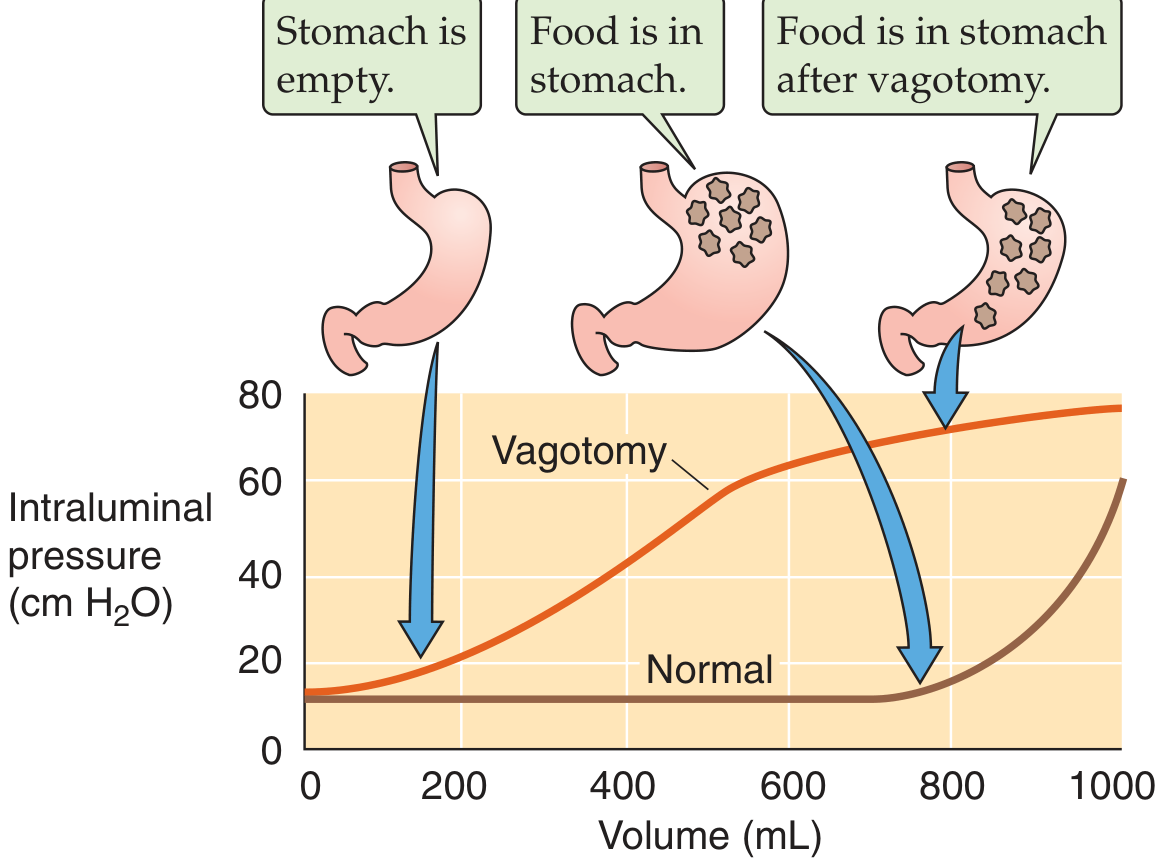
The average volume of water needed to produce a sensation of fullness in a healthy person is about 600 mL. People with functional dyspepsia feel full at only ~350 mL, reflecting impaired stomach wall relaxation.
2. Gastric Myoelectrical Activity Changes
When water enters an empty stomach, the electrical activity of the stomach (measurable as the electrogastrogram, EGG) changes in a characteristic pattern:
- Baseline: low-power 3 cycles-per-minute (cpm) rhythm
- Immediately after drinking: a brief "frequency dip" - the 3-cpm peaks temporarily disappear
- 20-30 minutes later: the 3-cpm peaks return and become more prominent as water empties into the duodenum
This reflects the stomach's neuromuscular response to stretching and subsequent emptying.
3. Gastric Acid - Minimal Stimulation
On a completely empty stomach, the parietal cells are in a basal secretion state - acid output is low. Water alone is a very weak stimulant for acid secretion. It does temporarily dilute what little acid is present, slightly raising the gastric pH, but this triggers only a mild compensatory gastrin response. Water does not trigger the cephalic phase (sight/smell) or the major gastric phase of acid secretion the way food does.
4. Emptying - Extremely Fast
This is the most important point: water is the fastest substance the stomach empties.
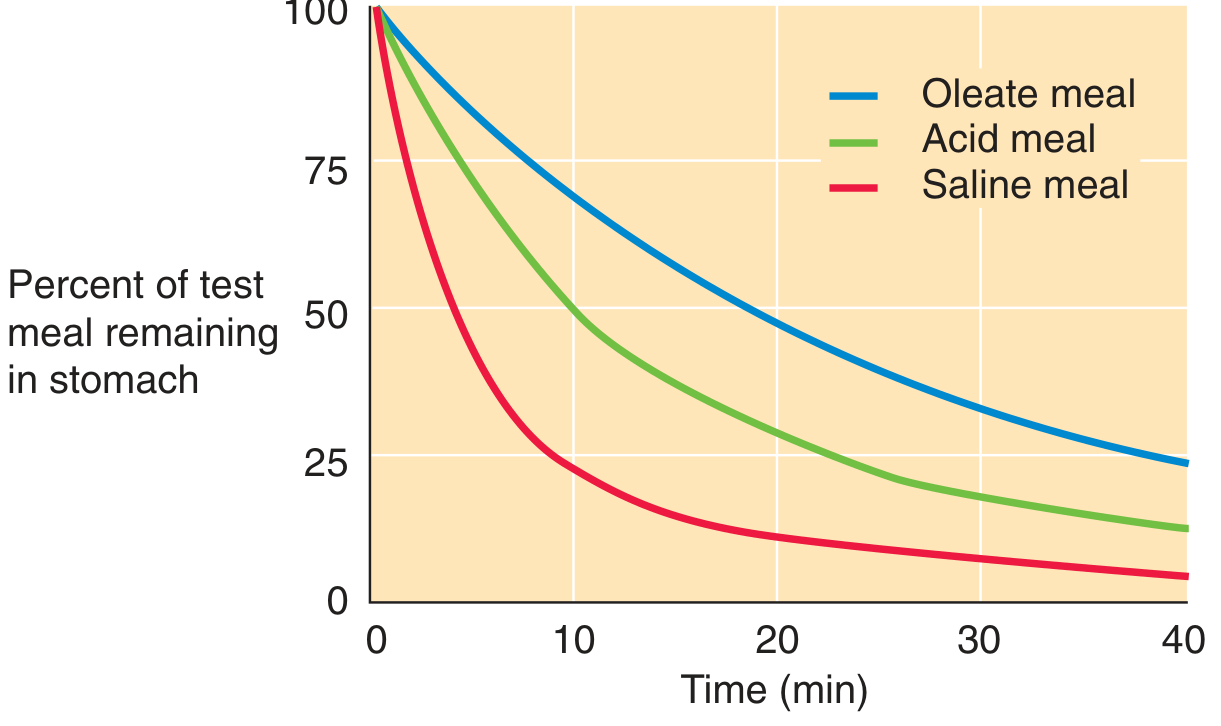
"The substance most rapidly emptied by the stomach is isotonic saline or water. Emptying of these liquids occurs without delay and is faster the greater the volume of fluid."
- Medical Physiology, Boron & Boulpaep
The emptying graph below compares water/saline (red) vs. acidic vs. fatty contents - water clears in under 20 minutes, while fats take 40+ minutes:
How emptying works for liquids:
- Liquid emptying is controlled by the proximal stomach (fundus), not the antrum
- The pyloric sphincter - which is tightly closed for solid particles - remains open enough to let water through easily
- No grinding or trituration is needed; water just flows through
"The pylorus usually is open enough for water and other fluids to empty from the stomach into the duodenum with ease."
- Guyton and Hall Textbook of Medical Physiology
On an empty stomach, water can begin reaching the small intestine in as little as 5 minutes, and most of it clears within 10-20 minutes.
5. What Happens to "Hunger Contractions"?
If you have been fasting for 12+ hours, the stomach may be having periodic hunger contractions (strong antral peristaltic waves driven by low blood glucose). Drinking water briefly stretches the stomach wall, which can temporarily suppress these hunger pangs by triggering the accommodation reflex and resetting the gastric pacemaker rhythm.
Summary Table
| Response | What Happens |
|---|---|
| Fundus wall | Relaxes (receptive relaxation / vagal reflex) |
| Intraluminal pressure | Stays low until very large volumes |
| Gastric acid | Minimal stimulation; temporary mild dilution of existing acid |
| Pyloric sphincter | Opens readily - no resistance to water |
| Emptying speed | Fastest of all ingested substances; starts within ~5 min |
| Gastric electrical activity | Brief 3-cpm "dip," then normalcy restored as stomach empties |
| Hunger contractions | Temporarily suppressed by stretch stimulus |
The stomach essentially treats water as a "pass-through" - it accommodates it briefly, does minimal work, and moves it downstream quickly. - Medical Physiology (Boron & Boulpaep); Guyton and Hall Textbook of Medical Physiology; Sleisenger and Fordtran's Gastrointestinal and Liver Disease
This is a shared conversation. Sign in to Orris to start your own chat.