
Teach me anti hypertensive drugs from kd tripathi everything about them and all the important points that I ace my exam
antihypertensive drug classification mechanism of action diagram
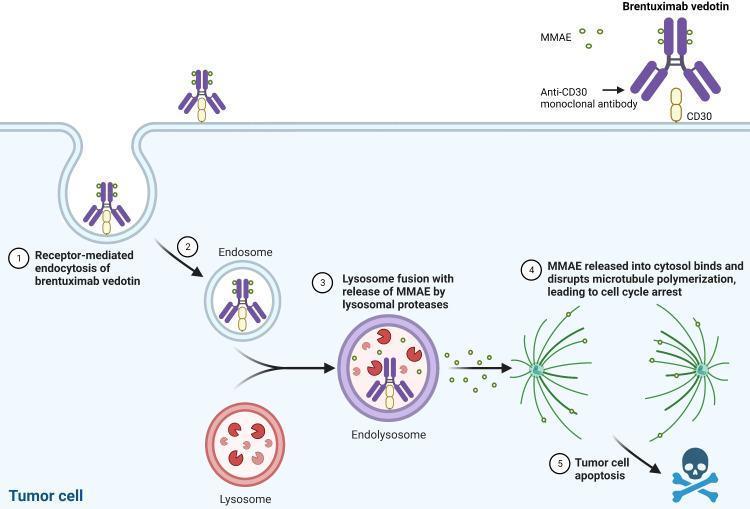
A pathophysiology diagram illustrating the mechanism of action (MOA) for Brentuximab vedotin, an antibody-drug conjugate (ADC), within a tumor cell. The process is depicted in five sequential stages: (1) Receptor-mediated endocytosis where the purple Y-shaped anti-CD30 monoclonal antibody, conjugated with yellow MMAE (monomethyl auristatin E) molecules, binds to the CD30 surface antigen. (2) Formation of an intracellular endosome containing the ADC complex. (3) Fusion of the endosome with a lysosome to form an endolysosome, where lysosomal proteases cleave the linker, releasing free MMAE into the cytosol. (4) Released MMAE binds to and disrupts microtubule polymerization, leading to cell cycle arrest. (5) Final induction of tumor cell apoptosis, represented by a skull and crossbones icon. The diagram uses standard biological iconography to explain targeted chemotherapy delivery in oncology, specifically for CD30-positive malignancies like Hodgkin lymphoma.
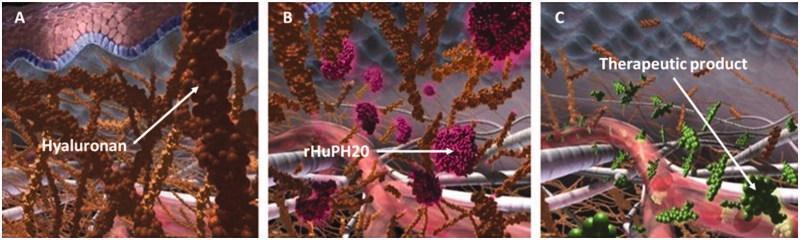
This three-panel pathophysiology diagram illustrates the mechanism of action of recombinant human hyaluronidase PH20 (rHuPH20) in facilitating subcutaneous drug delivery. Panel A depicts the baseline state of the subcutaneous extracellular matrix, where a dense, interconnected network of hyaluronan (represented as thick, brownish fibrous strands) creates a physical barrier that resists bulk fluid flow. Panel B shows the introduction of rHuPH20 (magenta globular molecules), which acts to depolymerize and fragment the hyaluronan strands, reducing the matrix viscosity. Panel C demonstrates the final stage where the hyaluronan is significantly degraded and sparse, allowing for the widespread dispersion and absorption of a co-administered therapeutic product (green clusters) into the interstitial space and surrounding vasculature. The diagram effectively teaches how enzymatic degradation of the interstitial barrier increases the permeability of the subcutaneous tissue, enabling the delivery of larger volumes of therapeutic agents.
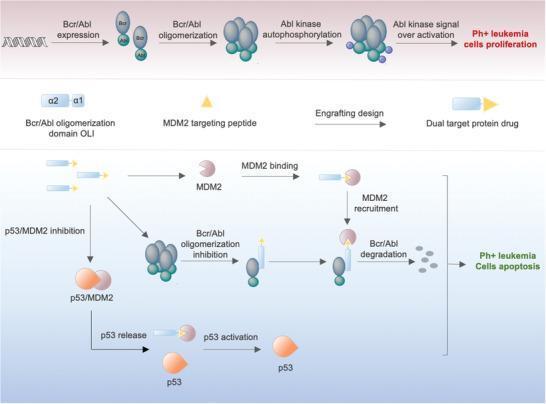
This medical schematic diagram illustrates the mechanism of action of a dual-target protein drug (PMIBcr/Abl-R6) in Philadelphia chromosome-positive (Ph+) leukemia cells. The top panel depicts the pathological pathway: Bcr/Abl expression leads to oligomerization via the OLI domain, followed by Abl kinase autophosphorylation and signal overactivation, resulting in leukemia cell proliferation. The middle panel shows the drug design, combining the Bcr/Abl oligomerization domain (α2 and α1 helices) with an MDM2-targeting peptide. The bottom panel demonstrates the therapeutic mechanism: the dual-target drug inhibits p53/MDM2 interaction to release and activate p53, while simultaneously disrupting Bcr/Abl oligomerization. Furthermore, by recruiting MDM2 (an E3 ligase) to Bcr/Abl, the drug facilitates Bcr/Abl protein degradation. The synergistic effect of Bcr/Abl inhibition/degradation and p53 activation promotes apoptosis in Ph+ leukemia cells. This diagram is intended for hematology-oncology education, focusing on molecular targeted therapy and PROTAC mechanisms.
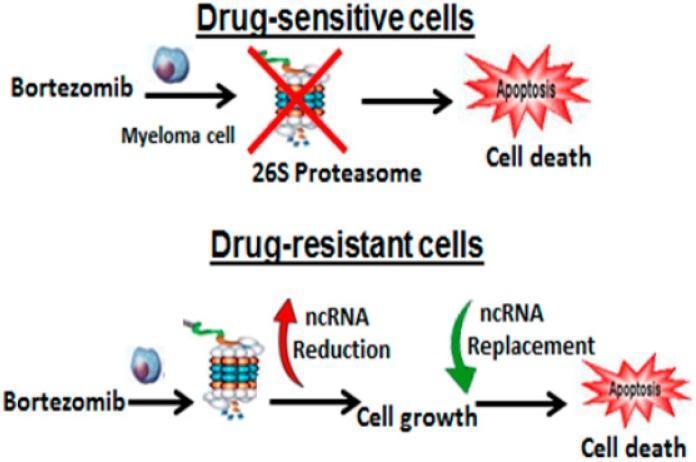
This pathophysiology diagram illustrates the mechanism of action of Bortezomib and the role of non-coding RNA (ncRNA) in drug resistance within Multiple Myeloma (MM) cells. The diagram is divided into two comparative sections: 'Drug-sensitive cells' and 'Drug-resistant cells'. In drug-sensitive cells, the proteasome inhibitor Bortezomib successfully targets the 26S proteasome (marked with a red 'X'), triggering apoptosis and subsequent cell death. In drug-resistant cells, the primary pathway shows that ncRNA reduction bypasses proteasome inhibition, promoting continued cell growth despite the presence of Bortezomib. However, the secondary 'ncRNA Replacement' pathway demonstrates that restoring these ncRNAs can circumvent resistance, re-inducing apoptosis and cell death. The visual uses standard signaling pathway conventions, including arrows for progression, inhibitory marks, and star-shaped bursts to represent cellular apoptosis. This educational illustration demonstrates the potential for lncRNA replacement therapy to restore sensitivity to proteasome inhibitors in hematologic malignancies.
Antihypertensive Drugs - Complete Exam Notes
BASICS FIRST: BP Physiology & Why It Matters
| Category | Systolic | Diastolic |
|---|---|---|
| Normal | 90-120 | 60-80 |
| Elevated | 120-129 | <80 |
| Stage 1 HTN | 130-139 | 80-89 |
| Stage 2 HTN | >140 | >90 |
- Risk of cardiovascular disease doubles with every 20/10 mmHg increment from 115/75 mmHg
- 85-90% cases = Essential (primary) hypertension (no identifiable cause)
- 10-15% = Secondary hypertension (renal artery stenosis, pheochromocytoma, Conn's syndrome, Cushing's, coarctation of aorta)
CLASSIFICATION OF ANTIHYPERTENSIVE DRUGS (KDT Style)
GROUP 1 - Diuretics
- Thiazides: Hydrochlorothiazide (HCTZ), Chlorthalidone, Indapamide
- Loop diuretics: Furosemide
- K+-sparing: Spironolactone, Eplerenone, Amiloride
GROUP 2 - Sympathoplegic (Adrenergic) Drugs
- Clonidine (alpha-2 agonist)
- Methyldopa (alpha-2 agonist - false transmitter)
- Moxonidine, Guanfacine
- Trimethaphan, Mecamylamine
- Reserpine (depletes NE stores)
- Guanethidine (blocks NE release)
- Selective alpha-1: Prazosin, Terazosin, Doxazosin
- Non-selective: Phenoxybenzamine, Phentolamine
- Non-selective: Propranolol, Nadolol, Timolol, Carteolol
- Cardioselective (beta-1): Metoprolol, Atenolol, Bisoprolol, Betaxolol
- With ISA: Pindolol, Acebutolol, Penbutolol
- Alpha+Beta blockers: Labetalol, Carvedilol, Nebivolol
GROUP 3 - Calcium Channel Blockers (CCBs)
- Dihydropyridines: Amlodipine, Nifedipine, Felodipine, Nicardipine, Nitrendipine
- Non-dihydropyridines: Verapamil (phenylalkylamine), Diltiazem (benzothiazepine)
GROUP 4 - RAAS Blockers
- ACE Inhibitors: Captopril, Enalapril, Lisinopril, Ramipril, Perindopril + others
- ARBs: Losartan, Valsartan, Candesartan, Telmisartan, Irbesartan, Olmesartan, Azilsartan
- Direct Renin Inhibitor: Aliskiren
- Aldosterone antagonists: Spironolactone, Eplerenone
GROUP 5 - Direct Vasodilators
- Arterial: Hydralazine, Minoxidil, Diazoxide
- Arterial + Venous: Sodium Nitroprusside
DRUG CLASS DEEP DIVES
1. DIURETICS
- Mechanism: Inhibit Na+/Cl- cotransporter in distal convoluted tubule
- Initially reduce plasma volume; long-term effect = reduce PVR
- Chlorthalidone is preferred over HCTZ - longer half-life, more effective at reducing cardiovascular events
- First-line in most patients
- Side effects: Hypokalemia, hyperuricemia (gout), hyperglycemia, hyperlipidemia, hypercalcemia, sexual dysfunction
- Contraindicated in gout (relative), pregnancy Category D
- Mechanism: Aldosterone receptor antagonist
- Spironolactone - non-selective (also blocks androgen receptors) → gynecomastia, menstrual irregularities
- Eplerenone - selective for aldosterone receptor → no sexual side effects
- Used in: Resistant HTN (4th-line add-on), primary hyperaldosteronism, heart failure
- Hyperkalemia is the key side effect - avoid in renal failure, with ACE inhibitors (risk of severe hyperkalemia)
2. BETA BLOCKERS
- Reduce heart rate and cardiac contractility → reduce CO
- Reduce renin release from juxtaglomerular cells
- Central reduction in sympathetic tone
| Drug | Selectivity | Special Feature |
|---|---|---|
| Propranolol | Non-selective | Prototype, membrane stabilizing, first-pass metabolism |
| Metoprolol | Beta-1 selective | Preferred in asthma/COPD, metabolized by CYP2D6 |
| Atenolol | Beta-1 selective | Renal excretion, once daily, less effective than metoprolol |
| Bisoprolol | Beta-1 selective | Long half-life, once daily, useful in heart failure |
| Pindolol | Non-selective + ISA | Partial agonist, less bradycardia, less cold extremities |
| Labetalol | Alpha+Beta (3:1 ratio) | IV use in hypertensive emergencies, pregnancy HTN |
| Carvedilol | Alpha+Beta | No ISA, antioxidant, used in heart failure |
| Nebivolol | Beta-1 + NO release | Vasodilatory via NO - least metabolic side effects |
- Bradycardia, heart block
- Bronchoconstriction (avoid in asthma - use cardioselective if must use)
- Fatigue, cold extremities
- Blunting of hypoglycemia symptoms (use with caution in diabetics)
- Hypertriglyceridemia, decreased HDL
- Withdrawal syndrome - do NOT abruptly stop (rebound tachycardia, angina, MI risk)
- Masking of hypoglycemia symptoms (sweating still occurs - only tachycardia masked)
3. CALCIUM CHANNEL BLOCKERS (CCBs)
| Feature | Dihydropyridines (Amlodipine) | Verapamil | Diltiazem |
|---|---|---|---|
| Primary effect | Peripheral vasodilation | Cardiac (HR, conduction) | Both |
| Heart rate | Reflex tachycardia | Bradycardia | Mild bradycardia |
| Used in | HTN, angina | HTN, SVT, angina | HTN, SVT, angina |
| AV block risk | No | Yes | Yes |
- Dihydropyridines: ankle edema, flushing, headache, reflex tachycardia (especially short-acting)
- Verapamil: constipation (most common side effect), bradycardia, AV block, heart failure
- Diltiazem: bradycardia, AV block (less constipation than verapamil)
4. ACE INHIBITORS
- Inhibit ACE (peptidyl dipeptidase) → block conversion of Angiotensin I → Angiotensin II
- Also inhibit bradykinin breakdown (plasma kininase) → bradykinin accumulates → vasodilation + cough
- Captopril: Prototype. Sulfhydryl group - unique SE (rash, taste disturbance, neutropenia). Short duration. Twice/thrice daily.
- Enalapril: Prodrug → enalaprilat (active). Most widely used oral agent.
- Enalaprilat: IV form - used in hypertensive emergencies
- Lisinopril: NOT a prodrug (only ACE inhibitor that is not a prodrug except captopril). Long-acting.
- All others (ramipril, perindopril, quinapril, fosinopril, etc.) are prodrugs metabolized in the liver
- Reduce PVR without reflex tachycardia (baroreceptor resetting + enhanced parasympathetic tone)
- Reduce proteinuria and protect kidneys (decrease glomerular efferent arteriolar resistance)
- Reduce cardiac preload and afterload - excellent in heart failure
- Diabetic nephropathy (renoprotective - reduces proteinuria)
- Post-MI (reduce mortality, prevent remodeling)
- Heart failure with reduced EF
- Chronic kidney disease with proteinuria
- After stroke (ramipril in HOPE trial)
- Dry cough (most common, due to bradykinin/substance P accumulation) - 10-15% patients - switch to ARB
- Angioedema (rare but serious - bradykinin-mediated - switch to ARB) - more common in African Americans
- Hyperkalemia (block aldosterone, less K+ excretion)
- Acute renal failure in bilateral renal artery stenosis or single-kidney renal artery stenosis (decrease GFR by removing efferent arteriolar constriction)
- Teratogenic - Category D/X - AVOID in pregnancy (fetotoxic - renal agenesis, oligohydramnios)
- First-dose hypotension (especially in Na+-depleted or volume-depleted patients)
- Captopril-specific: Rash, taste disturbance, neutropenia (due to sulfhydryl group)
5. ANGIOTENSIN RECEPTOR BLOCKERS (ARBs)
- Prototype ARB
- Prodrug → metabolized by CYP2C9 to active metabolite (EXP 3174)
- Uricosuric - uniquely lowers uric acid (useful in HTN + gout)
- Telmisartan - longest half-life among ARBs (~24h), PPAR-gamma agonist activity
- NO cough (don't affect bradykinin)
- Lower risk of angioedema
- Better tolerated
- Pregnancy (teratogenic)
- Bilateral renal artery stenosis
- Hyperkalemia
6. DIRECT RENIN INHIBITOR - ALISKIREN
- Mechanism: Blocks renin from cleaving angiotensinogen → angiotensin I
- Oral bioavailability low (~2.5%)
- Longest half-life among RAAS blockers
- Do NOT combine with ACEi or ARB (increased adverse effects, no added benefit)
- Contraindicated in pregnancy
7. CENTRALLY ACTING DRUGS
- Mechanism: Alpha-2 agonist in vasomotor center of medulla → reduces sympathetic outflow → reduces PVR + HR
- IV: Transient pressor response (peripheral alpha-2A receptor activation) then prolonged hypotension
- Available as transdermal patch (weekly application)
- Also used in: Opioid/alcohol withdrawal, ADHD, menopausal flushing, migraine prophylaxis
- Side effects: Sedation, dry mouth, bradycardia
- Rebound hypertension on sudden withdrawal - taper slowly
- Do NOT combine with beta blockers (bradycardia + block compensatory tachycardia)
- Mechanism: Converted to alpha-methylnorepinephrine (false transmitter) → stimulates central alpha-2 receptors
- Drug of choice in hypertension in PREGNANCY (safe, used for decades)
- Side effects: Sedation, mental depression, positive Coombs test (10-20% patients - hemolytic anemia in 1%), hepatotoxicity, lupus-like syndrome
- IV form available
8. ALPHA-1 BLOCKERS
- First-dose hypotension - always give at bedtime with first dose
- Favorable metabolic profile - improve insulin sensitivity, reduce LDL, increase HDL
- Useful in BPH (relax smooth muscle in prostate and bladder neck) - doxazosin/terazosin used for both HTN + BPH
9. DIRECT VASODILATORS
- Mechanism: Directly relaxes arteriolar smooth muscle (increases cGMP, possibly K+ channel opening)
- Arteriolar only (not venous) - no postural hypotension
- Used in: Pregnancy (IV/oral), heart failure (with isosorbide dinitrate in African Americans - BiDil combination)
- Side effects: Reflex tachycardia, fluid retention (must combine with beta blocker + diuretic)
- Lupus-like syndrome (dose-dependent - especially >200 mg/day, slow acetylators more susceptible)
- Drug-induced lupus: +ANA, anti-histone antibodies (NOT anti-dsDNA)
- Other: Headache, nausea
- Mechanism: Opens ATP-sensitive K+ channels → hyperpolarization → arteriolar dilation
- Very potent vasodilator - used in resistant/severe hypertension
- Must use with beta blocker (tachycardia) AND loop diuretic (fluid retention)
- Side effects: Hypertrichosis (hair growth - topical use for alopecia = Rogaine), fluid retention, pericardial effusion, reflex tachycardia
- IV bolus - used in hypertensive emergencies (now rarely used, largely replaced by nitroprusside/labetalol)
- Also used in hypoglycemia (inhibits insulin release)
- Mechanism: Releases NO + cyanide → activates guanylyl cyclase → increased cGMP → vasodilation (both arterial AND venous)
- Hypertensive emergencies (most powerful IV agent)
- Onset within seconds, duration 1-10 min after stopping infusion
- Light-sensitive - wrap in foil during infusion
- Dose: 0.5-10 mcg/kg/min IV infusion
- Cyanide toxicity: Metabolized to cyanide → thiocyanate (via rhodanese enzyme)
- Signs: Metabolic acidosis, arrhythmias, death
- Treatment: Sodium thiosulfate (sulfur donor) + hydroxocobalamin
- Thiocyanate toxicity (in renal failure, prolonged use): Weakness, psychosis, muscle spasms, seizures (thiocyanate >10 mg/dL)
SPECIAL SITUATIONS - EXAM FAVORITES
Drug of Choice in Specific Situations
| Situation | Preferred Drug |
|---|---|
| Hypertension in pregnancy | Methyldopa (1st choice), Labetalol, Nifedipine (oral), Hydralazine (IV) |
| Hypertension in diabetes | ACEi or ARB (renoprotective) |
| Hypertension + CKD with proteinuria | ACEi or ARB |
| Hypertension + heart failure (reduced EF) | ACEi/ARB + beta blocker (bisoprolol/carvedilol) + spironolactone + diuretic |
| Hypertension + angina | Beta blocker or CCB (amlodipine) |
| Hypertension + BPH | Alpha-1 blocker (doxazosin/terazosin) |
| Hypertension + gout | Losartan (uricosuric) |
| Hypertension + isolated systolic in elderly | Amlodipine or thiazide |
| Hypertension + SVT | Verapamil or diltiazem (NOT dihydropyridines) |
| Hypertension in African Americans | Thiazide or CCB (ACEi less effective) |
| Hypertension + post-MI | Beta blocker + ACEi |
| Hypertension emergency (IV needed) | Sodium nitroprusside, IV labetalol, IV enalaprilat, nicardipine |
| Hypertension in pheochromocytoma | Phenoxybenzamine (alpha blockade FIRST, then add beta blocker) |
| Resistant hypertension | Add spironolactone (mineralocorticoid receptor antagonist) |
DRUGS TO AVOID - Critical for Exam
| Situation | Avoid | Why |
|---|---|---|
| Pregnancy | ACEi, ARBs, aliskiren | Teratogenic (fetal renal dysplasia) |
| Bilateral renal artery stenosis | ACEi, ARBs | Acute renal failure |
| Asthma / severe COPD | Non-selective beta blockers | Bronchoconstriction |
| Heart block / severe bradycardia | Beta blockers, verapamil, diltiazem | Worsen conduction block |
| Pheochromocytoma | Beta blocker ALONE (without alpha blockade first) | Paradoxical hypertension (beta block leaves alpha unopposed) |
| Pre-surgery (ophthalmic) | Alert about alpha-1 blockers | Floppy iris syndrome |
| Renal failure | Spironolactone, ACEi, ARBs | Hyperkalemia risk |
| Gout | Thiazides | Hyperuricemia |
COMBINATION THERAPY - RATIONALE
- Vasodilation → decreased BP → baroreceptor activation → reflex tachycardia + sympathetic activation → increased CO and salt/water retention
- Vasodilator (hydralazine/minoxidil) + Beta blocker (blocks tachycardia) + Diuretic (blocks fluid retention)
- ACEi/ARB + CCB (amlodipine) - excellent efficacy, complementary mechanisms
- ACEi/ARB + Thiazide - classic combination
- CCB + Thiazide - works well
- ACEi/ARB + CCB + Thiazide = preferred triple combination
- ACEi + ARB (double RAAS blockade - increases hyperkalemia/AKI, no extra benefit - ONTARGET trial)
- Verapamil/diltiazem + Beta blocker (additive AV block)
- Two diuretics from same class
HIGH-YIELD EXAM MNEMONICS & ONE-LINERS
HYPERTENSIVE EMERGENCIES vs. URGENCIES
| Feature | Emergency | Urgency |
|---|---|---|
| End-organ damage | YES | No |
| Treatment | IV drugs, ICU | Oral drugs, 24-48 hr |
| Target BP | Reduce by 25% in 1 hr, then gradually | <160/110 over 24-48 hr |
- Sodium nitroprusside (most powerful - titrable)
- IV Labetalol (alpha+beta - good for most emergencies)
- IV Enalaprilat (ACEi)
- Nicardipine IV (DHP CCB - titratable)
- IV Hydralazine (pregnancy emergency)
- Fenoldopam (dopamine D1 agonist - renoprotective)
- Clonidine, Captopril (sublingual/oral), Labetalol oral
SOURCE NOTE
- Katzung Basic and Clinical Pharmacology, pp. 268-297
- Goodman & Gilman The Pharmacological Basis of Therapeutics, Chapter on Antihypertensives