
Kahlers disease
Reading File
Kahler's disease is another name for multiple myeloma - a malignant plasma cell neoplasm that produces monoclonal immunoglobulin (M protein), causing bone destruction, renal failure, anemia, and hypercalcemia.
Searching sources...
Finding Sources
Searching PubMed
"multiple myeloma" AND treatment
Reading File
Reading File
Finding Sources
Reading File
Finding Sources
Reading File
Reading File
Reading File
Finding Sources
Reading File
Reading File
Reading File
Loading Image
Reading File
Now I have comprehensive information to provide a thorough answer. Let me compile everything.
Kahler's Disease (Multiple Myeloma)
Kahler's disease is the eponymous name for multiple myeloma, named after the Austrian physician Otto Kahler who described the condition in 1889. It is a malignant neoplasm of plasma cells (terminally differentiated B lymphocytes) that accumulate in the bone marrow and produce a monoclonal immunoglobulin (M protein).
Epidemiology
- Approximately 30,000 new cases/year in the United States
- Median age at diagnosis: 70 years
- More common in males and in people of African descent (for unknown reasons)
- One of the most common lymphoid malignancies
Pathogenesis
Myeloma arises from a clonal expansion of malignant plasma cells. Key molecular events include:
- Chromosomal translocations fusing the IgH locus (chromosome 14) to oncogenes like cyclin D1 and cyclin D3, driving increased cell proliferation
- IL-6 from bone marrow stromal fibroblasts and macrophages supports myeloma cell proliferation
- Late-stage disease may show MYC translocations, particularly in aggressive cases
- Myeloma cells upregulate RANKL on stromal cells, activating osteoclasts and inhibiting osteoblasts - the net result is bone resorption
Pathophysiology - "CRAB" End-Organ Damage
The hallmark complications are summarized by the mnemonic CRAB:
| Letter | Complication | Mechanism |
|---|---|---|
| C | Hypercalcemia | RANKL-driven osteoclast activation + bone resorption |
| R | Renal failure | Bence Jones protein casts in distal tubules; light chain (AL) amyloid deposits; hypercalcemia-related |
| A | Anemia | Bone marrow replacement by plasma cells; normocytic normochromic type |
| B | Bone lesions | Lytic "punched-out" defects; pathologic fractures |
A myeloma-defining event also includes any of three biomarkers: clonal bone marrow plasma cells >60%, serum free light chain (FLC) ratio >100, or >1 focal lesion on MRI.
Immunoparesis is another major consequence - myeloma cells suppress normal B cell function. Despite elevated total immunoglobulin (from M protein), production of functional antibodies is depressed, putting patients at high risk for bacterial infections (a leading cause of death).
M Protein Profile
| Immunoglobulin Type | Frequency |
|---|---|
| IgG | 60% |
| IgA | 20-25% |
| Light chain only (Bence Jones) | ~20% |
| IgM, IgD, IgE | Rare |
| Non-secretory | ~1% |
Morphology & Imaging
Bone lesions:
- Multiple "punched-out" lytic defects, 1-4 cm in diameter, with no reactive sclerosis
- Most common sites: vertebral column, ribs, skull, pelvis, femur, clavicle, scapula
- Negative on bone scan (no reactive bone formation) - unlike metastatic carcinoma
- Pathologic fractures most common in vertebral column and femur
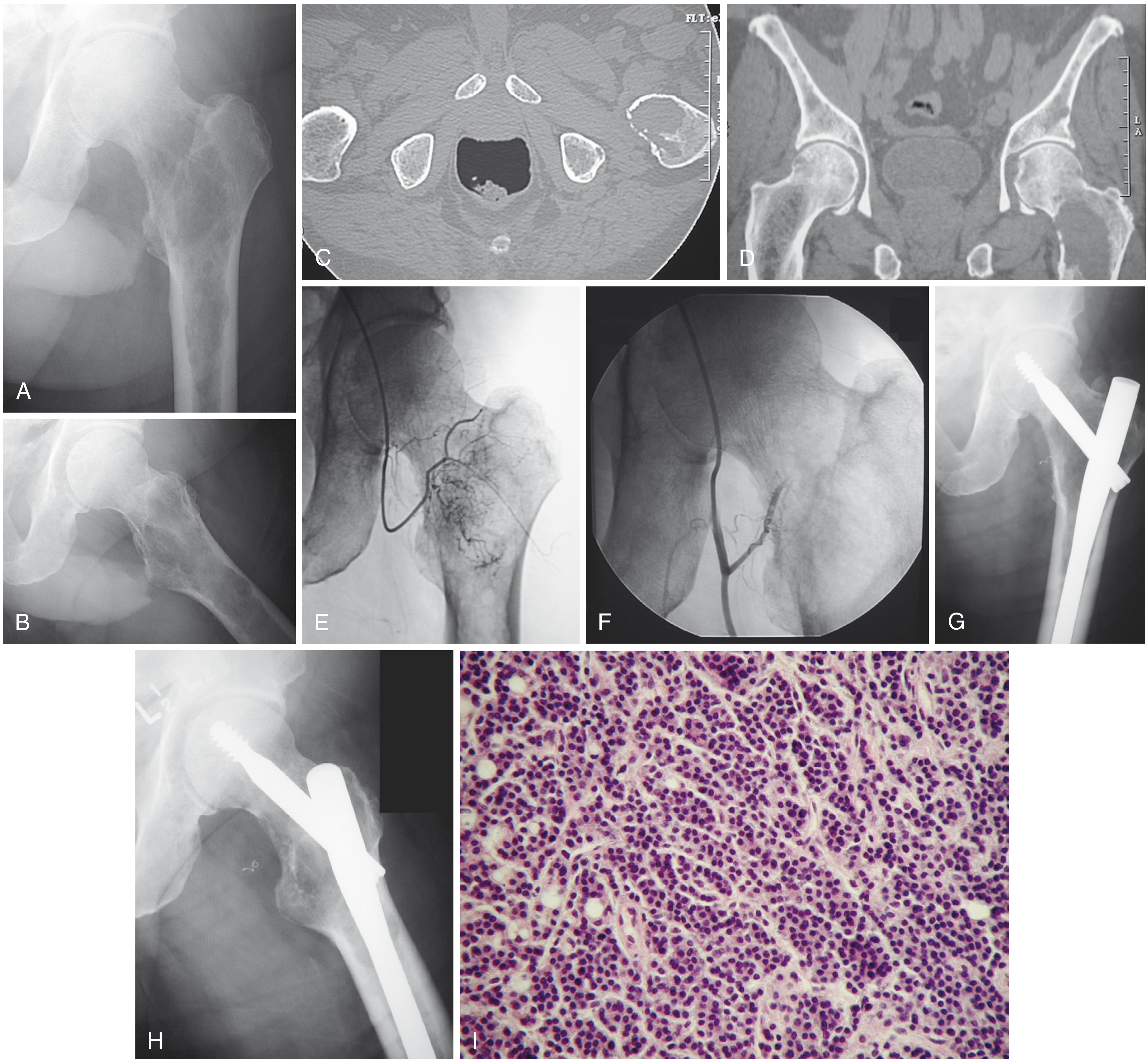
Bone marrow biopsy:
- Plasma cells >30% of cellularity (typically)
- Cells with "clock-face" chromatin, eccentric nucleus, perinuclear halo ("hof")
- Abnormal features: prominent nucleoli, Russell bodies (cytoplasmic immunoglobulin inclusions)
Myeloma kidney:
- Proteinaceous casts of Bence Jones proteins in distal tubules, surrounded by multinucleate giant cells
- Adjacent tubular epithelial necrosis/atrophy
- AL amyloid in glomeruli and vessel walls
Diagnostic Criteria (IMWG 2014)
Diagnosis of active multiple myeloma requires:
- Clonal bone marrow plasma cells ≥10% OR histologically proven plasmacytoma
- Plus either:
- Evidence of CRAB end-organ damage attributable to the plasma cell disorder, OR
- One of the myeloma-defining biomarkers (above)
Key laboratory tests:
- Serum protein electrophoresis (SPEP): tall, narrow-based M spike in gamma region
- Serum immunofixation to identify M protein type
- Serum free light chain assay: abnormal κ/λ ratio (normal 0.26-1.65)
- 24-hour urine for Bence Jones proteins
- Bone marrow biopsy
- Skeletal survey (X-ray) or whole-body low-dose CT/PET-CT
Staging
The Revised International Staging System (R-ISS) is based on:
- Serum β2-microglobulin and albumin levels
- Cytogenetic risk (e.g., del 17p, t(4;14), t(14;16) = high risk)
- LDH
Spectrum of Plasma Cell Disorders
| Entity | Plasma cells | M protein | End-organ damage |
|---|---|---|---|
| MGUS | <10% marrow | <3 g/dL | None |
| Smoldering myeloma | 10-59% marrow | ≥3 g/dL | None |
| Active myeloma | ≥10% OR any | Any | CRAB or biomarkers |
| Solitary plasmacytoma | Solitary lesion | Minimal | None elsewhere |
Treatment
Transplant-eligible patients (~50%)
- Induction (3-4 months): VRd (bortezomib + lenalidomide + dexamethasone) is the standard; adding daratumumab (DVRd) is considered in high-risk disease
- Stem cell collection (GCSF ± plerixafor)
- Autologous SCT: high-dose melphalan 200 mg/m² conditioning
- Maintenance: lenalidomide 10 mg/day (long-term); bortezomib added in high-risk disease
Transplant-ineligible patients
- DRd (daratumumab + lenalidomide + dexamethasone) or VRd at adjusted doses
- VCD (bortezomib + cyclophosphamide + dexamethasone) as alternative
Drug classes and mechanisms
| Drug Class | Agents | Mechanism |
|---|---|---|
| Proteasome inhibitors | Bortezomib, carfilzomib, ixazomib | Block 26S proteasome → NF-κB downregulation → apoptosis |
| IMiDs | Thalidomide, lenalidomide, pomalidomide | Immunomodulation, anti-angiogenesis, direct anti-myeloma effects |
| Anti-CD38 mAb | Daratumumab | Targets CD38 (highly expressed on myeloma cells) |
| Anti-SLAMF7 mAb | Elotuzumab | Targets SLAMF7 on myeloma cells |
| CAR-T therapy | Ide-cel (idecabtagene vicleucel) | Targets BCMA; used for relapsed/refractory after 4+ prior lines |
| Alkylating agents | Melphalan, cyclophosphamide | DNA cross-linking |
CAR-T note: Recent meta-analyses (2024) show significant activity for ide-cel and ciltacabtagene autoleucel in relapsed/refractory disease, but risks include cytokine release syndrome, neurotoxicity, and prolonged cytopenias. A 2024 meta-analysis comparing CAR-T vs bispecific antibodies in 3rd-line and beyond myeloma (PMID 39551604) is relevant for current practice decisions.
Prognosis
- Median overall survival: approximately 5 years with modern therapy
- Patients with multiple bone lesions, if untreated: rarely survive >6-12 months
- Smoldering myeloma may not require treatment for many years
- Multiple myeloma remains incurable with current therapy but remarkable progress has been made - Goldman-Cecil Medicine, 2024
Key Associations / Pearls
- Bence Jones proteins in urine = free light chains (not detected by standard urine dipstick)
- Rouleaux formation on peripheral blood smear due to elevated globulins
- Hyperviscosity syndrome (particularly with IgM) - blurred vision, bleeding, neurologic changes
- Amyloidosis (AL type) - certain light chains deposit as amyloid, worsening renal dysfunction
- Absence of M protein does NOT exclude diagnosis (1% nonsecretory myeloma)
- Unlike metastatic bone disease, myeloma lesions are cold on bone scan
Sources: Robbins & Kumar Basic Pathology, Goldman-Cecil Medicine, Katzung's Basic and Clinical Pharmacology 16e, Campbell's Operative Orthopaedics 15e
This is a shared conversation. Sign in to Orris to start your own chat.