
Dermoid cyst
Reading File
Finding Sources
Finding Sources
Searching Images
dermoid cyst histology gross pathology
Now let me read the most relevant sections from multiple textbooks in parallel:
Reading File
Reading File
Reading File
Reading File
Now let me read the Kanski ophthalmology section (continuation with symptoms/signs/treatment) and get the ovarian dermoid section plus the intracranial content:
Reading File
Finding Sources
Finding Sources
Reading File
Reading File
Reading File
Now let me fetch key images to include in the answer:
Loading Image
Loading Image
Loading Image
I now have comprehensive material. Here is a full clinical overview:
Dermoid Cyst
Definition and Pathogenesis
A dermoid cyst is an epithelial-lined congenital cyst formed by sequestration of ectodermal tissue along embryonic fusion planes during development. The cyst wall is lined by keratinizing stratified squamous epithelium and — critically — contains mature adnexal structures (pilosebaceous units, sweat glands, hair follicles, smooth muscle), which distinguishes it from an epidermoid cyst (no adnexal structures).
They are a separate entity from benign cystic teratomas (ovarian "dermoids"), which are neoplasms derived from all three germ layers. — Dermatology 2-Volume Set 5e
Classification
| Type | Origin | Notes |
|---|---|---|
| Congenital/inclusion dermoid | Fusion plane entrapment | Most common; head/neck, periorbital, midline |
| Tubulodermoid | Entrapment around embryonic tubular structures | Spinal/sacral region |
| Implantation (acquired) dermoid | Traumatic implantation of surface ectoderm | Fingertip/hand after thorn prick or needle injury |
| Ovarian (mature cystic teratoma) | Germ cell origin | Neoplasm — see below |
Cutaneous / Craniofacial Dermoid Cysts
Sites
Occur along embryonic closure zones:
- Lateral eyebrow (external angular dermoid) — most common
- Nasal root / dorsum of nose (fistula of the dorsum of the nose)
- Midline forehead, scalp (frontal → occipital)
- Mastoid process, floor of mouth, neck midline
- Chest, back, abdomen, perianal/sacral area, scrotum
Clinical Features
- Firm, non-compressible, non-pulsatile subcutaneous nodule, 1–4 cm
- Does not transilluminate
- Mobile under skin but often tethered to underlying periosteum
- No attachment to overlying skin
- A punctum or hair-tufted pit may be present → signifies underlying sinus
- Present within first year of life; 70% identified by age 5
Intracranial Extension ⚠️
- Nasal and midline scalp dermoids have ~25% overall risk of intracranial extension
- If a sinus ostium is present → risk rises to ~50%
- A nasal dermoid may extend to widen the nasal bridge
- Spinal dermoid/sinus may connect to subarachnoid space → risk of meningitis
- Intracranial dermoids can rupture → chemical meningitis or hydrocephalus from keratinous/sebaceous CSF contamination
Nasal and eyebrow dermoids may run in families (genetic component).
Orbital Dermoid Cyst
An orbital dermoid is a choristoma — histologically normal tissue in an abnormal location — displaced ectoderm along embryonic lines of closure.
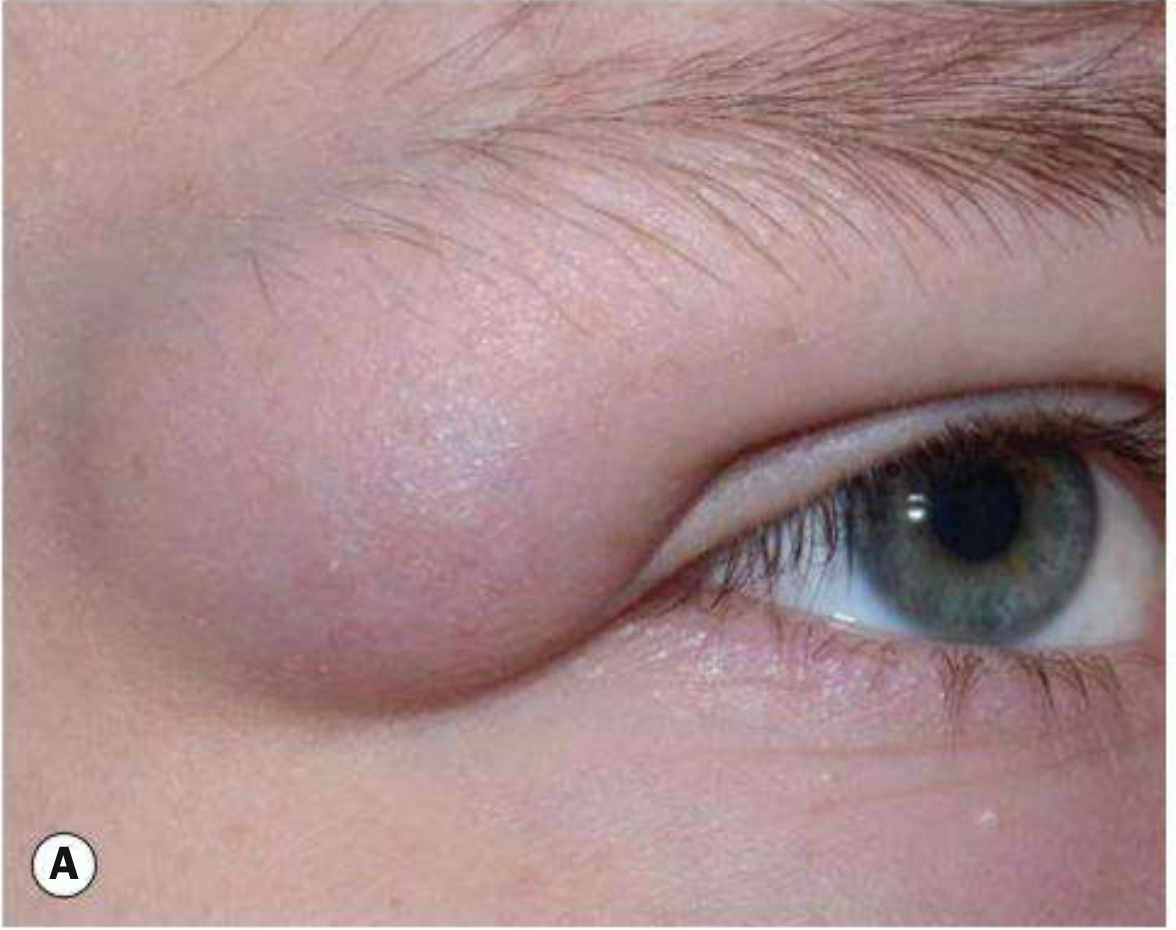
Superficial vs. Deep
| Feature | Superficial | Deep |
|---|---|---|
| Presentation | Infancy; painless nodule | Adolescence/adult; proptosis or acute inflamed orbit |
| Location | Superotemporal > superonasal orbit | Posterior to orbital septum |
| Exam | Firm, 1–2 cm, mobile, posterior margin palpable | Proptosis, dystopia, indistinct posterior margins |
| Imaging | Well-circumscribed heterogeneous cystic lesion | Well-circumscribed; may extend intracranially via bony defect |
Treatment: Excision in toto. Take care not to rupture the cyst wall — leakage of keratin causes severe granulomatous inflammation in surrounding tissue.
Histopathology
- Wall: keratinizing stratified squamous epithelium
- Contents: keratin debris, hair shafts, sebaceous material
- Wall structures: pilosebaceous units, apocrine/eccrine glands, smooth muscle bundles
- Portions of the wall may show a "shark tooth" (wavy eosinophilic) pattern resembling steatocystoma — Andrews' Diseases of the Skin
Ovarian Dermoid Cyst (Mature Cystic Teratoma)
The most common benign ovarian neoplasm in reproductive-age women. Strictly a germ cell tumor containing tissues from all three germ layers, but dominated by ectodermal derivatives.
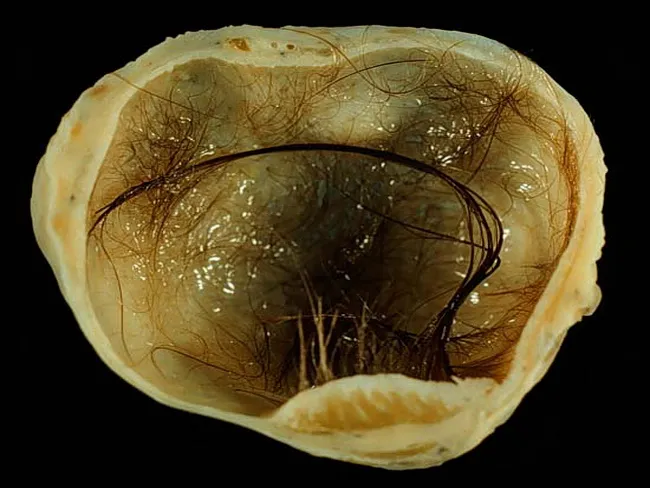
Key Features
- Contains: hair shafts, sebaceous material, teeth (odontogenic tissue), neural tissue
- Rokitansky protuberance (dermoid plug): mural nodule from which teeth and hair arise — pathognomonic on gross examination
- ~60% are clinically asymptomatic (found incidentally)
- Bilateral in ~10–15% of cases
Complications
- Ovarian torsion — most common complication
- Rupture → chemical peritonitis
- Infection
- Malignant transformation — rare (<2%), more common with advanced age
- Paraneoplastic anti-NMDA receptor encephalitis — when neural elements express NMDA-R antigens
Imaging
- Ultrasound: hyperechoic plug with posterior shadowing (Rokitansky protuberance); dermoid mesh pattern
- CT/MRI: fat attenuation/signal within the lesion is diagnostic; fat-fluid level, calcification (teeth)
Management
- Laparoscopic ovarian cystectomy — appropriate regardless of size; preserves fertility
- Oophorectomy — for larger cysts replacing the entire ovary
- Laparotomy — for very large cysts or when malignancy cannot be excluded
Cervical / Neck Dermoid
- Usually midline of the neck, asymptomatic
- Does not elevate with tongue protrusion (distinguishes from thyroglossal duct cyst, which does)
- May become acutely infected
- Treatment: Simple cystectomy after resolution of acute infection
Differential Diagnosis
| Lesion | Distinguishing Feature |
|---|---|
| Epidermoid cyst | No adnexal structures on histology |
| Pilonidal cyst | Midline sacral, symptomatic in adolescence |
| Thyroglossal duct cyst | Elevates with tongue protrusion/swallowing |
| Branchial cleft cyst | Lateral neck; lymphoid follicles on histology |
| Encephalocele | Pulsatile, compressible, impulse on coughing |
| Nasal glioma | No intracranial connection (usually) |
| Hemangioma | Vascular, compressible, may involute |
Imaging Guidelines
Preoperative imaging (CT first, followed by MRI if bony changes found) is mandatory before excision for:
- Midline nasal dermoids
- Midline scalp dermoids
- Posterior spinal dermoids
- Any lesion with a draining sinus ostium
Lateral eyebrow dermoids generally do not require pre-excision imaging.
Treatment Summary
| Site | Treatment |
|---|---|
| Periorbital/facial | Surgical excision in toto; neurosurgery consult if intracranial extension |
| Nasal/scalp midline | Preoperative CT/MRI mandatory; neurosurgery if CNS connection |
| Neck midline | Simple cystectomy |
| Spinal | MRI to exclude tethered cord; neurosurgical excision |
| Ovarian | Laparoscopic cystectomy; oophorectomy for large/whole-ovary replacement |
Sources: Andrews' Diseases of the Skin, p. 780 | Fitzpatrick's Dermatology, Vol. 1–2 | Dermatology 2-Volume Set 5e | Kanski's Clinical Ophthalmology 10th | Sabiston Textbook of Surgery | Cummings Otolaryngology | K.J. Lee's Essential Otolaryngology
This is a shared conversation. Sign in to Orris to start your own chat.