
PERV spirometry
Reading File
PERV in spirometry stands for Peak Expiratory Reserve Volume - wait, let me think more carefully. PERV is actually an acronym used to remember key spirometry values. Let me search the library for accurate information.
Searching sources...
Finding Sources
Finding Sources
Searching the Web
PERV spirometry mnemonics lung volumes
Finding Sources
Finding Sources
Searching the Web
PERV spirometry FEV FVC interpretation mnemonic medical
Reading File
Searching the Web
"PERV" spirometry steps interpretation approach
Reading File
Searching the Web
PERV acronym spirometry "Patient Effort Reproducibility Validity" OR "pattern" interpretation
Reading File
Reading File
Now I have enough information from authoritative textbook sources to give a thorough answer. "PERV" is a mnemonic used as a stepwise approach to interpreting spirometry. Let me compile the complete answer.
Loading Image
PERV is a 4-step mnemonic for systematically interpreting spirometry results. Here is a full breakdown:
PERV - Spirometry Interpretation Mnemonic
| Letter | Step | What to assess |
|---|---|---|
| P | Pattern | Is it obstructive, restrictive, mixed, or normal? |
| E | Extent / Severity | How severe is the impairment? |
| R | Reversibility | Does the pattern reverse with a bronchodilator? |
| V | Validity | Was the test technically acceptable and reproducible? |
P - Pattern
Use the FEV1/FVC ratio and FVC as the core values.
Obstructive pattern:
- FEV1/FVC ratio reduced (< lower limit of normal; often taken as < 0.70)
- FVC normal or mildly reduced (from air trapping)
- FEV1 reduced
- Flow-volume curve shows a "scooped" or concave expiratory limb
- Causes: COPD, asthma, bronchiectasis
Restrictive pattern:
- FEV1/FVC ratio normal or elevated
- FVC reduced (< 80% predicted)
- FEV1 reduced proportionally
- TLC reduced (requires full lung volumes for definitive diagnosis)
- Causes: pulmonary fibrosis, pleural disease, neuromuscular disease, obesity
Mixed pattern:
- FEV1/FVC ratio reduced AND FVC reduced significantly
- Seen in combined obstructive + restrictive disease
Goldman-Cecil Medicine summarises the key patterns as:
| FEV1 | FVC | FEV1/FVC | RV | TLC | |
|---|---|---|---|---|---|
| Normal | Normal | Normal | Normal | Normal | Normal |
| Obstructive | ↓ | Normal to ↓ | ↓ | ↑ | Normal to ↑↑ |
| Restrictive | ↓ | ↓↓ | Normal or ↑ | Normal or ↓ | ↓↓ |
| Weak chest wall | ↓ | ↓↓ | Normal or ↑ | ↑ | Normal or ↓ |
- Goldman-Cecil Medicine, Table 79.2
E - Extent (Severity)
Once a pattern is identified, grade severity based on % predicted FEV1 (ATS/ERS grading):
| Grade | FEV1 % predicted |
|---|---|
| Mild | ≥ 70% |
| Moderate | 60-69% |
| Moderately severe | 50-59% |
| Severe | 35-49% |
| Very severe | < 35% |
Note: use z-scores (z < -1.64 = below lower limit of normal) for more statistically valid classification rather than the 80% cutoff, which misclassifies the young and elderly.
R - Reversibility
After establishing an obstructive pattern, give a short-acting bronchodilator (usually salbutamol/albuterol 400 mcg) and repeat spirometry after 15-20 minutes.
Positive bronchodilator response (significant reversibility):
- FEV1 increases by ≥ 12% AND ≥ 200 mL from baseline
- Suggests asthma (reversible airway obstruction)
- Fixed obstruction with no/minimal response suggests COPD
The flow-volume curve below shows moderate obstruction with bronchodilator response - note the green (post-bronchodilator) curve with slightly higher early peak and improved flow:
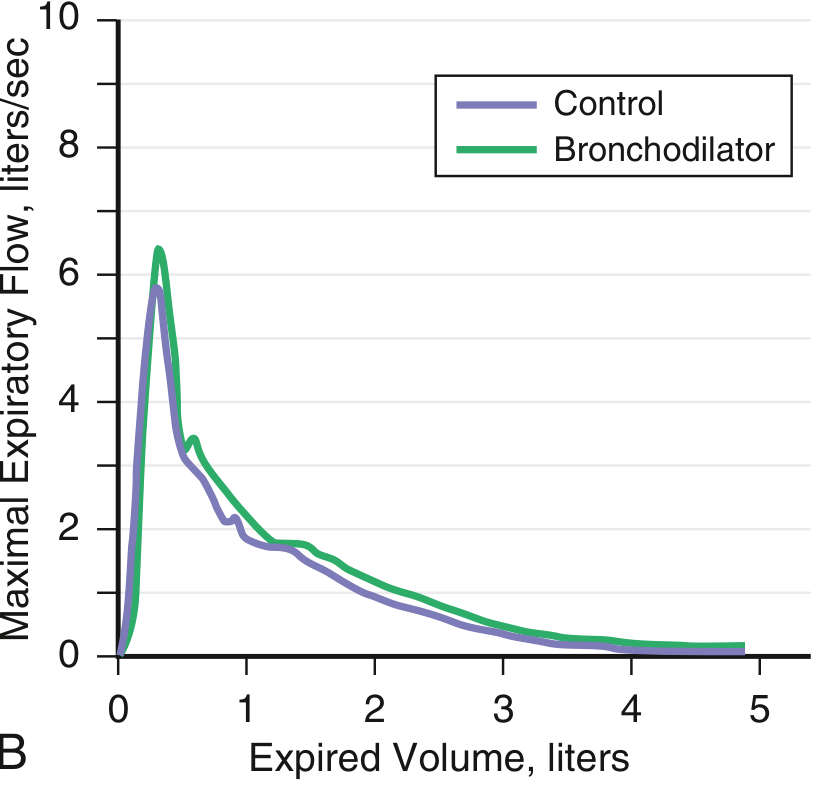
- Murray & Nadel's Respiratory Medicine
For asthma, a 20% and 200 mL increase in FVC post-bronchodilator is also suggestive. Additionally, a > 20% fall in FEV1 with methacholine challenge (PC20) supports bronchial hyperresponsiveness when baseline spirometry is normal.
V - Validity (Quality of the Test)
Before interpreting any results, confirm the test is technically acceptable. According to ATS/ERS standards:
- At least 3 acceptable maneuvers must be obtained
- Each blow must show no hesitation at start and last ≥ 6 seconds (plateau for ≥ 1 sec)
- The two largest FVC values must agree within 0.15 L (150 mL)
- The two largest FEV1 values must also agree within 0.15 L
- Up to 8 maneuvers may be attempted to achieve valid, reproducible results
- An irregular or jagged flow-volume curve suggests poor effort or suboptimal coaching
Poor quality invalidates interpretation regardless of the numerical values.
Quick Summary Table
| Step | Key question | Key value |
|---|---|---|
| P - Pattern | Obstructive / Restrictive / Mixed? | FEV1/FVC ratio + FVC |
| E - Extent | How severe? | % predicted FEV1 |
| R - Reversibility | Does it respond to bronchodilator? | ≥12% + ≥200 mL rise in FEV1 |
| V - Validity | Is the test technically reliable? | Repeatability within 150 mL |
Sources:
- Goldman-Cecil Medicine, 26th ed. - Pulmonary Function Tests (Ch. 73 & 79)
- Murray & Nadel's Textbook of Respiratory Medicine - Spirometry and Asthma chapters
- ATS/ERS 2022 spirometry standardization (updated guidelines using LLN and z-scores)
- AAFP stepwise approach to spirometry interpretation
Venice Pooling. Hello?
Hello! I'm here.
Could you clarify what you mean by "Venice Pooling"? A couple of possibilities:
Asking for Preferences
What are you referring to by 'Venice Pooling'?
This is a shared conversation. Sign in to Orris to start your own chat.