
Explain glycemic index of food. How will you apply in diabetic patient?
Reading File
Now let me search the medical library and run parallel queries for comprehensive coverage.
Finding Sources
Finding Sources
Searching PubMed
"glycemic index" AND diabetes
Now let me read the key textbook sections in parallel.
Reading File
Reading File
Reading File
Finding Sources
Let me get the Harrison's guidelines section and the Yamada GI section, and also fetch the GI diagram image.
Reading File
Reading File
Reading File
Loading Image
I now have comprehensive material from multiple authoritative textbooks. Here is the full, well-structured answer:
Glycemic Index of Food
1. Definition
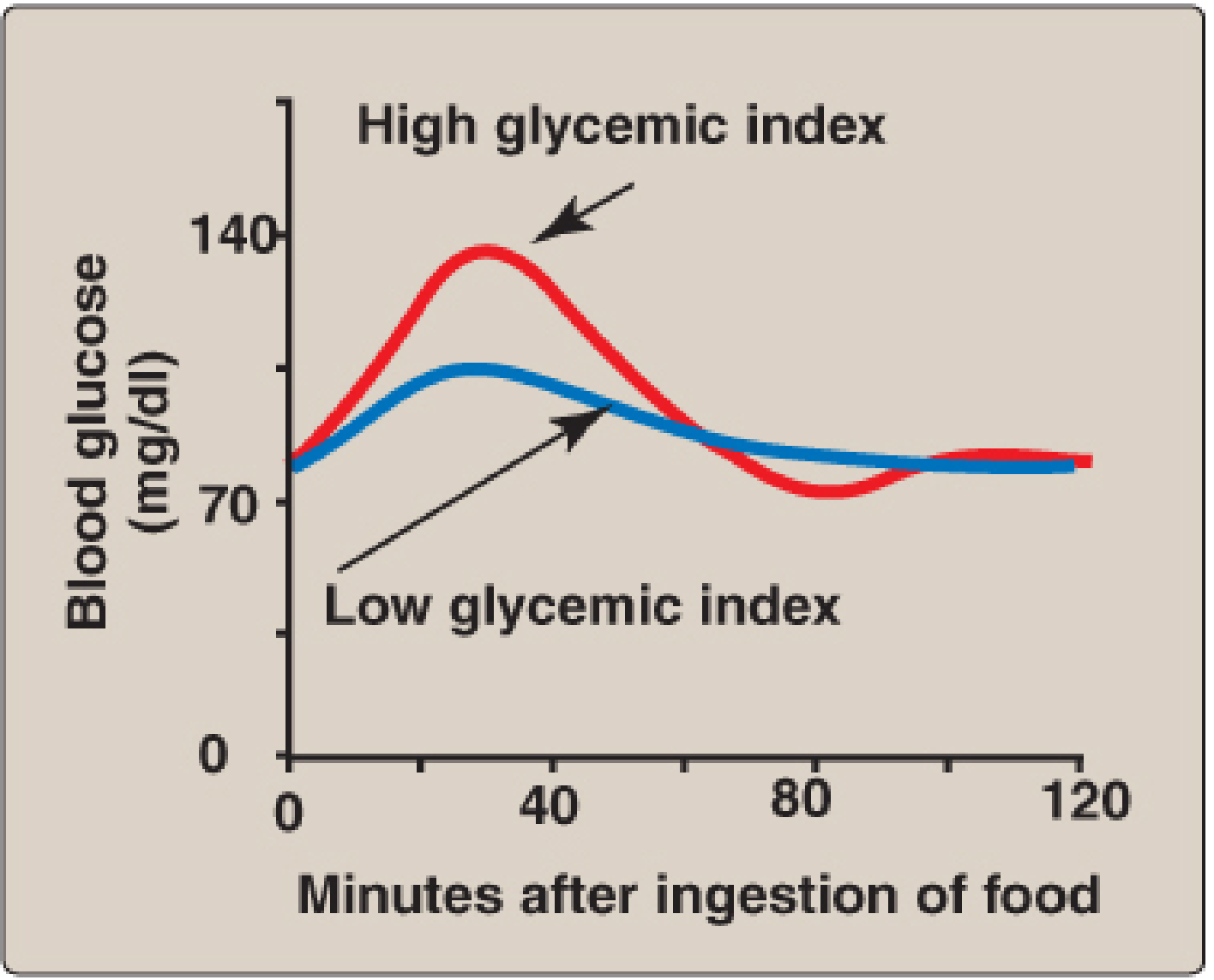
The Glycemic Index (GI) is a numerical ranking that measures how rapidly a carbohydrate-containing food raises blood glucose levels after ingestion, compared to a reference standard (usually pure glucose or white bread, given a GI of 100).
Technically, it is measured as the area under the 2-hour blood glucose response curve after consuming a fixed amount of carbohydrate (typically 50 g) from the test food, divided by the area under the curve after the same amount of the reference standard:
GI = (AUC of test food / AUC of reference food) × 100
- Lippincott's Illustrated Reviews: Biochemistry, Fig. 27.16
2. GI Classification
| Category | GI Value | Examples |
|---|---|---|
| Low GI | ≤ 55 | Lentils, beans, oats, most fruits, nonstarchy vegetables, nuts |
| Medium GI | 56-69 | Brown rice, whole wheat bread, sweet potato |
| High GI | ≥ 70 | White bread, white rice, candy, soda, fruit juice, most potatoes |
- Sleisenger & Fordtran's Gastrointestinal and Liver Disease, p. 2002
3. Factors That Determine GI
Several intrinsic and extrinsic factors influence the GI of a food:
- Starch structure - Foods rich in amylose (long, straight chains) digest more slowly → lower GI. Foods with more amylopectin (branched) digest faster → higher GI.
- Food processing - Whole grain has a lower GI than refined flour; cooked vs. raw affects GI (e.g., cooked starch is more digestible).
- Fiber content - Higher dietary fiber slows digestion and lowers GI.
- Physical form - Whole foods (intact cell walls) release glucose more slowly than pulverized or processed forms.
- Ripeness - Riper fruits have higher GI due to increased simple sugar content.
- Monosaccharide type - Fructose and sugar alcohols have lower GI than glucose. Sucrose has an intermediate GI.
- Fat and protein content of a meal - Both slow gastric emptying and lower postprandial glucose rise.
- Sleisenger & Fordtran's, p. 2002; Yamada's Gastroenterology, 7th Ed.
4. Glycemic Load (GL) - The Practical Partner
Glycemic Load = GI × grams of carbohydrate per serving / 100
GI alone does not account for the amount of carbohydrate in a realistic portion. GL corrects for this:
-
Example: Carrots have a high GI (~71), but a normal serving contains very little carbohydrate, so their GL is actually low. This makes them a perfectly fine choice for diabetics.
-
High GL meal: Pancakes + syrup + orange juice
-
Low GL meal: Fish + ½ cup brown rice + 2 cups mixed greens
-
Textbook of Family Medicine, 9th Ed.
5. Application in the Diabetic Patient
5a. Rationale
Postprandial hyperglycemia is a major driver of diabetic complications including retinopathy, nephropathy, and cardiovascular disease. Choosing low-GI foods blunts the postprandial blood glucose spike, supporting better glycemic control.
5b. Clinical Guidelines
Harrison's Principles of Internal Medicine (22E, 2025) explicitly recommends:
"Consider using glycemic index to predict how consumption of a particular food may affect blood glucose." - in its guidelines for ongoing comprehensive medical care for individuals with diabetes.
ADA Nutrition Therapy (2013, updated) and the Textbook of Family Medicine state:
"Substituting low-glycemic index foods for higher-glycemic index foods may modestly improve glycemic control."
However, the American Diabetes Association also notes that the utility of GI in routine clinical management of prediabetes and diabetes remains somewhat controversial - individual response to foods varies, and total carbohydrate quantity matters as much as quality.
5c. Practical Dietary Advice for Diabetic Patients
| Dietary Strategy | Practical Application |
|---|---|
| Replace high-GI carbs | White rice → brown rice or barley; white bread → whole grain bread |
| Eat more legumes | Lentils, chickpeas, kidney beans - all have low GI and high fiber |
| Add fiber to every meal | Fiber slows digestion and lowers postprandial glucose |
| Avoid sugar-sweetened beverages | Soda, fruit juice, candies have very high GI and GL |
| Eat whole fruit, not juice | Whole fruit has lower GI due to intact fiber |
| Pair carbs with protein/fat | Reduces overall postprandial glycemic response of the meal |
| Control portion sizes | High GI food in small amounts may have an acceptable glycemic load |
| Monitor carbohydrate quantity | For insulin-dependent patients, estimate total grams of carbohydrate per meal for insulin dose adjustment |
5d. Type 1 vs. Type 2 Diabetes
- Type 1 / Insulin-dependent Type 2: GI helps predict postprandial glucose spikes for flexible insulin dosing. Counting total carbohydrates remains the primary method, with GI used as a secondary predictor.
- Type 2 (diet/oral agent-managed): Low-GI eating patterns are particularly beneficial. Replacing high-GI foods with low-GI alternatives, combined with weight loss, can meaningfully reduce HbA1c.
- Overweight/obese diabetics: Low-GI + low glycemic load diets also support weight reduction, which further improves insulin sensitivity.
5e. Medical Nutrition Therapy Principles
Per the ADA and Textbook of Family Medicine:
- The "diabetic diet" is no longer a rigid prescription - individualized Medical Nutrition Therapy (MNT) by a registered dietitian is preferred.
- Personal preferences, culture, religion, financial circumstances, and metabolic goals all guide dietary planning.
- Modest weight loss (5-10% of body weight) in Type 2 DM improves glycemia, blood pressure, and lipids.
- Encourage a Mediterranean-style diet rich in monounsaturated and polyunsaturated fats, whole grains, legumes, and vegetables.
- Minimize trans fat and added sugar intake.
6. Summary Table: Low vs. High GI Foods for Diabetics
| Prefer (Low GI ≤55) | Limit (High GI ≥70) |
|---|---|
| Oats, barley | White rice, white bread |
| Lentils, beans, chickpeas | Cornflakes, white rice cakes |
| Most nonstarchy vegetables | Potatoes (especially mashed/baked) |
| Apples, pears, berries | Watermelon, dates |
| Nuts, seeds | Candy, cookies, cakes |
| Whole grain bread | Sugary drinks, fruit juice |
| Sweet potato | Instant/processed breakfast cereals |
Key Takeaway: GI is a useful tool but not the sole guide. In diabetic management, focus on:
- Low-GI food choices
- Appropriate portion sizes (glycemic load)
- Total carbohydrate counting
- Balanced meals with fiber, protein, and healthy fat
- Individualized nutrition therapy
Sources: Sleisenger & Fordtran's Gastrointestinal and Liver Disease; Yamada's Textbook of Gastroenterology, 7th Ed.; Lippincott Illustrated Reviews: Biochemistry, 8th Ed.; Textbook of Family Medicine, 9th Ed.; Harrison's Principles of Internal Medicine, 22E (2025)
This is a shared conversation. Sign in to Orris to start your own chat.