
hi
Hey! How can I help you today?
What is headache?
A headache is pain or discomfort in the head, scalp, or neck. It is one of the most common medical complaints. Headaches can range from mild and brief to severe and chronic, and they have many different causes and types.
Searching sources...
Reading File
Finding Sources
Searching the Web
headache definition types causes overview
Reading File
Reading File
Loading Image
Reading File
Here is a thorough overview of headache, drawing from Guyton and Hall Textbook of Medical Physiology and Bradley and Daroff's Neurology in Clinical Practice:
What is a Headache?
A headache is pain or discomfort felt on or around the surface of the head, arising either from deep intracranial structures or from extracranial sources. Contrary to common belief, the brain tissue itself is almost entirely insensitive to pain. Most headache pain originates from pain-sensitive structures such as:
-
The meninges (dural surfaces, venous sinuses)
-
The blood vessels of the brain and meninges (especially the middle meningeal artery)
-
Muscles of the scalp and neck
-
The nasal sinuses and eye structures
-
Guyton and Hall Textbook of Medical Physiology, p. 615
Areas of the Head Affected (by origin)
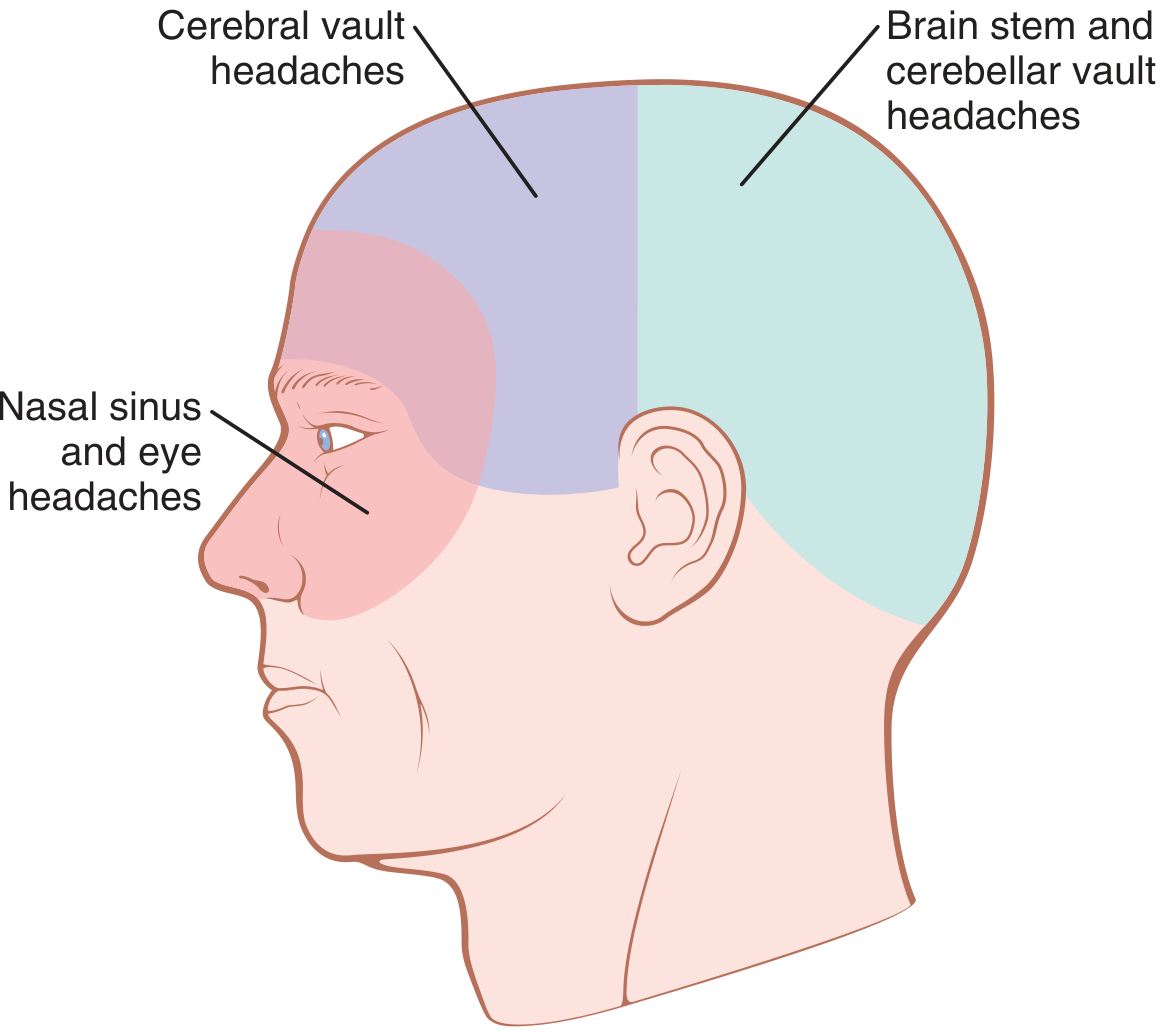
- Cerebral vault pain is referred to the front half of the head (via the trigeminal nerve/cranial nerve V)
- Brain stem and cerebellar pain is referred to the posterior (occipital) region (via CN IX, X, and cervical nerves)
- Nasal sinus and eye pain is referred to the frontal and retro-orbital areas
Two Major Categories
1. Primary Headaches
The headache is the disorder itself - not caused by another underlying condition.
| Type | Description |
|---|---|
| Tension-type | Most common; dull, pressure-like, "band around the head"; bilateral; caused by muscle spasm from stress or poor posture |
| Migraine | Moderate-severe, often unilateral, throbbing; lasts 4-72 hours; may have aura, nausea, photophobia; affects ~15% of population; 3x more common in women |
| Cluster | Severe, unilateral, around/behind one eye; associated with tearing and nasal congestion; occurs in clusters |
2. Secondary Headaches
The headache is a symptom of another medical condition - for example:
- Meningitis - one of the most severe headaches; caused by inflammation of the meninges
- Low CSF pressure - after spinal tap; due to loss of brain flotation
- Subarachnoid hemorrhage - classic "thunderclap headache" (worst headache of life)
- Hypertension - headache with dangerously elevated blood pressure (>180/120 mmHg)
- Sinusitis - pain referred from infected nasal/accessory nasal structures
- Eye strain - retro-orbital headache from ciliary muscle spasm or UV light exposure
Mechanism of Migraine (Key Physiology)
Migraine involves activation of the trigeminovascular system - trigeminal nerve fibers projecting to intracranial blood vessels. This triggers release of:
- Nitric oxide
- CGRP (calcitonin gene-related peptide)
- Substance P
These chemicals cause vasodilation and local neurogenic inflammation, ultimately signaling pain to the somatosensory cortex. There is also a strong genetic component - 65-90% of migraine patients have a positive family history.
- Guyton and Hall Textbook of Medical Physiology, p. 616
Red Flags (Warning Signs Requiring Imaging)
Per Bradley and Daroff's Neurology:
- Thunderclap headache (sudden, severe - possible aneurysm rupture)
- "Worst headache of life"
- New headache in a patient with cancer
- Headache with fever, altered mental status, or focal neurological deficits
- Progressive increase in frequency or severity
- Headaches always localized to one side
- Headache that does not respond to treatment
These warrant MRI (with gadolinium if initial scan is negative).
In summary, headache is a very common symptom with many possible causes - most are benign (tension or migraine), but some signal serious underlying disease. Proper classification guides treatment.
This is a shared conversation. Sign in to Orris to start your own chat.