
Intra orbital part of optic nerve
Reading File
Finding Sources
Finding Sources
The most relevant sources are Kanski's Clinical Ophthalmology and Gray's Anatomy for Students. Let me read those sections now.
Reading File
Reading File
Now let me fetch the anatomical image and search for more detail on the intraorbital optic nerve's course, relations, and blood supply.
Loading Image
Finding Sources
Searching Images
intraorbital optic nerve anatomy course relations
Now let me also get the Kanski block 6 content and the blood supply section for completeness.
Reading File
Finding Sources
Reading File
I now have comprehensive information to deliver a detailed, well-structured answer. Let me compile it.
Intraorbital Part of the Optic Nerve
Overview
The optic nerve (CN II) is not a true peripheral nerve but an extension of the brain, surrounded by cranial meninges (pia, arachnoid, dura mater). The subarachnoid space extends forward as far as the eyeball, making it continuous with the cerebral subarachnoid space and containing CSF — which is why raised intracranial pressure causes papilledema.
The nerve is ~50 mm in total length from globe to chiasm, divided into four segments:
| Segment | Length | Notes |
|---|---|---|
| Intraocular | ~1 mm | Optic disc; 1.5 mm vertical diameter |
| Intraorbital | 25–30 mm | Globe → optic foramen (orbital apex) |
| Intracanalicular | ~6 mm | Fixed to canal wall; dura fuses with periosteum |
| Intracranial | 5–16 mm (avg 10 mm) | Ends at chiasm; vulnerable to pituitary/aneurysm compression |
Intraorbital Segment — Key Features
Length & Diameter
- 25–30 mm long, extending from the posterior pole of the globe to the optic foramen at the orbital apex.
- Diameter 3–4 mm — larger than the intraocular segment because myelin sheaths are added to nerve fibres once the nerve exits the globe.
Course
- The nerve follows an S-shaped or sinuous course within the orbit — it is longer than the straight-line distance from globe to apex, which allows free movement of the eyeball without traction on the nerve.
Surroundings at the Apex
- At the orbital apex, the intraorbital nerve is encircled by the annulus of Zinn (common tendinous ring), from which the four rectus muscles originate.
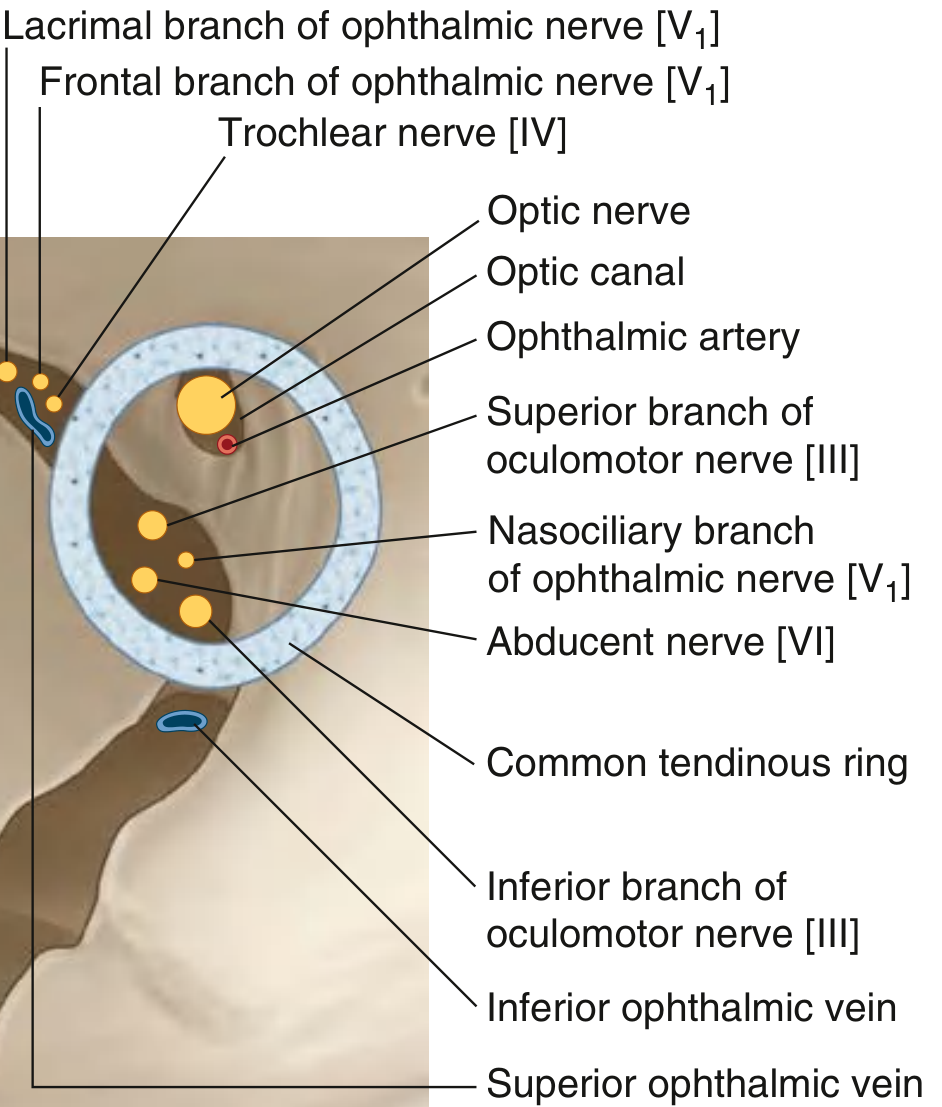
Cross-section at orbital apex (Gray's Anatomy for Students)
Meningeal Sheaths
The intraorbital nerve is wrapped by all three meningeal layers:
- Pia mater — innermost, delicate and vascular; sends septa (derived from pia) that divide the ~1.2 million nerve fibre bundles into ~600 fascicles.
- Arachnoid mater — middle layer.
- Dura mater — outermost, tough; continuous anteriorly with the sclera. Optic nerve fenestration (for benign intracranial hypertension) involves incision of this outer sheath.
- Subarachnoid space — between arachnoid and pia, contains CSF, continuous with the intracranial subarachnoid space.
Nerve Fibre Content
- ~1.2 million afferent fibres, each arising from a retinal ganglion cell.
- Most synapse in the lateral geniculate body; some reach pretectal nuclei (pupillary light reflex).
- Nearly one-third of fibres serve the central 5° of the visual field (macular representation).
- Fibres are arranged in ~600 bundles separated by fibrous septae from the pia mater.
Blood Supply
Ophthalmic Artery
- Branch of the internal carotid artery.
- At the optic canal, runs inferior and lateral to the nerve.
- As it crosses the optic nerve (5–15 mm from the globe), it gives off the central retinal artery, which pierces the nerve and travels forward in its core to divide at the optic disc into superior and inferior branches.
Central Retinal Artery
- Enters the optic nerve 8–12 mm behind the globe (some sources: 5–15 mm).
- Supplies the inner retina.
- Travels within the substance of the intraorbital nerve.
Optic Nerve Head / Disc Blood Supply
- Supplied by the circle of Zinn–Haller, fed by:
- 4–5 long posterior ciliary arteries
- Choroidal vessels
- Pial arterial network
Distal Intraorbital Segment (near globe)
- Supplied by small branches of the ophthalmic artery directly.
Pial Plexus
- A fine vascular network in the pia supplies the substance of the intraorbital nerve throughout its length.
Relations Within the Orbit
| Structure | Relation |
|---|---|
| Ophthalmic artery | Initially inferior and lateral; crosses superomedially over the nerve |
| Central retinal artery | Enters nerve inferiorly 8–12 mm behind globe |
| Superior branch of CN III | Passes over lateral side of optic nerve → superior rectus + levator |
| Inferior branch of CN III | Passes below and medial to optic nerve → medial rectus, inferior rectus, inferior oblique |
| Nasociliary nerve (V₁) | Crosses over the optic nerve superiorly |
| Superior and inferior ophthalmic veins | Adjacent within the intraconal space |
Clinical Relevance
- Optic neuritis: Demyelination of the intraorbital segment; painful eye movement, reduced visual acuity, central scotoma. MRI shows enhancement and swelling of the intraorbital optic nerve.
- Optic nerve sheath meningioma: Arises from meningothelial cells of the arachnoid surrounding the intraorbital nerve; produces classic "railroad-track" sign on CT/MRI.
- Indirect traumatic optic neuropathy (TON): Divided into anterior (anterior to central retinal artery entry point) and posterior forms.
- Papilledema: Raised ICP transmits via CSF in the subarachnoid sleeve surrounding the intraorbital nerve → impedes venous return via central retinal vein → disc oedema.
- Optic nerve fenestration: Incision of the dural sheath of the intraorbital nerve to relieve CSF pressure in idiopathic intracranial hypertension.
Sources:
- Kanski's Clinical Ophthalmology, 10th ed., pp. 778–779
- Gray's Anatomy for Students, p. 1083
- Localization in Clinical Neurology, 8th ed., pp. 337–338
This is a shared conversation. Sign in to Orris to start your own chat.