Make Make a horizontal poster. Of, uh, aerobic and anaerobic respire-- aerobic and anaerobic, uh, exercise. In horizontal. From WHO guidelines and include all its detail in one or two poster.
site:who.int WHO Guidelines on physical activity and sedentary behaviour adults children older adults pregnancy disability 2020 recommendations
physical activity guideline aerobic muscle strengthening
https://iris.who.int/server/api/core/bitstreams/f3885485-e7e…
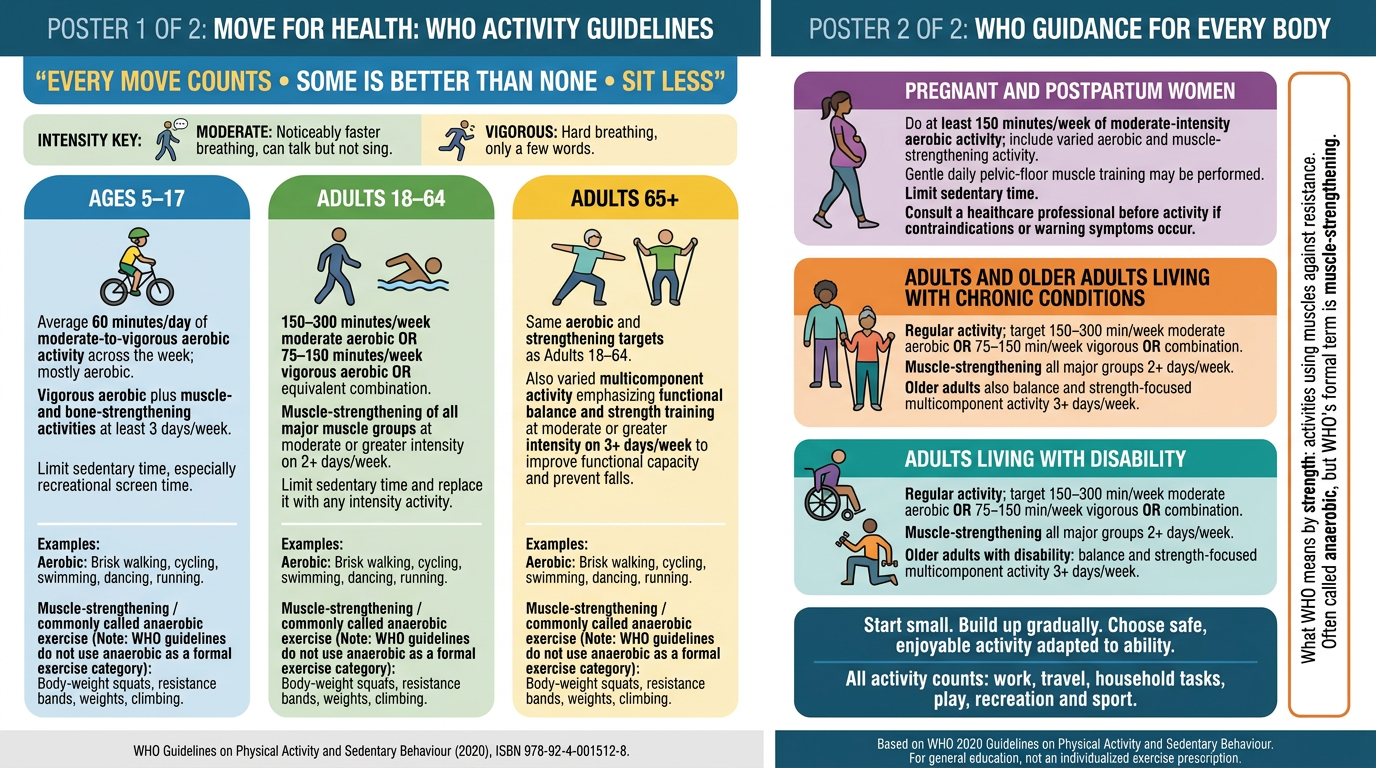
Create two separate landscape educational health posters as a matched set, labeled POSTER 1 OF 2 and POSTER 2 OF 2. They must be readable infographic posters and accurately reflect the WHO 2020 Guidelines on Physical Activity and Sedentary Behaviour. Use the term “aerobic exercise” and label the strength section “muscle-strengthening / commonly called anaerobic exercise,” with a small correction that WHO guidelines do not use anaerobic as a formal exercise category. Poster 1 title: MOVE FOR HEALTH: WHO ACTIVITY GUIDELINES. Include a clear key-message banner: “EVERY MOVE COUNTS • SOME IS BETTER THAN NONE • SIT LESS.” Include a simple intensity key: Moderate = noticeably faster breathing, can talk but not sing; Vigorous = hard breathing, only a few words. Include sections with exact recommendations: • Ages 5–17: average 60 minutes/day of moderate-to-vigorous aerobic activity across the week; mostly aerobic; vigorous aerobic plus muscle- and bone-strengthening activities at least 3 days/week; limit sedentary time, especially recreational screen time. • Adults 18–64: 150–300 minutes/week moderate aerobic OR 75–150 minutes/week vigorous aerobic OR equivalent combination; muscle-strengthening of all major muscle groups at moderate or greater intensity on 2+ days/week; limit sedentary time and replace it with any intensity activity. • Adults 65+: same aerobic and strengthening targets; also varied multicomponent activity emphasizing functional balance and strength training at moderate or greater intensity on 3+ days/week to improve functional capacity and prevent falls. Use icons: child cycling, adult brisk walking/swimming, older adult balance and resistance exercise. Add examples of aerobic movement: brisk walking, cycling, swimming, dancing, running. Add strength examples: body-weight squats, resistance bands, weights, climbing. Include WHO source: WHO Guidelines on Physical Activity and Sedentary Behaviour (2020), ISBN 978-92-4-001512-8. Poster 2 title: WHO GUIDANCE FOR EVERY BODY. Include sections: • Pregnant and postpartum women: do at least 150 minutes/week of moderate-intensity aerobic activity; include varied aerobic and muscle-strengthening activity; gentle daily pelvic-floor muscle training may be performed; limit sedentary time; consult a healthcare professional before activity if contraindications or warning symptoms occur. • Adults and older adults living with chronic conditions: regular activity; target 150–300 min/week moderate aerobic OR 75–150 min/week vigorous OR combination; muscle-strengthening all major groups 2+ days/week; older adults also balance and strength-focused multicomponent activity 3+ days/week. • Adults living with disability: regular activity; target 150–300 min/week moderate aerobic OR 75–150 min/week vigorous OR combination; muscle-strengthening all major groups 2+ days/week; older adults with disability: balance and strength-focused multicomponent activity 3+ days/week. Include “Start small. Build up gradually. Choose safe, enjoyable activity adapted to ability.” and “All activity counts: work, travel, household tasks, play, recreation and sport.” Include a sidebar: “What WHO means by strength: activities using muscles against resistance. Often called anaerobic, but WHO’s formal term is muscle-strengthening.” Use inclusive diverse figures, wheelchair athlete, pregnant person walking, person using resistance band. Footer: “Based on WHO 2020 Guidelines on Physical Activity and Sedentary Behaviour. For general education, not an individualized exercise prescription.”