
Angle man syndrome
I'll read the medical library skill first, then search for Angelman syndrome content.
Reading File
Now let me search the library and PubMed in parallel.
Finding Sources
Finding Sources
Searching PubMed
"Angelman syndrome"[MeSH Terms]
Good. Now let me read the key sections in parallel - Robbins (pathology/genetics), Emery's (genetics), and Harriet Lane (clinical/pediatric).
Reading File
Reading File
Reading File
Let me fetch the imprinting diagram image and also get the biochemistry image for visual clarity.
Loading Image
Loading Image
I have all the information needed for a thorough answer. Here is a comprehensive overview of Angelman Syndrome (AS):
Angelman Syndrome
Overview
Angelman syndrome (AS) is a neurogenetic disorder caused by loss of function of the maternally derived UBE3A gene on chromosome 15q11-q13. It occurs in approximately 1 in 15,000 births and was formerly nicknamed "happy puppet syndrome" due to its behavioral phenotype.
Clinical Features
| Feature | Detail |
|---|---|
| Behavioral | Happy demeanor, unprovoked/inappropriate laughter, hand-flapping, fascination with water |
| Neurological | Severe intellectual disability, absent or minimal speech |
| Motor | Ataxic gait, tremulous limb movements, hypotonia |
| Seizures | Characteristic and often severe; begin in infancy/early childhood |
| Craniofacial | Microcephaly |
| Other | Sleep disturbance, feeding difficulties (infancy), scoliosis, strabismus, constipation, GERD |
Genetics and Molecular Basis
AS is a classic example of genomic imprinting - a parent-of-origin effect where gene expression depends on which parent transmitted the allele.
The key gene is UBE3A (ubiquitin-protein ligase E3A), located at 15q11.2-q13:
- In most tissues, UBE3A is expressed from both alleles
- In the brain (particularly hippocampus and Purkinje cells of the cerebellum), only the maternal copy is active - the paternal copy is imprinted (silenced) by an antisense RNA transcript
- When the maternal UBE3A is lost, there is no functional UBE3A in the brain
- Loss of UBE3A inhibits synapse formation and synaptic plasticity
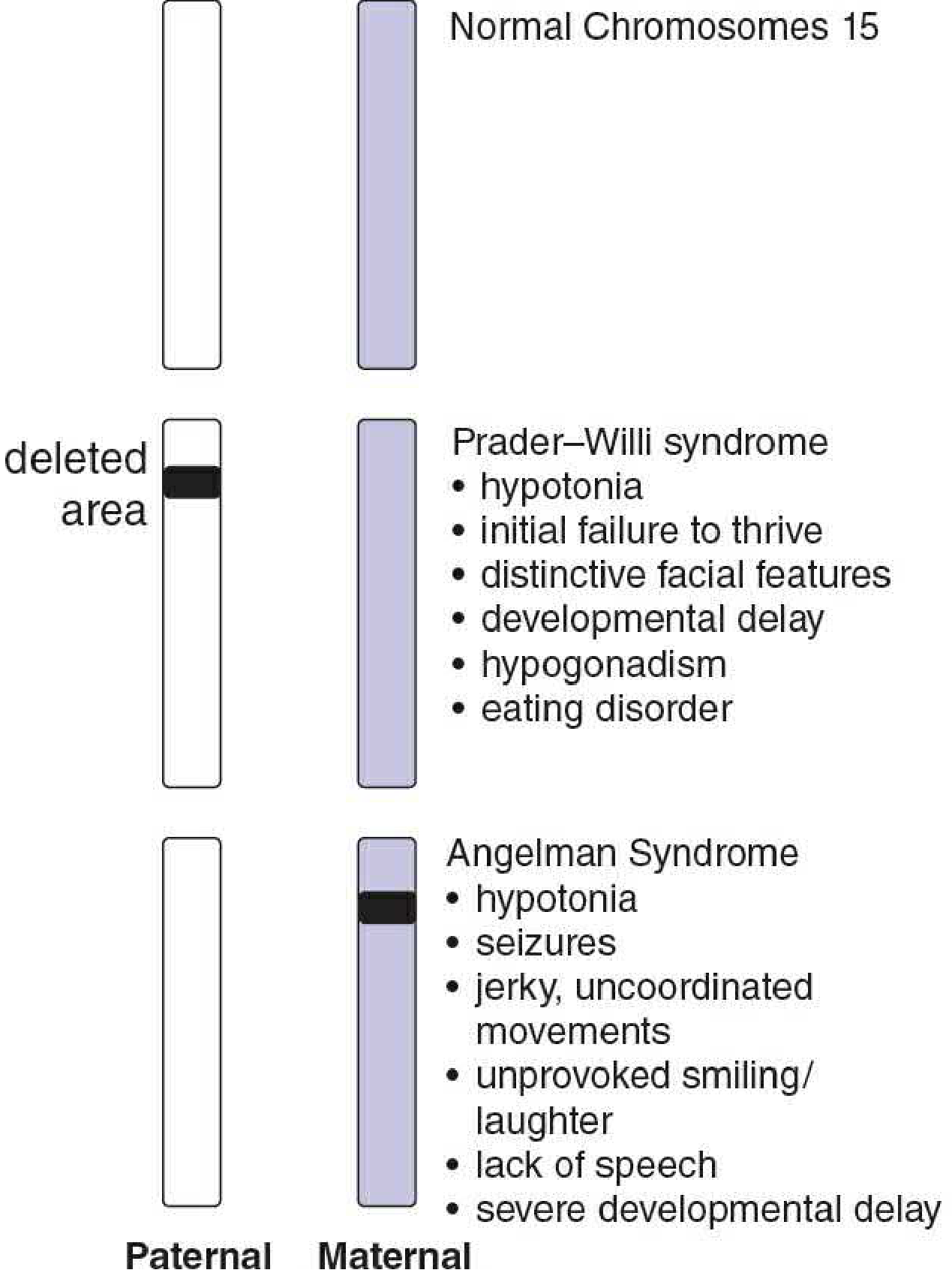
Mechanisms (four distinct causes)
| Mechanism | Frequency | Detail |
|---|---|---|
| Deletion of maternal 15q11.2-q13 | ~70% | Most common; 5 Mb interstitial deletion |
| Paternal uniparental disomy (UPD) | 20-25% | Two paternal copies of chr 15; no maternal UBE3A |
| Imprinting centre (IC) defect | ~5% | Maternal chromosome carries paternal imprint; mildest phenotype; risk of recurrence |
| UBE3A point mutation | ~10% | Pathogenic variant in UBE3A on maternal allele |
| Unknown | ~10% | Molecular defect not identified |
The imprinting control region (ICR/AS ICR) maps upstream of SNURF/SNRPN. An antisense RNA from the paternal allele silences UBE3A in neurons - this is why paternal UPD (having two paternal chromosomes) also causes AS.
Comparison with Prader-Willi Syndrome
Both AS and Prader-Willi syndrome (PWS) involve the same 15q11-q13 region, making them the classic teaching example of genomic imprinting:
| Feature | Angelman Syndrome | Prader-Willi Syndrome |
|---|---|---|
| Deleted chromosome | Maternal | Paternal |
| Key gene | UBE3A (single gene) | Multiple genes (SNORP family) |
| Phenotype | Happy affect, seizures, ataxia, no speech | Obesity, hyperphagia, hypogonadism, short stature, hypotonia |
| UPD type causing disease | Paternal UPD | Maternal UPD |
Diagnosis
- Methylation testing - detects ~80% of cases (detects abnormal maternal imprinting, maternal deletion, or paternal UPD)
- UBE3A sequencing - detects point mutations (~10%)
- Together these identify nearly all cases
- Chromosomal microarray can identify deletions
Management
There is no cure; management is supportive:
- Seizures: Antiepileptic drugs (AEDs) - avoid carbamazepine, vigabatrin, and tiagabine as AS is associated with movement abnormalities that these can worsen
- Communication: Speech therapy focused on nonverbal communication (AS patients have severe speech impairment)
- Sleep: Sedatives for nighttime wakefulness (sleep disturbance is common)
- Surveillance: Monitor for scoliosis, strabismus, GERD, constipation, feeding issues, behavior problems
- Physiotherapy: For gait and motor difficulties
Recurrence Risk
- Deletion or UPD: Very low recurrence risk (<1%)
- IC defect: Appreciable recurrence if mother carries the defect (up to 50%); even if mother tests negative, gonadal mosaicism gives non-trivial risk
- UBE3A point mutation: If maternally inherited, 50% recurrence risk
Sources: Robbins Pathologic Basis of Disease, p. 174 | Emery's Elements of Medical Genetics and Genomics | Harriet Lane Handbook, 23rd ed. | Principles of Neural Science (Kandel)
This is a shared conversation. Sign in to Orris to start your own chat.