
Popeye’s sign
Popeye's sign refers to a visible bulge in the upper arm caused by a ruptured biceps tendon (typically the long head), where the retracted muscle bunches up distally, resembling Popeye's cartoonishly muscular forearm.
Searching sources...
Reading File
Searching the Web
Popeye sign biceps tendon rupture clinical findings
Finding Sources
Reading File
Reading File
Reading File
Loading Image
Popeye's Sign
Popeye's sign (also called "Popeye deformity") is a clinical finding produced by complete rupture of the long head of the biceps brachii tendon. When the proximal anchor is lost, the muscle belly retracts distally and bunches up into a prominent, rounded hump in the mid-upper arm - resembling the exaggerated forearm of the cartoon character Popeye. It is best seen (and felt) when the patient actively flexes the elbow.
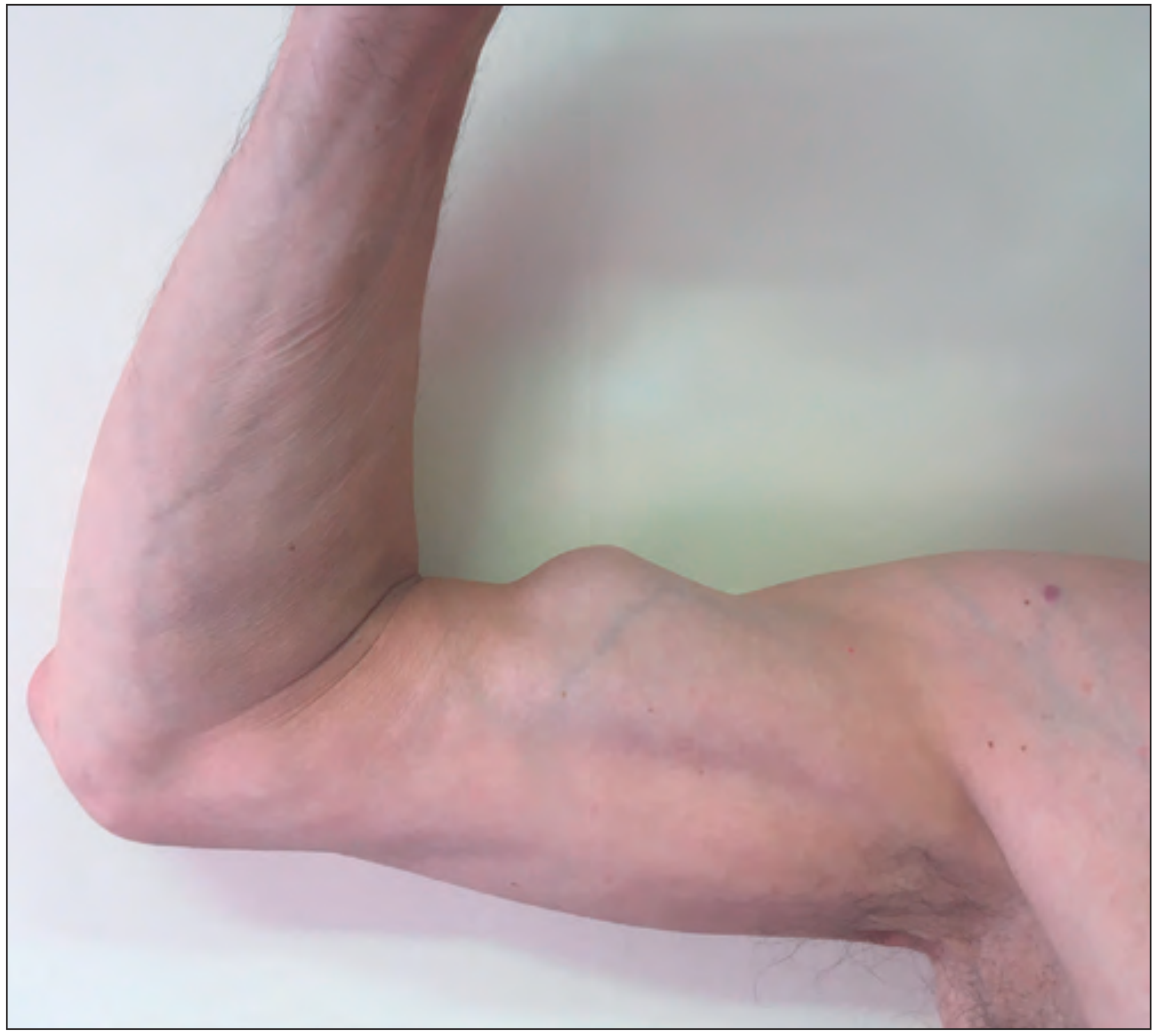
Anatomy
The biceps brachii has two heads:
- Long head - arises from the supraglenoid tubercle of the scapula; its tendon runs through the bicipital groove of the humerus (intra-articular but extra-synovial)
- Short head - arises from the coracoid process
The long head is by far the more vulnerable of the two. It is exposed to repetitive microtrauma and age-related degeneration within the bicipital groove. Approximately 96% of biceps tendon ruptures involve the long head proximally; distal ruptures account for ~3%.
Mechanism
Rupture is usually due to chronic attritional degeneration (microtears) superimposed on an acute event - either forced elbow extension or resisted supination and flexion. Risk factors include:
- Age >40
- Rotator cuff disease (most proximal ruptures are associated with it)
- Recent fluoroquinolone or oral corticosteroid use
- Heavy overhead or manual labor
The rupture may be spontaneous or follow a traumatic incident. Patients often report feeling or hearing a sudden "pop," followed by anterior shoulder/upper arm pain and ecchymosis.
Clinical Features
| Feature | Detail |
|---|---|
| Popeye sign | Distal bunching of the biceps belly - visible hump in the mid-upper arm |
| Ludington sign | Asymmetric muscle contour when both arms are placed behind the head and biceps contracted bilaterally |
| Pain | Acute anterior shoulder/arm pain at time of rupture; may settle quickly |
| Ecchymosis | Bruising along the anterior arm |
| Weakness | Forearm supination is most affected (~20% loss); elbow flexion stays relatively strong |
| Preserved elbow flexion | Brachialis and short head of biceps remain intact |
Why Functional Loss is Modest
Even with complete proximal long head rupture, elbow flexion strength is largely preserved because the brachialis is the primary elbow flexor, and the intact short head continues to contribute. The main functional deficit is forearm supination weakness (~20-40% loss). This is why many patients, especially older or less active individuals, cope well with conservative management.
Imaging
- X-ray: Usually normal; may show associated acromioclavicular arthritis or subacromial spurs
- Ultrasound: Excellent for confirming absence of tendon in the bicipital groove; first-line in many centers
- MRI: Confirmatory; best for defining the level of rupture and associated rotator cuff pathology
Management
| Patient | Approach |
|---|---|
| Older / less active | Conservative - sling, analgesia, range-of-motion rehab. Functional loss is minimal; cosmetic deformity accepted |
| Young / active / manual worker | Surgical referral - biceps tenodesis (reattaching tendon to humerus) or repair |
| Tenotomy without tenodesis | Avoids surgery but carries risk of persistent "Popeye" deformity and subjective cramping; does not cause significant weakness |
Immobilize acutely in a sling at 90° elbow flexion and refer to orthopedics or sports medicine within 1 week.
Key Differentials for Anterior Shoulder Pain After a "Pop"
- Subluxing biceps tendon (without full tear)
- Rotator cuff tear
- Glenohumeral dislocation
- Labral (SLAP) tear
Sources: Gray's Anatomy for Students, p. 1589 | Rosen's Emergency Medicine, p. 661 | Rheumatology (Elsevier 2022), p. 702 | Tintinalli's Emergency Medicine | Miller's Review of Orthopaedics 9th Ed.
This is a shared conversation. Sign in to Orris to start your own chat.