
characteristic features and their physiological basis of hypothyroidism in a 30 year old women
Reading File
Now let me search the medical library for comprehensive information on hypothyroidism features and physiology.
Finding Sources
Searching PubMed
hypothyroidism clinical features pathophysiology women
Finding Sources
Finding Sources
Excellent - I have great sources. Let me read the key sections from Harrison's and other textbooks in parallel.
Reading File
Reading File
Reading File
Now let me get Harrison's specific hypothyroidism section and the physiological basis from other relevant textbook sections.
Finding Sources
Finding Sources
Finding Sources
Reading File
Reading File
Finding Sources
Reading File
Finding Sources
Reading File
I can see the Harrison's chapter on Hypothyroidism. Let me read the clinical features section from Harrison's.
Reading File
I have very rich information now. Let me read the next portion which should contain the clinical features section in Harrison's (adult hypothyroidism).
Reading File
Excellent - this is the perfect detailed passage from Harrison's. Let me also fetch the image of the hypothyroid face and read the remaining clinical features.
Reading File
Loading Image
I now have a comprehensive set of textbook-sourced information. Let me compose the detailed, well-organized answer.
Hypothyroidism in a 30-Year-Old Woman: Features and Their Physiological Basis
In a woman of reproductive age, hypothyroidism most commonly results from Hashimoto's thyroiditis (chronic autoimmune thyroiditis). At 30, autoimmune destruction of thyroid tissue reduces circulating free T4 and T3, causing a broad spectrum of systemic effects since thyroid hormones regulate virtually every organ system. The most common cause worldwide is iodine deficiency; in iodine-sufficient regions, Hashimoto's predominates (mean annual incidence up to 4 per 1000 women).
Physiological Basis - Core Mechanism
Thyroid hormones (T3, T4) act via nuclear receptors to regulate gene transcription. Deficiency causes:
- Reduced basal metabolic rate (BMR) - decreased mitochondrial oxidative phosphorylation and thermogenesis
- Accumulation of glycosaminoglycans (hyaluronic acid, chondroitin sulfate) in the dermis and connective tissues, which trap water forming non-pitting myxedema
- Reduced cardiac inotropy and chronotropy via altered myosin heavy chain isoform expression and reduced calcium handling
- Reduced catecholamine sensitivity at the cellular level
Clinical Features and Their Physiological Basis
1. Skin and Appendages
| Feature | Physiological Basis |
|---|---|
| Dry, coarse skin; decreased sweating | Reduced sweat gland secretion due to low metabolic drive; thinning of epidermis |
| Pallor with yellow tinge ("peaches and cream") | Peripheral vasoconstriction (blood diverted from skin) + carotene accumulation (reduced conversion of beta-carotene to vitamin A) |
| Non-pitting edema - puffy face, periorbital puffiness, pretibial edema | Myxedema: glycosaminoglycans (hyaluronic acid) accumulate in dermis, trapping water - NOT true pitting edema |
| Dry, brittle hair; diffuse alopecia | Hair follicle growth slows due to low metabolic rate; reduced protein synthesis |
| Thinning of outer third of eyebrows (Hertoghe's sign) | Same mechanism as alopecia |
| Retarded nail growth | Reduced cell proliferation |
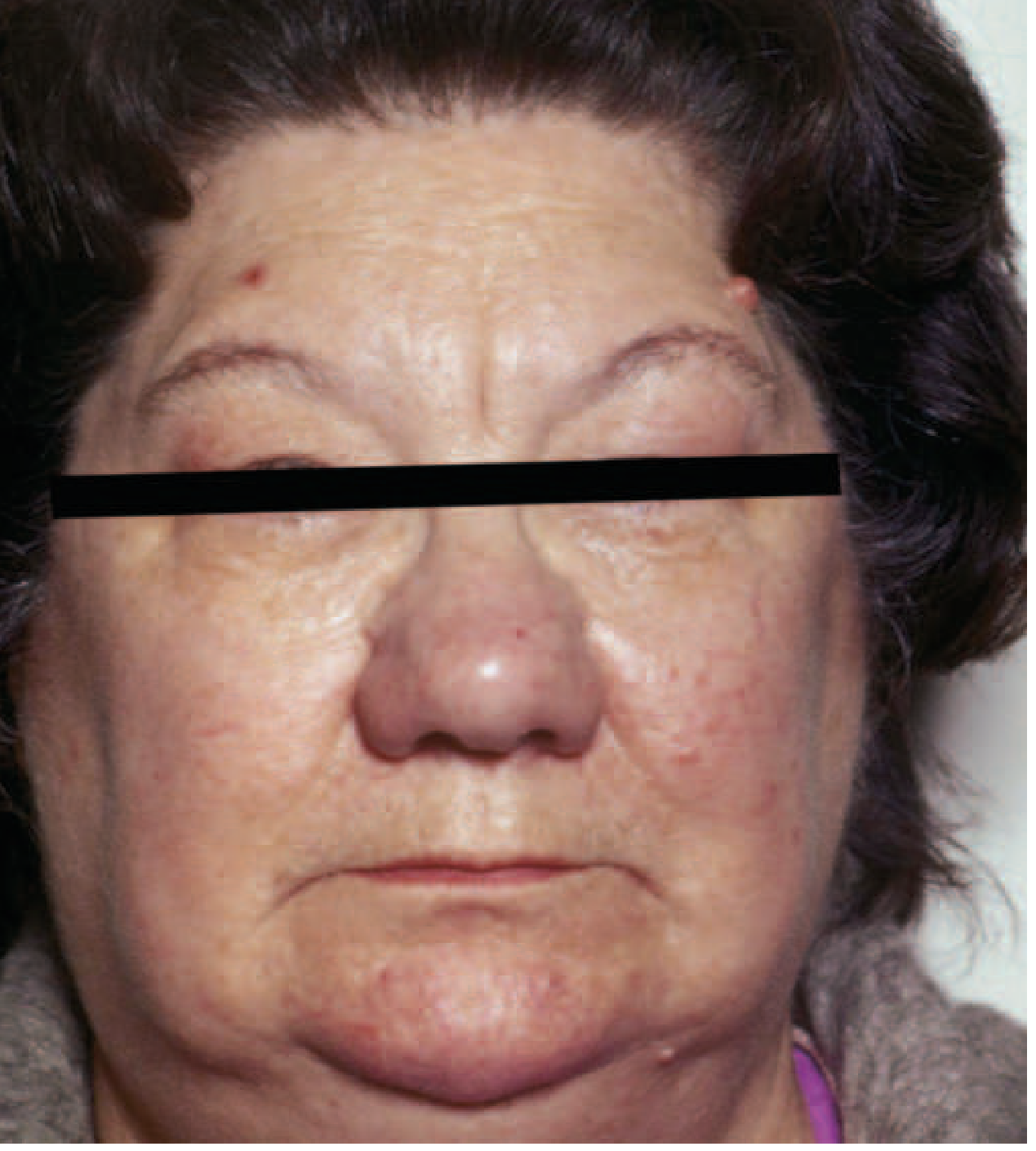
2. Cardiovascular
| Feature | Physiological Basis |
|---|---|
| Bradycardia | Thyroid hormones normally upregulate beta-adrenergic receptors and increase sinoatrial node firing rate; deficiency reduces heart rate |
| Reduced stroke volume | Decreased myocardial contractility from altered myosin heavy chain isoform expression (shift from alpha to beta isoform) and impaired calcium uptake |
| Diastolic hypertension | Increased peripheral vascular resistance (compensatory vasoconstriction to maintain perfusion) |
| Cool extremities | Blood flow diverted away from skin due to peripheral vasoconstriction |
| Pericardial effusion | Present in up to 30% - glycosaminoglycan accumulation in serous cavities; rarely compromises cardiac function |
| Dyspnea on exertion | Pleural effusion + impaired respiratory muscle function + reduced ventilatory drive + sleep apnea |
3. Metabolic
| Feature | Physiological Basis |
|---|---|
| Weight gain despite poor appetite | Reduced BMR - lower thermogenesis and oxidative metabolism. Weight gain is mostly modest and due to fluid retention in myxedematous tissues, not true fat |
| Cold intolerance | Reduced thermogenesis - thyroid hormone normally stimulates uncoupling protein (UCP) in brown fat and Na+/K+-ATPase activity, increasing heat production |
| Fatigue and weakness | Reduced mitochondrial energy production; impaired muscle metabolism |
| Hyperlipidemia (raised cholesterol and triglycerides) | Reduced LDL receptor expression and decreased lipoprotein lipase activity; hepatic clearance of LDL is reduced |
4. Neuromuscular
| Feature | Physiological Basis |
|---|---|
| Delayed relaxation of deep tendon reflexes (a hallmark sign) | Slowed rate of calcium reuptake into sarcoplasmic reticulum by SERCA pump (whose expression is thyroid hormone dependent); also reduced actin-myosin ATPase activity |
| Muscle stiffness, cramps, pain | Altered muscle energy metabolism; impaired glycogenolysis and gluconeogenesis |
| Pseudomyotonia (Hoffman syndrome) | Enlarged, slow-contracting muscles; same mechanism as delayed DTR |
| Carpal tunnel syndrome and other entrapment neuropathies | Glycosaminoglycan accumulation causing local tissue swelling compressing peripheral nerves |
| Paresthesias | Median nerve compression (carpal tunnel) + peripheral neuropathy |
| Cerebellar ataxia (rare) | Cerebellar Purkinje cell dysfunction from thyroid hormone deprivation (reversible with T4 replacement) |
5. Neuropsychiatric
| Feature | Physiological Basis |
|---|---|
| Poor memory, difficulty concentrating | Reduced cerebral glucose metabolism (PET shows lower activity in amygdala, hippocampus, and anterior cingulate cortex) |
| Depression, psychosis (rare - "myxedema madness") | Thyroid hormones modulate monoaminergic (serotonin, dopamine) neurotransmitter systems |
| Slowed speech and mentation | Reduced neuronal metabolic activity |
| Hoarse voice | Fluid accumulation (myxedema) in the vocal cords and tongue from glycosaminoglycan deposition |
6. Reproductive (particularly relevant in a 30-year-old woman)
| Feature | Physiological Basis |
|---|---|
| Menorrhagia (early) | Thyroid hormones regulate the normal maturation of granulosa cells and corpus luteum function; hypothyroidism impairs progesterone production, causing anovulatory cycles with unopposed estrogen and heavy bleeding |
| Oligomenorrhea/amenorrhea (later) | Prolonged hypothyroidism disrupts HPO axis - TRH elevation stimulates prolactin release; hyperprolactinemia suppresses GnRH pulsatility |
| Galactorrhea | Elevated TRH (feedback response to low T4) stimulates pituitary lactotrophs to secrete prolactin |
| Reduced fertility / recurrent miscarriage | Anovulation; thyroid hormones are essential for implantation and early placentation; TPO antibodies independently increase miscarriage risk |
| Decreased libido | Reduced sex hormone-binding globulin (SHBG) and hyperprolactinemia |
7. Gastrointestinal
| Feature | Physiological Basis |
|---|---|
| Constipation | Reduced gastrointestinal motility from slowed smooth muscle contraction; decreased metabolic rate throughout GI tract |
| Weight gain with poor appetite | As above - metabolic slowing |
| Ascites (rare) | Generalized serous cavity fluid accumulation from glycosaminoglycan mechanisms |
8. Hematologic
| Feature | Physiological Basis |
|---|---|
| Normocytic or macrocytic anemia | Reduced erythropoietin production; reduced bone marrow activity; B12 deficiency if concomitant pernicious anemia (autoimmune association) |
| Rarely, iron-deficiency anemia | Heavy menstrual bleeding causes iron loss |
9. ENT Manifestations
| Feature | Physiological Basis |
|---|---|
| Hoarse voice | Myxedema of vocal cords and laryngeal tissues |
| Sensorineural hearing loss | Fluid in middle ear; myxedema of cochlear membranes |
| Macroglossia | Glycosaminoglycan accumulation in tongue |
10. Relevant Laboratory Findings
| Finding | Basis |
|---|---|
| Elevated TSH | Reduced negative feedback from low free T4 on pituitary thyrotrophs |
| Low free T4 | Primary thyroid gland failure |
| Elevated cholesterol and triglycerides | Reduced LDL receptor and lipoprotein lipase expression |
| Elevated creatine phosphokinase (CK) | Muscle membrane instability due to low thyroid hormone |
| Anemia | As above |
| Positive TPO antibodies (>95% of Hashimoto's) | Autoimmune etiology confirmation |
Special Notes for a 30-Year-Old Woman
- This is a prime reproductive age group - menstrual irregularity, infertility, and recurrent miscarriage are often the presenting complaints
- Subclinical hypothyroidism (raised TSH, normal T4) carries an annual progression risk to overt hypothyroidism of ~4% when TPO antibodies are positive
- Autoimmune hypothyroidism in this age group frequently co-occurs with type 1 diabetes, Addison's disease (Schmidt's syndrome), vitiligo, pernicious anemia, and rheumatoid arthritis - screen for these
- Onset is typically insidious; patients often become fully aware of their symptoms only after euthyroidism is restored with treatment
Sources: Harrison's Principles of Internal Medicine 22E, Chapter 395 (Hypothyroidism); Cummings Otolaryngology Head and Neck Surgery; Scott-Brown's Otorhinolaryngology Head & Neck Surgery, Table 61.12
This is a shared conversation. Sign in to Orris to start your own chat.