
Ecg
I can help with ECG (electrocardiogram)! Could you clarify what you're looking for?
Asking for Preferences
What aspect of ECG are you interested in?
Reading File
Finding Sources
Searching Images
ECG normal electrocardiogram waveform PQRST labeled diagram
Finding Sources
Loading Image
Finding Sources
Reading File
Finding Sources
Finding Sources
Reading File
Reading File
Reading File
Finding Sources
Finding Sources
Reading File
Reading File
Loading Image
Reading File
Here is a comprehensive guide to ECG basics and interpretation, sourced from Harrison's Principles of Internal Medicine 22E and Kaplan & Sadock's Comprehensive Textbook of Psychiatry.
What is an ECG?
An ECG (electrocardiogram) is a graphical record of the heart's electrical activity, detected by metallic electrodes on the limbs and chest wall. It is noninvasive, inexpensive, and detects arrhythmias, conduction disturbances, myocardial ischemia/infarction, electrolyte disturbances, and drug toxicities. — Harrison's, Ch. 247
The ECG Waveform
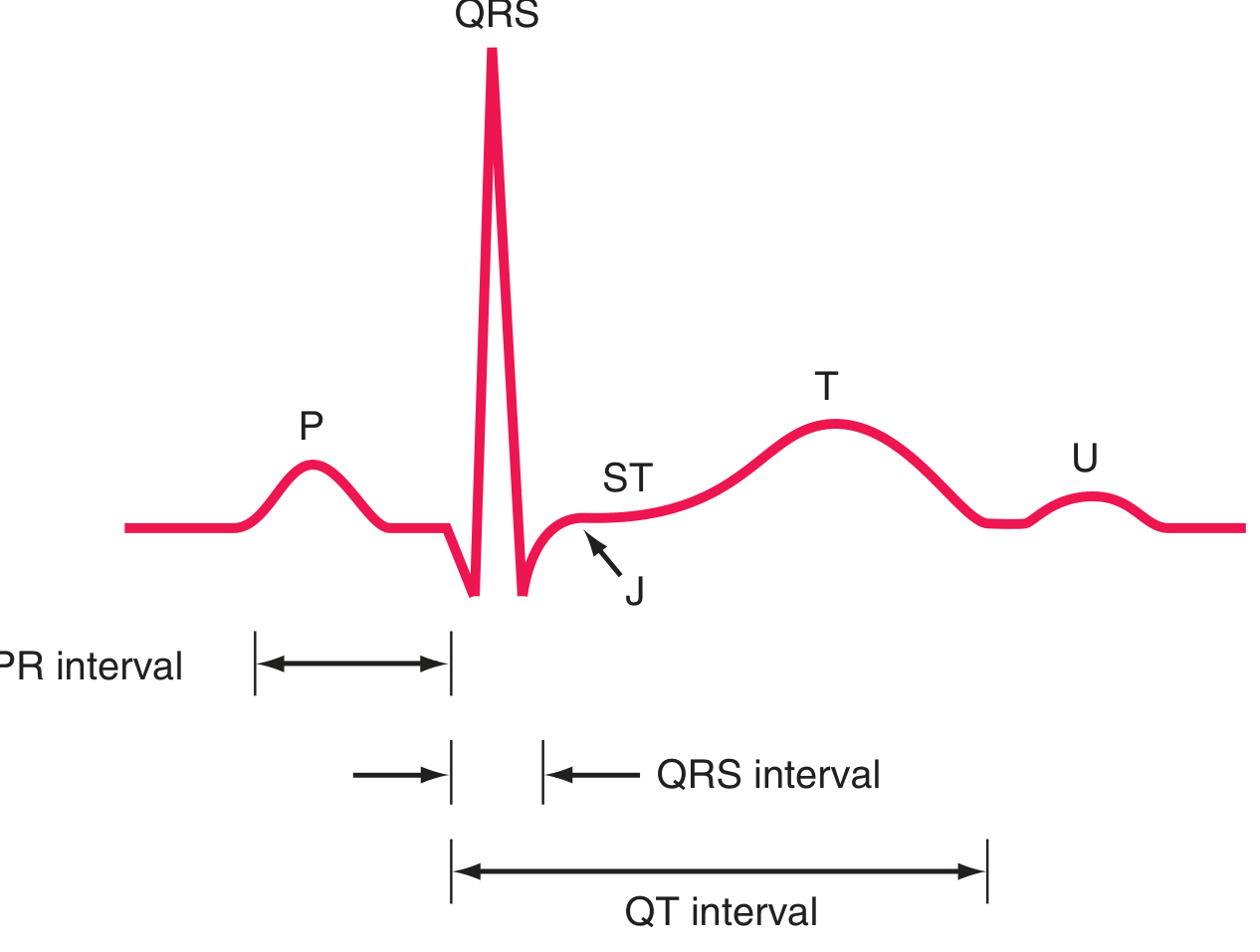
Each wave reflects a specific electrical event:
| Wave / Complex | Electrical Event |
|---|---|
| P wave | Atrial depolarization |
| QRS complex | Ventricular depolarization |
| ST segment | Ventricular plateau (isoelectric) |
| T wave | Ventricular repolarization |
| U wave | Thought to reflect repolarization of Purkinje fibers (small, often absent) |
| J point | Junction between end of QRS and start of ST segment |
Atrial repolarization is not visible — it is buried within the QRS complex.
Key Intervals & Normal Values
| Interval | What It Measures | Normal Range |
|---|---|---|
| PR interval | Atrial → ventricular conduction (includes AV node delay) | 120–200 ms (3–5 small boxes) |
| QRS duration | Ventricular depolarization time | ≤100–110 ms (<2.5 small boxes) |
| QT interval | Total ventricular depolarization + repolarization | Rate-dependent; QTc ≤450 ms (men), ≤460 ms (women) |
| RR interval | Time between consecutive beats | Used to calculate heart rate |
Heart rate calculation:
- Divide 300 by the number of large boxes between two consecutive R waves
- Or count QRS complexes in a 10-second strip × 6
The 12 Leads
The 12 ECG leads view the heart from different angles:
- 6 limb leads (I, II, III, aVR, aVL, aVF) — frontal plane
- 6 chest leads (V1–V6) — horizontal plane
Each lead records a positive deflection when depolarization moves toward its positive pole, and a negative deflection when it moves away.
Systematic Approach to ECG Interpretation
Harrison's recommends analyzing 14 parameters in every ECG:
- Standardization / calibration — Is the paper speed 25 mm/s? Is 1 mV = 10 mm?
- Rhythm — Sinus vs. non-sinus; regular vs. irregular
- Heart rate — Bradycardia (<60 bpm) or tachycardia (>100 bpm)?
- PR interval — Prolonged (heart block) or short (pre-excitation)?
- QRS duration — Wide (bundle branch block, ventricular origin) or narrow?
- QT/QTc interval — Prolonged = risk of torsades de pointes
- Mean QRS electrical axis — Normal, left axis deviation, right axis deviation?
- P waves — Present before every QRS? Normal morphology?
- QRS voltages — Low voltage or high voltage (hypertrophy)?
- Precordial R-wave progression — R grows V1→V6?
- Abnormal Q waves — Pathological Q waves = prior infarction?
- ST segments — Elevation or depression?
- T waves — Inversion, flattening, or peaked?
- U waves — Prominent U wave = hypokalemia?
Rhythm Assessment
| Feature | Significance |
|---|---|
| P wave before every QRS | Normal sinus rhythm |
| No P waves | Atrial fibrillation or junctional rhythm |
| Wide QRS (>100 ms) | Bundle branch block or ventricular origin |
| Narrow complex tachycardia | Supraventricular origin |
| Wide complex tachycardia | Ventricular tachycardia until proven otherwise |
Key ST/T Wave Changes
| Finding | Common Causes |
|---|---|
| ST elevation | STEMI, pericarditis, myocarditis, early repolarization, LV aneurysm, hyperkalemia |
| ST depression | Ischemia, digoxin effect |
| T-wave inversion | Ischemia, pericarditis, PE, subarachnoid hemorrhage, electrolyte disturbances |
| Peaked T waves | Hyperkalemia (earliest ECG sign), hyperacute MI |
| QT prolongation | Hypokalemia, hypomagnesemia, drugs (antipsychotics, TCAs), hypothyroidism |
ECG Grid Basics
- Small box = 40 ms (0.04 s) horizontally; 0.1 mV vertically
- Large box = 200 ms (0.20 s) horizontally; 0.5 mV vertically
- Standard speed = 25 mm/s; standard calibration = 1 mV = 10 mm
Sources: Harrison's Principles of Internal Medicine, 22E, Ch. 247 (Goldberger); Kaplan & Sadock's Comprehensive Textbook of Psychiatry, Ch. 27.2
This is a shared conversation. Sign in to Orris to start your own chat.