
Derivatives of endoderm mesoderm ectoderm mbbs 1st year notes
Reading File
Finding Sources
Finding Sources
Reading File
Reading File
Loading Image
Loading Image
Reading File
I now have comprehensive information from two authoritative embryology textbooks plus two excellent diagrams. Here are your complete MBBS 1st year notes on germ layer derivatives:
Derivatives of the Three Germ Layers — MBBS 1st Year Notes
Sources: The Developing Human: Clinically Oriented Embryology (Moore & Persaud) | Histology: A Text and Atlas (Ross & Pawlina)
The Three Primary Germ Layers
During gastrulation (week 3), the bilaminar embryonic disc becomes trilaminar by formation of three germ layers: ectoderm (outer), mesoderm (middle), endoderm (inner). All tissues and organs of the body are derived from these three layers.
Diagram of Germ Layer Derivatives
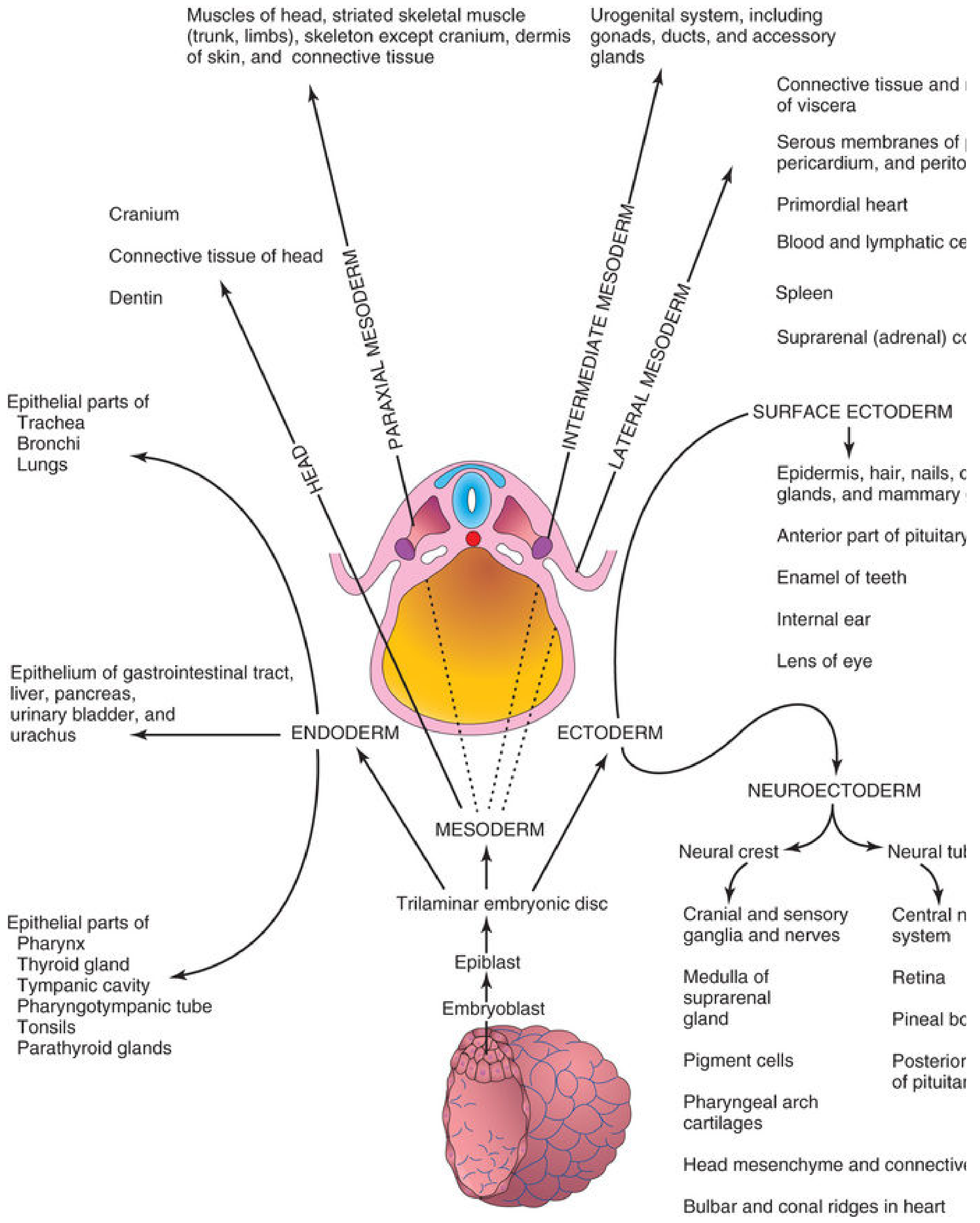
Fig. 5.5 — Schematic drawing of derivatives of the three germ layers (Moore & Persaud, The Developing Human)
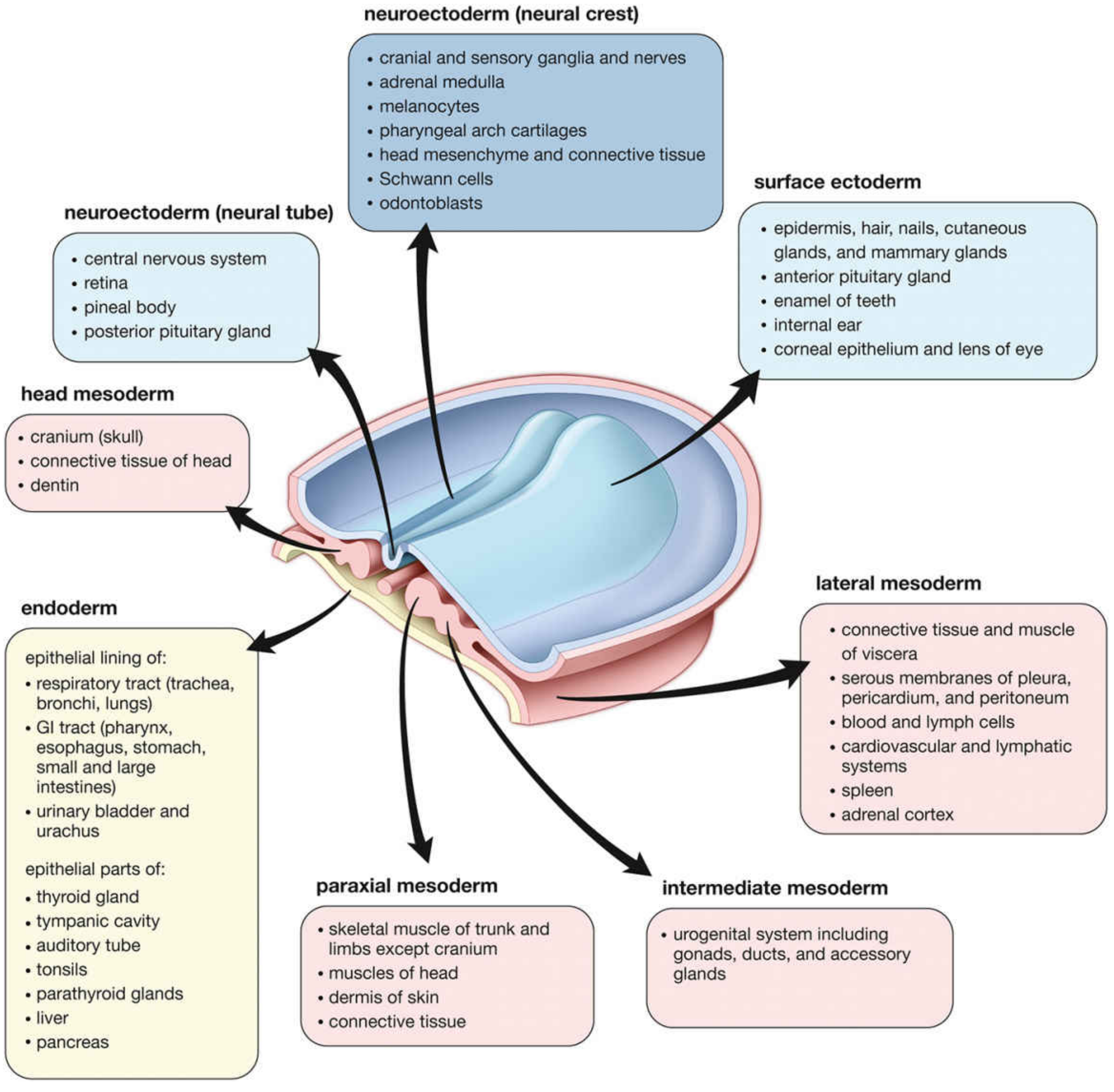
Fig. 4.5 — Detailed diagram showing subdivisions of mesoderm and ectoderm with their derivatives (Ross & Pawlina, Histology)
1. ECTODERM
Ectoderm divides into surface ectoderm and neuroectoderm (which further gives neural tube and neural crest cells).
A. Surface Ectoderm
| Structure | Derivative |
|---|---|
| Skin | Epidermis, hair, nails |
| Glands | Cutaneous (sweat, sebaceous) glands; mammary glands |
| Teeth | Enamel (dentin is from neural crest/mesoderm) |
| Eye | Corneal epithelium, lens |
| Ear | Internal ear (membranous labyrinth) |
| Pituitary | Adenohypophysis (anterior pituitary) |
| Mouth/Anus | Mucosa of oral cavity; lower part of anal canal |
B. Neuroectoderm — Neural Tube
| Structure |
|---|
| Central nervous system (brain + spinal cord) |
| Retina |
| Pineal body (gland) |
| Posterior pituitary (neurohypophysis) |
C. Neuroectoderm — Neural Crest Cells
(Migrate extensively — give rise to diverse structures)
| Structure |
|---|
| Cranial & sensory ganglia (V, VII, IX, X) + peripheral nerves |
| Autonomic ganglia |
| Schwann cells & satellite cells (PNS supporting cells) |
| Adrenal (suprarenal) medulla |
| Melanocytes / pigment cells of dermis |
| Pharyngeal arch cartilages |
| Head mesenchyme & connective tissue |
| Odontoblasts (dentin-forming cells) |
| Bulbar and conal ridges of the heart |
| Meninges of brain and spinal cord |
High-yield: Adrenal medulla = neuroectoderm (neural crest). Adrenal cortex = mesoderm.
2. MESODERM
Mesoderm is subdivided into paraxial, intermediate, and lateral mesoderm plus head mesoderm.
A. Paraxial Mesoderm (Somites)
| Structure |
|---|
| Skeletal muscles of trunk and limbs |
| Muscles of head |
| Dermis of skin |
| Connective tissue (general) |
B. Intermediate Mesoderm
| Structure |
|---|
| Urogenital system: kidneys, gonads (ovaries & testes), genital ducts, accessory glands |
C. Lateral Mesoderm
| Structure |
|---|
| Connective tissue and smooth muscle of viscera |
| Serous membranes: pleura, pericardium, peritoneum (mesothelium lining body cavities) |
| Blood and lymph cells; cardiovascular & lymphatic systems |
| Primordial heart |
| Spleen |
| Adrenal (suprarenal) cortex |
D. Head Mesoderm
| Structure |
|---|
| Cranium (skull bones) |
| Connective tissue of head |
| Dentin (along with neural crest contribution) |
Summary of mesoderm derivatives: Connective tissue, cartilage, bone, striated & smooth muscle, heart, blood & lymphatic vessels, kidneys, gonads, genital ducts, serous membranes, spleen, adrenal cortex.
3. ENDODERM
Endoderm is the innermost layer. It lines the primitive gut tube and gives rise to the epithelial linings and parenchyma of organs derived from it.
Epithelial Lining of Gut & Derivatives
| Structure |
|---|
| Entire alimentary canal epithelium (except oral cavity & lower anal canal — those are ectoderm) |
| Liver parenchyma |
| Pancreas |
| Gallbladder |
| Epithelium of urinary bladder and most of urethra (including urachus) |
Epithelium of Respiratory Tract
| Structure |
|---|
| Trachea, bronchi, and lungs |
Pharyngeal Pouch Derivatives
| Structure |
|---|
| Thyroid gland (epithelial component) |
| Parathyroid glands |
| Thymus |
| Tonsils (parenchyma) |
| Tympanic cavity lining |
| Pharyngotympanic (Eustachian / auditory) tube lining |
Quick High-Yield Summary Table
| Germ Layer | Key Derivatives | Common Exam Points |
|---|---|---|
| Surface Ectoderm | Skin, hair, nails, lens, cornea, enamel, anterior pituitary, internal ear | Anterior pituitary = ectoderm (Rathke's pouch) |
| Neuroectoderm (Neural Tube) | CNS, retina, posterior pituitary, pineal | |
| Neural Crest | PNS ganglia, adrenal medulla, melanocytes, pharyngeal cartilages, Schwann cells | Adrenal medulla = neural crest (NOT mesoderm) |
| Paraxial Mesoderm | Skeletal muscle (trunk/limbs), dermis | |
| Intermediate Mesoderm | Kidneys, gonads, genital ducts | |
| Lateral Mesoderm | Heart, blood vessels, serous membranes, adrenal cortex, spleen | Adrenal cortex = mesoderm |
| Endoderm | GI tract lining, liver, pancreas, thyroid, parathyroid, thymus, lungs, urinary bladder | Oral cavity & lower anal canal = ectoderm (exception!) |
Classic Exam Traps
| Structure | Origin | Why tricky? |
|---|---|---|
| Adrenal medulla | Neural crest (ectoderm) | Rest of adrenal = mesoderm |
| Enamel of teeth | Surface ectoderm | Dentin = neural crest/mesoderm |
| Anterior pituitary | Surface ectoderm (Rathke's pouch) | Posterior pituitary = neuroectoderm |
| Oral cavity mucosa | Surface ectoderm | Rest of GI = endoderm |
| Lower anal canal | Surface ectoderm | Rest of anal canal = endoderm |
| Spleen | Lateral mesoderm | Often mistaken for endoderm |
| Liver / Pancreas | Endoderm | Only epithelial component; supporting stroma = mesoderm |
| Retina | Neuroectoderm (neural tube) | Lens = surface ectoderm |
— The Developing Human: Clinically Oriented Embryology (Moore & Persaud), pp. 246–249 | Histology: A Text and Atlas (Ross & Pawlina), pp. 309–316
This is a shared conversation. Sign in to Orris to start your own chat.