
Scabies from standard textbook
Reading File
Now let me search for scabies in the medical library:
Finding Sources
Searching PubMed
scabies treatment management
The best sources are Fitzpatrick's Dermatology and Rosen's Emergency Medicine. Let me read those comprehensively in parallel:
Reading File
Reading File
Excellent content so far. Let me now read more of Fitzpatrick's (the primary dermatology textbook) for the full clinical picture:
Reading File
Reading File
Now let me get the key sections from Fitzpatrick's that I haven't read yet - the clinical features, diagnosis, and treatment sections:
Reading File
I now have comprehensive content. Let me also fetch the key clinical images from Fitzpatrick's:
Loading Image
Loading Image
Reading File
Now let me fetch the remaining key images and the rest of the clinical/treatment section:
Loading Image
Loading Image
Loading Image
Reading File
I now have comprehensive content from Fitzpatrick's Dermatology and Rosen's Emergency Medicine. Let me compile the full answer:
Scabies
Sources: Fitzpatrick's Dermatology (8e), Rosen's Emergency Medicine, Goldman-Cecil Medicine
At a Glance
- Human infestation by Sarcoptes scabiei var. hominis - a mite that completes its entire life cycle within the epidermis
- Causes a diffuse, pruritic eruption after an incubation period of 4 to 6 weeks
- Transmitted by close physical contact or fomites
- First-line treatment: permethrin 5% cream (topical) or oral ivermectin
- All household members and close contacts must be treated simultaneously
Epidemiology
Scabies is a worldwide problem affecting all ages, races, and socioeconomic groups. Over 100 million persons are affected annually. Prevalence in some underdeveloped countries ranges from 4% to 100%. It occurs more commonly in winter months. Transmission is primarily by close personal contact - though once classified as an STI, its equally high prevalence in children confirms that non-sexual close contact is sufficient. Fomite transmission is best documented with crusted scabies - 6000 mites/g of debris have been detected from sheets, floors, and furniture.
An infested host usually harbors 3 to 50 mites (normal scabies), but immunocompromised patients (HIV, leprosy, paraplegics) with crusted scabies can harbor millions of mites with minimal pruritus. Infants and the elderly may harbor 50-250 mites.
Etiology and Pathogenesis
Sarcoptes scabiei var. hominis - family Sarcoptidae, class Arachnida.
Mite characteristics:
- Pearl-like, translucent, white, eyeless, oval shape with 4 pairs of short stubby legs
- Adult female: 0.4 × 0.3 mm (just too small to see with the naked eye); male is slightly smaller
- Cannot fly or jump
- Survives 3 days off host in a sterile environment; 7 days in mineral oil
Life cycle (entirely on human skin):
- The female mite excavates a sloping burrow of 0.5-5 mm/day in the stratum corneum to the stratum granulosum boundary
- She lays 0-4 eggs/day, up to 50 eggs over her 30-day lifespan; the burrow can reach 1 cm
- Eggs hatch in 10-12 days; larvae leave the burrow to mature on the skin surface
- Larvae molt to nymphs, which survive only 2-5 days off the host
- The male lives on the skin surface and enters burrows to mate
Clinical Features
Symptoms
- Intense nocturnal pruritus - the hallmark symptom
- Onset typically 4-6 weeks after first infestation (may be delayed up to 3 months); with reinfestation, symptoms appear within 2-3 days
- Some individuals remain asymptomatic "carriers" despite being infested
Classic Distribution (adults)
- Interdigital webs, sides of fingers
- Volar wrists and lateral palms
- Elbows, axillae
- Scrotum, penis, labia, areolae in women
- Subungual skin
- Head and neck spared in healthy adults
Distribution in special populations
- Infants and young children: generalized involvement including face, scalp, palms, and soles
- Crusted (Norwegian) scabies: hyperkeratotic plaques on palms and soles, dystrophy of nails
Lesions
- Small (<5 mm) papules or pustules, often with excoriations
- Indurated crusted nodules in infants (intertriginous areas and trunk)
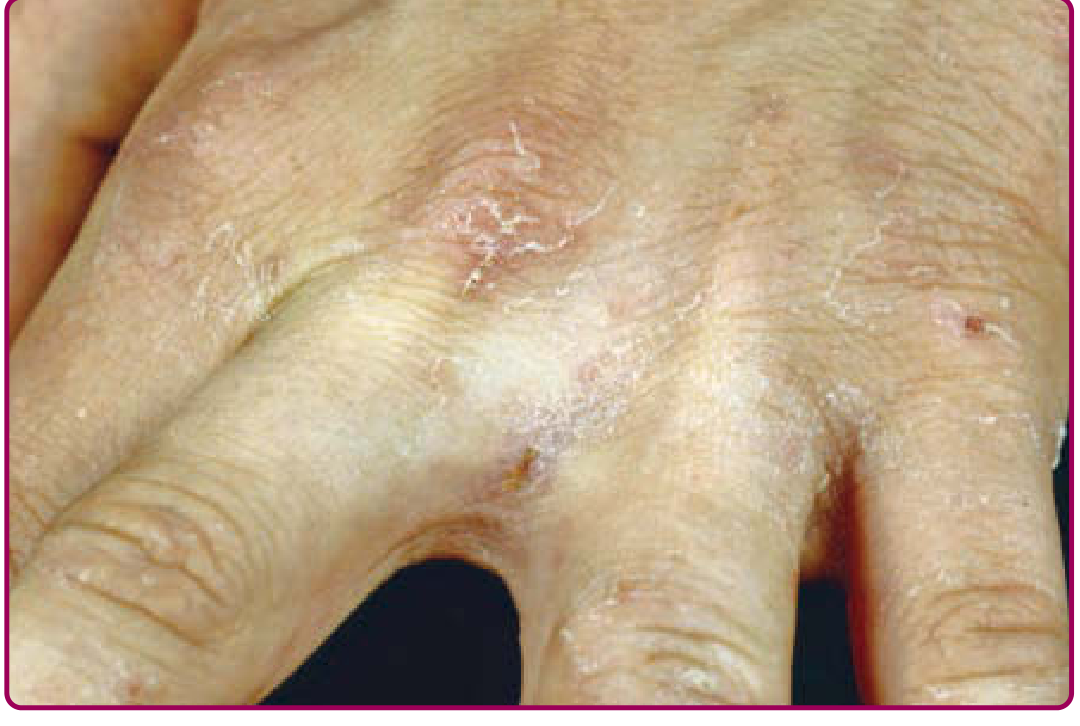
- Burrows - the pathognomonic lesion
The Pathognomonic Burrow
The burrow is a thin, thread-like, linear, or J-shaped/S-shaped tunnel in the stratum corneum, 1-10 mm in length. Best seen in interdigital webs and wrists. Can be difficult to find in early stages or after extensive excoriation.
Visualization tip: Rub a black felt-tip marker over the area, then wipe with an alcohol pad - the burrow retains ink and appears darker than surrounding skin.
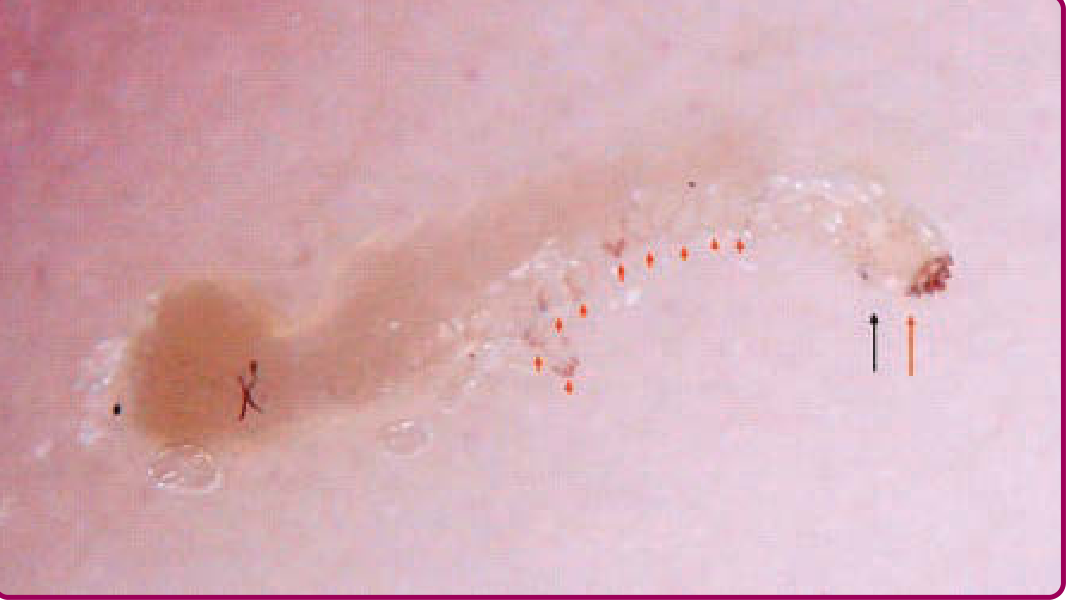
Dermoscopy reveals the "triangle" or "delta-wing jet" sign (the dense mite head parts at the forward end of the burrow):
Crusted (Norwegian) Scabies
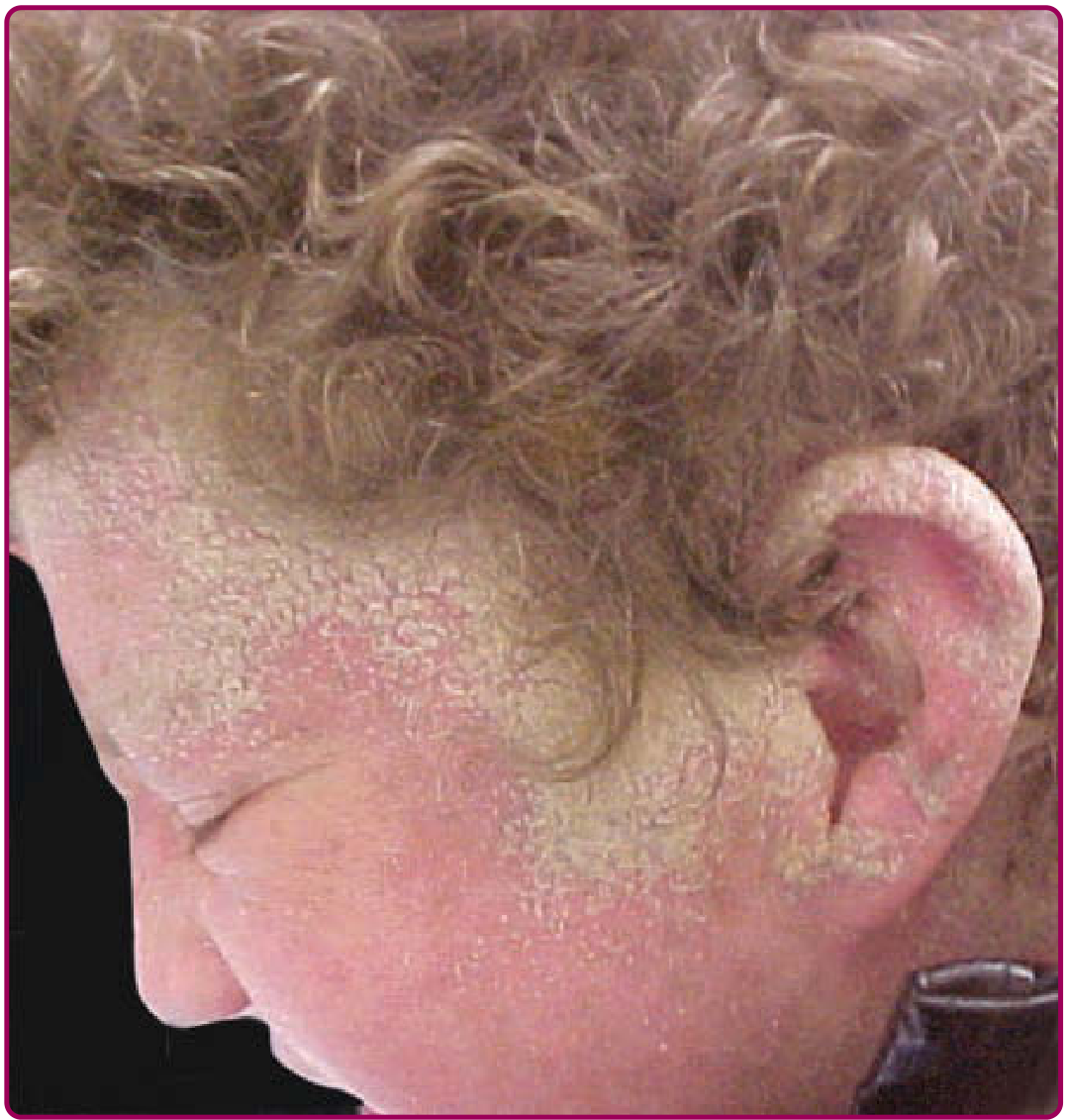
- Hyperkeratotic plaques on palmar and plantar regions
- Thickening and dystrophy of fingernails and toenails
- Host may harbor thousands to millions of mites but symptoms are minimal or absent
- Notoriously contagious - anyone in the general vicinity is at risk
- Risk groups: HIV infection, leprosy, paraplegia, elderly, dementia, neuropathy
Diagnosis
Clinical diagnosis based on history (nocturnal pruritus, contact history) + characteristic distribution.
Definitive diagnosis = microscopic identification of mites, eggs, or fecal pellets (scybala):
Technique:
- Place a drop of mineral oil over a burrow
- Scrape longitudinally with a #15 scalpel blade along the burrow length (avoid causing bleeding)
- Best sites: unexcoriated burrow, papule, or vesicle
- Apply scrapings to a glass slide and examine under low-power microscopy
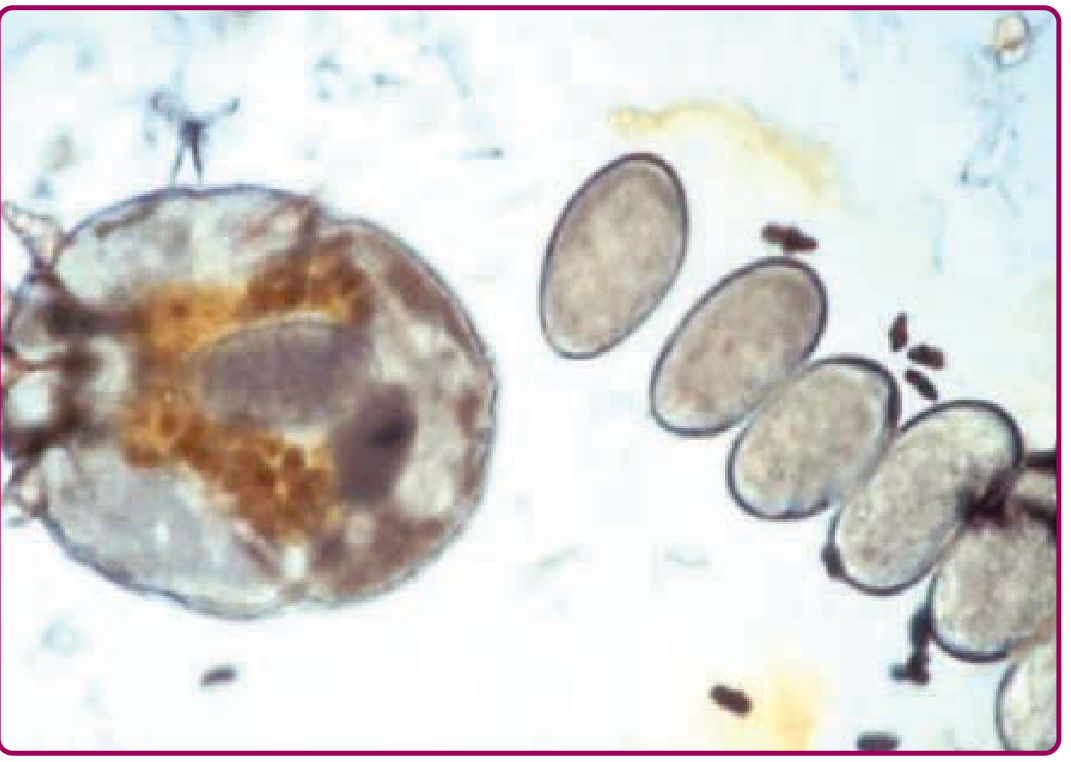
Skin biopsy can be diagnostic if the mite is transected in the stratum corneum (though not routinely done).
No serologic tests for human scabies exist. In practice, diagnosis is often based on clinical impression and confirmed by response to treatment.
Differential Diagnosis
| Category | Conditions |
|---|---|
| Most Likely | Atopic dermatitis, dyshidrotic eczema, pyoderma, contact dermatitis, insect bite reaction, id reaction, varicella, miliaria |
| Consider | Dermatitis herpetiformis, lichen planus |
| Also consider | Pityriasis rosea, papular urticaria, secondary syphilis, folliculitis, seborrheic dermatitis, psoriasis |
Complications
- Secondary impetiginization (pyoderma)
- Poststreptococcal glomerulonephritis - from scabies-induced pyoderma by Streptococcus pyogenes
- Lymphangitis and septicemia - reported in crusted scabies
- Bullous pemphigoid - scabies infestation can trigger this autoimmune blistering disorder
Treatment
Treatment combines a scabicide + fomite control. Two applications (1 week apart) are required to kill nymphs that hatched after initial treatment.
First-Line Treatments
| Agent | Details |
|---|---|
| Permethrin 5% cream (topical) | Apply from neck down (face and scalp in infants/children); special attention to finger/toe creases, cleft of buttocks, umbilicus, under nails; leave on overnight (8-12 hours), then wash off; repeat in 1-2 weeks |
| Oral ivermectin | 200 μg/kg given twice, 1 week apart; FDA-approved for onchocerciasis/strongyloides; off-label for scabies; success ~100% when entire household treated |
Other Agents
| Agent | Notes |
|---|---|
| 5-10% sulfur | Inexpensive, messy, malodorous, can cause irritant dermatitis; considered safest for neonates and pregnant females |
| Crotamiton | Considerably less effective than all other options |
Special Populations
- Pregnant/breastfeeding/children <2 years: Limit permethrin application to 2 hours only (2 applications, 1 week apart)
- Children <15 kg or pregnant/lactating: Ivermectin NOT recommended (blood-brain barrier not fully developed in young children; drug acts on glutamate/GABA nerve synapses)
- Crusted scabies: Combination of oral ivermectin + topical scabicide (oral alone won't penetrate the thick keratinous debris under nails)
Post-treatment Expectations
- Most patients experience symptom relief within 3 days
- Rash and pruritus may persist up to 4 weeks after adequate treatment - this is called "postscabetic itch" and does not indicate treatment failure
Prevention and Fomite Control
- Treat all family members and close contacts simultaneously (to prevent reinfestation from asymptomatic carriers)
- After treatment, wear clean clothing; wash all clothing, pillowcases, towels, and bedding used in the previous week in hot water and dry at high heat
- Non-washables: dry-clean, iron, put in dryer without washing, or seal in a plastic bag in a warm area for 2 weeks
- Vacuum floors, carpets, upholstery (home and car), furniture
- Fumigation of living spaces is NOT recommended
- Pets do NOT need treatment (they do not harbor the human scabies mite)
- Fitzpatrick's Dermatology (8e), Chapter 178, pp. 3303-3307
- Rosen's Emergency Medicine, Chapter 107, pp. 2411-2412
- Goldman-Cecil Medicine
This is a shared conversation. Sign in to Orris to start your own chat.