
Explain pellegra in detail
Reading File
Now I'll search the medical library in parallel for comprehensive information on pellagra.
Finding Sources
Finding Sources
Searching PubMed
pellagra niacin deficiency
Excellent sources found. Now I'll read the key sections in parallel from multiple textbooks.
Reading File
Reading File
Reading File
Reading File
Now let me get the remaining content from Andrews' (diagnosis/treatment), Bradley's (neurology), and Harrison's, plus grab the clinical image.
Reading File
Reading File
Reading File
Loading Image
I now have comprehensive information from multiple authoritative textbooks. Let me compile the detailed answer.
Pellagra
Pellagra (from the Italian pelle agra, meaning "rough skin") is a systemic nutritional disease caused by deficiency of niacin (vitamin B3/nicotinic acid) or its amino acid precursor tryptophan. It is classically defined by the triad of Dermatitis, Diarrhea, and Dementia — the "Three Ds" — and is fatal if untreated.
Biochemistry & Pathophysiology
Niacin is the precursor to two critical coenzymes in carbohydrate (and broader cellular) metabolism:
- NAD (nicotinamide adenine dinucleotide)
- NADP (nicotinamide adenine dinucleotide phosphate)
These coenzymes are essential for hundreds of oxidation-reduction reactions throughout the body. When niacin is unavailable, cellular energy metabolism is severely compromised, particularly in rapidly dividing cells (gut epithelium, skin) and metabolically active neurons.
The tryptophan → niacin pathway is central: 60 mg of tryptophan yields approximately 1 mg of nicotinic acid, a conversion that requires pyridoxine (vitamin B6) as a cofactor. Concurrent deficiency of riboflavin or pyridoxine, both required for this synthesis, can precipitate pellagra even when dietary tryptophan intake seems adequate.
Harper's Illustrated Biochemistry, 32nd Ed.
Etiology & Risk Factors
Primary (Dietary)
- Diets predominantly based on corn (maize), millet, or sorghum — corn is low in both tryptophan and niacin, and much of its niacin is in bound form (niacytin), which is not bioavailable
- Pellagra can develop within 60 days of dietary niacin deficiency
- Historically endemic in the American South (early 1900s) and remains common in parts of Asia and Africa where corn is the dietary staple
Secondary (Disease/Malabsorption)
- Alcoholism — the most common cause in developed countries (impaired absorption and intake)
- Carcinoid tumors — divert tryptophan toward serotonin (5-HT) synthesis, accounting for up to 60% of tryptophan metabolism; depriving NAD synthesis
- Hartnup disease — autosomal recessive defect in the neutral amino acid transporter, causing intestinal malabsorption and renal wasting of tryptophan
- GI disorders: Crohn disease, celiac disease, gastroenterostomy, chronic colitis, jejunoileitis, prolonged diarrhea
- Prolonged IV nutritional support without adequate vitamins
- Anorexia nervosa and other restrictive eating disorders
Drug-Induced
Several medications interfere with niacin biosynthesis:
| Drug | Mechanism |
|---|---|
| Isoniazid (INH) | Competes with pyridoxal phosphate; impairs tryptophan → niacin conversion |
| Azathioprine / 6-mercaptopurine | Interfere with niacin biosynthesis |
| 5-Fluorouracil | Inhibits niacin metabolism |
| Ethionamide / Pyrazinamide / Protionamide | Similar mechanism to isoniazid |
| Anticonvulsants (phenytoin, phenobarbital, carbamazepine) | Rarely, dose-dependent pellagra |
Andrews' Diseases of the Skin; Bradley and Daroff's Neurology in Clinical Practice
Clinical Features
The "Three Ds"
1. Dermatitis
The most characteristic and often earliest feature. Key aspects:
-
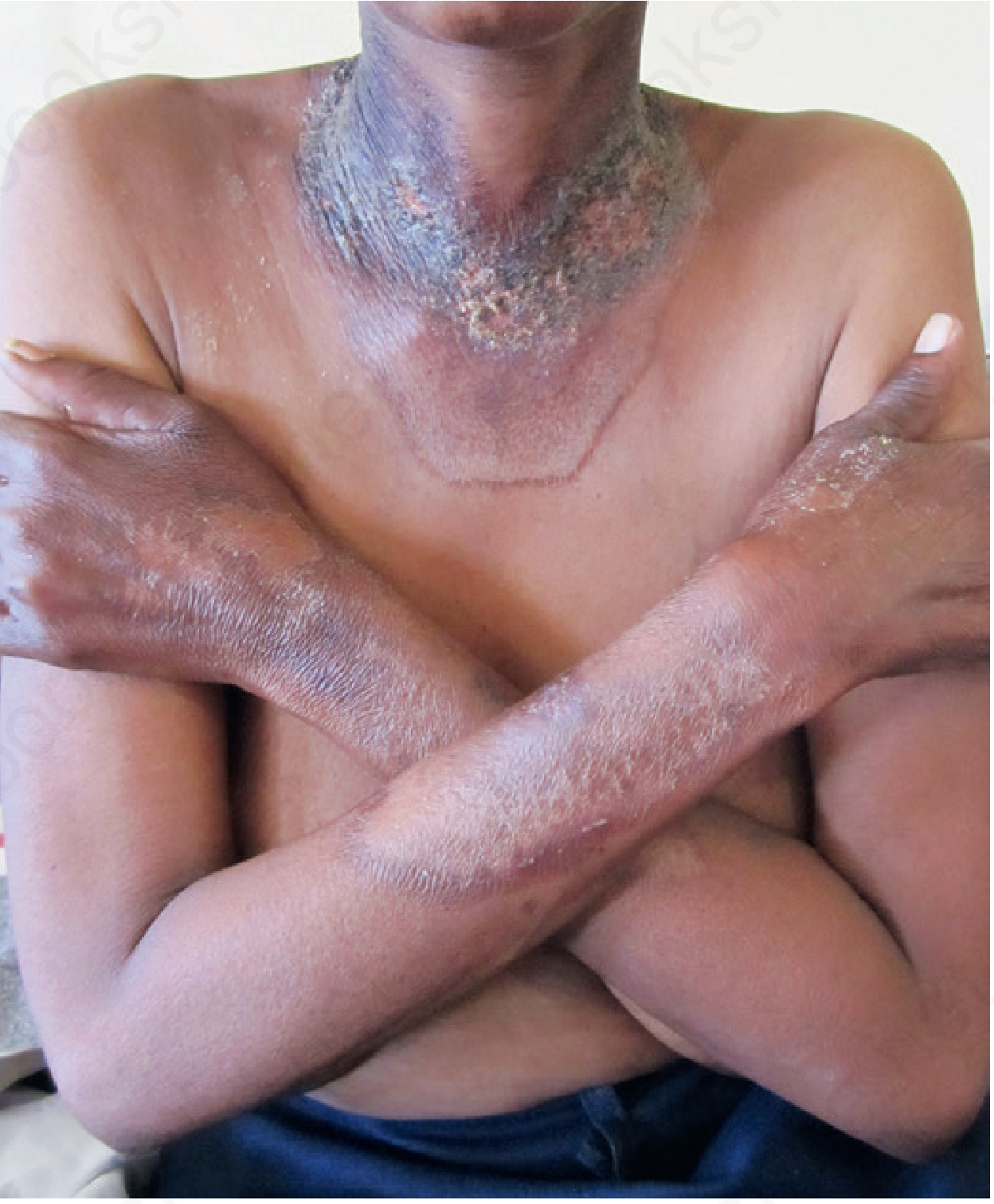
Photosensitive eruption that worsens in spring/summer, distributed symmetrically on sun-exposed areas:
- Face, neck ("Casal necklace" — a collar-like band across the lower neck and upper chest)
- Dorsal hands and extensor forearms
- Tops of feet
-
Stages of skin change:
- Acute: Erythema, swelling, burning/itching after sun exposure — mimics sunburn but takes ~4× longer to recover
- Wet pellagra (severe): Vesicular or bullous eruption
- Chronic: Thickening, scaling, hyperpigmentation (copper/mahogany hue)
- Late: Dry, smooth, paper-thin, parchment-like skin; ultimately glassy in texture
-
Nasal changes: Dull erythema of the bridge with fine yellow powdery scales ("sulfur flakes") over follicular orifices; dilated pores with inspissated sebum — resembles seborrheic dermatitis but by location
2. Diarrhea (GI tract)
- Anorexia, abdominal pain, nausea
- Watery diarrhea — may be bloody
- Stomatitis, glossitis (bright red "beefy" tongue), cheilitis
- Fluid and electrolyte imbalance
3. Dementia / Neuropsychiatric
The neurologic syndrome evolves in stages:
Early:
- Insomnia, fatigue, irritability, nervousness
- Mental dullness, apathy, mild memory impairment
- Depression — may resemble neurasthenia or a primary psychiatric disorder
Intermediate:
- Acute confusional psychosis
- Hallucinations, delusions (including delusions of parasitosis)
- Paresthesias, muscle weakness, headaches, dizziness
Late/Severe:
- Spasticity, Babinski sign, gegenhalten (paratonia), startle myoclonus
- Seizures, stupor, coma
- Progressive dementia
Adams and Victor's Principles of Neurology; Bradley and Daroff's Neurology
A fourth D — Death — is classically appended: untreated pellagra is fatal.
Neuropathology
The neuropathologic changes in pellagra are distinctive:
- Neuronal chromatolysis: Betz cells (large motor cortex neurons), basal ganglia cells, cranial motor nuclei, cerebellar dentate nuclei, and anterior horn cells become swollen and rounded with eccentric nuclei and loss of Nissl bodies — similar to a retrograde axonal injury pattern
- Spinal cord: Symmetrical degeneration of the dorsal columns (especially the columns of Goll/gracilis) and, to a lesser extent, the corticospinal tracts — closely resembles subacute combined degeneration (SCD) of vitamin B12 deficiency
- Peripheral nerves: Axonal degeneration resembling that of nutritional beriberi
The condition may be underrecognized; a postmortem study found pellagra-like encephalopathy in 5 of 59 patients thought to have Creutzfeldt-Jakob disease.
Adams and Victor's Principles of Neurology; Bradley and Daroff's Neurology
Histopathology of Skin
- Pallor and vacuolar changes of keratinocytes in the upper stratum malpighii (just below the granular layer)
- Attenuation or loss of the granular layer
- In severe ("wet") pellagra: intraepidermal cleft formation (explaining vesiculation)
- Depletion of Langerhans cells in lesional skin — a distinctive and relatively specific finding
Andrews' Diseases of the Skin
Diagnosis
Pellagra is primarily a clinical diagnosis. No reliable blood test for niacin levels is widely available.
Clinical clues:
- Characteristic photodistributed dermatitis + GI + neuropsychiatric symptoms
- History of corn-based diet, alcoholism, relevant drugs, or malabsorptive disease
- Therapeutic response is diagnostic: skin lesions begin to resolve within 24 hours of niacin supplementation
Laboratory support:
- Measurement of urinary N-methylnicotinamide (a niacin metabolite) — reduced in deficiency, though not universally available
- Rule out other nutritional deficiencies (B12, thiamine) that may coexist
Treatment
| Intervention | Details |
|---|---|
| Nicotinamide (preferred) | 100 mg orally three times daily for several weeks; nicotinamide lacks the vasodilatory/flushing side effects of niacin |
| Nicotinic acid (niacin) | 50 mg orally several times/day; 25 mg IM/IV 2–3×/day if GI absorption impaired |
| Harrison's dose range | 40–250 mg/day |
| Diet correction | Animal proteins, eggs, milk, vegetables; correct underlying nutritional deficit |
| Fluid/electrolyte replacement | For diarrhea-related losses |
| Treat underlying cause | Alcohol cessation, address drug interactions, treat malabsorption |
- Skin response is often dramatic — improvement within 24 hours confirms the diagnosis
- Neurologic recovery may take longer and is not always complete in advanced cases
- Excess niacin (>500 mg/day of nicotinamide, or 1–6 g/day of nicotinic acid for hyperlipidemia) causes hepatotoxicity and flushing
Andrews' Diseases of the Skin; Bradley and Daroff's Neurology; Harrison's Principles of Internal Medicine 22E (2025)
Epidemiology
- Historical: Epidemic in the U.S. South in the early 20th century; largely eradicated after mandatory niacin enrichment of bread flour (~1940)
- Current burden: Remains a problem in sub-Saharan Africa, South Asia, and among displaced populations (refugees) on corn-dominant diets
- Sex: Twice as many women as men are affected in endemic areas — likely due to inhibition of tryptophan metabolism by estrogen metabolites
- Developed world: Confined almost entirely to alcoholics, institutionalized patients, and those on implicated drug regimens
Key Associations Summary
| Feature | Details |
|---|---|
| Deficient nutrient | Niacin (B3) / Tryptophan |
| Classic dietary cause | Corn-based diet |
| Mnemonic | 3 Ds: Dermatitis, Diarrhea, Dementia (+ Death if untreated) |
| Skin sign | Casal necklace (photodistributed collar rash) |
| Key drug causes | Isoniazid, azathioprine, 5-FU |
| Key disease associations | Carcinoid, Hartnup disease, alcoholism |
| Treatment | Nicotinamide 100 mg TID |
| Response to treatment | Skin improves within 24 hours |
Sources: Andrews' Diseases of the Skin; Fitzpatrick's Dermatology; Adams and Victor's Principles of Neurology 12th Ed.; Bradley and Daroff's Neurology in Clinical Practice; Harrison's Principles of Internal Medicine 22E (2025); Harper's Illustrated Biochemistry 32nd Ed.
This is a shared conversation. Sign in to Orris to start your own chat.