
Hernia
Reading File
"Hernia" is a broad topic. Let me clarify what you need before diving in.
Asking for Preferences
What aspect of hernia are you looking for?
I'll provide a comprehensive overview of hernia covering all key aspects.
Finding Sources
Searching the Web
hernia types classification management overview 2024
Good — I have strong textbook sources. Let me now read the main hernia sections in parallel.
Reading File
Reading File
Reading File
Searching Images
hernia types anatomy diagram inguinal femoral umbilical
I have comprehensive textbook content. Let me read a bit more detail on inguinal hernia anatomy and the hiatal hernia section, then compile the full answer.
Finding Sources
Reading File
I now have excellent content from multiple surgical and GI textbooks. Let me compile the comprehensive answer.
Loading Image
Here is a comprehensive overview of hernias:
Hernia — Comprehensive Overview
Definition
A hernia is the protrusion of an organ or tissue through a defect or weakness in the wall that normally contains it. Most hernias involve abdominal contents pushing through weaknesses in the abdominal wall or peritoneum.
Anatomical Classification & Types
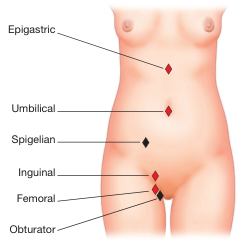
Groin Hernias
| Type | Location | Key Features |
|---|---|---|
| Indirect inguinal | Lateral to inferior epigastric vessels, through the deep inguinal ring | Most common overall; follows the processus vaginalis; more common in males |
| Direct inguinal | Medial to inferior epigastric vessels, through Hesselbach's triangle | Acquired weakness; pushes directly through the abdominal wall |
| Femoral | Below inguinal ligament, medial to femoral vein in femoral canal | More common in women; high incarceration rate (~45%) due to small, rigid neck |
| Pantaloon | Combination of direct + indirect | Straddles the inferior epigastric vessels; difficult to reduce manually |
Differentiating direct vs. indirect inguinal hernia clinically: Place the thenar eminence on the ASIS — the index finger points to a direct hernia, the middle finger to an indirect hernia. - Thieme Atlas of Anatomy
Ventral / Abdominal Wall Hernias
| Type | Location | Notes |
|---|---|---|
| Umbilical | Through the fibromuscular umbilical ring | Congenital in infants (often resolves by age 5); acquired in adults with raised intra-abdominal pressure (obesity, ascites, pregnancy) |
| Epigastric | Midline through linea alba, above umbilicus | Usually preperitoneal fat only |
| Incisional | Through a prior surgical scar | Occurs in ~20% of laparotomy patients; recurrence rate 20–50% |
| Spigelian | Through the semilunar line, lateral to rectus muscle | Intramural — often missed on examination |
| Obturator | Through obturator foramen | Rare; "little old lady" hernia; presents with medial thigh pain (Howship–Romberg sign) |
Diaphragmatic / Internal Hernias
| Type | Notes |
|---|---|
| Hiatal (sliding / Type I) | Gastro-oesophageal junction migrates above diaphragm; strongly associated with GERD |
| Paraesophageal (Type II–IV) | Gastric fundus or other organs herniate beside the oesophagus |
| Paraduodenal | Most common congenital internal hernia |
| Post-surgical internal hernia | After Roux-en-Y bypass, colectomy, or Whipple — bowel herniates through mesenteric defects |
| Congenital diaphragmatic hernia (CDH) | Bowel in thorax; neonatal emergency |
Pathophysiology
All hernias result from a combination of increased intra-abdominal pressure and a structural weakness in the containing wall. Predisposing factors include:
- Age, male sex (for inguinal)
- Obesity, chronic cough, straining, heavy lifting
- Previous surgery (incisional hernias)
- Connective tissue disorders
Clinical Spectrum — Reducible → Incarcerated → Strangulated
| State | Definition | Management |
|---|---|---|
| Reducible | Contents can be returned spontaneously or manually | Elective repair |
| Incarcerated | Contents are trapped; cannot reduce | Urgent; manual reduction may be attempted if no strangulation |
| Strangulated | Ischaemia of trapped contents (bowel/omentum) | Surgical emergency |
Strangulation risk is inversely related to the size of the hernia neck. Femoral hernias strangulate in up to 40% of cases at first presentation; incisional hernias in only ~2%. Umbilical hernias account for ~15% of emergency hernia surgery, with up to 60% showing strangulation at operation. — Sleisenger & Fordtran's GI & Liver Disease
Richter hernia: Only part of the bowel wall is trapped, so complete obstruction may be absent even with strangulation — a diagnostic trap, most often with femoral or inguinal hernias.
Hiatal Hernia & GERD
Hiatal hernia is present in 54–94% of patients with reflux oesophagitis. It promotes reflux by:
- Displacing the LES above the diaphragm → reduces basal LES pressure
- Creating a persistent acid pocket in the hernia sac
- Increasing transient LES relaxation (tLESR) frequency
- Abolishing the pressure augmentation normally provided by crural diaphragm contraction
Large (≥3 cm), non-reducible hiatal hernias are particularly prone to severe GERD and are associated with Barrett's oesophagus and oesophageal adenocarcinoma. — Sleisenger & Fordtran's GI & Liver Disease
Diagnosis
- Physical examination: visible or palpable bulge, cough impulse, reducibility
- Ultrasound: useful for groin hernias, especially in obese patients
- CT scan: gold standard for internal hernias, incarcerated hernias, and complex cases; differentiates hernia type and assesses bowel viability
- Endoscopy / barium swallow: for hiatal hernia
Management
Watchful Waiting
Acceptable for asymptomatic inguinal hernias in older or unfit patients, as annual risk of acute incarceration is low (~0.2%/year).
Surgery
Surgery is the definitive treatment. Urgency is dictated by the clinical state:
Elective repair principles:
- Tissue repair (e.g., Shouldice, Bassini): primary suture repair of the defect; higher recurrence than mesh
- Mesh repair (e.g., Lichtenstein): tension-free; gold standard for most adult inguinal hernias; significantly lower recurrence rates
- Laparoscopic approaches:
- TAPP (Transabdominal Preperitoneal): mesh placed in preperitoneal space via peritoneal flap
- TEP (Totally Extraperitoneal): mesh placed without entering peritoneal cavity
Emergency repair (incarceration/strangulation):
- Quick resuscitation, IV antibiotics, urgent OR
- Assess bowel viability; resect if non-viable
- Mesh use is controversial in contaminated fields — open tissue repair is preferred initially; mesh repair reserved for subsequent elective repair if needed. — Mulholland & Greenfield's Surgery
Pediatric Considerations
High incidence of indirect inguinal hernia in infants (due to patent processus vaginalis) — treated with high ligation without mesh. Umbilical hernias in children usually resolve spontaneously by age 5; surgery if persistent, >2 cm, or complicated.
Key Associations to Remember
| Hernia | Classic Association |
|---|---|
| Femoral | Middle-aged woman, high strangulation risk |
| Richter | Partial bowel wall trap; no complete obstruction |
| Obturator | Elderly thin woman; Howship–Romberg sign |
| Spigelian | Interparietal / intramural; easy to miss |
| Pantaloon | Direct + indirect combined |
| Hiatal | GERD, Barrett's, adenocarcinoma |
| CDH | Neonatal respiratory distress (Bochdalek most common) |
Sources: Mulholland & Greenfield's Surgery 7e; Sleisenger & Fordtran's GI & Liver Disease; Roberts & Hedges' Clinical Procedures in Emergency Medicine; Bailey & Love's Short Practice of Surgery 28e; Thieme Atlas of Anatomy; Schwartz's Principles of Surgery 11e
Explain the surgical repair techniques (mesh vs. tissue) in detail
Finding Sources
Finding Sources
Finding Sources
Finding Sources
Finding Sources
Finding Sources
Excellent hits. Now reading the key sections in parallel:
Reading File
Reading File
Reading File
Searching Images
Lichtenstein hernia mesh repair technique surgical steps
Reading File
Reading File
Searching PubMed
hernia repair mesh versus tissue recurrence chronic pain
Loading Image
Reading Article
PMID: 38963034
Reading File
Reading File
Searching Images
TEP totally extraperitoneal laparoscopic hernia repair preperitoneal space steps
Loading Image
Reading File
Here is the detailed breakdown of hernia surgical repair techniques:
Hernia Surgical Repair: Mesh vs. Tissue Techniques
Background & Historical Context
The history of hernia repair spans three eras:
- Pre-Bassini era — high mortality/morbidity; crude technique
- Tissue repair era (1880s–1980s) — Bassini (1884) transformed outcomes; subsequently refined into Shouldice and McVay repairs
- Tension-free mesh era (1989–present) — Lichtenstein's polypropylene mesh patch became the paradigm shift; laparoscopic approaches (TAPP, TEP) followed in the 1990s
"The popularization of tension-free prosthetic mesh repairs signified a paradigm shift in the surgical concept of inguinal hernia pathophysiology." — Schwartz's Principles of Surgery 11e
PART 1 — TISSUE (PURE) REPAIRS
These repairs use the patient's own anatomical layers, sutured under tension to reconstruct the inguinal floor. They are indicated when mesh cannot be used: contaminated fields, bowel strangulation/resection, or patient refusal.
1. Bassini Repair (Historic — Limited Modern Use)
Principle: Triple-layer reconstruction of the inguinal floor.
Steps:
- Incise transversalis fascia from pubic tubercle to internal ring
- Bluntly dissect preperitoneal fat from posterior transversalis fascia
- Triple-layer suture: internal oblique + transversus abdominis + transversalis fascia fixed together to the shelving edge of the inguinal ligament with interrupted sutures
- Lateral repair narrows and reinforces the medial border of the internal ring
Limitation: High recurrence because all layers are brought under tension. Largely superseded.
2. Shouldice Repair (Gold Standard Tissue Repair)
Principle: A four-layer running suture technique that distributes tension across multiple planes, reducing recurrence compared to Bassini.
Steps in detail:
- Isolate and mobilize the spermatic cord; divide the genital branch of the genitofemoral nerve (causes ipsilateral scrotal numbness)
- Incise transversalis fascia from pubic tubercle to internal ring; develop upper and lower fascial flaps
- Suture 1 (Layer 1): Iliopubic tract sutured to lateral edge of rectus sheath at pubic tubercle; continuous suture runs laterally, approximating the inferior transversalis flap to the posterior surface of the superior flap → reaches internal ring
- Suture 1 (Layer 2 — return pass): Same suture turns back medially, approximating superior transversalis flap edge to shelving edge of inguinal ligament → tied at pubic tubercle
- Suture 2 (Layer 3): Begins at internal ring, runs medially apposing internal oblique and transversus aponeuroses to the external oblique aponeurosis
- Suture 2 (Layer 4): Returns laterally through same structures, tied at internal ring
Outcomes:
- In experienced hands at specialized centres: recurrence ~1%
- Significant learning curve: recurrence drops from 9.4% → 2.5% after just 6 repetitions
- Meta-analysis (Cochrane 2012): recurrence OR 3.65 (95% CI 1.79–7.47) higher than Lichtenstein mesh — but much better than other tissue repairs
- Chronic pain, SSI, and seroma rates comparable to Lichtenstein
- Requires longer operative time and hospital stay
3. McVay (Cooper's Ligament) Repair
Principle: Sutures the conjoined tendon to Cooper's (pectineal) ligament rather than the inguinal ligament — uniquely closes both the inguinal and femoral rings.
Specific indications:
- Femoral hernia repair (only tissue repair that addresses the femoral defect)
- When prosthetic mesh is contraindicated
Key step: A relaxing incision in the anterior rectus sheath (2–4 cm vertical) is mandatory to relieve tension created by suturing to Cooper's ligament; without it, ischemic necrosis of the repair can occur.
4. Desarda Repair (Modern Tension-Free Tissue Repair)
Principle: Uses an autogenous strip of external oblique aponeurosis as a biological patch to reinforce the inguinal floor — conceptually similar to mesh but using native tissue.
Evidence: A 2019 meta-analysis of 14 RCTs found the Desarda repair had a recurrence rate ~40% higher than Lichtenstein but similar chronic pain and SSI rates. Recurrence was lower than Shouldice. Gaining traction in resource-limited settings and in patients refusing synthetic materials.
PART 2 — PROSTHETIC MESH REPAIRS (OPEN)
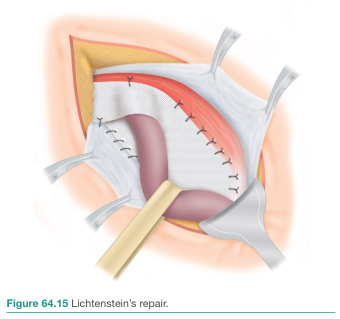
5. Lichtenstein Tension-Free Repair (Global Gold Standard)
Principle: A flat polypropylene mesh is sutured posterior to the inguinal floor, spanning the entire canal and both direct and indirect spaces — no tension on native tissue.
Detailed steps:
- Incision: 6–8 cm oblique cut inferior/medial to ASIS, extending to just lateral to symphysis pubis
- Dissection: External oblique aponeurosis opened; ilioinguinal and iliohypogastric nerves identified and preserved; cord isolated on Penrose drain
- Hernia sac: Separated from cord; high ligation of indirect sac; direct sac reduced
- Mesh preparation: "Flat iron" shaped; keyhole cut in the distal lateral edge to accommodate the spermatic cord
- Mesh fixation:
- Medial edge: overlaps pubic tubercle by ≥2 cm (avoids direct suture into periosteum — reduces osteitis/chronic pain)
- Inferior edge: running or interrupted suture to shelving edge of inguinal ligament, medial → lateral, ending past the internal ring
- Superior edge: interrupted absorbable sutures to internal oblique/conjoined tendon
- Lateral tails: wrapped around spermatic cord to fashion a new internal ring (snug but not constricting)
- Nerve care: Ilioinguinal and genital branch of genitofemoral nerve are either placed with cord structures or excluded from the repair to prevent entrapment
Key technical nuance: The mesh must be slightly domed/relaxed (not taut flat) to accommodate increased intra-abdominal pressure without tearing.
Outcomes:
- Recurrence rate in a 3,019-patient series: 0.2%
- Mesh repair vs. tissue repair: OR for recurrence = 0.37 (95% CI 0.26–0.51) — dramatically lower
- Shorter hospital stay, faster return to activities vs. tissue repairs
- European Hernia Society guidelines: preferred open technique for unilateral and bilateral inguinal hernias
6. Plug and Patch Technique (Rutkow-Robbins / Gilbert)
Principle: A 3D conical polypropylene plug fills the hernia defect first, then an onlay mesh patch covers the inguinal floor — two-component repair.
- Indirect hernia: Plug placed alongside cord through the internal ring, sutured to ring margins
- Direct hernia: Sac reduced; plug sutured to Cooper's ligament, inguinal ligament, and surrounding tissue; onlay patch placed over the floor
Caution: Meta-analysis shows equivalent outcomes to Lichtenstein, but intra-abdominal plug migration and erosion into contiguous structures occurs in ~6% of cases — this limits its use. Current guidelines prefer a flat mesh over 3D prostheses.
7. Rives-Stoppa (Preperitoneal Giant Prosthetic Reinforcement)
Principle: Large mesh placed in the preperitoneal space via a midline infraumbilical incision, spanning the entire myopectineal orifice (space of Retzius extending beyond obturator foramen). Intra-abdominal pressure holds the mesh against the wall (Pascal's principle — no fixation sutures needed).
Indications: Large, recurrent, or bilateral inguinal hernias.
Outcomes: Chronic pain and recurrence rates equivalent to Lichtenstein; longer operative time.
PART 3 — MINIMALLY INVASIVE (LAPAROSCOPIC / ROBOTIC) MESH REPAIRS
Both laparoscopic approaches place mesh in the preperitoneal space to cover all three potential defects: indirect, direct, and femoral (the myopectineal orifice of Fruchaud).
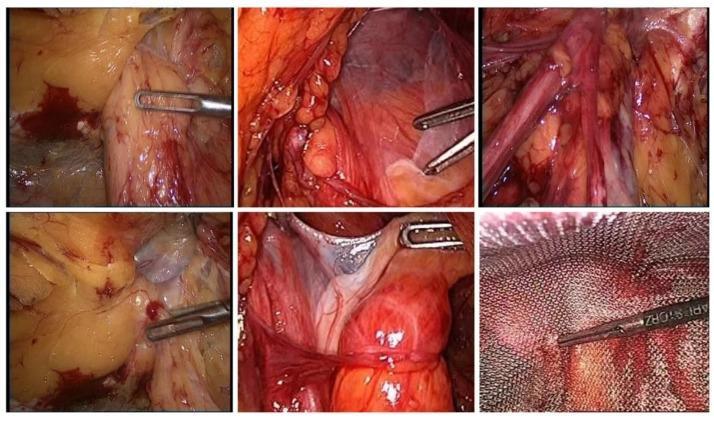
8. TAPP — Transabdominal Preperitoneal Repair
Access: Standard laparoscopy enters the peritoneal cavity.
Steps:
- Camera port at umbilicus (≥15 cm from pubis); two lateral 5-mm working ports
- Peritoneal flap raised 4–6 cm superior to hernia defect, incised to ASIS
- Dissection to achieve critical view of myopectineal orifice: identify direct space, indirect space, femoral space; Cooper's ligament; inferior epigastric vessels
- Parietalization of the spermatic cord (cord structures separated from peritoneum)
- Mesh (≥10×15 cm) placed to cover all three spaces; tacked to Cooper's ligament and abdominal wall (avoiding the "triangle of doom" — external iliac vessels — and "triangle of pain" — lateral cutaneous and genitofemoral nerves)
- Peritoneal flap closed to exclude mesh from peritoneal cavity → prevents adhesions and visceral injury
Advantages: Allows inspection of contralateral side; technically easier to learn than TEP; better ergonomics for bilateral repair.
Disadvantages: Enters peritoneal cavity → higher (theoretical) risk of visceral injury; general anaesthesia usually required.
9. TEP — Totally Extraperitoneal Repair
Access: Peritoneal cavity is never entered — entire procedure in the preperitoneal space.
Steps:
- 1–2 cm infraumbilical incision; anterior rectus sheath incised; muscle fibres spread to reveal posterior rectus sheath
- Preperitoneal space developed from umbilicus to pubic tubercle using balloon-mediated dissection (or blunt dissection)
- Hasson cannula inserted; two additional 5-mm midline ports placed inferiorly
- Dissection to critical view of myopectineal orifice; cord parietalized
- Mesh placed; preperitoneal space deflated under direct vision to confirm stable mesh positioning (no peritoneal flap closure needed)
Advantages: No peritoneal entry → lower visceral injury risk; no peritoneal closure step required; may be done under spinal anaesthesia.
Disadvantages: Steeper learning curve (surgeons need ~100 cases to plateau); limited working space; peritoneal tears can collapse the working space.
eTEP (Enhanced-View TEP): Extends the space by dividing the arcuate line, improving port ergonomics and operative field — growing in adoption.
10. Robotic-Assisted Repair (rTAPP / rTEP)
Follows the same anatomical approach as laparoscopic TAPP/TEP but with the da Vinci robotic system. Advantages: 3D visualisation, wristed instruments, improved ergonomics for the surgeon. Current evidence shows equivalent outcomes to laparoscopic approaches; cost remains higher but is decreasing with adoption.
Comparative Outcomes: Evidence Summary
| Comparison | Key Finding | Source |
|---|---|---|
| Mesh vs. tissue (open) | Mesh: OR for recurrence = 0.37 (CI 0.26–0.51); shorter stay, faster recovery | Schwartz's 11e / Cochrane |
| Shouldice vs. other tissue repairs | Shouldice: OR 0.62 (CI 0.45–0.85) — best tissue repair | Cochrane meta-analysis |
| Shouldice vs. Lichtenstein | Shouldice 3.65× higher recurrence | Cochrane 2012 |
| Lichtenstein vs. Plug & Patch | Equivalent outcomes; plug migration risk ~6% | Schwartz's 11e |
| Open vs. laparoscopic | Equivalent recurrence (5-yr); laparoscopic: less acute pain, faster return to activity, higher cost | Schwartz's 11e |
| TAPP vs. TEP | No significant difference in recurrence, chronic pain, or serious adverse events (Cochrane 2024, PMID 38963034, 23 RCTs, n=2,266); TEP has marginally faster return to work | Andresen & Rosenberg, Cochrane 2024 |
| Learning curve | Open Lichtenstein: rapid (proficient after a few cases); TEP: 30–100+ cases; VA Cooperative Study showed 10.1% vs 4.9% recurrence (laparoscopic vs open) until surgeons crossed ~250 cases | Schwartz's 11e |
Choosing the Right Approach: Decision Framework
Is the field contaminated / bowel strangulated?
  YES → Tissue repair (Shouldice or McVay); delay mesh
  NO  ↓

Is this a femoral hernia with no mesh option?
  YES → McVay repair (only tissue repair closing femoral ring)
  NO  ↓

Open or laparoscopic?
  Bilateral hernias → Laparoscopic (TAPP or TEP) strongly preferred
  Recurrent hernia (prior anterior repair) → TEP/TAPP (uses different plane)
  Recurrent hernia (prior posterior repair) → Open Lichtenstein (anterior)
  Surgeon inexperienced in laparoscopy → Open Lichtenstein
  Patient preference / fit for GA → Guide choice accordingly

Open approach → Lichtenstein (preferred) or Plug & Patch
Laparoscopic → TAPP or TEP (equivalent outcomes; surgeon preference)
Complications to Know
| Complication | Technique(s) at Risk | Notes |
|---|---|---|
| Chronic groin pain | All open; nerve entrapment in Lichtenstein | Most common long-term complaint (~10–12%); ilioinguinal, iliohypogastric, genitofemoral nerves at risk |
| Recurrence | Tissue repairs >> mesh; high if mesh <10×15 cm | Related to tension and mesh size |
| Mesh infection | All mesh repairs | Rare (~0.1%); often requires mesh removal |
| Plug migration/erosion | Plug & Patch | ~6%; can erode into bowel, bladder, vessels |
| Visceral/vascular injury | TAPP > TEP | "Triangle of doom" (iliac vessels) and "triangle of pain" (lateral nerves) during tacking |
| Seroma | All; more common with large direct defect | Usually self-limiting |
| Testicular atrophy / ischaemia | All inguinal; risk with re-do surgery | Injury to testicular artery in cord |
| Osteitis pubis | Lichtenstein if sutured directly to tubercle | Avoided by overlapping but not transfixing periosteum |
*Sources: Schwartz's Principles of Surgery 11e; Sabiston Textbook of Surgery; Current Surgical Therapy 14e; Bailey & Love's Short Practice of Surgery 28e; Andresen & Rosenberg, Cochrane Database Syst Rev 2024 (PMID 38963034)*The answer above covers all major repair techniques in depth. Here's a quick orientation to the structure:
Tissue repairs (4 techniques):
- Bassini — historic 3-layer; largely abandoned
- Shouldice — 4-layer running suture; best tissue repair; ~1% recurrence in expert hands; but 3.65× higher recurrence than mesh
- McVay — uses Cooper's ligament; uniquely repairs femoral defects; requires relaxing incision
- Desarda — autologous external oblique patch; good for mesh-free scenarios
Open mesh repairs (3 techniques):
- Lichtenstein — global gold standard; 0.2% recurrence; short learning curve; EHS-recommended
- Plug & Patch — 3D plug + flat mesh; equivalent outcomes to Lichtenstein but ~6% plug migration risk limits its use
- Rives-Stoppa — giant preperitoneal mesh; best for recurrent/bilateral/large defects
Minimally invasive repairs:
- TAPP — enters peritoneum; easier to learn; can inspect contralateral side
- TEP — stays extraperitoneal; lower visceral injury risk; steeper learning curve (~100 cases)
- eTEP / Robotic — emerging; expanding operative space; equivalent outcomes
The key clinical takeaway: mesh reduces recurrence by ~63% vs. tissue (OR 0.37). For open repair, Lichtenstein is preferred. For bilateral or recurrent hernias after prior anterior repair, laparoscopic TAPP/TEP is preferred. Tissue repair remains essential when mesh is contraindicated (contamination, strangulation).
This is a shared conversation. Sign in to Orris to start your own chat.