
Thyroiditis in detail
Reading File
Now let me search the medical library for comprehensive thyroiditis content in parallel:
Finding Sources
Searching PubMed
thyroiditis classification diagnosis treatment
Excellent sources found. Let me now read the most comprehensive ones in parallel — Harrison's, Robbins Pathology, Goldman-Cecil, and the Tietz Lab Medicine sections:
Reading File
Reading File
Reading File
Reading File
Excellent content. Let me read the remaining sections — continuing Harrison's for subacute/silent/Riedel, and the Robbins Pathology detailed sections for histology and pathogenesis, plus search for images:
Reading File
Reading File
Reading File
Searching Images
Hashimoto thyroiditis histology lymphocytic infiltration
Let me also get the Goldman-Cecil section and a subacute thyroiditis image in parallel:
Reading File
Searching Images
subacute granulomatous de Quervain thyroiditis giant cells
I now have comprehensive material from multiple authoritative sources. Let me also quickly check the Goldman-Cecil section for more on subacute thyroiditis and Riedel's, plus the Harrison's clinical data:
Reading File
Reading File
I now have comprehensive, multi-source content to write a detailed answer. Let me compose it:
Thyroiditis — A Comprehensive Overview
Thyroiditis refers to a heterogeneous group of disorders characterized by thyroid inflammation. They differ in etiology, clinical course, thyroid function changes, histology, and management.
Classification
Thyroiditis is best classified by onset/duration and presence or absence of pain (Harrison's 22e):
| Category | Subtypes |
|---|---|
| Acute | Suppurative (bacterial/fungal), Radiation, Amiodarone |
| Subacute | Viral (de Quervain), Silent (including postpartum), Drug-induced (IFN, TKIs, immune checkpoint inhibitors) |
| Chronic | Hashimoto's, Atrophic, Riedel's, Parasitic |
1. Hashimoto Thyroiditis (Chronic Lymphocytic Thyroiditis)
Epidemiology
- Most common cause of hypothyroidism in iodine-sufficient regions
- Peak incidence: 45–65 years
- Female predominance: 10:1 to 20:1
- Can affect children (major cause of non-endemic goiter in pediatrics)
- First described by Hakaru Hashimoto in 1912 (struma lymphomatosa)
Pathogenesis
A breakdown of self-tolerance to thyroid autoantigens via multiple immunological mechanisms:
- CD8+ cytotoxic T cells directly kill thyroid follicular cells
- CD4+ Th1 cells produce IFN-γ → macrophage activation → follicular damage
- Antithyroid antibodies (anti-TPO, anti-Tg): may damage follicular cells via complement-dependent or antibody-dependent cellular cytotoxicity (role as cause vs. consequence is debated)
Genetic susceptibility: Polymorphisms in CTLA4, PTPN22, and IL2RA (all regulators of T-cell responses) increase risk — same genes implicated in Graves disease.
Morphology (Histology)
- Diffuse, pale-yellow, firm, well-demarcated goiter
- Dense lymphoplasmacytic infiltrate with germinal center formation
- Thyroid follicles are atrophic
- Follicular epithelial cells undergo Hürthle (oncocytic) cell change — eosinophilic granular cytoplasm representing metaplasia under chronic injury
- Variable fibrosis

Clinical Presentation
- Initially: firm, symmetric goiter (lobulated, may mimic MNG)
- Gradually: gland atrophies → overt hypothyroidism
- Symptoms of hypothyroidism: fatigue, cold intolerance, constipation, weight gain, dry skin, bradycardia
Laboratory & Investigations
| Test | Findings |
|---|---|
| Anti-TPO antibodies | Positive in ~90% |
| Anti-Tg antibodies | Positive in 20–50% |
| TSH | Elevated (subclinical → overt hypothyroidism) |
| T4, T3 | Low in overt hypothyroidism |
| Thyroid ultrasound | Hypoechoic, heterogeneous texture; lobulated gland |
Progression: TSH rises first (subclinical hypothyroidism) → then T4 falls → T3 falls last (thyroid failure)
Complications
- Primary B-cell lymphoma of the thyroid (rare but strongly associated) — MALT or DLBCL; results from chronic B-cell stimulation
- Increased frequency of papillary thyroid carcinoma, particularly in women
- FNA biopsy needed to distinguish from lymphoma
Treatment
- Overt hypothyroidism or subclinical hypothyroidism with high antibody titers: levothyroxine (target: normalize TSH)
- TSH-suppressive doses may be used short-term to reduce goiter size
- Monitor with TSH
2. Subacute Granulomatous Thyroiditis (de Quervain / Viral / Painful Thyroiditis)
Etiology & Epidemiology
- Most common cause of painful thyroid
- Accounts for up to 5% of clinical thyroid disorders
- Incidence: 5× more common in women; peak in 4th–5th decades (Harrison: 30–50 years)
- Viral trigger (mumps, coxsackievirus, influenza, adenoviruses, echoviruses, SARS-CoV-2, post-COVID vaccine)
- Occurs seasonally coinciding with enterovirus peak
- HLA-B35 association
Pathophysiology
Viral injury → follicular rupture → granulomatous inflammation → release of preformed thyroid hormones into circulation → transient thyrotoxicosis → hormone depletion → transient hypothyroidism → recovery (euthyroidism in most)
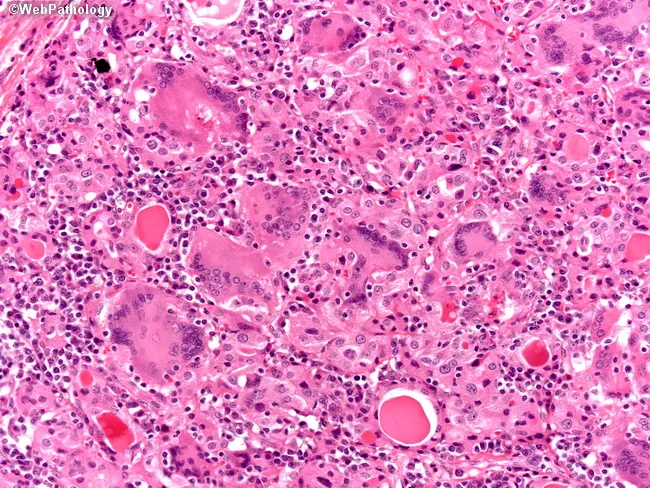
Histology
- Foreign-body giant cells surrounding disrupted follicles containing colloid
- Epithelioid histiocyte aggregates (granulomas)
- Dense lymphoplasmacytic infiltrate
- Follicular architecture disrupted; no caseous necrosis (distinguishes from TB)
Clinical Features
- Onset 2–3 weeks after upper respiratory tract infection
- Neck pain: moderate to severe, may radiate to jaw, ear, or anterior chest; may migrate from one lobe to the other
- Fever, myalgias, fatigue
- Firm, exquisitely tender thyroid on palpation
- No cervical lymphadenopathy
- ~50% have symptoms of thyrotoxicosis (palpitations, heat intolerance, tremor)
Phases
| Phase | Duration | TSH | T4/T3 | Symptoms |
|---|---|---|---|---|
| Thyrotoxic | 2–4 months | ↓ (suppressed) | ↑ (T4:T3 ratio >20) | Palpitations, heat intolerance |
| Euthyroid (transitional) | 1–2 months | Normal | Normal | Asymptomatic |
| Hypothyroid | Up to 6–9 months | ↑ | ↓ | Fatigue, cold intolerance |
| Recovery | — | Normalizes | Normalizes | Full recovery in ~95% |
The T4:T3 ratio >20 (reflecting stored hormone ratios) distinguishes from Graves disease, where T3 is preferentially elevated.
Investigations
| Test | Result |
|---|---|
| ESR | Markedly elevated (hallmark during painful phase) |
| WBC | Normal or mildly elevated |
| Anti-TPO / Anti-Tg | Usually negative (unlike Hashimoto's) |
| TRAb | Negative (distinguishes from Graves) |
| Radioactive iodine uptake (RAIU) | Low to undetectable during thyrotoxic phase |
| Ultrasound | Hypoechoic regions; decreased Doppler flow |
| Serum thyroglobulin | Elevated (early biomarker of inflammatory thyroiditis) |
Treatment
- β-blockers (e.g., atenolol 25–50 mg/day) for thyrotoxic symptoms — antithyroid drugs are contraindicated (no excess synthesis)
- NSAIDs for mild-moderate pain
- Prednisone 40–60 mg/day with slow taper over ≥4–6 weeks for severe pain (taper slowly to prevent recurrence)
- Levothyroxine if symptomatic hypothyroidism develops (weight-based if overt; low-dose if subclinical)
- Prognosis: ~95% achieve full recovery; permanent hypothyroidism in a minority
3. Silent / Painless Thyroiditis (Subacute Lymphocytic Thyroiditis)
Includes:
- Sporadic silent thyroiditis — occurs outside pregnancy
- Postpartum thyroiditis — occurs within 12 months of delivery
Epidemiology
- Postpartum thyroiditis: 4–10% of pregnancies
- In women TPO-antibody positive in first trimester: 50% develop postpartum thyroiditis
- Sporadic: age 30–60 years; 1.5× more frequent in women
- Postpartum incidence ~20× higher than Graves disease postpartum
Pathophysiology
- Autoimmune destruction; similar to Hashimoto's but transient
- HLA haplotype associations
- Lymphocyte and complement-mediated damage
- Release of preformed hormones → destruction-induced thyrotoxicosis
Clinical Patterns (Postpartum)
- ~20%: triphasic — thyrotoxicosis → euthyroid → hypothyroidism
- ~50%: isolated hypothyroidism only
- ~30%: isolated thyrotoxicosis only
- Thyrotoxic phase: usually mild, relatively asymptomatic; nontender goiter
- Toxic phase: 1–3 months; hypothyroid phase: up to 1 year
Key Differentiating Features from Graves Disease
| Feature | Silent/Postpartum Thyroiditis | Graves Disease |
|---|---|---|
| Pain | None | None |
| TRAb | Negative | Positive |
| T3:T4 ratio | Low (<20) | High (T3 dominant) |
| RAIU | Low | High |
| Color Doppler | Decreased flow | Markedly increased flow |
| Exophthalmos/bruit | Absent | May be present |
| Anti-TPO | Usually positive | Sometimes positive |
Treatment
- Thyrotoxic phase: β-blockers if symptomatic; antithyroid drugs contraindicated
- Hypothyroid phase: Levothyroxine if TSH >10 mIU/L or symptomatic
- Long-term risk: up to 30–50% of women remain hypothyroid at 1 year; annual TSH monitoring recommended
- Associated conditions: Graves disease, type 1 diabetes, SLE, chronic viral hepatitis
4. Acute (Suppurative) Thyroiditis
Etiology
- Rare; bacterial, fungal, or parasitic infection of the thyroid
- Common pathogens: Staphylococcus, Streptococcus, Enterobacter, Aspergillus, Candida, Histoplasma, Pneumocystis
- In children/young adults: piriform sinus fistula (remnant of 4th branchial pouch, predominantly left-sided)
- In elderly: pre-existing goiter, malignancy degeneration
Clinical Features
- Thyroid pain radiating to throat or ears
- Fever, dysphagia, erythema overlying the thyroid
- Small, tender, possibly asymmetric goiter
- Systemic febrile illness, lymphadenopathy
- Thyroid function usually normal
Investigations
- ESR and WBC elevated
- FNA biopsy: PMN infiltration; culture identifies organism
- CT/ultrasound: to localize abscess
Complications
- Tracheal obstruction, septicemia, retropharyngeal abscess, mediastinitis, jugular venous thrombosis
Treatment
- Antibiotics guided by Gram stain and culture
- Surgical drainage if abscess present
- Immunocompromised patients: rule out fungal/mycobacterial/Pneumocystis thyroiditis
5. Riedel Thyroiditis (Chronic Fibrous Thyroiditis / Riedel Disease)
- Extremely rare: 0.05% of thyroid disease
- Dense fibrosis replacing thyroid tissue and invading adjacent structures (trachea, esophagus, vessels)
- Now recognized as part of the IgG4-related systemic sclerosing disease spectrum
- Histology: lymphocytes, plasma cells, and dense fibrosis
- Presentation: rock-hard thyroid, tracheal compression, dysphagia
- Most patients euthyroid initially → hypothyroidism as fibrosis progresses
- Thyroid antibodies may be present
- Diagnosis: open (surgical) biopsy (FNA usually insufficient through dense fibrous tissue)
- Treatment: Surgery (to relieve compression); immunosuppressants (tamoxifen, steroids) effective in early disease
6. Drug-Induced Thyroiditis
| Drug | Mechanism | Type |
|---|---|---|
| Amiodarone | Iodine excess + direct toxicity | Can be subacute or chronic |
| Interferon-α | Immune activation | Hashimoto-like or silent |
| Tyrosine kinase inhibitors (sorafenib, sunitinib) | Immune dysregulation | Destructive |
| Immune checkpoint inhibitors (anti-PD-1, anti-CTLA-4) | T-cell disinhibition | Destructive thyroiditis |
Comparative Summary
| Feature | Hashimoto | Subacute (de Quervain) | Silent/Postpartum | Acute Suppurative | Riedel |
|---|---|---|---|---|---|
| Pain | No | Yes | No | Yes | Variable (compressive) |
| Autoimmune | Yes | No | Yes | No | Partially (IgG4) |
| Course | Chronic → hypothyroid | Self-limited | Self-limited | Acute | Progressive fibrosis |
| Anti-TPO | >90% | Usually negative | Usually positive | Negative | Variable |
| ESR | Normal/mildly elevated | Markedly elevated | Normal/mild | Elevated | Normal |
| RAIU | Low-normal | Very low | Very low | Normal | Low if hypothyroid |
| Treatment | Levothyroxine | NSAIDs/steroids, β-blockers | β-blockers, LT4 if needed | Antibiotics ± surgery | Surgery ± immunosuppressants |
Key Points to Remember
- Most common thyroiditis: Hashimoto's (most common cause of hypothyroidism in iodine-sufficient countries)
- Most common painful thyroiditis: de Quervain's
- Transient thyrotoxicosis + low RAIU = destructive thyroiditis (de Quervain, silent, postpartum) — never treat with antithyroid drugs
- Anti-TPO positive + TRAb negative + low RAIU: favors silent/postpartum thyroiditis over Graves
- Riedel thyroiditis: IgG4-related; mimics malignancy clinically; diagnose by open biopsy
- Piriform sinus fistula: structural predisposition to acute suppurative thyroiditis in children
- Postpartum thyroiditis: annual TSH monitoring for life after episode
Sources: Harrison's Principles of Internal Medicine 22e; Robbins, Cotran & Kumar Pathologic Basis of Disease; Robbins & Kumar Basic Pathology; Goldman-Cecil Medicine International Edition; Tietz Textbook of Laboratory Medicine 7e
This is a shared conversation. Sign in to Orris to start your own chat.