
Harmones secreted by pancreas
Hormones Secreted by the Pancreas
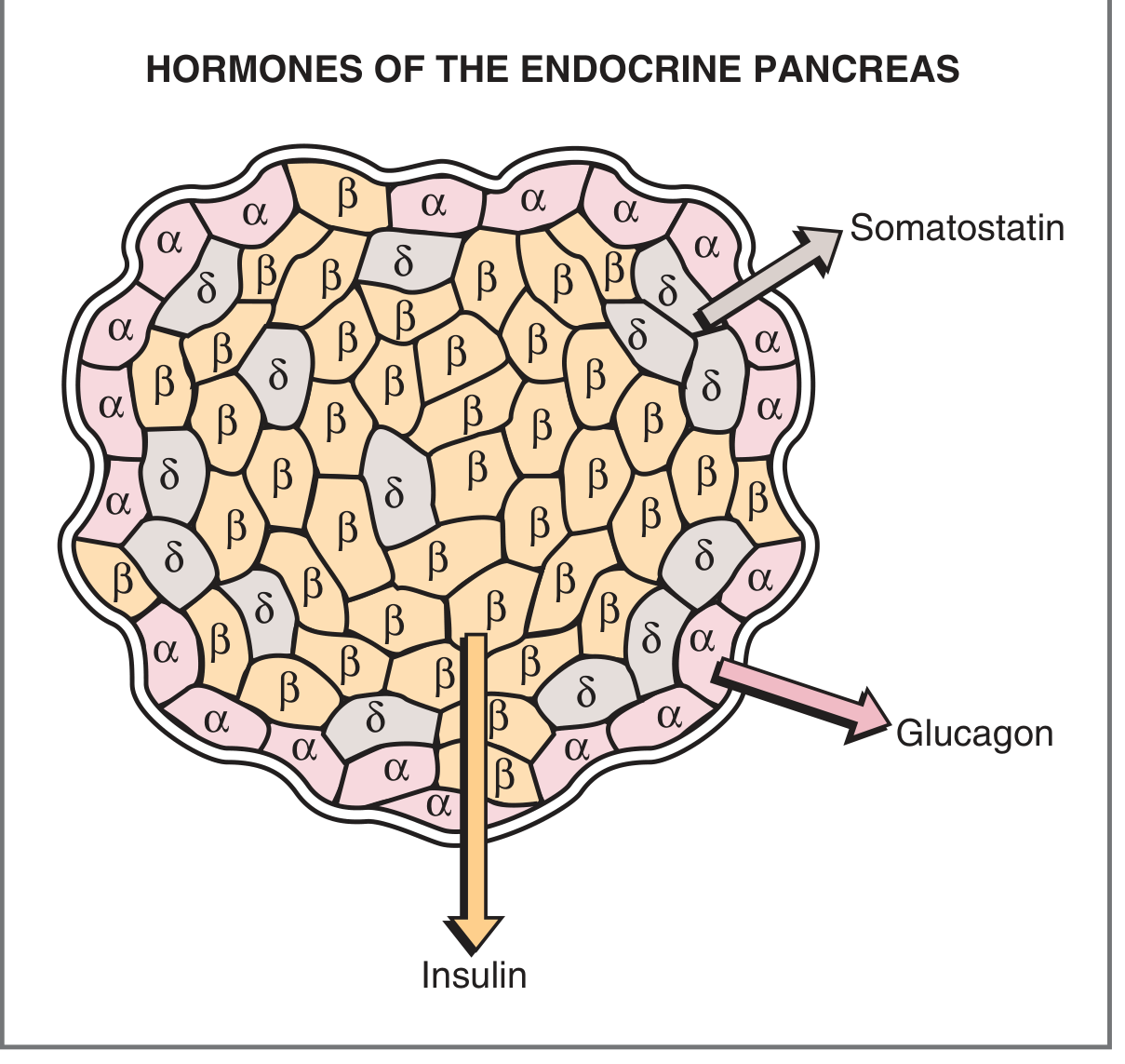
Islet Cell Types and Their Hormones
| Cell Type | % of Islet | Hormone | Location in Islet |
|---|---|---|---|
| Beta (β) | ~60-65% | Insulin + Amylin (IAPP) | Central core |
| Alpha (α) | ~20-30% | Glucagon | Outer rim |
| Delta (δ) | ~5-10% | Somatostatin | Interposed between α and β |
| PP / F cells | Rare | Pancreatic Polypeptide (PP) | Scattered |
| Epsilon (ε) | Very rare | Ghrelin | Scattered |
1. Insulin (Beta cells)
- Structure: Peptide dimer (A-chain: 21 amino acids + B-chain), MW ~5700-6000 Da
- Stimulus: High blood glucose, amino acids, GLP-1, parasympathetic activity
- Actions (hormone of "abundance"):
- Increases glucose uptake into cells (via GLUT4 insertion) → lowers blood glucose
- Promotes glycogen synthesis, inhibits glycogenolysis and gluconeogenesis
- Promotes fat deposition, inhibits lipolysis
- Promotes protein synthesis (anabolic)
- Drives K⁺ into cells (lowers blood K⁺)
- Clinical note: Deficiency or resistance causes diabetes mellitus
2. Glucagon (Alpha cells)
- Structure: Polypeptide, ~3500 Da
- Stimulus: Low blood glucose, amino acids, sympathetic activity
- Actions (opposite of insulin):
- Stimulates hepatic glycogenolysis and gluconeogenesis → raises blood glucose
- Promotes lipolysis and ketogenesis
- Mobilizes energy stores during fasting
- Clinical note: Glucagonoma causes hyperglycemia, weight loss, necrolytic migratory erythema
3. Somatostatin (Delta cells)
- Structure: Polypeptide, ~1650 Da
- Actions (universal inhibitor):
- Inhibits secretion of both insulin and glucagon (paracrine effect)
- Inhibits exocrine pancreatic secretion
- Inhibits GH and TSH release from the anterior pituitary
- Inhibits gastric HCl secretion
- Inhibits gut motility and other GI hormones
- Clinical note: Somatostatin analogs (e.g., octreotide) are used therapeutically for acromegaly, carcinoid syndrome, and variceal bleeding
4. Pancreatic Polypeptide - PP (PP / F cells)
- Structure: Polypeptide, ~4200 Da
- Actions:
- Inhibits pancreatic exocrine secretion (enzymes and bicarbonate)
- Inhibits bile secretion and intestinal motility
- Facilitates hepatic action of insulin
- Stimulates gastric chief cell activity
- Released after a meal, especially a protein-rich meal
5. Ghrelin (Epsilon cells)
- Actions:
- Decreases insulin secretion and action
- Stimulates appetite (hunger hormone)
- Also produced by the stomach
6. Amylin / IAPP (Beta cells, co-secreted with insulin)
- Also called Islet Amyloid Polypeptide
- Co-secreted with insulin from beta cells
- Counter-regulates insulin secretion and function
- Slows gastric emptying, suppresses glucagon
- In type 2 diabetes, amylin deposits form islet amyloid plaques
- Clinical use: Pramlintide is a synthetic amylin analog used in diabetes treatment
7. Pancreastatin (Beta cells)
- Decreases insulin and somatostatin secretion
- Increases glucagon secretion
- Decreases exocrine pancreatic secretion
8. Peptide YY - PYY
- Increases insulin secretion and promotes beta-cell growth
Key Regulatory Relationships
- High glucose → stimulates β cells (insulin ↑) + inhibits α cells (glucagon ↓)
- Low glucose → stimulates α cells (glucagon ↑) + inhibits β cells (insulin ↓)
- Somatostatin from δ cells inhibits both insulin and glucagon (paracrine)
- Sympathetic nerves → increase glucagon, inhibit insulin
- Parasympathetic nerves → increase both insulin and glucagon
Create a summary document on pancreatic hormones and their clinical significance
What format should the summary document be in? · Who is the target audience?
mkdir -p /home/daytona/workspace/pancreatic-hormones && ls /home/daytona/workspace/
~/pancreatic-hormones/generate_pdf.py
from reportlab.lib.pagesizes import A4
from reportlab.lib import colors
from reportlab.lib.styles import getSampleStyleSheet, ParagraphStyle
from reportlab.lib.units import cm, mm
from reportlab.platypus import (
    SimpleDocTemplate, Paragraph, Spacer, Table, TableStyle,
    HRFlowable, KeepTogether
)
from reportlab.lib.enums import TA_CENTER, TA_LEFT, TA_JUSTIFY
from reportlab.platypus import PageBreak

OUTPUT = "/home/daytona/workspace/pancreatic-hormones/Pancreatic_Hormones_Summary.pdf"

# ── Colour palette ──────────────────────────────────────────────
C_BLUE_DARK  = colors.HexColor("#1A3A5C")   # header / title
C_BLUE_MED   = colors.HexColor("#2E6DA4")   # section titles
C_BLUE_LIGHT = colors.HexColor("#D6E8F7")   # section header bg
C_TEAL       = colors.HexColor("#1B7A7A")   # hormone name band
C_TEAL_LIGHT = colors.HexColor("#D0EFEF")   # hormone row bg
C_AMBER      = colors.HexColor("#E67E22")   # clinical box accent
C_AMBER_LIGHT= colors.HexColor("#FEF3E2")   # clinical box bg
C_GREEN_DARK = colors.HexColor("#1E6B3C")   # key fact label
C_GREEN_LIGHT= colors.HexColor("#D4EDDA")   # key fact bg
C_GRAY       = colors.HexColor("#F4F6F8")   # alt row bg
C_WHITE      = colors.white
C_BLACK      = colors.HexColor("#1C1C1C")

doc = SimpleDocTemplate(
    OUTPUT,
    pagesize=A4,
    leftMargin=1.8*cm, rightMargin=1.8*cm,
    topMargin=2*cm, bottomMargin=2*cm,
)

W = A4[0] - 3.6*cm   # usable width

styles = getSampleStyleSheet()

# Custom styles
def sty(name, **kw):
    return ParagraphStyle(name, **kw)

title_style = sty("DocTitle",
    fontSize=22, fontName="Helvetica-Bold",
    textColor=C_WHITE, alignment=TA_CENTER, spaceAfter=4)

subtitle_style = sty("DocSub",
    fontSize=11, fontName="Helvetica",
    textColor=colors.HexColor("#BDE0FF"), alignment=TA_CENTER, spaceAfter=2)

section_style = sty("Section",
    fontSize=13, fontName="Helvetica-Bold",
    textColor=C_BLUE_DARK, spaceBefore=14, spaceAfter=6)

hormone_name_style = sty("HormoneName",
    fontSize=12, fontName="Helvetica-Bold",
    textColor=C_WHITE, alignment=TA_LEFT)

body_style = sty("Body",
    fontSize=9.5, fontName="Helvetica",
    textColor=C_BLACK, leading=14, spaceAfter=3)

small_style = sty("Small",
    fontSize=8.5, fontName="Helvetica",
    textColor=C_BLACK, leading=13)

bold_style = sty("Bold",
    fontSize=9.5, fontName="Helvetica-Bold",
    textColor=C_BLACK, leading=14)

clinical_title_style = sty("ClinTitle",
    fontSize=9.5, fontName="Helvetica-Bold",
    textColor=C_AMBER)

table_header_style = sty("TblHdr",
    fontSize=9, fontName="Helvetica-Bold",
    textColor=C_WHITE, alignment=TA_CENTER)

table_cell_style = sty("TblCell",
    fontSize=8.5, fontName="Helvetica",
    textColor=C_BLACK, leading=12, alignment=TA_LEFT)

footer_style = sty("Footer",
    fontSize=7.5, fontName="Helvetica",
    textColor=colors.HexColor("#999999"), alignment=TA_CENTER)

story = []

# ════════════════════════════════════════════════════════════════
# TITLE BLOCK
# ════════════════════════════════════════════════════════════════
title_data = [[
    Paragraph("HORMONES OF THE PANCREAS", title_style),
],[
    Paragraph("Clinical Summary for Medical Students", subtitle_style),
],[
    Paragraph("Islets of Langerhans · Endocrine Pancreas", subtitle_style),
]]
title_tbl = Table(title_data, colWidths=[W])
title_tbl.setStyle(TableStyle([
    ("BACKGROUND", (0,0), (-1,-1), C_BLUE_DARK),
    ("TOPPADDING",  (0,0), (-1,-1), 10),
    ("BOTTOMPADDING",(0,0),(-1,-1), 10),
    ("ROUNDEDCORNERS", [8]),
]))
story.append(title_tbl)
story.append(Spacer(1, 0.4*cm))

# ════════════════════════════════════════════════════════════════
# OVERVIEW BOX
# ════════════════════════════════════════════════════════════════
overview_text = (
    "The pancreas is both an <b>exocrine</b> gland (secreting digestive enzymes into the duodenum) "
    "and an <b>endocrine</b> gland. The endocrine function resides in the <b>Islets of Langerhans</b>, "
    "which make up 1-2% of pancreatic mass (~1 million islets, each with 2,500-4,000 cells). "
    "Five distinct cell types secrete hormones that regulate glucose, fat, amino acid metabolism, "
    "and GI function."
)
overview_para = Paragraph(overview_text, ParagraphStyle("ov",
    fontSize=9.5, fontName="Helvetica", textColor=C_BLACK, leading=14,
    leftIndent=8, rightIndent=8))
overview_tbl = Table([[overview_para]], colWidths=[W])
overview_tbl.setStyle(TableStyle([
    ("BACKGROUND", (0,0), (-1,-1), C_BLUE_LIGHT),
    ("BOX", (0,0), (-1,-1), 1, C_BLUE_MED),
    ("TOPPADDING",  (0,0),(-1,-1), 8),
    ("BOTTOMPADDING",(0,0),(-1,-1), 8),
    ("LEFTPADDING", (0,0),(-1,-1), 8),
    ("RIGHTPADDING",(0,0),(-1,-1), 8),
]))
story.append(overview_tbl)
story.append(Spacer(1, 0.5*cm))

# ════════════════════════════════════════════════════════════════
# QUICK-REFERENCE TABLE — Islet cell types
# ════════════════════════════════════════════════════════════════
story.append(Paragraph("Islet Cell Types at a Glance", section_style))
story.append(HRFlowable(width=W, thickness=1.5, color=C_BLUE_MED, spaceAfter=6))

qr_headers = [
    Paragraph("Cell", table_header_style),
    Paragraph("% Islet", table_header_style),
    Paragraph("Location", table_header_style),
    Paragraph("Hormone(s)", table_header_style),
    Paragraph("Mnemonic", table_header_style),
]

qr_rows = [
    ["β (Beta)", "60-65%", "Central core", "Insulin, Amylin (IAPP)", "β = Both insulin & amylin; B for Blood sugar ↓"],
    ["α (Alpha)", "20-30%", "Outer rim", "Glucagon", "A for Away — glucose goes Away from liver"],
    ["δ (Delta)", "5-10%", "Interposed", "Somatostatin", "D for Dampen — dampens all"],
    ["PP / F", "<5%", "Scattered", "Pancreatic Polypeptide", "PP = Pause Pancreas (inhibits exocrine)"],
    ["ε (Epsilon)", "Rare", "Scattered", "Ghrelin", "E for Eat — hunger signal"],
]

def make_qr_row(row_data, bg):
    return [Paragraph(cell, ParagraphStyle("qrc",
        fontSize=8.5, fontName="Helvetica", textColor=C_BLACK,
        leading=12)) for cell in row_data]

col_widths = [W*0.11, W*0.09, W*0.12, W*0.22, W*0.46]
qr_table_data = [qr_headers] + [make_qr_row(r, C_GRAY) for r in qr_rows]

qr_table = Table(qr_table_data, colWidths=col_widths)
qr_table.setStyle(TableStyle([
    ("BACKGROUND", (0,0), (-1,0), C_BLUE_DARK),
    ("BACKGROUND", (0,1), (-1,1), C_WHITE),
    ("BACKGROUND", (0,2), (-1,2), C_GRAY),
    ("BACKGROUND", (0,3), (-1,3), C_WHITE),
    ("BACKGROUND", (0,4), (-1,4), C_GRAY),
    ("BACKGROUND", (0,5), (-1,5), C_WHITE),
    ("GRID", (0,0), (-1,-1), 0.5, colors.HexColor("#CCCCCC")),
    ("TOPPADDING",  (0,0),(-1,-1), 5),
    ("BOTTOMPADDING",(0,0),(-1,-1), 5),
    ("LEFTPADDING", (0,0),(-1,-1), 6),
    ("RIGHTPADDING",(0,0),(-1,-1), 6),
    ("VALIGN", (0,0), (-1,-1), "MIDDLE"),
    ("ROWBACKGROUNDS", (0,1),(-1,-1), [C_WHITE, C_GRAY]),
]))
story.append(qr_table)
story.append(Spacer(1, 0.5*cm))

# ════════════════════════════════════════════════════════════════
# HELPER: hormone section card
# ════════════════════════════════════════════════════════════════
def hormone_card(number, name, cell, structure,
                 stimulus_list, actions_list, clinical_list,
                 drug_note=None):
    """Returns a list of flowables forming a coloured hormone card."""
    elements = []

    # Header band
    header_data = [[
        Paragraph(f"{number}. {name}", hormone_name_style),
        Paragraph(f"Cell: {cell}  |  {structure}", ParagraphStyle("hs2",
            fontSize=9, fontName="Helvetica", textColor=colors.HexColor("#CCE5FF"),
            alignment=TA_LEFT)),
    ]]
    header_tbl = Table(header_data, colWidths=[W*0.5, W*0.5])
    header_tbl.setStyle(TableStyle([
        ("BACKGROUND", (0,0), (-1,-1), C_TEAL),
        ("TOPPADDING",  (0,0),(-1,-1), 7),
        ("BOTTOMPADDING",(0,0),(-1,-1), 7),
        ("LEFTPADDING", (0,0),(-1,-1), 10),
        ("VALIGN", (0,0),(-1,-1), "MIDDLE"),
    ]))

    # Build inner content: stimulus | actions | clinical
    def bullet_list(items, color=C_BLACK):
        return "\n".join(f"• {i}" for i in items)

    stim_para = Paragraph(
        "<b>Secretion Stimulated By:</b><br/>" +
        "  ".join(f"• {s}" for s in stimulus_list),
        ParagraphStyle("sp", fontSize=8.5, fontName="Helvetica",
                       textColor=C_BLACK, leading=13))

    action_para = Paragraph(
        "<b>Key Actions:</b><br/>" +
        "<br/>".join(f"• {a}" for a in actions_list),
        ParagraphStyle("ap", fontSize=8.5, fontName="Helvetica",
                       textColor=C_BLACK, leading=13))

    clinical_content = "<b>Clinical Significance:</b><br/>" + \
        "<br/>".join(f"▸ {c}" for c in clinical_list)
    if drug_note:
        clinical_content += f"<br/><b>Drug:</b> {drug_note}"

    clin_para = Paragraph(clinical_content,
        ParagraphStyle("cp", fontSize=8.5, fontName="Helvetica",
                       textColor=C_BLACK, leading=13))

    body_data = [[stim_para, action_para, clin_para]]
    col_w = [W*0.27, W*0.36, W*0.37]
    body_tbl = Table(body_data, colWidths=col_w)
    body_tbl.setStyle(TableStyle([
        ("BACKGROUND", (0,0), (-1,-1), C_TEAL_LIGHT),
        ("TOPPADDING",  (0,0),(-1,-1), 7),
        ("BOTTOMPADDING",(0,0),(-1,-1), 7),
        ("LEFTPADDING", (0,0),(-1,-1), 8),
        ("RIGHTPADDING",(0,0),(-1,-1), 6),
        ("VALIGN", (0,0),(-1,-1), "TOP"),
        ("LINEAFTER", (0,0),(1,-1), 0.5, colors.HexColor("#A0CFCF")),
    ]))

    wrapper = Table([[header_tbl],[body_tbl]], colWidths=[W])
    wrapper.setStyle(TableStyle([
        ("BOX", (0,0),(-1,-1), 1, C_TEAL),
        ("TOPPADDING",(0,0),(-1,-1), 0),
        ("BOTTOMPADDING",(0,0),(-1,-1), 0),
        ("LEFTPADDING",(0,0),(-1,-1), 0),
        ("RIGHTPADDING",(0,0),(-1,-1), 0),
    ]))

    elements.append(KeepTogether([wrapper, Spacer(1, 0.3*cm)]))
    return elements

# ════════════════════════════════════════════════════════════════
# HORMONE CARDS
# ════════════════════════════════════════════════════════════════
story.append(Paragraph("Individual Hormone Profiles", section_style))
story.append(HRFlowable(width=W, thickness=1.5, color=C_BLUE_MED, spaceAfter=8))

# 1. INSULIN
story += hormone_card(
    1, "INSULIN", "Beta (β) cells", "Peptide; 51 AA (A+B chains linked by S-S); MW ~6000 Da",
    stimulus_list=[
        "↑ Blood glucose (primary)", "Amino acids (arginine, leucine)",
        "GLP-1 & GIP (incretins)", "Parasympathetic (vagal) stimulation",
        "Sulphonylureas (drug)"
    ],
    actions_list=[
        "↑ Glucose uptake into muscle & fat (GLUT4 insertion)",
        "↑ Glycogen synthesis; ↓ Glycogenolysis & gluconeogenesis",
        "↑ Protein synthesis (anabolic); ↓ Proteolysis",
        "↑ Lipogenesis; ↓ Lipolysis & ketogenesis",
        "Drives K⁺ into cells → lowers serum K⁺",
        "Down-regulates its own receptor (obesity/T2DM)"
    ],
    clinical_list=[
        "Type 1 DM: absolute insulin deficiency (autoimmune β-cell destruction)",
        "Type 2 DM: relative deficiency + peripheral insulin resistance",
        "Insulinoma: excess secretion → hypoglycemia (Whipple's triad)",
        "DKA: insulin deficiency → ketoacidosis (Type 1)",
        "HHS: severe hyperglycemia without ketosis (Type 2)",
        "Insulin in hyperkalaemia: drives K⁺ into cells (with dextrose)"
    ],
    drug_note="Insulin analogues (rapid: lispro/aspart; long: glargine/detemir); Sulphonylureas stimulate release; Metformin improves sensitivity"
)

# 2. GLUCAGON
story += hormone_card(
    2, "GLUCAGON", "Alpha (α) cells", "Polypeptide; 29 AA; MW ~3500 Da",
    stimulus_list=[
        "↓ Blood glucose (primary)", "Amino acids (protein meal)",
        "Sympathetic stimulation / catecholamines", "Fasting / exercise",
        "Somatostatin inhibits it"
    ],
    actions_list=[
        "↑ Hepatic glycogenolysis → raises blood glucose",
        "↑ Gluconeogenesis (liver)",
        "↑ Lipolysis & ketogenesis (adipose tissue)",
        "↑ cAMP (acts via Gs-protein coupled receptor)",
        "Opposite effects to insulin — counter-regulatory hormone"
    ],
    clinical_list=[
        "Glucagonoma (4 D's): Dermatitis (necrolytic migratory erythema), Diabetes, DVT, Depression",
        "Hypoglycaemia rescue: glucagon 1 mg IM (diabetics, unconscious)",
        "Beta-blocker overdose: glucagon bypasses β-receptor to restore cardiac contractility",
        "DKA: excess glucagon worsens ketogenesis",
        "Somatostatin analogues (octreotide) suppress glucagonoma symptoms"
    ],
    drug_note="Glucagon kit (hypoglycaemia rescue); GLP-1 agonists (liraglutide, semaglutide) mimic incretin axis"
)

# 3. SOMATOSTATIN
story += hormone_card(
    3, "SOMATOSTATIN (SST)", "Delta (δ) cells", "Polypeptide; SST-14 or SST-28; MW ~1650 Da",
    stimulus_list=[
        "High glucose, amino acids, fatty acids",
        "GIP, glucagon, CCK",
        "Paracrine signals from neighbouring islet cells"
    ],
    actions_list=[
        "Inhibits BOTH insulin AND glucagon secretion (paracrine)",
        "Inhibits GH and TSH release (anterior pituitary)",
        "Inhibits gastric acid (HCl) & pepsin secretion",
        "Inhibits pancreatic exocrine secretion",
        "Inhibits intestinal motility & nutrient absorption",
        "Inhibits virtually all GI hormones (universal inhibitor)"
    ],
    clinical_list=[
        "Somatostatinoma: triad of diabetes, cholelithiasis, steatorrhoea",
        "Carcinoid syndrome: octreotide controls flushing and diarrhoea",
        "Acromegaly: octreotide suppresses GH",
        "Oesophageal varices: octreotide reduces portal pressure",
        "Post-op pancreatic fistulae: octreotide reduces secretion"
    ],
    drug_note="Octreotide (short-acting SST analogue); Lanreotide, Pasireotide (long-acting)"
)

# 4. PANCREATIC POLYPEPTIDE
story += hormone_card(
    4, "PANCREATIC POLYPEPTIDE (PP)", "PP / F cells", "Polypeptide; 36 AA; MW ~4200 Da",
    stimulus_list=[
        "Protein-rich meal", "Fasting / hypoglycaemia",
        "Vagal (cholinergic) stimulation", "Exercise"
    ],
    actions_list=[
        "↓ Pancreatic exocrine enzyme & bicarbonate secretion",
        "↓ Bile secretion & gallbladder motility",
        "↓ Intestinal motility",
        "Facilitates hepatic action of insulin",
        "Stimulates gastric chief cell secretion"
    ],
    clinical_list=[
        "PP-oma: rare functional islet tumour; watery diarrhoea",
        "PP levels used as marker for pancreatic endocrine tumour activity",
        "Elevated in MEN-1 related pancreatic tumours",
        "Low PP response to hypoglycaemia seen in autonomic neuropathy (diabetic)"
    ],
    drug_note="No approved PP-based drugs currently; research ongoing in obesity (PP suppresses appetite)"
)

# 5. GHRELIN
story += hormone_card(
    5, "GHRELIN", "Epsilon (ε) cells (also stomach)", "Peptide; 28 AA; acylated form is active",
    stimulus_list=[
        "Fasting / empty stomach", "Hypoglycaemia",
        "Low body weight / caloric restriction"
    ],
    actions_list=[
        "Stimulates appetite (orexigenic — 'hunger hormone')",
        "Stimulates GH release (GH secretagogue)",
        "↓ Insulin secretion and action",
        "↑ Gastric motility and acid secretion",
        "Promotes fat storage (anti-lipolytic)"
    ],
    clinical_list=[
        "Prader-Willi syndrome: very high ghrelin → uncontrollable hunger",
        "Post-bariatric surgery (sleeve gastrectomy): ghrelin falls → appetite suppression",
        "Cachexia / cancer anorexia: ghrelin analogues (anamorelin) investigated",
        "Type 2 DM: elevated fasting ghrelin worsens insulin resistance"
    ],
    drug_note="Anamorelin (ghrelin receptor agonist) — approved in Japan for cancer cachexia"
)

# 6. AMYLIN
story += hormone_card(
    6, "AMYLIN (IAPP)", "Beta (β) cells — co-secreted with insulin", "Polypeptide; 37 AA; forms amyloid fibrils",
    stimulus_list=[
        "Meals (co-released with insulin)", "High glucose",
        "Protein / fat ingestion"
    ],
    actions_list=[
        "Slows gastric emptying → blunts post-meal glucose spike",
        "Suppresses post-meal glucagon secretion",
        "Reduces food intake (satiety signal via hypothalamus)",
        "Complements insulin in post-prandial glucose control"
    ],
    clinical_list=[
        "Type 2 DM: amylin fibrils (IAPP aggregates) deposit in islets → β-cell loss",
        "Amyloid deposits are a hallmark of pancreatic histology in T2DM",
        "Type 1 DM: amylin is also deficient (alongside insulin)",
        "Alzheimer's disease: IAPP amyloid structurally similar to Aβ plaque"
    ],
    drug_note="Pramlintide (synthetic amylin analogue) — adjunct to insulin in T1DM and T2DM; reduces HbA1c and weight"
)

story.append(Spacer(1, 0.3*cm))

# ════════════════════════════════════════════════════════════════
# GLUCOSE REGULATION SUMMARY TABLE
# ════════════════════════════════════════════════════════════════
story.append(Paragraph("Glucose Regulation — Insulin vs. Glucagon", section_style))
story.append(HRFlowable(width=W, thickness=1.5, color=C_BLUE_MED, spaceAfter=8))

reg_headers = [
    Paragraph("Parameter", table_header_style),
    Paragraph("INSULIN (β-cell)", table_header_style),
    Paragraph("GLUCAGON (α-cell)", table_header_style),
]
reg_rows = [
    ["Trigger", "↑ Blood glucose, amino acids, incretins", "↓ Blood glucose, amino acids, stress"],
    ["Blood glucose effect", "↓ (hypoglycaemic)", "↑ (hyperglycaemic)"],
    ["Glycogenolysis", "↓ Inhibits", "↑ Stimulates"],
    ["Gluconeogenesis", "↓ Inhibits", "↑ Stimulates"],
    ["Glycogen synthesis", "↑ Stimulates", "↓ Inhibits"],
    ["Lipolysis / Ketogenesis", "↓ Inhibits", "↑ Stimulates"],
    ["Protein synthesis", "↑ Stimulates (anabolic)", "↓ Inhibits (catabolic)"],
    ["Receptor / Pathway", "Tyrosine kinase receptor → PI3K/Akt", "GPCR (Gs) → cAMP → PKA"],
    ["State", "'Fed' / Anabolic state", "'Fasted' / Catabolic state"],
]

def make_reg_cell(text, bold=False):
    style = ParagraphStyle("rc",
        fontSize=8.5, fontName="Helvetica-Bold" if bold else "Helvetica",
        textColor=C_BLACK, leading=12)
    return Paragraph(text, style)

reg_data = [reg_headers]
for i, row in enumerate(reg_rows):
    cells = [make_reg_cell(row[0], bold=True),
             make_reg_cell(row[1]),
             make_reg_cell(row[2])]
    reg_data.append(cells)

reg_col_w = [W*0.22, W*0.39, W*0.39]
reg_tbl = Table(reg_data, colWidths=reg_col_w)
reg_tbl.setStyle(TableStyle([
    ("BACKGROUND", (0,0), (-1,0), C_BLUE_DARK),
    ("ROWBACKGROUNDS", (0,1),(-1,-1), [C_WHITE, C_GRAY]),
    ("GRID", (0,0),(-1,-1), 0.4, colors.HexColor("#CCCCCC")),
    ("TOPPADDING",(0,0),(-1,-1), 5),
    ("BOTTOMPADDING",(0,0),(-1,-1), 5),
    ("LEFTPADDING",(0,0),(-1,-1), 6),
    ("RIGHTPADDING",(0,0),(-1,-1), 6),
    ("VALIGN",(0,0),(-1,-1), "MIDDLE"),
]))
story.append(reg_tbl)
story.append(Spacer(1, 0.4*cm))

# ════════════════════════════════════════════════════════════════
# KEY CLINICAL CONDITIONS TABLE
# ════════════════════════════════════════════════════════════════
story.append(Paragraph("Key Clinical Conditions — Quick Reference", section_style))
story.append(HRFlowable(width=W, thickness=1.5, color=C_BLUE_MED, spaceAfter=8))

clin_headers = [
    Paragraph("Condition", table_header_style),
    Paragraph("Hormone Involved", table_header_style),
    Paragraph("Pathophysiology", table_header_style),
    Paragraph("Key Features", table_header_style),
    Paragraph("Treatment Principle", table_header_style),
]

clin_rows = [
    ["Type 1 DM", "↓ Insulin (absolute)", "Autoimmune β-cell destruction (anti-GAD, anti-IA2 Ab)",
     "Polyuria, polydipsia, weight loss; DKA prone", "Insulin replacement (basal-bolus)"],
    ["Type 2 DM", "↓ Insulin (relative) + resistance", "Insulin resistance → β-cell exhaustion; amyloid deposits",
     "Gradual onset; obesity, acanthosis nigricans", "Metformin → stepwise; insulin when needed"],
    ["DKA", "Severe ↓ Insulin, ↑ Glucagon", "Unrestrained lipolysis → ketoacid production; anion gap metabolic acidosis",
     "Kussmaul breathing, fruity breath, pH <7.3", "IV insulin + fluids + K⁺ replacement"],
    ["Insulinoma", "↑ Insulin (autonomous)", "Benign β-cell tumour (>90%); inappropriate insulin secretion",
     "Whipple's triad: hypoglycaemia, symptoms, relief with glucose", "Surgical resection; diazoxide pre-op"],
    ["Glucagonoma", "↑ Glucagon (autonomous)", "Malignant α-cell tumour; part of MEN-1",
     "4 D's: Dermatitis (NME), DM, DVT, Depression", "Octreotide; surgery; streptozocin"],
    ["Somatostatinoma", "↑ Somatostatin", "Rare δ-cell tumour; inhibits insulin, glucagon, exocrine",
     "Triad: DM, gallstones, steatorrhoea", "Surgery; octreotide for symptoms"],
    ["Acromegaly", "↑ GH (SST insufficient)", "Excess GH from pituitary; normally inhibited by SST",
     "Enlarged hands/feet, coarse features, DM", "Octreotide/lanreotide; surgery/radiotherapy"],
]

def make_clin_cell(text):
    return Paragraph(text, ParagraphStyle("clc",
        fontSize=7.8, fontName="Helvetica", textColor=C_BLACK, leading=11))

clin_data = [clin_headers]
for i, row in enumerate(clin_rows):
    clin_data.append([make_clin_cell(c) for c in row])

clin_col_w = [W*0.14, W*0.15, W*0.24, W*0.23, W*0.24]
clin_tbl = Table(clin_data, colWidths=clin_col_w)
clin_tbl.setStyle(TableStyle([
    ("BACKGROUND", (0,0),(-1,0), colors.HexColor("#8B1A1A")),
    ("TEXTCOLOR", (0,0),(-1,0), C_WHITE),
    ("ROWBACKGROUNDS", (0,1),(-1,-1), [C_AMBER_LIGHT, C_WHITE]),
    ("GRID", (0,0),(-1,-1), 0.4, colors.HexColor("#CCCCCC")),
    ("TOPPADDING",(0,0),(-1,-1), 4),
    ("BOTTOMPADDING",(0,0),(-1,-1), 4),
    ("LEFTPADDING",(0,0),(-1,-1), 5),
    ("RIGHTPADDING",(0,0),(-1,-1), 5),
    ("VALIGN",(0,0),(-1,-1), "TOP"),
]))
story.append(clin_tbl)
story.append(Spacer(1, 0.4*cm))

# ════════════════════════════════════════════════════════════════
# HIGH-YIELD EXAM FACTS BOX
# ════════════════════════════════════════════════════════════════
story.append(Paragraph("High-Yield Exam Points", section_style))
story.append(HRFlowable(width=W, thickness=1.5, color=C_BLUE_MED, spaceAfter=8))

hyfacts = [
    "Insulin is the ONLY hormone that LOWERS blood glucose.",
    "Glucagon, cortisol, adrenaline, and GH are all counter-regulatory (hyperglycaemic).",
    "Somatostatin is a universal inhibitor — it suppresses insulin, glucagon, GH, TSH, and GI hormones.",
    "C-peptide is co-secreted with insulin in equimolar amounts and has a longer half-life — used to distinguish endogenous insulin from exogenous injection.",
    "Proinsulin → insulin + C-peptide (cleavage of connecting peptide by prohormone convertase).",
    "GLUT2 (high-Km) is the glucose sensor on β-cells; GLUT4 is the insulin-dependent transporter in muscle/fat.",
    "Sulphonylureas (e.g., glibenclamide) close K-ATP channels on β-cells → depolarisation → Ca²⁺ entry → insulin release.",
    "GLP-1 (glucagon-like peptide-1) is an incretin from L-cells; it enhances glucose-dependent insulin secretion — basis for GLP-1 agonists (semaglutide).",
    "Insulinoma: measure serum insulin, C-peptide, and proinsulin simultaneously during a 72-hour fast.",
    "MEN-1 (Wermer's syndrome): Parathyroid + Pituitary + Pancreatic islet tumours (3 P's).",
    "Whipple's triad (insulinoma): symptoms of hypoglycaemia + documented low glucose + relief with glucose administration.",
    "Ghrelin is the only gut peptide that INCREASES appetite (all others — GLP-1, PYY, CCK — decrease it).",
    "Amylin (IAPP) aggregates form islet amyloid — hallmark histology in Type 2 DM.",
    "Diazoxide opens K-ATP channels on β-cells → hyperpolarisation → inhibits insulin release (used in insulinoma pre-op).",
]

hy_rows = [[Paragraph(f"{'★'} {f}", ParagraphStyle("hyf",
    fontSize=8.5, fontName="Helvetica", textColor=C_BLACK, leading=13))]
           for f in hyfacts]

hy_tbl = Table(hy_rows, colWidths=[W])
hy_tbl.setStyle(TableStyle([
    ("BACKGROUND", (0,0),(-1,-1), C_GREEN_LIGHT),
    ("ROWBACKGROUNDS", (0,0),(-1,-1), [C_GREEN_LIGHT, colors.HexColor("#EAF7EE")]),
    ("TOPPADDING",(0,0),(-1,-1), 4),
    ("BOTTOMPADDING",(0,0),(-1,-1), 4),
    ("LEFTPADDING",(0,0),(-1,-1), 10),
    ("RIGHTPADDING",(0,0),(-1,-1), 8),
    ("BOX",(0,0),(-1,-1), 1, C_GREEN_DARK),
    ("LINEBELOW",(0,0),(-1,-2), 0.3, colors.HexColor("#B0DFBF")),
]))
story.append(hy_tbl)
story.append(Spacer(1, 0.4*cm))

# ════════════════════════════════════════════════════════════════
# PHARMACOLOGY TABLE
# ════════════════════════════════════════════════════════════════
story.append(Paragraph("Pharmacology Summary — Drugs Targeting Pancreatic Hormones", section_style))
story.append(HRFlowable(width=W, thickness=1.5, color=C_BLUE_MED, spaceAfter=8))

ph_headers = [
    Paragraph("Drug / Class", table_header_style),
    Paragraph("Target", table_header_style),
    Paragraph("Mechanism", table_header_style),
    Paragraph("Clinical Use", table_header_style),
]
ph_rows = [
    ["Insulin (all types)", "Insulin receptor", "Directly replaces deficient insulin; activates tyrosine kinase → glucose uptake", "T1DM, T2DM, DKA, HHS, hyperkalaemia"],
    ["Sulphonylureas (glibenclamide, gliclazide)", "β-cell K-ATP channel", "Close K-ATP channels → depolarise → Ca²⁺ influx → insulin release", "T2DM (stimulate endogenous insulin)"],
    ["GLP-1 agonists (semaglutide, liraglutide)", "GLP-1 receptor", "Glucose-dependent insulin secretion ↑, glucagon ↓, gastric emptying ↓, weight ↓", "T2DM, obesity (Wegovy), CV risk reduction"],
    ["DPP-4 inhibitors (sitagliptin)", "DPP-4 enzyme", "Prevent GLP-1 degradation → prolong incretin effect", "T2DM; weight-neutral"],
    ["Metformin", "Mitochondrial complex I", "↓ Hepatic gluconeogenesis; improves insulin sensitivity; activates AMPK", "First-line T2DM; PCOS"],
    ["Diazoxide", "K-ATP channel opener on β-cell", "Opens K-ATP → hyperpolarises β-cell → inhibits insulin release", "Insulinoma (pre-op), congenital hyperinsulinism"],
    ["Octreotide / Lanreotide", "Somatostatin receptors (SSTR2/5)", "Mimics SST; suppresses GH, glucagon, insulin, GI hormones", "Acromegaly, carcinoid, glucagonoma, variceal bleed"],
    ["Pramlintide", "Amylin receptor", "Slows gastric emptying, suppresses glucagon, reduces appetite", "Adjunct to insulin in T1DM and T2DM"],
    ["Glucagon kit", "Glucagon receptor (Gs-GPCR)", "↑ Hepatic glycogenolysis; ↑ cAMP → glucose release", "Hypoglycaemia rescue; beta-blocker/CCB overdose"],
]

def make_ph(text):
    return Paragraph(text, ParagraphStyle("phc",
        fontSize=7.8, fontName="Helvetica", textColor=C_BLACK, leading=11))

ph_data = [ph_headers]
for row in ph_rows:
    ph_data.append([make_ph(c) for c in row])

ph_col_w = [W*0.22, W*0.15, W*0.35, W*0.28]
ph_tbl = Table(ph_data, colWidths=ph_col_w)
ph_tbl.setStyle(TableStyle([
    ("BACKGROUND", (0,0),(-1,0), colors.HexColor("#4A235A")),
    ("TEXTCOLOR", (0,0),(-1,0), C_WHITE),
    ("ROWBACKGROUNDS", (0,1),(-1,-1), [colors.HexColor("#F5EEF8"), C_WHITE]),
    ("GRID", (0,0),(-1,-1), 0.4, colors.HexColor("#CCCCCC")),
    ("TOPPADDING",(0,0),(-1,-1), 4),
    ("BOTTOMPADDING",(0,0),(-1,-1), 4),
    ("LEFTPADDING",(0,0),(-1,-1), 5),
    ("RIGHTPADDING",(0,0),(-1,-1), 5),
    ("VALIGN",(0,0),(-1,-1), "TOP"),
]))
story.append(ph_tbl)
story.append(Spacer(1, 0.4*cm))

# ════════════════════════════════════════════════════════════════
# FOOTER
# ════════════════════════════════════════════════════════════════
story.append(HRFlowable(width=W, thickness=0.5, color=colors.HexColor("#BBBBBB"), spaceAfter=4))
story.append(Paragraph(
    "Sources: Schwartz's Principles of Surgery 11e · Costanzo Physiology 7e · Junqueira's Basic Histology 17e · "
    "Lippincott Pharmacology · Katzung's Basic & Clinical Pharmacology 16e  |  Document generated for medical education purposes.",
    ParagraphStyle("foot", fontSize=7, fontName="Helvetica",
                   textColor=colors.HexColor("#999999"), alignment=TA_CENTER)))

# ════════════════════════════════════════════════════════════════
# BUILD
# ════════════════════════════════════════════════════════════════
doc.build(story)
print(f"PDF saved to: {OUTPUT}")
cd /home/daytona/workspace/pancreatic-hormones && python generate_pdf.py 2>&1
ls -lh /home/daytona/workspace/pancreatic-hormones/
Pancreatic Hormones Summary
PDF Document · PDF
- Cell source and molecular structure
- What stimulates secretion
- Key physiological actions
- Clinical significance
- Relevant drugs
- Covered: Insulin, Glucagon, Somatostatin, Pancreatic Polypeptide, Ghrelin, Amylin (IAPP)
PowerPoint file presentation for harmones secreted by pancreas
~/pancreatic-hormones/generate_pptx.js
const pptxgen = require("pptxgenjs");

const pres = new pptxgen();
pres.layout = "LAYOUT_16x9";
pres.title = "Hormones Secreted by the Pancreas";
pres.author = "Medical Education";

// ── Colour Palette ──────────────────────────────────────────────
const C = {
  navy:        "0D2B4E",   // dominant dark
  teal:        "0E7C7B",   // accent 1 (hormone colour)
  amber:       "E67E22",   // accent 2 (clinical)
  green:       "1E6B3C",   // accent 3 (exam facts)
  purple:      "5B2C8D",   // accent 4 (pharmacology)
  white:       "FFFFFF",
  offwhite:    "F0F6FF",
  lightTeal:   "D0EFEF",
  lightAmber:  "FEF0E2",
  lightGreen:  "D4EDDA",
  lightPurple: "EDE7F6",
  gray:        "F4F6F8",
  darkText:    "1C1C1C",
  mutedText:   "555555",
  lineColor:   "BBBBBB",
};

// ── Slide Dimensions ────────────────────────────────────────────
const W = 10, H = 5.625;

// ═══════════════════════════════════════════════════════════════
// HELPER FUNCTIONS
// ═══════════════════════════════════════════════════════════════
function addSlideHeader(slide, title, subtitle, bgColor, titleColor) {
  // Full-width top bar
  slide.addShape(pres.shapes.RECTANGLE, {
    x: 0, y: 0, w: W, h: 1.1,
    fill: { color: bgColor || C.navy },
    line: { color: bgColor || C.navy },
  });
  slide.addText(title, {
    x: 0.4, y: 0.08, w: 9.2, h: 0.6,
    fontSize: 22, bold: true, color: titleColor || C.white,
    fontFace: "Calibri", margin: 0,
  });
  if (subtitle) {
    slide.addText(subtitle, {
      x: 0.4, y: 0.7, w: 9.2, h: 0.35,
      fontSize: 11, color: "BDE0FF", fontFace: "Calibri", margin: 0,
    });
  }
}

function addFooter(slide, text) {
  slide.addShape(pres.shapes.RECTANGLE, {
    x: 0, y: H - 0.28, w: W, h: 0.28,
    fill: { color: C.navy }, line: { color: C.navy },
  });
  slide.addText(text || "Hormones of the Pancreas", {
    x: 0, y: H - 0.28, w: W, h: 0.28,
    fontSize: 7.5, color: "88AABB", align: "center",
    fontFace: "Calibri", margin: 0,
  });
}

function card(slide, x, y, w, h, headerText, headerBg, bodyLines, bodyFontSize) {
  // Card header
  slide.addShape(pres.shapes.RECTANGLE, {
    x, y, w, h: 0.32,
    fill: { color: headerBg }, line: { color: headerBg },
  });
  slide.addText(headerText, {
    x: x + 0.06, y: y + 0.03, w: w - 0.1, h: 0.26,
    fontSize: 10, bold: true, color: C.white,
    fontFace: "Calibri", margin: 0,
  });
  // Card body
  slide.addShape(pres.shapes.RECTANGLE, {
    x, y: y + 0.32, w, h: h - 0.32,
    fill: { color: C.offwhite }, line: { color: headerBg, pt: 0.5 },
  });
  slide.addText(bodyLines, {
    x: x + 0.08, y: y + 0.36, w: w - 0.14, h: h - 0.42,
    fontSize: bodyFontSize || 8.5, color: C.darkText,
    fontFace: "Calibri", valign: "top", wrap: true, margin: 0,
  });
}

// ═══════════════════════════════════════════════════════════════
// SLIDE 1 — TITLE SLIDE
// ═══════════════════════════════════════════════════════════════
{
  const s = pres.addSlide();

  // Background: full dark
  s.addShape(pres.shapes.RECTANGLE, {
    x: 0, y: 0, w: W, h: H,
    fill: { color: C.navy }, line: { color: C.navy },
  });

  // Teal accent bar left
  s.addShape(pres.shapes.RECTANGLE, {
    x: 0, y: 0, w: 0.18, h: H,
    fill: { color: C.teal }, line: { color: C.teal },
  });

  // Decorative circles (representing islet cells)
  const circles = [
    { x: 7.8, y: 0.3, r: 1.4, c: "1A4A7A", t: 50 },
    { x: 8.6, y: 1.5, r: 0.9, c: "0E7C7B", t: 60 },
    { x: 7.2, y: 1.8, r: 0.6, c: "E67E22", t: 70 },
    { x: 8.9, y: 0.4, r: 0.55, c: "5B2C8D", t: 65 },
  ];
  circles.forEach(c => {
    s.addShape(pres.shapes.OVAL, {
      x: c.x, y: c.y, w: c.r, h: c.r,
      fill: { color: c.c, transparency: c.t },
      line: { color: c.c },
    });
  });

  // Title text
  s.addText("HORMONES OF THE PANCREAS", {
    x: 0.5, y: 1.2, w: 7.2, h: 0.8,
    fontSize: 30, bold: true, color: C.white,
    fontFace: "Calibri", charSpacing: 2,
  });

  // Teal underline
  s.addShape(pres.shapes.RECTANGLE, {
    x: 0.5, y: 2.05, w: 5.5, h: 0.05,
    fill: { color: C.teal }, line: { color: C.teal },
  });

  s.addText("Islets of Langerhans · Endocrine Pancreas", {
    x: 0.5, y: 2.2, w: 7.2, h: 0.4,
    fontSize: 14, color: "88CCDD", fontFace: "Calibri", italic: true,
  });

  s.addText("A Complete Medical Student Guide", {
    x: 0.5, y: 2.7, w: 7.2, h: 0.35,
    fontSize: 11, color: "AABBCC", fontFace: "Calibri",
  });

  // Bottom info band
  s.addShape(pres.shapes.RECTANGLE, {
    x: 0, y: H - 0.8, w: W, h: 0.8,
    fill: { color: "091E36" }, line: { color: "091E36" },
  });
  s.addText([
    { text: "Topics Covered: ", options: { bold: true, color: C.teal } },
    { text: "Insulin · Glucagon · Somatostatin · Pancreatic Polypeptide · Ghrelin · Amylin · Clinical Significance · Pharmacology", options: { color: "AABBCC" } },
  ], {
    x: 0.3, y: H - 0.75, w: 9.4, h: 0.7,
    fontSize: 9, fontFace: "Calibri",
  });
}

// ═══════════════════════════════════════════════════════════════
// SLIDE 2 — PANCREAS OVERVIEW
// ═══════════════════════════════════════════════════════════════
{
  const s = pres.addSlide();
  s.addShape(pres.shapes.RECTANGLE, { x:0,y:0,w:W,h:H, fill:{color:C.gray}, line:{color:C.gray} });
  addSlideHeader(s, "The Endocrine Pancreas — Overview", "Structure & Function of the Islets of Langerhans");
  addFooter(s);

  // Left: overview text box
  s.addShape(pres.shapes.RECTANGLE, {
    x: 0.3, y: 1.25, w: 4.4, h: 3.9,
    fill: { color: C.white }, line: { color: C.lineColor, pt: 0.8 },
    shadow: { type: "outer", color: "000000", blur: 5, offset: 2, angle: 135, opacity: 0.08 },
  });
  s.addText([
    { text: "What is the Endocrine Pancreas?\n", options: { bold: true, color: C.navy, fontSize: 11 } },
    { text: "The pancreas has two components:\n", options: { color: C.mutedText, fontSize: 9 } },
    { text: "• Exocrine: ", options: { bold: true, color: C.darkText, fontSize: 9 } },
    { text: "Acinar cells → digestive enzymes into gut\n", options: { color: C.darkText, fontSize: 9 } },
    { text: "• Endocrine: ", options: { bold: true, color: C.teal, fontSize: 9 } },
    { text: "Islets of Langerhans → hormones into bloodstream\n\n", options: { color: C.darkText, fontSize: 9 } },
    { text: "Islets of Langerhans:\n", options: { bold: true, color: C.navy, fontSize: 11 } },
    { text: "• ~1 million islets in adult pancreas\n• 1–2% of total pancreatic mass\n• 2,500–4,000 cells per islet\n• 5 distinct endocrine cell types\n\n", options: { color: C.darkText, fontSize: 9 } },
    { text: "Cellular Architecture:\n", options: { bold: true, color: C.navy, fontSize: 11 } },
    { text: "• β cells fill the central core\n• α cells form the outer rim\n• δ cells interpose between α and β\n• PP and ε cells scattered throughout\n\n", options: { color: C.darkText, fontSize: 9 } },
    { text: "Communication: ", options: { bold: true, color: C.navy, fontSize: 9 } },
    { text: "Gap junctions, paracrine signals, and autonomic innervation (sympathetic + parasympathetic) coordinate hormone secretion.", options: { color: C.darkText, fontSize: 9 } },
  ], { x: 0.45, y: 1.32, w: 4.1, h: 3.75, fontFace: "Calibri", valign: "top", wrap: true });

  // Right: cell type cards
  const cellTypes = [
    { cell: "β (Beta) Cell", pct: "60–65%", hormone: "Insulin + Amylin", bg: C.teal },
    { cell: "α (Alpha) Cell", pct: "20–30%", hormone: "Glucagon", bg: "2980B9" },
    { cell: "δ (Delta) Cell", pct: "5–10%", hormone: "Somatostatin", bg: "8E44AD" },
    { cell: "PP / F Cell", pct: "<5%", hormone: "Pancreatic Polypeptide", bg: C.amber },
    { cell: "ε (Epsilon) Cell", pct: "Rare", hormone: "Ghrelin", bg: C.green },
  ];
  cellTypes.forEach((ct, i) => {
    const y = 1.25 + i * 0.76;
    s.addShape(pres.shapes.RECTANGLE, {
      x: 5.0, y, w: 4.65, h: 0.68,
      fill: { color: C.white }, line: { color: ct.bg, pt: 1.5 },
    });
    s.addShape(pres.shapes.RECTANGLE, {
      x: 5.0, y, w: 0.12, h: 0.68,
      fill: { color: ct.bg }, line: { color: ct.bg },
    });
    s.addText(ct.cell, {
      x: 5.18, y: y + 0.06, w: 2.0, h: 0.25,
      fontSize: 10, bold: true, color: ct.bg, fontFace: "Calibri", margin: 0,
    });
    s.addText(ct.pct + " of islet", {
      x: 5.18, y: y + 0.34, w: 2.0, h: 0.22,
      fontSize: 8, color: C.mutedText, fontFace: "Calibri", margin: 0,
    });
    s.addText("→ " + ct.hormone, {
      x: 7.1, y: y + 0.18, w: 2.5, h: 0.3,
      fontSize: 9.5, bold: true, color: C.darkText, fontFace: "Calibri", margin: 0,
    });
  });
}

// ═══════════════════════════════════════════════════════════════
// SLIDE 3 — INSULIN
// ═══════════════════════════════════════════════════════════════
{
  const s = pres.addSlide();
  s.addShape(pres.shapes.RECTANGLE, { x:0,y:0,w:W,h:H, fill:{color:C.gray}, line:{color:C.gray} });
  addSlideHeader(s, "1. Insulin", "β (Beta) Cells  ·  Peptide hormone (A + B chains, 51 AA)  ·  MW ~6,000 Da  ·  Hormone of 'Abundance'", C.teal);
  addFooter(s, "Insulin — β Cells");

  // Stimuli card
  card(s, 0.3, 1.2, 3.0, 2.0, "▲ Secretion Stimulated By", C.teal, [
    { text: "• High blood glucose (primary trigger)\n• Amino acids (arginine, leucine)\n• GLP-1 & GIP (incretins)\n• Parasympathetic (vagal) stimulation\n• Sulphonylureas (drug-induced)", options: { fontSize: 8.5, color: C.darkText, breakLine: false } },
  ]);

  // Actions card
  card(s, 3.5, 1.2, 3.8, 2.0, "⚡ Key Physiological Actions", C.navy, [
    { text: "• ↑ Glucose uptake (GLUT4 insertion) → ↓ blood glucose\n• ↑ Glycogen synthesis; ↓ glycogenolysis & gluconeogenesis\n• ↑ Lipogenesis; ↓ lipolysis & ketogenesis\n• ↑ Protein synthesis (anabolic)\n• Drives K⁺ into cells → lowers serum K⁺", options: { fontSize: 8.5, color: C.darkText } },
  ]);

  // Clinical card
  card(s, 7.5, 1.2, 2.2, 2.0, "🏥 Clinical", "8B1A1A", [
    { text: "• T1DM: absolute deficiency\n• T2DM: relative + resistance\n• DKA: uncontrolled\n• HHS: severe hyperglycaemia\n• Insulinoma: excess\n• Hyperkalaemia Rx", options: { fontSize: 8, color: C.darkText } },
  ]);

  // Mechanism card (bottom left)
  card(s, 0.3, 3.3, 4.5, 1.95, "⚙ Mechanism of Action", C.teal, [
    { text: "Receptor: Tyrosine Kinase Receptor (α₂β₂ tetramer)\n• Insulin binds α-subunits → β-subunit autophosphorylation\n• Activates PI3K/Akt pathway → GLUT4 translocation to membrane\n• Stimulates gene transcription (nucleus, Golgi, ER)\n• Down-regulates own receptor in obesity/T2DM", options: { fontSize: 8.5, color: C.darkText } },
  ]);

  // Drugs card (bottom right)
  card(s, 5.0, 3.3, 4.65, 1.95, "💊 Key Drugs", "4A235A", [
    { text: "• Insulin analogues: rapid (lispro, aspart), long-acting (glargine, detemir)\n• Sulphonylureas: close K-ATP → stimulate release\n• Metformin: ↓ gluconeogenesis, ↑ sensitivity\n• GLP-1 agonists: semaglutide, liraglutide\n• DPP-4 inhibitors: sitagliptin (prolong incretin)", options: { fontSize: 8.5, color: C.darkText } },
  ]);
}

// ═══════════════════════════════════════════════════════════════
// SLIDE 4 — GLUCAGON
// ═══════════════════════════════════════════════════════════════
{
  const s = pres.addSlide();
  s.addShape(pres.shapes.RECTANGLE, { x:0,y:0,w:W,h:H, fill:{color:C.gray}, line:{color:C.gray} });
  addSlideHeader(s, "2. Glucagon", "α (Alpha) Cells  ·  Polypeptide, 29 AA  ·  MW ~3,500 Da  ·  Counter-regulatory Hormone", "2980B9");
  addFooter(s, "Glucagon — α Cells");

  card(s, 0.3, 1.2, 3.0, 2.0, "▲ Secretion Stimulated By", "2980B9", [
    { text: "• ↓ Blood glucose (primary)\n• Amino acids (protein-rich meal)\n• Sympathetic stimulation / catecholamines\n• Fasting / prolonged exercise\n• Somatostatin INHIBITS release", options: { fontSize: 8.5, color: C.darkText } },
  ]);

  card(s, 3.5, 1.2, 3.8, 2.0, "⚡ Key Physiological Actions", C.navy, [
    { text: "• ↑ Hepatic glycogenolysis → ↑ blood glucose\n• ↑ Gluconeogenesis (liver)\n• ↑ Lipolysis & ketogenesis (adipose)\n• Receptor: GPCR (Gs) → ↑ cAMP → PKA\n• OPPOSITE effects to insulin", options: { fontSize: 8.5, color: C.darkText } },
  ]);

  card(s, 7.5, 1.2, 2.2, 2.0, "🏥 Clinical", "8B1A1A", [
    { text: "• Glucagonoma:\n  4D's: Dermatitis,\n  DM, DVT, Dep.\n• Hypoglycaemia\n  rescue (1mg IM)\n• β-blocker OD Rx\n• Worsens DKA", options: { fontSize: 8, color: C.darkText } },
  ]);

  // Glucagonoma box
  s.addShape(pres.shapes.RECTANGLE, {
    x: 0.3, y: 3.3, w: 4.5, h: 1.95,
    fill: { color: C.lightAmber }, line: { color: C.amber, pt: 1 },
  });
  s.addText("Glucagonoma — The 4 D's", {
    x: 0.4, y: 3.35, w: 4.3, h: 0.3,
    fontSize: 10, bold: true, color: C.amber, fontFace: "Calibri", margin: 0,
  });
  const fourDs = [
    { d: "Dermatitis", detail: "Necrolytic migratory erythema (NME) — pathognomonic" },
    { d: "Diabetes", detail: "Glucagon excess → hyperglycaemia" },
    { d: "DVT", detail: "Hypercoagulability (venous thromboembolism)" },
    { d: "Depression", detail: "Neuropsychiatric manifestation" },
  ];
  fourDs.forEach((item, i) => {
    s.addText([
      { text: item.d + ": ", options: { bold: true, color: C.amber } },
      { text: item.detail, options: { color: C.darkText } },
    ], { x: 0.5, y: 3.68 + i * 0.37, w: 4.1, h: 0.35, fontSize: 8.5, fontFace: "Calibri", margin: 0 });
  });

  card(s, 5.0, 3.3, 4.65, 1.95, "💊 Drugs & Treatment", "4A235A", [
    { text: "• Glucagon kit: IM/SC for hypoglycaemia rescue\n• Beta-blocker OD: glucagon bypasses β-receptor (↑ cAMP → inotropy)\n• GLP-1 agonists (semaglutide): exploit glucagon receptor family\n• Octreotide: suppresses glucagonoma\n• Streptozocin: chemotherapy for glucagonoma", options: { fontSize: 8.5, color: C.darkText } },
  ]);
}

// ═══════════════════════════════════════════════════════════════
// SLIDE 5 — SOMATOSTATIN
// ═══════════════════════════════════════════════════════════════
{
  const s = pres.addSlide();
  s.addShape(pres.shapes.RECTANGLE, { x:0,y:0,w:W,h:H, fill:{color:C.gray}, line:{color:C.gray} });
  addSlideHeader(s, "3. Somatostatin (SST)", "δ (Delta) Cells  ·  Polypeptide (SST-14 / SST-28)  ·  Universal Inhibitor", "8E44AD");
  addFooter(s, "Somatostatin — δ Cells");

  card(s, 0.3, 1.2, 3.0, 2.0, "▲ Secretion Stimulated By", "8E44AD", [
    { text: "• High glucose, amino acids, fatty acids\n• GIP, glucagon, CCK\n• Paracrine signals from islet cells\n• Mixed meal (coordinated response)", options: { fontSize: 9, color: C.darkText } },
  ]);

  card(s, 3.5, 1.2, 6.2, 2.0, "⚡ Actions — SST Inhibits EVERYTHING", "8E44AD", [
    { text: "• Inhibits insulin AND glucagon (paracrine — δ cells interposed between α and β)\n• Inhibits GH and TSH release (anterior pituitary)\n• Inhibits gastric HCl and pepsin secretion\n• Inhibits pancreatic exocrine secretion (enzymes + bicarbonate)\n• Inhibits intestinal motility and nutrient absorption\n• Inhibits virtually all GI hormones (secretin, CCK, GIP, motilin, VIP)", options: { fontSize: 8.5, color: C.darkText } },
  ]);

  // Somatostatinoma triad box
  s.addShape(pres.shapes.RECTANGLE, {
    x: 0.3, y: 3.3, w: 4.5, h: 1.95,
    fill: { color: C.lightPurple }, line: { color: "8E44AD", pt: 1 },
  });
  s.addText("Somatostatinoma Triad", {
    x: 0.4, y: 3.35, w: 4.3, h: 0.3,
    fontSize: 10, bold: true, color: "8E44AD", fontFace: "Calibri", margin: 0,
  });
  const triad = [
    { item: "Diabetes Mellitus", reason: "↓ Insulin secretion" },
    { item: "Cholelithiasis (gallstones)", reason: "↓ Bile secretion & gallbladder motility" },
    { item: "Steatorrhoea", reason: "↓ Pancreatic enzymes → fat malabsorption" },
  ];
  triad.forEach((t, i) => {
    s.addText([
      { text: "• " + t.item + ": ", options: { bold: true, color: "8E44AD" } },
      { text: t.reason, options: { color: C.darkText } },
    ], { x: 0.5, y: 3.72 + i * 0.42, w: 4.1, h: 0.38, fontSize: 8.5, fontFace: "Calibri", margin: 0 });
  });

  card(s, 5.0, 3.3, 4.65, 1.95, "💊 Clinical Uses of SST Analogues", "4A235A", [
    { text: "• Octreotide (short-acting):\n  - Acromegaly (↓ GH)\n  - Carcinoid syndrome (↓ flushing & diarrhoea)\n  - Glucagonoma / VIPoma\n  - Oesophageal variceal bleed (↓ portal pressure)\n  - Post-op pancreatic fistulae\n• Lanreotide / Pasireotide: long-acting depot forms", options: { fontSize: 8.5, color: C.darkText } },
  ]);
}

// ═══════════════════════════════════════════════════════════════
// SLIDE 6 — PP, GHRELIN, AMYLIN (3 hormones on one slide)
// ═══════════════════════════════════════════════════════════════
{
  const s = pres.addSlide();
  s.addShape(pres.shapes.RECTANGLE, { x:0,y:0,w:W,h:H, fill:{color:C.gray}, line:{color:C.gray} });
  addSlideHeader(s, "4–6. Pancreatic Polypeptide · Ghrelin · Amylin", "PP Cells · ε Cells · β Cells (co-secreted with Insulin)");
  addFooter(s, "PP · Ghrelin · Amylin");

  // PP Card
  const ppY = 1.18;
  s.addShape(pres.shapes.RECTANGLE, { x:0.2, y:ppY, w:3.15, h:0.32, fill:{color:C.amber}, line:{color:C.amber} });
  s.addText("Pancreatic Polypeptide (PP)  —  PP / F Cells", { x:0.28, y:ppY+0.04, w:3.0, h:0.24, fontSize:9, bold:true, color:C.white, fontFace:"Calibri", margin:0 });
  s.addShape(pres.shapes.RECTANGLE, { x:0.2, y:ppY+0.32, w:3.15, h:1.55, fill:{color:C.lightAmber}, line:{color:C.amber, pt:0.6} });
  s.addText([
    { text: "Stimulated by: ", options: { bold: true } },
    { text: "protein meal, fasting, vagal stimulation\n", options: {} },
    { text: "Actions:\n", options: { bold: true } },
    { text: "• ↓ Pancreatic exocrine secretion\n• ↓ Bile secretion & gut motility\n• Facilitates hepatic insulin action\n", options: {} },
    { text: "Clinical: ", options: { bold: true } },
    { text: "PPoma (rare); marker for MEN-1 pancreatic tumours; low PP response in autonomic neuropathy", options: {} },
  ], { x:0.28, y:ppY+0.36, w:2.95, h:1.44, fontSize:8.2, color:C.darkText, fontFace:"Calibri", valign:"top", wrap:true });

  // Ghrelin Card
  const ghY = 1.18;
  s.addShape(pres.shapes.RECTANGLE, { x:3.55, y:ghY, w:3.15, h:0.32, fill:{color:C.green}, line:{color:C.green} });
  s.addText("Ghrelin  —  ε (Epsilon) Cells  +  Stomach", { x:3.63, y:ghY+0.04, w:3.0, h:0.24, fontSize:9, bold:true, color:C.white, fontFace:"Calibri", margin:0 });
  s.addShape(pres.shapes.RECTANGLE, { x:3.55, y:ghY+0.32, w:3.15, h:1.55, fill:{color:C.lightGreen}, line:{color:C.green, pt:0.6} });
  s.addText([
    { text: "Stimulated by: ", options: { bold: true } },
    { text: "fasting, empty stomach, hypoglycaemia\n", options: {} },
    { text: "Actions:\n", options: { bold: true } },
    { text: "• Stimulates appetite (orexigenic)\n• Stimulates GH release (GH secretagogue)\n• ↓ Insulin secretion & action\n• ↑ Gastric motility\n", options: {} },
    { text: "Clinical: ", options: { bold: true } },
    { text: "Prader-Willi: very high ghrelin; Post-sleeve gastrectomy: ghrelin ↓ → satiety; Anamorelin (cancer cachexia)", options: {} },
  ], { x:3.63, y:ghY+0.36, w:2.95, h:1.44, fontSize:8.2, color:C.darkText, fontFace:"Calibri", valign:"top", wrap:true });

  // Amylin Card
  const amY = 1.18;
  s.addShape(pres.shapes.RECTANGLE, { x:6.9, y:amY, w:2.9, h:0.32, fill:{color:"8B1A1A"}, line:{color:"8B1A1A"} });
  s.addText("Amylin (IAPP)  —  β Cells", { x:6.98, y:amY+0.04, w:2.75, h:0.24, fontSize:9, bold:true, color:C.white, fontFace:"Calibri", margin:0 });
  s.addShape(pres.shapes.RECTANGLE, { x:6.9, y:amY+0.32, w:2.9, h:1.55, fill:{color:"FDE8E8"}, line:{color:"8B1A1A", pt:0.6} });
  s.addText([
    { text: "Co-secreted with insulin after meals\n", options: { bold: true } },
    { text: "Actions:\n", options: { bold: true } },
    { text: "• ↓ Gastric emptying → blunts glucose spike\n• Suppresses post-meal glucagon\n• ↓ Appetite (hypothalamus)\n", options: {} },
    { text: "Clinical: ", options: { bold: true } },
    { text: "IAPP aggregates = islet amyloid (T2DM hallmark). Deficient in T1DM. Structural similarity to Alzheimer Aβ plaque.", options: {} },
  ], { x:6.98, y:amY+0.36, w:2.72, h:1.44, fontSize:8.2, color:C.darkText, fontFace:"Calibri", valign:"top", wrap:true });

  // Bottom summary row — key mnemonic tags
  const tags = [
    { text: "PP: Pauses Pancreas (inhibits exocrine)", bg: C.amber },
    { text: "Ghrelin: Only GUT hormone that INCREASES appetite", bg: C.green },
    { text: "Amylin: T2DM amyloid marker; Pramlintide in clinic", bg: "8B1A1A" },
  ];
  tags.forEach((tag, i) => {
    s.addShape(pres.shapes.RECTANGLE, {
      x: 0.2 + i * 3.3, y: 4.78, w: 3.1, h: 0.47,
      fill: { color: tag.bg }, line: { color: tag.bg },
    });
    s.addText(tag.text, {
      x: 0.28 + i * 3.3, y: 4.8, w: 2.95, h: 0.43,
      fontSize: 8.5, bold: true, color: C.white, fontFace: "Calibri",
      align: "center", valign: "middle",
    });
  });
}

// ═══════════════════════════════════════════════════════════════
// SLIDE 7 — INSULIN vs GLUCAGON COMPARISON
// ═══════════════════════════════════════════════════════════════
{
  const s = pres.addSlide();
  s.addShape(pres.shapes.RECTANGLE, { x:0,y:0,w:W,h:H, fill:{color:C.gray}, line:{color:C.gray} });
  addSlideHeader(s, "Insulin vs. Glucagon — Glucose Regulation", "The Two Master Metabolic Hormones");
  addFooter(s, "Insulin vs Glucagon");

  const rows = [
    ["Parameter", "INSULIN  (β-cell)", "GLUCAGON  (α-cell)"],
    ["Main trigger", "↑ Blood glucose, amino acids, incretins", "↓ Blood glucose, fasting, amino acids"],
    ["Blood glucose effect", "↓ LOWERS (hypoglycaemic)", "↑ RAISES (hyperglycaemic)"],
    ["Glycogenolysis", "↓ Inhibits", "↑ Stimulates"],
    ["Gluconeogenesis", "↓ Inhibits", "↑ Stimulates"],
    ["Glycogen synthesis", "↑ Stimulates", "↓ Inhibits"],
    ["Lipolysis / Ketogenesis", "↓ Inhibits", "↑ Stimulates"],
    ["Protein synthesis", "↑ Stimulates (anabolic)", "↓ Inhibits (catabolic)"],
    ["Receptor / Pathway", "Tyrosine kinase → PI3K/Akt → GLUT4", "GPCR (Gs) → ↑ cAMP → PKA"],
    ["Metabolic state", "'Fed' / Anabolic", "'Fasted' / Catabolic"],
  ];

  const colW = [2.4, 3.7, 3.7];
  const startX = 0.15;
  const startY = 1.18;
  const rowH = 0.39;

  rows.forEach((row, ri) => {
    const y = startY + ri * rowH;
    const isHeader = ri === 0;
    row.forEach((cell, ci) => {
      const x = startX + colW.slice(0, ci).reduce((a, b) => a + b, 0);
      const bg = isHeader
        ? [C.navy, C.teal, "2980B9"][ci]
        : ci === 0 ? "EAF0F8" : ri % 2 === 0 ? C.white : C.gray;
      s.addShape(pres.shapes.RECTANGLE, {
        x, y, w: colW[ci], h: rowH,
        fill: { color: bg }, line: { color: C.lineColor, pt: 0.3 },
      });
      s.addText(cell, {
        x: x + 0.08, y: y + 0.04, w: colW[ci] - 0.12, h: rowH - 0.06,
        fontSize: isHeader ? 10 : 8.5,
        bold: isHeader || ci === 0,
        color: isHeader ? C.white : C.darkText,
        fontFace: "Calibri", valign: "middle", margin: 0,
      });
    });
  });
}

// ═══════════════════════════════════════════════════════════════
// SLIDE 8 — CLINICAL CONDITIONS
// ═══════════════════════════════════════════════════════════════
{
  const s = pres.addSlide();
  s.addShape(pres.shapes.RECTANGLE, { x:0,y:0,w:W,h:H, fill:{color:C.gray}, line:{color:C.gray} });
  addSlideHeader(s, "Clinical Conditions — Pancreatic Hormone Disorders", "Excess, Deficiency & Tumour Syndromes", "8B1A1A");
  addFooter(s, "Clinical Conditions");

  const conditions = [
    { name: "Type 1 DM", hormone: "↓↓ Insulin", path: "Autoimmune β-cell destruction (Anti-GAD, anti-IA2 Ab)", features: "Polyuria, polydipsia, weight loss; DKA prone; young onset", rx: "Insulin replacement (basal-bolus)" },
    { name: "Type 2 DM", hormone: "↓ Insulin + resistance", path: "Insulin resistance → β-cell exhaustion; amyloid deposits in islets", features: "Gradual onset; obesity; acanthosis nigricans; hyperglycaemia", rx: "Metformin → stepwise; insulin when needed" },
    { name: "DKA", hormone: "Severe ↓ Insulin, ↑ Glucagon", path: "Unrestrained lipolysis → ketoacids; anion-gap metabolic acidosis", features: "Kussmaul breathing, fruity breath, pH <7.3, hyperglycaemia", rx: "IV insulin + fluids + K⁺ replacement" },
    { name: "Insulinoma", hormone: "↑↑ Insulin (autonomous)", path: "Benign β-cell tumour (>90%); inappropriate fasting insulin", features: "Whipple's triad: hypoglycaemia + symptoms + relief with glucose", rx: "Surgical resection; diazoxide pre-op" },
    { name: "Glucagonoma", hormone: "↑↑ Glucagon", path: "Malignant α-cell tumour; MEN-1 association", features: "4 D's: NME dermatitis, DM, DVT, Depression", rx: "Octreotide; surgery; streptozocin" },
    { name: "Somatostatinoma", hormone: "↑↑ Somatostatin", path: "Rare δ-cell tumour; inhibits insulin, glucagon, exocrine", features: "Triad: DM + gallstones + steatorrhoea", rx: "Surgery; octreotide" },
  ];

  const colW2 = [1.5, 1.5, 2.4, 2.4, 2.0];
  const headers = ["Condition", "Hormone", "Pathophysiology", "Key Features", "Treatment"];
  const startX = 0.1, startY2 = 1.18, rowH2 = 0.56;

  // Header row
  headers.forEach((h, ci) => {
    const x = startX + colW2.slice(0, ci).reduce((a, b) => a + b, 0);
    s.addShape(pres.shapes.RECTANGLE, { x, y: startY2, w: colW2[ci], h: 0.34, fill: { color: "8B1A1A" }, line: { color: "8B1A1A" } });
    s.addText(h, { x: x+0.05, y: startY2+0.04, w: colW2[ci]-0.08, h: 0.26, fontSize: 9, bold: true, color: C.white, fontFace: "Calibri", margin: 0 });
  });

  // Data rows
  conditions.forEach((cond, ri) => {
    const y = startY2 + 0.34 + ri * rowH2;
    const bg = ri % 2 === 0 ? C.lightAmber : C.white;
    const cells = [cond.name, cond.hormone, cond.path, cond.features, cond.rx];
    cells.forEach((cell, ci) => {
      const x = startX + colW2.slice(0, ci).reduce((a, b) => a + b, 0);
      s.addShape(pres.shapes.RECTANGLE, { x, y, w: colW2[ci], h: rowH2, fill: { color: bg }, line: { color: C.lineColor, pt: 0.3 } });
      s.addText(cell, {
        x: x+0.05, y: y+0.04, w: colW2[ci]-0.08, h: rowH2-0.06,
        fontSize: ci === 0 ? 8.5 : 7.8,
        bold: ci === 0,
        color: ci === 0 ? "8B1A1A" : C.darkText,
        fontFace: "Calibri", valign: "top", wrap: true, margin: 0,
      });
    });
  });
}

// ═══════════════════════════════════════════════════════════════
// SLIDE 9 — PHARMACOLOGY
// ═══════════════════════════════════════════════════════════════
{
  const s = pres.addSlide();
  s.addShape(pres.shapes.RECTANGLE, { x:0,y:0,w:W,h:H, fill:{color:C.gray}, line:{color:C.gray} });
  addSlideHeader(s, "Pharmacology — Drugs Targeting Pancreatic Hormones", "Mechanism-Based Drug Classes", "4A235A");
  addFooter(s, "Pharmacology");

  const drugs = [
    { drug: "Insulin analogues\n(lispro, aspart, glargine)", target: "Insulin receptor", mech: "Replaces deficient hormone → GLUT4 ↑, glucose uptake", use: "T1DM, T2DM, DKA, hyperkalaemia" },
    { drug: "Sulphonylureas\n(glibenclamide, gliclazide)", target: "K-ATP channels (β-cell)", mech: "Close K-ATP → depolarise β-cell → Ca²⁺ entry → insulin release", use: "T2DM — stimulate endogenous insulin" },
    { drug: "GLP-1 agonists\n(semaglutide, liraglutide)", target: "GLP-1 receptor", mech: "Glucose-dependent insulin ↑, glucagon ↓, gastric emptying ↓, weight ↓", use: "T2DM, obesity (Wegovy), CV risk" },
    { drug: "DPP-4 inhibitors\n(sitagliptin)", target: "DPP-4 enzyme", mech: "Inhibit GLP-1/GIP degradation → prolong incretin effect", use: "T2DM — weight neutral" },
    { drug: "Metformin", target: "Mitochondrial complex I / AMPK", mech: "↓ Hepatic gluconeogenesis; ↑ insulin sensitivity; activates AMPK", use: "First-line T2DM, PCOS" },
    { drug: "Diazoxide", target: "K-ATP channel opener", mech: "Opens K-ATP → hyperpolarise β-cell → inhibits insulin release", use: "Insulinoma pre-op; congenital hyperinsulinism" },
    { drug: "Octreotide / Lanreotide", target: "Somatostatin receptors (SSTR2/5)", mech: "Mimics SST → suppresses GH, glucagon, insulin, GI hormones", use: "Acromegaly, carcinoid, glucagonoma, varices" },
    { drug: "Pramlintide", target: "Amylin receptor", mech: "↓ Gastric emptying; suppresses glucagon; ↓ appetite", use: "Adjunct insulin in T1DM and T2DM" },
    { drug: "Glucagon kit", target: "Glucagon receptor (Gs-GPCR)", mech: "↑ Hepatic glycogenolysis → ↑ cAMP → glucose release", use: "Hypoglycaemia rescue; β-blocker / CCB OD" },
  ];

  const cw = [2.1, 2.0, 3.4, 2.4];
  const heads = ["Drug / Class", "Target", "Mechanism", "Clinical Use"];
  const sx = 0.1, sy = 1.18;

  heads.forEach((h, ci) => {
    const x = sx + cw.slice(0, ci).reduce((a, b) => a + b, 0);
    s.addShape(pres.shapes.RECTANGLE, { x, y: sy, w: cw[ci], h: 0.32, fill: { color: "4A235A" }, line: { color: "4A235A" } });
    s.addText(h, { x: x+0.05, y: sy+0.03, w: cw[ci]-0.08, h: 0.26, fontSize: 9, bold: true, color: C.white, fontFace: "Calibri", margin: 0 });
  });

  drugs.forEach((d, ri) => {
    const y = sy + 0.32 + ri * 0.43;
    const bg = ri % 2 === 0 ? C.lightPurple : C.white;
    const cells = [d.drug, d.target, d.mech, d.use];
    cells.forEach((cell, ci) => {
      const x = sx + cw.slice(0, ci).reduce((a, b) => a + b, 0);
      s.addShape(pres.shapes.RECTANGLE, { x, y, w: cw[ci], h: 0.43, fill: { color: bg }, line: { color: C.lineColor, pt: 0.25 } });
      s.addText(cell, {
        x: x+0.05, y: y+0.03, w: cw[ci]-0.08, h: 0.37,
        fontSize: 7.8, bold: ci === 0, color: ci === 0 ? "4A235A" : C.darkText,
        fontFace: "Calibri", valign: "top", wrap: true, margin: 0,
      });
    });
  });
}

// ═══════════════════════════════════════════════════════════════
// SLIDE 10 — HIGH-YIELD EXAM POINTS
// ═══════════════════════════════════════════════════════════════
{
  const s = pres.addSlide();
  s.addShape(pres.shapes.RECTANGLE, { x:0,y:0,w:W,h:H, fill:{color:C.gray}, line:{color:C.gray} });
  addSlideHeader(s, "High-Yield Exam Points", "Key Facts for USMLE / MBBS / Clinical Exams", C.green);
  addFooter(s, "High-Yield Exam Points");

  const facts = [
    "Insulin is the ONLY hormone that LOWERS blood glucose. All others (glucagon, cortisol, adrenaline, GH) are counter-regulatory.",
    "C-peptide is co-secreted with insulin in equimolar amounts; longer half-life → used to detect endogenous insulin (insulinoma vs. exogenous injection).",
    "Proinsulin → Insulin + C-peptide (cleavage by prohormone convertase in secretory granules).",
    "GLUT2 (high-Km) = glucose sensor on β-cells. GLUT4 (insulin-dependent) = in muscle and adipose tissue.",
    "Sulphonylureas close K-ATP on β-cells → depolarisation → Ca²⁺ influx → insulin release. Diazoxide OPENS K-ATP (opposite effect).",
    "GLP-1 (incretin from L-cells) enhances glucose-dependent insulin release. GLP-1 agonists (semaglutide) exploit this pathway.",
    "Whipple's triad (insulinoma): (1) symptoms of hypoglycaemia, (2) documented low glucose, (3) relief with glucose.",
    "MEN-1 (3 P's): Parathyroid + Pituitary + Pancreatic tumours. Glucagonoma, insulinoma, and VIPoma are all MEN-1 associated.",
    "Ghrelin = ONLY GI peptide that INCREASES appetite. All others (GLP-1, PYY, CCK) decrease appetite.",
    "Amyloid (IAPP) deposits in pancreatic islets are the histological hallmark of Type 2 DM.",
    "Glucagonoma: Necrolytic Migratory Erythema (NME) is PATHOGNOMONIC — starts periorificially, migrates cyclically.",
    "Octreotide reduces portal pressure in variceal bleeding by splanchnic vasoconstriction (via SST receptors on vessels).",
    "Insulin drives K⁺ into cells — used therapeutically in hyperkalaemia (give with dextrose to prevent hypoglycaemia).",
  ];

  const mid = Math.ceil(facts.length / 2);
  const col1 = facts.slice(0, mid);
  const col2 = facts.slice(mid);

  [col1, col2].forEach((col, ci) => {
    const x = ci === 0 ? 0.2 : 5.1;
    const colWidth = 4.7;
    col.forEach((fact, fi) => {
      const y = 1.18 + fi * 0.49;
      s.addShape(pres.shapes.RECTANGLE, {
        x, y, w: colWidth, h: 0.44,
        fill: { color: fi % 2 === 0 ? C.lightGreen : C.white },
        line: { color: C.green, pt: 0.4 },
      });
      s.addShape(pres.shapes.RECTANGLE, { x, y, w: 0.08, h: 0.44, fill: { color: C.green }, line: { color: C.green } });
      s.addText("★ " + fact, {
        x: x + 0.12, y: y + 0.04, w: colWidth - 0.18, h: 0.36,
        fontSize: 7.8, color: C.darkText, fontFace: "Calibri", valign: "top", wrap: true, margin: 0,
      });
    });
  });
}

// ═══════════════════════════════════════════════════════════════
// SLIDE 11 — SUMMARY / CLOSING
// ═══════════════════════════════════════════════════════════════
{
  const s = pres.addSlide();
  s.addShape(pres.shapes.RECTANGLE, { x:0,y:0,w:W,h:H, fill:{color:C.navy}, line:{color:C.navy} });

  // Teal left bar
  s.addShape(pres.shapes.RECTANGLE, { x:0,y:0,w:0.18,h:H, fill:{color:C.teal}, line:{color:C.teal} });

  s.addText("SUMMARY", { x:0.4, y:0.3, w:9.2, h:0.5, fontSize:26, bold:true, color:C.white, fontFace:"Calibri", charSpacing:3 });
  s.addShape(pres.shapes.RECTANGLE, { x:0.4, y:0.85, w:5.0, h:0.05, fill:{color:C.teal}, line:{color:C.teal} });
  s.addText("Hormones of the Pancreas — Key Takeaways", { x:0.4, y:0.95, w:9, h:0.35, fontSize:12, color:"88CCDD", fontFace:"Calibri", italic:true });

  const summaryItems = [
    { cell: "β", hormone: "Insulin", one: "Lowers glucose, anabolic, GLUT4, K⁺ shift", bg: C.teal },
    { cell: "α", hormone: "Glucagon", one: "Raises glucose, glycogenolysis, ketogenesis", bg: "2980B9" },
    { cell: "δ", hormone: "Somatostatin", one: "Universal inhibitor — insulin, glucagon, GH, GI", bg: "8E44AD" },
    { cell: "PP", hormone: "Pancreatic Polypeptide", one: "Inhibits exocrine pancreas and bile", bg: C.amber },
    { cell: "ε", hormone: "Ghrelin", one: "Hunger hormone — only orexigenic GI peptide", bg: C.green },
    { cell: "β", hormone: "Amylin (IAPP)", one: "Slows gastric emptying; islet amyloid in T2DM", bg: "8B1A1A" },
  ];

  summaryItems.forEach((item, i) => {
    const col = i < 3 ? 0 : 1;
    const row = i % 3;
    const x = col === 0 ? 0.35 : 5.2;
    const y = 1.42 + row * 1.1;
    s.addShape(pres.shapes.OVAL, { x: x, y: y+0.1, w: 0.55, h: 0.55, fill:{color:item.bg}, line:{color:item.bg} });
    s.addText(item.cell, { x: x, y: y+0.1, w: 0.55, h: 0.55, fontSize: 9, bold: true, color: C.white, align: "center", valign: "middle", fontFace: "Calibri" });
    s.addText(item.hormone, { x: x+0.62, y: y+0.12, w: 3.8, h: 0.28, fontSize: 11, bold: true, color: C.white, fontFace: "Calibri", margin: 0 });
    s.addText(item.one, { x: x+0.62, y: y+0.4, w: 3.8, h: 0.28, fontSize: 9, color: "AABBCC", fontFace: "Calibri", margin: 0 });
  });

  s.addText("Sources: Schwartz's Surgery 11e · Costanzo Physiology 7e · Junqueira's Histology 17e · Lippincott Pharmacology · Katzung 16e", {
    x: 0.3, y: H-0.35, w: 9.4, h: 0.3,
    fontSize: 7, color: "445566", align: "center", fontFace: "Calibri",
  });
}

// ═══════════════════════════════════════════════════════════════
// WRITE FILE
// ═══════════════════════════════════════════════════════════════
const outputPath = "/home/daytona/workspace/pancreatic-hormones/Pancreatic_Hormones.pptx";
pres.writeFile({ fileName: outputPath })
  .then(() => console.log("PPTX saved to: " + outputPath))
  .catch(e => { console.error(e); process.exit(1); });
cd /home/daytona/workspace/pancreatic-hormones && node generate_pptx.js 2>&1
ls -lh /home/daytona/workspace/pancreatic-hormones/
Pancreatic Hormones
Presentation · PPTX
| Slide | Content |
|---|---|
| 1 | Title slide with decorative islet cell circles |
| 2 | Endocrine Pancreas Overview — islet structure, 5 cell types with colour-coded cards |
| 3 | Insulin — stimuli, actions, mechanism (tyrosine kinase/PI3K/GLUT4), clinical significance, drugs |
| 4 | Glucagon — actions, Glucagonoma 4 D's breakdown, treatment |
| 5 | Somatostatin — universal inhibitor actions, Somatostatinoma triad, octreotide uses |
| 6 | PP · Ghrelin · Amylin — three hormones side by side with clinical pearls |
| 7 | Insulin vs. Glucagon comparison table (10 parameters, colour-coded) |
| 8 | Clinical Conditions table — T1DM, T2DM, DKA, Insulinoma, Glucagonoma, Somatostatinoma |
| 9 | Pharmacology table — 9 drug classes with mechanisms and clinical uses |
| 10 | 13 High-Yield Exam Points (starred, two-column layout) |
| 11 | Summary closing slide — all 6 hormones at a glance |
Make the ppylt of harmones secreted by pancreas by Biochemical aspect
~/pancreatic-hormones/generate_biochem_pptx.js
const pptxgen = require("pptxgenjs");

const pres = new pptxgen();
pres.layout = "LAYOUT_16x9";
pres.title = "Pancreatic Hormones — Biochemical Aspects";
pres.author = "Medical Biochemistry";

// ── Colour Palette (Biochemistry theme: deep indigo + gold + green) ──
const C = {
  indigo:       "1A1A5E",
  indigoDark:   "0D0D3B",
  indigoMid:    "2D2D8E",
  gold:         "D4A017",
  goldLight:    "FFF3CD",
  teal:         "0E7C7B",
  tealLight:    "D0F0EF",
  green:        "1B5E20",
  greenLight:   "D4EDDA",
  red:          "8B1A1A",
  redLight:     "FDECEA",
  purple:       "4A148C",
  purpleLight:  "EDE7F6",
  amber:        "E65100",
  amberLight:   "FFF3E0",
  gray:         "F5F5F5",
  lineGray:     "CCCCCC",
  white:        "FFFFFF",
  dark:         "1C1C1C",
  muted:        "555555",
};

const W = 10, H = 5.625;

// ═══════════════════════════════════════════════════════════
// HELPERS
// ═══════════════════════════════════════════════════════════
function hdr(s, title, sub, bg) {
  s.addShape(pres.shapes.RECTANGLE, { x:0,y:0,w:W,h:1.0, fill:{color:bg||C.indigo}, line:{color:bg||C.indigo} });
  // Gold accent left stripe
  s.addShape(pres.shapes.RECTANGLE, { x:0,y:0,w:0.16,h:1.0, fill:{color:C.gold}, line:{color:C.gold} });
  s.addText(title, { x:0.28,y:0.07,w:9.5,h:0.52, fontSize:21, bold:true, color:C.white, fontFace:"Calibri", margin:0 });
  if (sub) s.addText(sub, { x:0.28,y:0.62,w:9.5,h:0.32, fontSize:10, color:"BBCCEE", fontFace:"Calibri", italic:true, margin:0 });
}

function footer(s, txt) {
  s.addShape(pres.shapes.RECTANGLE, { x:0,y:H-0.26,w:W,h:0.26, fill:{color:C.indigoDark}, line:{color:C.indigoDark} });
  s.addText(txt||"Pancreatic Hormones — Biochemical Aspects", { x:0,y:H-0.26,w:W,h:0.26, fontSize:7, color:"6677AA", align:"center", fontFace:"Calibri" });
}

function bg(s) {
  s.addShape(pres.shapes.RECTANGLE, { x:0,y:0,w:W,h:H, fill:{color:C.gray}, line:{color:C.gray} });
}

// Section box: coloured header + white body
function box(s, x, y, w, h, htxt, hbg, bodyLines, fz) {
  s.addShape(pres.shapes.RECTANGLE, { x,y,w,h:0.3, fill:{color:hbg}, line:{color:hbg} });
  s.addText(htxt, { x:x+0.07,y:y+0.03,w:w-0.1,h:0.24, fontSize:9.5, bold:true, color:C.white, fontFace:"Calibri", margin:0 });
  s.addShape(pres.shapes.RECTANGLE, { x,y:y+0.3,w,h:h-0.3, fill:{color:C.white}, line:{color:hbg,pt:0.7} });
  s.addText(bodyLines, { x:x+0.09,y:y+0.35,w:w-0.14,h:h-0.42, fontSize:fz||8.5, color:C.dark, fontFace:"Calibri", valign:"top", wrap:true, margin:0 });
}

// Step circle
function circle(s, x, y, r, num, label, bg2) {
  s.addShape(pres.shapes.OVAL, { x,y,w:r,h:r, fill:{color:bg2||C.indigo}, line:{color:bg2||C.indigo} });
  s.addText(String(num), { x,y,w:r,h:r, fontSize:11, bold:true, color:C.white, align:"center", valign:"middle", fontFace:"Calibri" });
  s.addText(label, { x:x+r+0.05,y:y,w:3.5,h:r, fontSize:8, color:C.dark, fontFace:"Calibri", valign:"middle", margin:0 });
}

// Arrow right
function arrow(s, x, y, w2) {
  s.addShape(pres.shapes.RECTANGLE, { x,y:y+0.11,w:w2,h:0.07, fill:{color:C.gold}, line:{color:C.gold} });
  s.addShape(pres.shapes.RIGHT_ARROW, { x:x+w2-0.01,y:y+0.04,w:0.2,h:0.22, fill:{color:C.gold}, line:{color:C.gold} });
}

// ═══════════════════════════════════════════════════════════
// SLIDE 1 — TITLE
// ═══════════════════════════════════════════════════════════
{
  const s = pres.addSlide();
  s.addShape(pres.shapes.RECTANGLE, { x:0,y:0,w:W,h:H, fill:{color:C.indigoDark}, line:{color:C.indigoDark} });
  // Gold diagonal accent band (simulated with two rectangles)
  s.addShape(pres.shapes.RECTANGLE, { x:0,y:0,w:0.22,h:H, fill:{color:C.gold}, line:{color:C.gold} });
  s.addShape(pres.shapes.RECTANGLE, { x:0,y:H-0.55,w:W,h:0.55, fill:{color:"111133"}, line:{color:"111133"} });

  // Decorative hexagons (molecules)
  [[8.1,0.4,0.7,"1E1E6A"],[9.0,1.2,0.5,"0D4A4A"],[8.5,2.2,0.9,"1A3A1A",60],[7.5,3.0,0.5,"4A148C",55]].forEach(([x,y,r,c,t])=>{
    s.addShape(pres.shapes.HEXAGON, { x,y,w:r,h:r, fill:{color:c,transparency:t||45}, line:{color:c} });
  });

  s.addText("PANCREATIC HORMONES", { x:0.4,y:0.9,w:7.5,h:0.7, fontSize:30, bold:true, color:C.white, fontFace:"Calibri", charSpacing:2 });
  s.addText("BIOCHEMICAL ASPECTS", { x:0.4,y:1.58,w:7.5,h:0.6, fontSize:22, bold:true, color:C.gold, fontFace:"Calibri", charSpacing:3 });
  s.addShape(pres.shapes.RECTANGLE, { x:0.4,y:2.22,w:6.0,h:0.05, fill:{color:C.gold}, line:{color:C.gold} });

  s.addText("Synthesis · Structure · Secretion Mechanism · Signal Transduction · Metabolic Pathways", {
    x:0.4,y:2.35,w:8,h:0.4, fontSize:11, color:"99AABB", fontFace:"Calibri", italic:true
  });

  const topics = [
    "Gene → Preproinsulin → Proinsulin → Insulin",
    "K-ATP Channel · Ca²⁺ · Exocytosis",
    "Tyrosine Kinase → IRS → PI3K/Akt",
    "cAMP → PKA → Glycogenolysis",
    "Glucose–Fatty Acid Cycle · Randle Cycle",
  ];
  topics.forEach((t,i)=>{
    s.addShape(pres.shapes.RECTANGLE, { x:0.4,y:2.92+i*0.34,w:7.8,h:0.3, fill:{color:i%2===0?"162244":"1A2A54"}, line:{color:"223366"} });
    s.addText("▸ "+t, { x:0.55,y:2.95+i*0.34,w:7.5,h:0.24, fontSize:9, color:"AABBDD", fontFace:"Calibri", margin:0 });
  });

  s.addText("Source: Lippincott Biochemistry 8e · Costanzo Physiology 7e · Guyton & Hall · Lippincott Pharmacology",
    { x:0.4,y:H-0.5,w:9,h:0.2, fontSize:7, color:"445577", fontFace:"Calibri" });
}

// ═══════════════════════════════════════════════════════════
// SLIDE 2 — OVERVIEW: HORMONE BIOCHEMISTRY SNAPSHOT
// ═══════════════════════════════════════════════════════════
{
  const s = pres.addSlide(); bg(s);
  hdr(s, "Biochemical Overview — Pancreatic Hormones at a Glance", "Chemical nature, gene, MW and receptor class for each hormone");
  footer(s);

  const cols = ["Hormone","Cell","Gene / Chromosome","Structure","MW (Da)","Receptor Type","2nd Messenger"];
  const rows = [
    ["Insulin","β (Beta)","Chromosome 11 (INS gene)","Polypeptide; A chain (21AA) + B chain (30AA); 3 S-S bonds","~6,000","Receptor Tyrosine Kinase (RTK)","PI3K/Akt, MAPK"],
    ["Glucagon","α (Alpha)","Chromosome 2 (GCG gene)","Polypeptide; 29 AA single chain; α-helix at N-term","~3,500","GPCR (Gs-coupled)","↑ cAMP → PKA"],
    ["Somatostatin","δ (Delta)","Chromosome 3 (SST gene)","SST-14 (cyclic 14AA) or SST-28; disulfide-bridged ring","1,640","GPCR (Gi-coupled)","↓ cAMP; ↑ K⁺ efflux"],
    ["Pancreatic Polypeptide","PP / F","Chromosome 17 (PPY gene)","36 AA; hairpin PP-fold (polyproline II helix + α-helix)","~4,200","GPCR (Y4 receptor)","↓ cAMP"],
    ["Ghrelin","ε (Epsilon)","Chromosome 3 (GHRL gene)","28 AA; acylated (n-octanoyl at Ser³) — essential for activity","~3,300","GPCR (GHS-R1a)","↑ cAMP; ↑ Ca²⁺"],
    ["Amylin (IAPP)","β (Beta, co-secreted)","Chromosome 12 (IAPP gene)","37 AA; C-terminal amidation; N-terminal disulfide loop","~3,900","Calcitonin receptor-like","↑ cAMP"],
  ];

  const cw = [1.3,0.8,1.6,2.15,0.75,1.65,1.65];
  const sx=0.05, sy=1.08, rh=0.56;

  // header
  cols.forEach((h,ci)=>{
    const x=sx+cw.slice(0,ci).reduce((a,b)=>a+b,0);
    s.addShape(pres.shapes.RECTANGLE,{x,y:sy,w:cw[ci],h:0.32,fill:{color:C.indigo},line:{color:C.indigo}});
    s.addText(h,{x:x+0.04,y:sy+0.03,w:cw[ci]-0.06,h:0.26,fontSize:8,bold:true,color:C.white,fontFace:"Calibri",margin:0,align:"center"});
  });

  rows.forEach((row,ri)=>{
    const y=sy+0.32+ri*rh;
    const bg2=ri%2===0?C.white:"F0F4FF";
    row.forEach((cell,ci)=>{
      const x=sx+cw.slice(0,ci).reduce((a,b)=>a+b,0);
      s.addShape(pres.shapes.RECTANGLE,{x,y,w:cw[ci],h:rh,fill:{color:bg2},line:{color:C.lineGray,pt:0.3}});
      s.addText(cell,{x:x+0.04,y:y+0.05,w:cw[ci]-0.06,h:rh-0.08,fontSize:ci===0?8:7.5,bold:ci===0,
        color:ci===0?C.indigo:C.dark,fontFace:"Calibri",valign:"top",wrap:true,margin:0});
    });
  });
}

// ═══════════════════════════════════════════════════════════
// SLIDE 3 — INSULIN SYNTHESIS (Gene → Active Hormone)
// ═══════════════════════════════════════════════════════════
{
  const s = pres.addSlide(); bg(s);
  hdr(s,"Insulin — Biosynthesis Pathway","Gene (Chr 11) → Preproinsulin → Proinsulin → Insulin + C-Peptide",C.teal);
  footer(s,"Insulin Biosynthesis");

  // Embed the textbook diagram
  const imgUrl = "https://cdn.orris.care/cdss_images/036a326a0489d35dfd5214a0402321c0597842002563cf994d766e0b0b3153f8.png";
  const imgs = JSON.parse(require("child_process").execSync(
    `node /home/daytona/skills/shared/scripts/fetch_images.js "${imgUrl}"`
  ).toString());
  if (imgs[0] && !imgs[0].error) {
    s.addImage({ data: imgs[0].base64, x:0.25,y:1.1,w:4.6,h:2.2 });
    s.addText("Fig: Preproinsulin → Proinsulin → Insulin + C-peptide\n(Lippincott Biochemistry 8e, Fig 23.3)", {
      x:0.25,y:3.35,w:4.6,h:0.3, fontSize:7, color:C.muted, fontFace:"Calibri", italic:true
    });
  }

  // Step-by-step details
  const steps = [
    { n:1, color:C.teal,   label:"Gene Transcription",   detail:"INS gene (Chr 11) transcribed → mRNA. Gene belongs to insulin/IGF superfamily." },
    { n:2, color:C.indigo, label:"Preproinsulin (110 AA)", detail:"Ribosomes synthesize preproinsulin (MW ~11,500). Contains signal peptide (24 AA) + B chain + C-peptide + A chain." },
    { n:3, color:C.green,  label:"Proinsulin (86 AA)",    detail:"Signal peptide cleaved in RER → proinsulin (MW ~9,000). Three disulfide bonds form (2 inter-chain, 1 intra-A-chain). Folding occurs here." },
    { n:4, color:C.gold,   label:"Golgi Packaging",       detail:"Proinsulin transferred to Golgi → packaged into secretory granules. Prohormone convertases (PC1/3, PC2) + carboxypeptidase E cleave C-peptide." },
    { n:5, color:C.red,    label:"Insulin + C-Peptide",   detail:"Active insulin (MW ~6,000; A+B chains) + C-peptide (31 AA) stored in granules. Released in equimolar amounts by exocytosis." },
  ];

  steps.forEach((st,i)=>{
    const y = 1.1 + i * 0.84;
    s.addShape(pres.shapes.OVAL,{ x:5.05,y:y+0.04,w:0.36,h:0.36, fill:{color:st.color}, line:{color:st.color} });
    s.addText(String(st.n),{ x:5.05,y:y+0.04,w:0.36,h:0.36, fontSize:10, bold:true, color:C.white, align:"center", valign:"middle", fontFace:"Calibri" });
    s.addText(st.label,{ x:5.46,y:y+0.04,w:4.3,h:0.28, fontSize:9.5, bold:true, color:st.color, fontFace:"Calibri", margin:0 });
    s.addText(st.detail,{ x:5.46,y:y+0.34,w:4.3,h:0.44, fontSize:8, color:C.dark, fontFace:"Calibri", margin:0, wrap:true });
  });
}

// ═══════════════════════════════════════════════════════════
// SLIDE 4 — INSULIN SECRETION MECHANISM (K-ATP / Ca²⁺)
// ═══════════════════════════════════════════════════════════
{
  const s = pres.addSlide(); bg(s);
  hdr(s,"Insulin — Secretion Mechanism (β-Cell)","Glucose-Sensing via GLUT2/Glucokinase → K-ATP Channel → Depolarisation → Ca²⁺ → Exocytosis",C.teal);
  footer(s,"Insulin Secretion Mechanism");

  // Left: flow diagram (simulated with boxes + arrows)
  const steps2 = [
    { txt:"Glucose enters β-cell via GLUT2\n(high-Km, non-saturable transporter)", color:C.teal },
    { txt:"Glucokinase (hexokinase IV) phosphorylates\nglucose → Glucose-6-phosphate\n(Key sensor: not inhibited by G-6-P)", color:C.indigo },
    { txt:"Glycolysis + TCA → ↑ ATP/ADP ratio\n(Critical intracellular signal)", color:C.green },
    { txt:"↑ ATP closes K-ATP channels\n(SUR1/Kir6.2 complex)\n→ Membrane depolarisation (ΔΨ)", color:C.amber },
    { txt:"Depolarisation opens voltage-gated\nCa²⁺ channels → ↑ intracellular Ca²⁺", color:C.red },
    { txt:"Ca²⁺ triggers SNARE-mediated exocytosis\nof insulin granules → Insulin + C-peptide released", color:C.purple },
  ];

  steps2.forEach((st,i)=>{
    const x=0.2, y=1.08+i*0.74, bh=0.65;
    s.addShape(pres.shapes.RECTANGLE,{ x,y,w:4.2,h:bh, fill:{color:C.white}, line:{color:st.color,pt:1.2} });
    s.addShape(pres.shapes.RECTANGLE,{ x,y,w:0.14,h:bh, fill:{color:st.color}, line:{color:st.color} });
    s.addShape(pres.shapes.OVAL,{ x:0.26,y:y+0.14,w:0.35,h:0.35, fill:{color:st.color}, line:{color:st.color} });
    s.addText(String(i+1),{ x:0.26,y:y+0.14,w:0.35,h:0.35, fontSize:10, bold:true, color:C.white, align:"center", valign:"middle", fontFace:"Calibri" });
    s.addText(st.txt,{ x:0.68,y:y+0.07,w:3.65,h:bh-0.1, fontSize:8.2, color:C.dark, fontFace:"Calibri", valign:"middle", wrap:true, margin:0 });
    // Downward connector
    if (i<5) s.addShape(pres.shapes.RECTANGLE,{ x:2.1,y:y+bh,w:0.06,h:0.09, fill:{color:C.gold}, line:{color:C.gold} });
  });

  // Right: additional regulation details
  box(s,4.65,1.08,5.1,1.3,"Key Biochemical Players",C.indigo,[
    {text:"• GLUT2: ",options:{bold:true}},{text:"High-Km glucose transporter — ensures β-cell glucose uptake ∝ blood glucose\n",options:{}},
    {text:"• Glucokinase: ",options:{bold:true}},{text:"Rate-limiting enzyme; sigmoidal kinetics (S₀.₅ ~8 mM); no product inhibition\n",options:{}},
    {text:"• K-ATP channel: ",options:{bold:true}},{text:"SUR1 (sulphonylurea receptor) + Kir6.2 subunits; target of sulphonylurea drugs\n",options:{}},
    {text:"• Ca²⁺: ",options:{bold:true}},{text:"Second messenger; activates PKC and calmodulin-dependent kinases → exocytosis",options:{}},
  ],8);

  box(s,4.65,2.5,5.1,1.3,"Pharmacological Modulation",C.purple,[
    {text:"Sulphonylureas (glibenclamide): ",options:{bold:true,color:C.purple}},{text:"Bind SUR1 → CLOSE K-ATP → stimulate insulin release\n",options:{}},
    {text:"Diazoxide: ",options:{bold:true,color:C.red}},{text:"Binds SUR1 → OPEN K-ATP → inhibit insulin release\n",options:{}},
    {text:"GLP-1 agonists: ",options:{bold:true,color:C.green}},{text:"↑ cAMP → PKA → potentiates Ca²⁺ signalling → amplifies exocytosis\n",options:{}},
    {text:"Incretins (GLP-1, GIP): ",options:{bold:true}},{text:"Released from gut; lower threshold for glucose-stimulated secretion",options:{}},
  ],8);

  box(s,4.65,3.92,5.1,1.4,"First Phase vs Second Phase Secretion",C.teal,[
    {text:"Phase 1 (0–10 min): ",options:{bold:true,color:C.teal}},{text:"Rapid release of pre-formed insulin from readily releasable granule pool. Blunts post-prandial glucose spike.\n",options:{}},
    {text:"Phase 2 (10–60 min): ",options:{bold:true,color:C.indigo}},{text:"Sustained release from reserve granule pool. Requires new synthesis. \n",options:{}},
    {text:"Note: ",options:{bold:true,color:C.red}},{text:"First-phase secretion is LOST early in T2DM — important diagnostic feature.",options:{color:C.red}},
  ],8);
}

// ═══════════════════════════════════════════════════════════
// SLIDE 5 — INSULIN SIGNAL TRANSDUCTION
// ═══════════════════════════════════════════════════════════
{
  const s = pres.addSlide(); bg(s);
  hdr(s,"Insulin — Signal Transduction Cascade","Receptor Tyrosine Kinase → IRS-1/2 → PI3K/Akt Pathway & MAPK Pathway",C.teal);
  footer(s,"Insulin Signal Transduction");

  // Left cascade diagram
  const cascade = [
    { label:"Insulin binds α-subunits of RTK",      detail:"α₂β₂ tetrameric receptor; α-subunits extracellular (binding site); β-subunits transmembrane + cytoplasmic kinase domain", color:C.teal },
    { label:"β-subunit autophosphorylation (Tyr)",  detail:"Conformational change → trans-autophosphorylation of tyrosine residues on β-subunits → activates intrinsic tyrosine kinase", color:C.indigo },
    { label:"IRS-1/2 phosphorylation",              detail:"Insulin receptor substrates (IRS-1, IRS-2) phosphorylated on multiple tyrosines → docking sites for SH2-domain proteins", color:C.green },
    { label:"PI3K activation",                      detail:"IRS binds PI3K p85 regulatory subunit → activates p110 catalytic subunit → PIP₂ → PIP₃ (phosphatidylinositol-3,4,5-triphosphate)", color:C.gold },
    { label:"PDK1 → Akt/PKB activation",            detail:"PIP₃ recruits PDK1 → phosphorylates Akt (Ser473/Thr308) → activated Akt (protein kinase B)", color:C.amber },
    { label:"Metabolic outcomes",                   detail:"GLUT4 vesicle translocation to membrane (↑ glucose uptake) · Glycogen synthase kinase-3 (GSK-3) inhibition → glycogen synthesis · mTOR activation → protein synthesis · FOXO inactivation → ↓ gluconeogenesis", color:C.red },
  ];

  cascade.forEach((c,i)=>{
    const y=1.08+i*0.74, x=0.2;
    s.addShape(pres.shapes.RECTANGLE,{x,y,w:4.4,h:0.66,fill:{color:C.white},line:{color:c.color,pt:1}});
    s.addShape(pres.shapes.RECTANGLE,{x,y,w:0.12,h:0.66,fill:{color:c.color},line:{color:c.color}});
    s.addText(c.label,{x:x+0.18,y:y+0.04,w:4.15,h:0.28,fontSize:9,bold:true,color:c.color,fontFace:"Calibri",margin:0});
    s.addText(c.detail,{x:x+0.18,y:y+0.33,w:4.15,h:0.3,fontSize:7.8,color:C.dark,fontFace:"Calibri",margin:0,wrap:true});
    if(i<5) s.addShape(pres.shapes.RECTANGLE,{x:2.2,y:y+0.66,w:0.06,h:0.08,fill:{color:C.gold},line:{color:C.gold}});
  });

  // Right panel: MAPK pathway + GLUT4 mechanism + key enzymes
  box(s,4.8,1.08,4.96,1.3,"MAPK / ERK Pathway (Growth/Gene Effects)",C.purple,[
    {text:"Parallel pathway from IRS:\n",options:{bold:true}},
    {text:"IRS → Grb2/SOS → Ras → Raf → MEK → ERK1/2\n",options:{color:C.purple}},
    {text:"Outcomes: ",options:{bold:true}},{text:"Gene transcription, cell growth, protein synthesis, β-cell proliferation. Less important for acute metabolic effects.",options:{}},
  ],8);

  box(s,4.8,2.5,4.96,1.3,"GLUT4 Translocation Mechanism",C.teal,[
    {text:"Akt phosphorylates AS160 (TBC1D4)\n",options:{bold:true}},
    {text:"→ Inactivates Rab-GAP → Rab proteins remain GTP-bound → GLUT4 storage vesicles (GSVs) traffic to plasma membrane\n",options:{}},
    {text:"Net result: ",options:{bold:true}},{text:"3–40× increase in surface GLUT4 → ↑ glucose uptake in muscle & adipose",options:{color:C.teal}},
  ],8);

  box(s,4.8,3.92,4.96,1.4,"Key Enzyme Targets of Insulin Signalling",C.green,[
    {text:"↑ Glycogen synthase",options:{bold:true,color:C.green}},{text:" (via GSK-3 inhibition → dephosphorylation)\n",options:{}},
    {text:"↑ Acetyl-CoA carboxylase (ACC)",options:{bold:true}},{text:" → ↑ malonyl-CoA → ↑ fatty acid synthesis\n",options:{}},
    {text:"↓ HSL (hormone-sensitive lipase)",options:{bold:true,color:C.red}},{text:" → ↓ lipolysis\n",options:{}},
    {text:"↓ PEPCK & G6Pase",options:{bold:true,color:C.red}},{text:" → ↓ gluconeogenesis (via FOXO1 nuclear exclusion)",options:{}},
  ],8);
}

// ═══════════════════════════════════════════════════════════
// SLIDE 6 — INSULIN METABOLIC EFFECTS (3-tissue table)
// ═══════════════════════════════════════════════════════════
{
  const s = pres.addSlide(); bg(s);
  hdr(s,"Insulin — Biochemical Metabolic Effects","Actions on Liver, Muscle, and Adipose Tissue | 'Hormone of the Fed State'",C.teal);
  footer(s,"Insulin Metabolic Effects");

  const tissues = [
    {
      name:"LIVER", icon:"🏭",
      carb: "↑ Glycogen synthesis (↑ glucokinase, glycogen synthase)\n↓ Glycogenolysis (↓ glycogen phosphorylase)\n↓ Gluconeogenesis (↓ PEPCK, FBPase-1, G6Pase via FOXO1)\n↓ Glycolysis inhibition (↓ PFK-1 via ↑ F-2,6-BP)",
      lipid:"↑ Fatty acid synthesis (↑ ACC → ↑ malonyl-CoA)\n↑ VLDL secretion (↑ TAG synthesis)\n↓ β-oxidation (malonyl-CoA inhibits CPT-1)\n↓ Ketogenesis",
      prot: "↑ Protein synthesis\n↑ Amino acid uptake\n↓ Protein catabolism (↓ proteasomal degradation)",
    },
    {
      name:"MUSCLE", icon:"💪",
      carb: "↑ Glucose uptake (GLUT4 translocation to sarcolemma)\n↑ Glycogen synthesis (↑ glycogen synthase via GSK-3 ↓)\n↑ Glycolysis (↑ PFK-1 activity)\n↓ Glycogenolysis",
      lipid:"↑ Lipoprotein lipase (LPL) activity → ↑ FA uptake\n↑ FA oxidation for energy\n↑ malonyl-CoA → ↓ CPT-1 activity at high glucose",
      prot: "↑ Protein synthesis (mTOR/S6K1 → ↑ translation)\n↑ Amino acid uptake\n↓ Muscle proteolysis (major anabolic effect)",
    },
    {
      name:"ADIPOSE", icon:"🫧",
      carb: "↑ Glucose uptake (GLUT4)\n↑ Glycolysis → ↑ glycerol-3-phosphate (backbone for TAG)\n↑ Conversion of glucose → acetyl-CoA → FA\n↓ Gluconeogenesis (minor)",
      lipid:"↑ LPL activity → cleaves chylomicron TAG → ↑ FA uptake\n↑ TAG synthesis (lipogenesis) → fat storage\n↓ Hormone-sensitive lipase (HSL) → ↓ lipolysis (↓ FFA & glycerol release)\n↓ Ketone production",
      prot: "↑ Protein synthesis (adipokine regulation)\n↑ Leptin synthesis\nMinor effects on proteolysis",
    },
  ];

  const subHeaders = ["Carbohydrate Metabolism","Lipid Metabolism","Protein Metabolism"];
  const cw2=[1.0,2.9,3.0,3.0];
  const sx=0.05,sy=1.08,rh=1.45;

  // Column headers
  ["Tissue",...subHeaders].forEach((h,ci)=>{
    const x=sx+cw2.slice(0,ci).reduce((a,b)=>a+b,0);
    const bg2=[C.indigoDark,C.teal,C.amber,C.green][ci];
    s.addShape(pres.shapes.RECTANGLE,{x,y:sy,w:cw2[ci],h:0.35,fill:{color:bg2},line:{color:bg2}});
    s.addText(h,{x:x+0.04,y:sy+0.04,w:cw2[ci]-0.06,h:0.28,fontSize:9,bold:true,color:C.white,fontFace:"Calibri",margin:0,align:"center"});
  });

  tissues.forEach((t,ri)=>{
    const y=sy+0.35+ri*rh;
    const rowBg=ri%2===0?C.white:"F0F4FF";
    // Tissue name cell
    s.addShape(pres.shapes.RECTANGLE,{x:sx,y,w:cw2[0],h:rh,fill:{color:C.indigo},line:{color:C.indigo}});
    s.addText(t.name,{x:sx+0.04,y:y+rh/2-0.2,w:0.9,h:0.4,fontSize:10,bold:true,color:C.white,fontFace:"Calibri",align:"center",valign:"middle"});
    // Data cells
    [t.carb,t.lipid,t.prot].forEach((cell,ci)=>{
      const x=sx+cw2.slice(0,ci+1).reduce((a,b)=>a+b,0);
      s.addShape(pres.shapes.RECTANGLE,{x,y,w:cw2[ci+1],h:rh,fill:{color:rowBg},line:{color:C.lineGray,pt:0.3}});
      s.addText(cell,{x:x+0.06,y:y+0.06,w:cw2[ci+1]-0.1,h:rh-0.1,fontSize:7.8,color:C.dark,fontFace:"Calibri",valign:"top",wrap:true,margin:0});
    });
  });
}

// ═══════════════════════════════════════════════════════════
// SLIDE 7 — GLUCAGON BIOCHEMISTRY
// ═══════════════════════════════════════════════════════════
{
  const s = pres.addSlide(); bg(s);
  hdr(s,"Glucagon — Biochemistry","Synthesis · cAMP/PKA Pathway · Metabolic Effects on Liver","2980B9");
  footer(s,"Glucagon Biochemistry");

  // Left: structure & synthesis
  box(s,0.2,1.08,4.55,2.0,"Structure & Synthesis","2980B9",[
    {text:"Gene: ",options:{bold:true}},{text:"GCG gene (Chr 2) encodes proglucagon — a single precursor processed differently in different tissues:\n",options:{}},
    {text:"• Pancreatic α-cells: ",options:{bold:true,color:"2980B9"}},{text:"Proglucagon → Glucagon (29 AA) + glicentin-related pancreatic peptide\n",options:{}},
    {text:"• Intestinal L-cells: ",options:{bold:true,color:C.green}},{text:"Proglucagon → GLP-1 + GLP-2 + oxyntomodulin (tissue-specific PC1/3 cleavage)\n",options:{}},
    {text:"Structure: ",options:{bold:true}},{text:"29 AA single-chain polypeptide; α-helical near N-terminus; MW ~3,500 Da; no disulfide bonds.\n",options:{}},
    {text:"Half-life: ",options:{bold:true}},{text:"~5 min. Degraded by DPP-4, NEP 24.11 (neprilysin), and hepatic enzymes.",options:{}},
  ],8);

  // Right: cAMP pathway
  box(s,4.95,1.08,4.8,2.0,"Signal Transduction: Gs-GPCR → cAMP → PKA","2980B9",[
    {text:"1. Glucagon binds GPCR (Gs-coupled) on hepatocyte\n",options:{bold:true}},
    {text:"2. Gs activates adenylyl cyclase → ATP → cAMP (↑↑)\n",options:{}},
    {text:"3. cAMP activates PKA (protein kinase A)\n",options:{}},
    {text:"   PKA phosphorylates:\n",options:{}},
    {text:"   • Glycogen phosphorylase kinase → phosphorylates glycogen phosphorylase b → a (active)\n   • Glycogen synthase → inactivated (phosphorylated)\n   • PFK-2 / F-2,6-BPase bifunctional enzyme → lowers F-2,6-BP → ↓ PFK-1 → ↓ glycolysis\n   • Hormone-sensitive lipase (HSL) → ↑ lipolysis\n",options:{}},
    {text:"4. PKA also enters nucleus → phosphorylates CREB → ↑ PEPCK and G6Pase gene transcription",options:{color:C.red}},
  ],7.8);

  // Bottom left: metabolic effects table
  const effects = [
    ["Glycogenolysis","↑↑ Activates","Glycogen phosphorylase a via PKA","↑ Blood glucose","Liver"],
    ["Gluconeogenesis","↑↑ Promotes","↑ PEPCK, G6Pase via CREB; amino acids & lactate as substrates","↑ Blood glucose","Liver"],
    ["Glycolysis","↓↓ Inhibits","↓ F-2,6-BP (via PFK-2 phosphorylation) → ↓ PFK-1 activity","↓ Glucose oxidation","Liver"],
    ["Lipolysis","↑ Promotes","PKA phosphorylates & activates HSL in adipocytes","↑ FFA & glycerol → ↑ ketones","Adipose"],
    ["Ketogenesis","↑ Promotes","↓ malonyl-CoA (↓ ACC activity) → ↑ CPT-1 → ↑ β-oxidation","↑ Ketone bodies","Liver"],
    ["FA synthesis","↓ Inhibits","PKA phosphorylates & inactivates ACC → ↓ malonyl-CoA","↓ De novo lipogenesis","Liver"],
  ];

  const cw3=[1.6,1.0,3.1,1.7,1.45];
  const hdrs=["Process","Effect","Biochemical Mechanism","Outcome","Tissue"];
  const sx2=0.2,sy2=3.18,rh2=0.35;

  hdrs.forEach((h,ci)=>{
    const x=sx2+cw3.slice(0,ci).reduce((a,b)=>a+b,0);
    s.addShape(pres.shapes.RECTANGLE,{x,y:sy2,w:cw3[ci],h:0.3,fill:{color:"2980B9"},line:{color:"2980B9"}});
    s.addText(h,{x:x+0.04,y:sy2+0.03,w:cw3[ci]-0.06,h:0.24,fontSize:8.5,bold:true,color:C.white,fontFace:"Calibri",margin:0});
  });
  effects.forEach((row,ri)=>{
    const y=sy2+0.3+ri*rh2;
    const bg2=ri%2===0?C.white:"EFF4FF";
    row.forEach((cell,ci)=>{
      const x=sx2+cw3.slice(0,ci).reduce((a,b)=>a+b,0);
      s.addShape(pres.shapes.RECTANGLE,{x,y,w:cw3[ci],h:rh2,fill:{color:bg2},line:{color:C.lineGray,pt:0.3}});
      s.addText(cell,{x:x+0.04,y:y+0.04,w:cw3[ci]-0.06,h:rh2-0.06,fontSize:7.8,
        bold:ci===0,color:ci===1?(row[1].startsWith("↑")?"1B5E20":"8B1A1A"):C.dark,
        fontFace:"Calibri",valign:"middle",wrap:true,margin:0});
    });
  });
}

// ═══════════════════════════════════════════════════════════
// SLIDE 8 — SOMATOSTATIN, PP, GHRELIN, AMYLIN BIOCHEMISTRY
// ═══════════════════════════════════════════════════════════
{
  const s = pres.addSlide(); bg(s);
  hdr(s,"Somatostatin · Pancreatic Polypeptide · Ghrelin · Amylin — Biochemistry","Structure, Receptor, Signal Transduction & Biochemical Mechanism",C.purple);
  footer(s,"SST · PP · Ghrelin · Amylin Biochemistry");

  const hormones = [
    {
      name:"SOMATOSTATIN (SST)", color:C.purple, cell:"δ cells",
      struct:"SST-14: 14 AA cyclic peptide (disulfide bridge between Cys³-Cys¹⁴)\nSST-28: 28 AA N-terminal extended form\nGene: SST (Chr 3) → preprosomatostatin → SST-14/28",
      receptor:"5 GPCR subtypes (SSTR1–5); Gi-coupled:\n→ ↓ cAMP (inhibits adenylyl cyclase)\n→ Opens K⁺ channels → hyperpolarisation\n→ Blocks Ca²⁺ channels → ↓ exocytosis",
      mech:"Paracrine: δ-cells directly contact α and β cells via processes.\nInhibits insulin & glucagon secretion.\nInhibits pituitary GH & TSH via SSTR2.\nInhibits all GI secretions via Gi pathway."
    },
    {
      name:"PANCREATIC POLYPEPTIDE (PP)", color:C.amber, cell:"PP/F cells",
      struct:"36 AA; adopts PP-fold: N-terminal polyproline II helix + C-terminal amphipathic α-helix (hairpin)\nGene: PPY (Chr 17) → preproPP → PP\nAmidated C-terminus essential for activity",
      receptor:"Y4 receptor (neuropeptide Y receptor family); Gi-coupled:\n→ ↓ cAMP\n→ Inhibits secretory cells of pancreatic acini\n→ Inhibits smooth muscle of gallbladder & gut",
      mech:"Inhibits pancreatic exocrine secretion (enzymes + HCO₃⁻) post-prandially.\nReduces gallbladder contraction.\nSuppresses appetite via hypothalamic Y4R.\nReleased proportionally to meal calorie content."
    },
    {
      name:"GHRELIN", color:C.green, cell:"ε cells + gastric fundus",
      struct:"28 AA; UNIQUE acylation: n-octanoyl group on Ser³ (essential for biological activity)\nAcylation catalysed by GOAT enzyme (ghrelin O-acyltransferase)\nGene: GHRL (Chr 3) → preproghrelin; processed to ghrelin + obestatin",
      receptor:"GHS-R1a (growth hormone secretagogue receptor 1a); Gq/Gs-coupled:\n→ ↑ cAMP + ↑ IP₃/DAG → ↑ intracellular Ca²⁺\n→ Activates NPY/AgRP neurons in hypothalamus → hunger",
      mech:"Only known orexigenic (appetite-stimulating) GI peptide.\nAcylated form stimulates GH release from pituitary.\nDecreases β-cell insulin secretion.\nRises before meals; suppressed after eating."
    },
    {
      name:"AMYLIN (IAPP)", color:C.red, cell:"β cells (co-secreted with insulin)",
      struct:"37 AA; C-terminal amidation; N-terminal disulfide loop (Cys²-Cys⁷)\nMW ~3,900 Da; gene: IAPP (Chr 12)\nHighly amyloidogenic: hydrophobic core (AA 20–29) → β-sheet → fibrils",
      receptor:"Calcitonin receptor-like receptor (CALCR) + RAMPs (1,2,3):\n→ Gs → ↑ cAMP → PKA\n→ Acts in area postrema + hypothalamus",
      mech:"Slows gastric emptying → blunts glucose spike post-meal.\nSuppresses post-prandial glucagon from α-cells.\nInduces satiety via CNS (area postrema).\nAmyloid plaques (IAPP fibrils) in T2DM islets → β-cell toxicity → loss of β-cell mass."
    },
  ];

  const cols2 = 2;
  hormones.forEach((h,i)=>{
    const col = i%2, row2 = Math.floor(i/2);
    const x = col===0?0.18:5.1, y = 1.08+row2*2.26;
    const w = 4.72, totalH = 2.1;

    // Header
    s.addShape(pres.shapes.RECTANGLE,{x,y,w,h:0.28,fill:{color:h.color},line:{color:h.color}});
    s.addText(h.name+" — "+h.cell,{x:x+0.08,y:y+0.03,w:w-0.1,h:0.22,fontSize:9,bold:true,color:C.white,fontFace:"Calibri",margin:0});

    // 3 sub-columns
    const subW = (w)/3;
    const subHdrs=["Structure / Gene","Receptor & Pathway","Biochemical Mechanism"];
    const contents=[h.struct,h.receptor,h.mech];
    subHdrs.forEach((sh,si)=>{
      const sx3=x+si*subW;
      s.addShape(pres.shapes.RECTANGLE,{x:sx3,y:y+0.28,w:subW,h:0.24,fill:{color:h.color+"33"},line:{color:h.color,pt:0.4}});
      s.addText(sh,{x:sx3+0.04,y:y+0.3,w:subW-0.06,h:0.2,fontSize:7.5,bold:true,color:h.color,fontFace:"Calibri",margin:0});
      s.addShape(pres.shapes.RECTANGLE,{x:sx3,y:y+0.52,w:subW,h:totalH-0.52,fill:{color:C.white},line:{color:h.color,pt:0.4}});
      s.addText(contents[si],{x:sx3+0.05,y:y+0.56,w:subW-0.08,h:totalH-0.62,fontSize:7.5,color:C.dark,fontFace:"Calibri",valign:"top",wrap:true,margin:0});
    });
  });
}

// ═══════════════════════════════════════════════════════════
// SLIDE 9 — GLUCOSE-FATTY ACID (RANDLE) CYCLE
// ═══════════════════════════════════════════════════════════
{
  const s = pres.addSlide(); bg(s);
  hdr(s,"Glucose–Fatty Acid Cycle (Randle Cycle) & Metabolic Integration","How insulin and glucagon coordinate fuel metabolism across tissues",C.green);
  footer(s,"Randle Cycle & Metabolic Integration");

  // Left: Randle cycle explanation
  box(s,0.2,1.08,4.55,2.2,"Randle Cycle — Biochemical Basis",C.green,[
    {text:"Core concept: ",options:{bold:true,color:C.green}},{text:"Glucose and fatty acids compete as fuels in muscle and heart. Proposed by Philip Randle, 1963.\n\n",options:{}},
    {text:"When FA oxidation is high (fasting / glucagon dominant):\n",options:{bold:true}},
    {text:"β-oxidation → ↑ Acetyl-CoA → ↑ citrate → inhibits PFK-1\n↑ NADH → inhibits pyruvate dehydrogenase (PDH)\n↑ Acetyl-CoA → inhibits PDH kinase → PDH inactivated\n→ ↓ Glucose oxidation even when glucose is available\n\n",options:{}},
    {text:"When insulin dominates (fed state):\n",options:{bold:true}},{text:"↑ Malonyl-CoA → inhibits CPT-1 → ↓ FA entry into mitochondria → forces glucose use as primary fuel",options:{}},
  ],8.5);

  // Right: Insulin-Glucagon ratio
  box(s,4.95,1.08,4.8,2.2,"Insulin:Glucagon Molar Ratio (I:G Ratio)",C.indigo,[
    {text:"Clinical significance of I:G ratio:\n",options:{bold:true,color:C.indigo}},
    {text:"• Fed state: ",options:{bold:true}},{text:"I:G ratio HIGH → anabolic metabolism\n",options:{}},
    {text:"• Fasted state: ",options:{bold:true}},{text:"I:G ratio LOW → catabolic metabolism\n",options:{}},
    {text:"• DKA: ",options:{bold:true,color:C.red}},{text:"I:G ratio near 0 → unopposed glucagon → glycogenolysis, gluconeogenesis, ketogenesis\n\n",options:{}},
    {text:"Key enzymes regulated by I:G ratio:\n",options:{bold:true}},
    {text:"PFK-1, PDH, glycogen synthase, ACC, HSL, PEPCK, G6Pase\n— all shift activity with the ratio",options:{}},
  ],8.5);

  // Bottom: coordinated fuel switch table
  const fueltable = [
    ["State","Insulin","Glucagon","I:G Ratio","Fuel Used","Key Biochemistry"],
    ["Fed (Post-meal)","↑↑","↓","High (>1)","Glucose","Glycogen synthesis, lipogenesis, protein synthesis; GLUT4 up; glycolysis ↑"],
    ["Fasting (Overnight)","↓","↑","Low (<1)","Fatty acids","Glycogenolysis → gluconeogenesis → lipolysis; malonyl-CoA ↓; CPT-1 ↑"],
    ["Prolonged fasting","↓↓","↑↑","Very low","Ketones + FA","Ketogenesis (β-oxidation → acetyl-CoA → ketones); glucose spared for brain"],
    ["DKA","~0","↑↑↑","Near 0","FFA + Ketones","Uncontrolled ketogenesis; H⁺ from ketoacid dissociation → metabolic acidosis"],
    ["Exercise","↓ slightly","↑","Decreasing","Glucose + FA","Hepatic glycogenolysis + muscle glycogen; FA for sustained effort"],
  ];
  const cw4=[1.3,1.0,1.0,0.9,1.15,4.5];
  const sx3=0.2,sy3=3.42,rh3=0.33;

  fueltable.forEach((row,ri)=>{
    const y=sy3+ri*rh3;
    const isH=ri===0;
    const bg2=isH?C.indigoDark:ri%2===0?C.white:"F0F6F0";
    row.forEach((cell,ci)=>{
      const x=sx3+cw4.slice(0,ci).reduce((a,b)=>a+b,0);
      s.addShape(pres.shapes.RECTANGLE,{x,y,w:cw4[ci],h:rh3,fill:{color:bg2},line:{color:C.lineGray,pt:0.3}});
      s.addText(cell,{x:x+0.04,y:y+0.04,w:cw4[ci]-0.06,h:rh3-0.06,
        fontSize:isH?8:7.8, bold:isH||ci===0,
        color:isH?C.white:ci===0?C.green:C.dark,
        fontFace:"Calibri",valign:"middle",wrap:true,margin:0});
    });
  });
}

// ═══════════════════════════════════════════════════════════
// SLIDE 10 — KEY BIOCHEMICAL ENZYMES REGULATED BY PANCREATIC HORMONES
// ═══════════════════════════════════════════════════════════
{
  const s = pres.addSlide(); bg(s);
  hdr(s,"Key Enzymes Regulated by Pancreatic Hormones","Phosphorylation / Dephosphorylation as the Master Switch",C.amber);
  footer(s,"Key Enzyme Regulation");

  const enzymes = [
    { enzyme:"Glycogen Phosphorylase", pathway:"Glycogen → Glucose-1-P", insulin:"Inactive (dephosphorylated)", glucagon:"Active (phosphorylated by PKA)", net:"Glucagon promotes, insulin inhibits glycogenolysis" },
    { enzyme:"Glycogen Synthase", pathway:"UDP-Glucose → Glycogen", insulin:"Active (dephosphorylated; GSK-3 inhibited)", glucagon:"Inactive (phosphorylated by PKA)", net:"Insulin promotes, glucagon inhibits glycogen storage" },
    { enzyme:"Pyruvate Kinase (L-type)", pathway:"PEP → Pyruvate", insulin:"Active (dephosphorylated)", glucagon:"Inactive (phosphorylated by PKA → ↓ glycolysis)", net:"Glucagon diverts PEP to gluconeogenesis" },
    { enzyme:"Pyruvate Dehydrogenase (PDH)", pathway:"Pyruvate → Acetyl-CoA", insulin:"Active (↑ PDH phosphatase)", glucagon:"Less active (↑ PDH kinase via ↑ acetyl-CoA)", net:"Insulin favours full glucose oxidation" },
    { enzyme:"Acetyl-CoA Carboxylase (ACC)", pathway:"Acetyl-CoA → Malonyl-CoA", insulin:"Active (dephosphorylated → ↑ FA synthesis)", glucagon:"Inactive (phosphorylated by AMPK/PKA → ↓ malonyl-CoA)", net:"Glucagon promotes β-oxidation by removing malonyl-CoA" },
    { enzyme:"Hormone-Sensitive Lipase (HSL)", pathway:"TAG → FFA + Glycerol", insulin:"Inactive (dephosphorylated by PP2A)", glucagon:"Active (phosphorylated by PKA)", net:"Glucagon promotes lipolysis; insulin opposes" },
    { enzyme:"PEPCK (Phosphoenolpyruvate Carboxykinase)", pathway:"OAA → PEP (gluconeogenesis)", insulin:"↓ Gene expression (FOXO1 excluded from nucleus)", glucagon:"↑ Gene expression (CREB activated by PKA)", net:"Master enzyme of gluconeogenesis; glucagon drives it" },
    { enzyme:"PFK-2 / Fructose-2,6-BPase", pathway:"F-6-P ↔ F-2,6-BP", insulin:"Kinase active → ↑ F-2,6-BP → activates PFK-1 → ↑ glycolysis", glucagon:"Phosphatase active → ↓ F-2,6-BP → ↓ PFK-1 → ↓ glycolysis", net:"F-2,6-BP is the key allosteric regulator of glycolysis" },
  ];

  const cw5=[2.0,1.6,2.2,2.2,1.9];
  const hdrs2=["Enzyme","Metabolic Pathway","↑ Insulin Effect","↑ Glucagon Effect","Net Significance"];
  const sx4=0.1,sy4=1.08,rh4=0.48;

  hdrs2.forEach((h,ci)=>{
    const x=sx4+cw5.slice(0,ci).reduce((a,b)=>a+b,0);
    const bg3=[C.indigoDark,C.teal,"1B5E20",C.amber,"555555"][ci]||C.indigo;
    s.addShape(pres.shapes.RECTANGLE,{x,y:sy4,w:cw5[ci],h:0.32,fill:{color:bg3},line:{color:bg3}});
    s.addText(h,{x:x+0.04,y:sy4+0.03,w:cw5[ci]-0.06,h:0.26,fontSize:8.5,bold:true,color:C.white,fontFace:"Calibri",margin:0});
  });

  enzymes.forEach((row,ri)=>{
    const y=sy4+0.32+ri*rh4;
    const bg3=ri%2===0?C.white:"FFF8E1";
    const cells=[row.enzyme,row.pathway,row.insulin,row.glucagon,row.net];
    cells.forEach((cell,ci)=>{
      const x=sx4+cw5.slice(0,ci).reduce((a,b)=>a+b,0);
      s.addShape(pres.shapes.RECTANGLE,{x,y,w:cw5[ci],h:rh4,fill:{color:bg3},line:{color:C.lineGray,pt:0.3}});
      s.addText(cell,{x:x+0.04,y:y+0.04,w:cw5[ci]-0.06,h:rh4-0.06,
        fontSize:ci===0?8.2:7.5,bold:ci===0,
        color:ci===0?C.indigo:ci===2?"1B5E20":ci===3?C.amber:C.dark,
        fontFace:"Calibri",valign:"top",wrap:true,margin:0});
    });
  });
}

// ═══════════════════════════════════════════════════════════
// SLIDE 11 — BIOCHEMICAL BASIS OF DIABETES (Insulin Resistance)
// ═══════════════════════════════════════════════════════════
{
  const s = pres.addSlide(); bg(s);
  hdr(s,"Biochemical Basis of Diabetes Mellitus","T1DM: Absolute Insulin Deficiency | T2DM: Insulin Resistance & Relative Deficiency",C.red);
  footer(s,"Biochemical Basis of DM");

  box(s,0.2,1.08,4.6,2.1,"Type 1 DM — Absolute Insulin Deficiency",C.red,[
    {text:"Aetiology: ",options:{bold:true}},{text:"Autoimmune destruction of β-cells. Auto-antibodies: anti-GAD65 (glutamate decarboxylase), anti-IA-2 (tyrosine phosphatase), anti-insulin, anti-ZnT8 (zinc transporter)\n",options:{}},
    {text:"Biochemical Consequences:\n",options:{bold:true,color:C.red}},
    {text:"• No insulin → no GLUT4 insertion → hyperglycaemia\n• Unopposed glucagon → glycogenolysis + gluconeogenesis\n• ↑ HSL → lipolysis → ↑ FFA → ↑ acetyl-CoA → ↑ HMG-CoA → ↑ ketones (acetoacetate, β-hydroxybutyrate)\n• Ketonuria + osmotic diuresis → dehydration\n• H⁺ from ketoacid dissociation → anion-gap metabolic acidosis (DKA)",options:{}},
  ],8);

  box(s,5.0,1.08,4.75,2.1,"Type 2 DM — Insulin Resistance",C.amber,[
    {text:"Aetiology: ",options:{bold:true}},{text:"Peripheral insulin resistance → compensatory hyperinsulinaemia → β-cell exhaustion\n",options:{}},
    {text:"Molecular mechanisms of resistance:\n",options:{bold:true,color:C.amber}},
    {text:"• Serine phosphorylation of IRS-1/2 (by IKK-β, PKC-θ) → impairs tyrosine phosphorylation → ↓ PI3K/Akt\n• DAG accumulates (from lipid overload) → activates PKC → blocks insulin signalling\n• Inflammatory cytokines (TNF-α, IL-6) activate IKK-β → serine phosphorylates IRS-1\n• ER stress → UPR (unfolded protein response) → disrupts insulin signalling\n• IAPP amyloid deposits → β-cell lipotoxicity → apoptosis",options:{}},
  ],8);

  box(s,0.2,3.28,4.6,1.98,"DKA Biochemistry — Metabolic Cascade",C.red,[
    {text:"No insulin → ↑ glucagon → ↑ cAMP → ↑ PKA:\n",options:{bold:true}},
    {text:"→ Glycogenolysis (↑ glucose)\n→ Gluconeogenesis (↑ glucose)\n→ Lipolysis (↑ FFA to liver)\n→ ↓ malonyl-CoA → CPT-1 active → β-oxidation → ↑↑ acetyl-CoA\n→ Acetyl-CoA exceeds TCA capacity → HMG-CoA pathway → ketone bodies\n→ Acetoacetate + β-hydroxybutyrate → dissociate → H⁺ → pH ↓ → Anion gap ↑\n→ Osmotic diuresis → loss of K⁺ (total body K⁺ low despite normal serum K⁺!)",options:{}},
  ],8);

  box(s,5.0,3.28,4.75,1.98,"HbA1c — Biochemical Basis",C.green,[
    {text:"Glycated haemoglobin:\n",options:{bold:true,color:C.green}},
    {text:"Non-enzymatic glycation (Maillard reaction):\nGlucose + Hb-β chain N-terminus (Val¹) → Schiff base → Amadori product → HbA1c\n\n",options:{}},
    {text:"Reflects mean glucose over 8–12 weeks (RBC lifespan ~120 days).\n",options:{}},
    {text:"• Normal: ",options:{bold:true}},{text:"<5.7%\n",options:{}},
    {text:"• Pre-diabetes: ",options:{bold:true,color:C.amber}},{text:"5.7–6.4%\n",options:{}},
    {text:"• Diabetes: ",options:{bold:true,color:C.red}},{text:"≥6.5%\n",options:{}},
    {text:"Fructosamine: ",options:{bold:true}},{text:"Reflects 2–3 weeks of glucose control (albumin glycation)",options:{}},
  ],8);
}

// ═══════════════════════════════════════════════════════════
// SLIDE 12 — CLOSING SUMMARY
// ═══════════════════════════════════════════════════════════
{
  const s = pres.addSlide();
  s.addShape(pres.shapes.RECTANGLE,{x:0,y:0,w:W,h:H,fill:{color:C.indigoDark},line:{color:C.indigoDark}});
  s.addShape(pres.shapes.RECTANGLE,{x:0,y:0,w:0.18,h:H,fill:{color:C.gold},line:{color:C.gold}});
  s.addShape(pres.shapes.RECTANGLE,{x:0,y:H-0.5,w:W,h:0.5,fill:{color:"0A0A2A"},line:{color:"0A0A2A"}});

  s.addText("BIOCHEMICAL SUMMARY",{x:0.35,y:0.2,w:9.3,h:0.55,fontSize:24,bold:true,color:C.white,fontFace:"Calibri",charSpacing:2});
  s.addShape(pres.shapes.RECTANGLE,{x:0.35,y:0.8,w:5.5,h:0.05,fill:{color:C.gold},line:{color:C.gold}});
  s.addText("Pancreatic Hormones — Key Biochemical Concepts",{x:0.35,y:0.9,w:9,h:0.35,fontSize:11,color:"99AACC",fontFace:"Calibri",italic:true});

  const items = [
    { label:"Insulin", detail:"Gene→Preproinsulin→Proinsulin→Insulin+C-peptide | RTK→IRS→PI3K/Akt→GLUT4 | Promotes glycogen, FA, protein synthesis | GSK-3↓, HSL↓, PEPCK↓", color:C.teal },
    { label:"Glucagon", detail:"Gs-GPCR→↑cAMP→PKA | Activates glycogen phosphorylase, inactivates glycogen synthase, ACC | ↓F-2,6-BP→↓PFK-1 | ↑PEPCK/G6Pase via CREB", color:"2980B9" },
    { label:"Somatostatin", detail:"Gi-GPCR→↓cAMP+opens K⁺ channels | Inhibits Ca²⁺-mediated exocytosis in α and β cells | SST-14 cyclic peptide (Cys³-Cys¹⁴ disulfide)", color:C.purple },
    { label:"PP / Ghrelin / Amylin", detail:"PP: Gi/Y4R→↓cAMP, inhibits exocrine | Ghrelin: acylated (Ser³ n-octanoyl), GHS-R1a, orexigenic | Amylin: CALCR+RAMP, ↑cAMP, slows gastric emptying; amyloid in T2DM", color:C.amber },
    { label:"Master Switch", detail:"Phosphorylation (PKA) = Glucagon state | Dephosphorylation (PP2A/insulin) = Insulin state | Randle cycle: Glucose ↔ FA competition | I:G ratio determines fed vs fasted metabolism", color:C.gold },
    { label:"Diabetes", detail:"T1DM: autoimmune (anti-GAD, anti-IA-2) → DKA via uncontrolled β-oxidation→ketogenesis | T2DM: IRS serine phosphorylation by PKC/IKK-β → insulin resistance → IAPP amyloid→β-cell loss", color:C.red },
  ];

  items.forEach((item,i)=>{
    const col=i%2, row2=Math.floor(i/2);
    const x=col===0?0.3:5.15, y=1.35+row2*1.1;
    s.addShape(pres.shapes.RECTANGLE,{x,y,w:4.65,h:0.96,fill:{color:"0F1F3D"},line:{color:item.color,pt:1}});
    s.addShape(pres.shapes.RECTANGLE,{x,y,w:0.1,h:0.96,fill:{color:item.color},line:{color:item.color}});
    s.addText(item.label,{x:x+0.16,y:y+0.08,w:4.42,h:0.28,fontSize:10.5,bold:true,color:item.color,fontFace:"Calibri",margin:0});
    s.addText(item.detail,{x:x+0.16,y:y+0.38,w:4.42,h:0.52,fontSize:8,color:"AABBCC",fontFace:"Calibri",wrap:true,margin:0});
  });

  s.addText("Sources: Lippincott Biochemistry 8e · Costanzo Physiology 7e · Guyton & Hall Medical Physiology · Lippincott Pharmacology · Schwartz's Surgery 11e",
    {x:0.3,y:H-0.46,w:9.4,h:0.3,fontSize:7,color:"445577",align:"center",fontFace:"Calibri"});
}

// ═══════════════════════════════════════════════════════════
// WRITE FILE
// ═══════════════════════════════════════════════════════════
const out = "/home/daytona/workspace/pancreatic-hormones/Pancreatic_Hormones_Biochemistry.pptx";
pres.writeFile({fileName:out})
  .then(()=>console.log("Saved: "+out))
  .catch(e=>{console.error(e);process.exit(1);});
Failed to create session: bad request: failed to resolve container IP after 3 attempts: no IP address found. Is the Sandbox started?
We encountered an error while processing your request. Please try again or reach out to us for help.