Maple syrup urine disease
"maple syrup urine disease"[MeSH Terms]
Maple Syrup Urine Disease (MSUD)
Overview
Pathophysiology
- E1α and E1β - thiamine pyrophosphate (TPP)-dependent decarboxylase
- E2 - dihydrolipoyl transacylase
- E3 - dihydrolipoyl dehydrogenase (shared with pyruvate dehydrogenase and alpha-ketoglutarate dehydrogenase complexes)
- Lippincott Biochemistry 8th ed., p. 768
- Tietz Textbook of Laboratory Medicine 7th ed.
Clinical Forms
| Type | BCKD Activity | Features |
|---|---|---|
| Classic (neonatal) | Near zero | Most severe; symptoms within days of birth |
| Intermediate | Up to 30% normal | Milder symptoms; onset infancy to adolescence |
| Intermittent | Variable | Episodes triggered by high protein intake or catabolism; may be normal between episodes |
| Thiamine-responsive | Partial | Responds to pharmacologic doses of thiamine (vitamin B1) |
| E3 deficiency | E3 absent | Combined deficiency of BCKD, pyruvate dehydrogenase, and alpha-ketoglutarate dehydrogenase; lactic acidosis is also present |
- Tietz Textbook of Laboratory Medicine 7th ed.
Clinical Presentation
- Normal birth and uneventful first 24-48 hours (as BCAAs build up from dietary protein)
- Feeding difficulties and vomiting - first week of life
- Lethargy, hypotonia/hypertonia progressing to decerebrate rigidity
- Seizures
- Respiratory irregularities
- Coma if untreated
- Maple syrup/caramelized sugar odor of urine (and ear wax)
- Ketonuria (positive urine ketones)
- Hypoglycemia
- Fatal within weeks if untreated; survivors have severe intellectual disability
-
Recurrent vomiting, ataxia, lethargy
-
Developmental delay, seizures
-
Decompensation triggered by illness, fasting, or high protein intake
-
May return to near-normal between episodes but accumulate neurologic deficits
-
Henry's Clinical Diagnosis and Management by Laboratory Methods
-
Kaplan and Sadock's Synopsis of Psychiatry
Diagnosis
- Newborn screening (tandem mass spectrometry): elevated leucine and isoleucine; normal phenylalanine distinguishes MSUD from PKU
- Patients with milder forms can be missed on screening
- 2,4-Dinitrophenylhydrazine (DNPH) test - forms a yellow/white precipitate with alpha-keto acids (positive in MSUD, also positive in PKU, histidinemia, and other ketoacidurias; must exclude simple ketonuria first)
- Urine organic acid analysis shows characteristic branched-chain keto acids and 2-hydroxyisovaleric acid during decompensation
- Plasma amino acid analysis - markedly elevated leucine (usually most prominent), isoleucine, and valine, PLUS the pathognomonic L-alloisoleucine (a stereoisomer not normally present)
- Gas chromatography / thin-layer chromatography / NMR spectroscopy of urine
- BCKD enzyme activity in leukocytes or cultured skin fibroblasts (classic MSUD shows little or no activity)
- Tietz Textbook of Laboratory Medicine 7th ed.
- Henry's Clinical Diagnosis and Management
Treatment
- Peritoneal dialysis or hemodialysis (continuous renal replacement therapy) in neonates with severe toxic levels - rapidly clears BCAAs
- High-calorie, BCAA-free IV nutrition to halt catabolism
- Glucose infusion to suppress muscle protein breakdown
- BCAA-free synthetic formula - the cornerstone; provides all other amino acids, calories, and nutrients
- Controlled supplementation of leucine, isoleucine, and valine in amounts sufficient for growth but below toxic levels
- Leucine levels are monitored most closely (primary neurotoxin)
- During illness or catabolism, protein restriction must be intensified as endogenous muscle breakdown raises BCAA levels dangerously
- High-dose thiamine in thiamine-responsive MSUD variants (stabilizes the BCKD complex)
- Increasingly used - the liver is the primary site of BCAA oxidation
- Restores sufficient BCKD activity to relax dietary restrictions significantly
- A 2023 review notes benefits in metabolic stabilization but highlights risks and long-term challenges (Deon et al., Int J Dev Neurosci 2023)
- Lippincott Biochemistry 8th ed., p. 768-769
- Tietz Textbook of Laboratory Medicine 7th ed.
Neurologic Consequences
- Cerebral edema is the direct result of leucine accumulation in the brain
- Delayed diagnosis or poor control leads to intellectual disability, seizure disorder, spastic diplegia
- White matter abnormalities visible on diffusion-weighted MRI during acute decompensation (restricted diffusion in deep white matter, brainstem, cerebellum)
- Early diagnosis and strict metabolic control give the best neurocognitive outcome
Summary Table
| Feature | Detail |
|---|---|
| Inheritance | Autosomal recessive |
| Enzyme defect | BCKD complex (E1α, E1β, E2, or E3 subunit) |
| Substrate accumulating | Leucine, isoleucine, valine + keto acids |
| Pathognomonic marker | L-alloisoleucine in plasma |
| Odor | Maple syrup / caramelized sugar (urine, cerumen) |
| Key screening test | Newborn MS/MS screen; DNPH urine test |
| Confirmatory test | Plasma amino acids (elevated BCAAs + L-alloisoleucine) |
| Primary neurotoxin | Leucine (cerebral edema) |
| Odor source | Isoleucine keto acid (2-keto-3-methylvaleric acid) |
| Treatment | BCAA-restricted diet; thiamine in responsive variants; liver transplant |
| Outcome without treatment | Death within weeks (classic); intellectual disability in survivors |
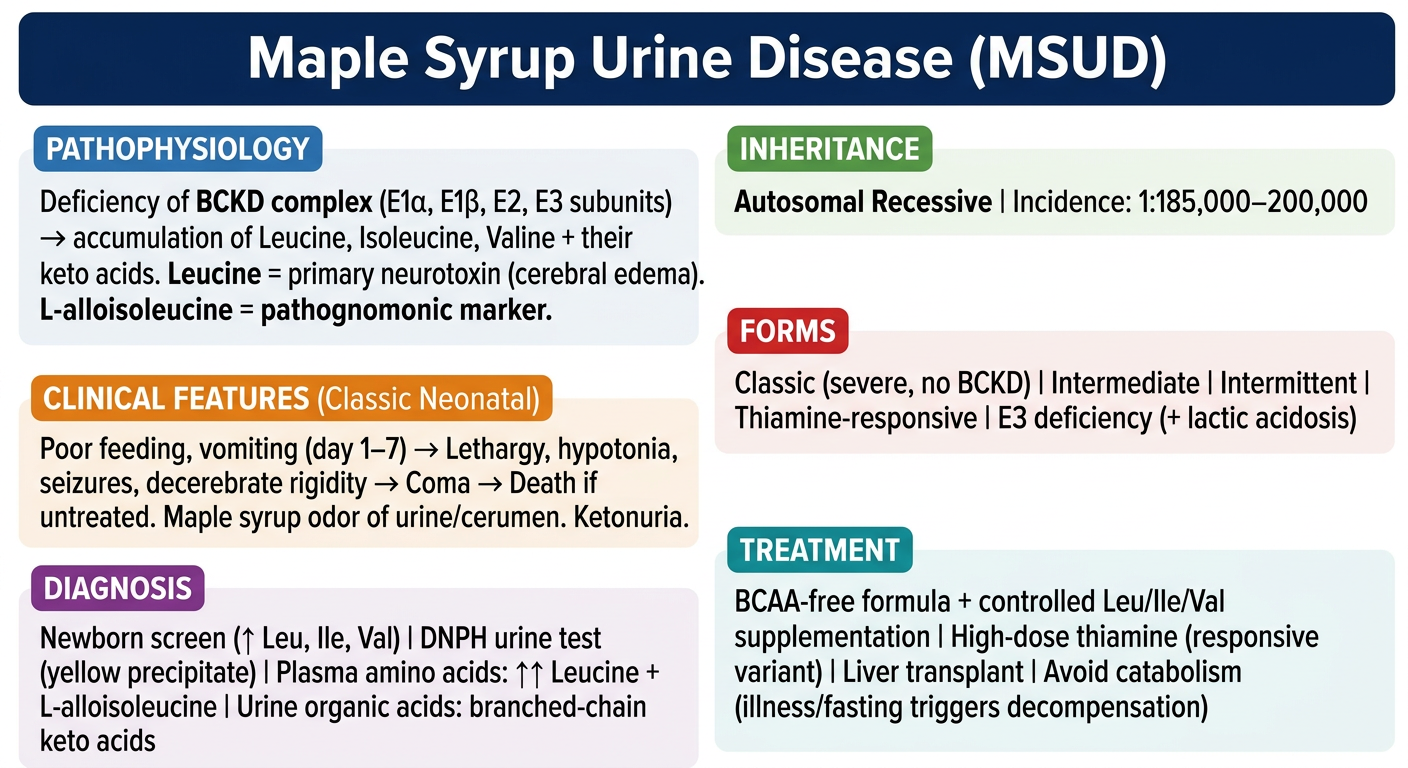
Flashcard of it
Medical flashcard for Maple Syrup Urine Disease (MSUD). Front side at top with title "Maple Syrup Urine Disease (MSUD)" on a dark navy blue header. Below, the card is split into clean sections with colored label tags: PATHOPHYSIOLOGY: Deficiency of BCKD complex (E1α, E1β, E2, E3 subunits) → accumulation of Leucine, Isoleucine, Valine + their keto acids. Leucine = primary neurotoxin (cerebral edema). L-alloisoleucine = pathognomonic marker. INHERITANCE: Autosomal Recessive | Incidence: 1:185,000–200,000 CLINICAL FEATURES (Classic Neonatal): Poor feeding, vomiting (day 1–7) → Lethargy, hypotonia, seizures, decerebrate rigidity → Coma → Death if untreated. Maple syrup odor of urine/cerumen. Ketonuria. FORMS: Classic (severe, no BCKD) | Intermediate | Intermittent | Thiamine-responsive | E3 deficiency (+ lactic acidosis) DIAGNOSIS: Newborn screen (↑ Leu, Ile, Val) | DNPH urine test (yellow precipitate) | Plasma amino acids: ↑↑ Leucine + L-alloisoleucine | Urine organic acids: branched-chain keto acids TREATMENT: BCAA-free formula + controlled Leu/Ile/Val supplementation | High-dose thiamine (responsive variant) | Liver transplant | Avoid catabolism (illness/fasting triggers decompensation) Clean, professional medical study card design with white background, color-coded section headers (blue, green, orange, red, purple), clear sans-serif font, compact and readable layout.