
Help me understand the implications of PEEP in positive pressure ventilation
Reading File
PEEP (Positive End-Expiratory Pressure) is the pressure maintained in the airways at the end of expiration during mechanical ventilation. It prevents alveolar collapse, improves oxygenation by increasing functional residual capacity (FRC), but carries risks including barotrauma and reduced cardiac output if set too high.
Searching sources...
Finding Sources
Searching PubMed
"PEEP" AND "mechanical ventilation" AND "lung protective"
Good results. Now let me read the most detailed textbook sections in parallel.
Reading File
Reading File
Finding Sources
Excellent material from multiple authoritative textbooks. Let me now read the dedicated PEEP sections from Fishman's and Murray & Nadel's for comprehensive coverage.
Reading File
Reading File
Excellent. Now let me get the pulmonary effects and hemodynamic/adverse effects sections from Morgan & Mikhail and also search for PEEP in ARDS/optimal PEEP titration content.
Reading File
Finding Sources
Now let me read the Harrison's section on PEEP management in ARDS and the Morgan & Mikhail hemodynamic/adverse effects section.
Reading File
Reading File
Reading File
Finding Sources
Reading File
Let me now read the Harrison's adverse cardiopulmonary effects section and the Miller's esophageal/transpulmonary PEEP titration section.
Reading File
Reading File
I now have comprehensive content from multiple authoritative sources. Let me compile the full answer.
Loading Image
I now have everything needed for a comprehensive answer. Here it is:
PEEP in Positive Pressure Ventilation
Definition
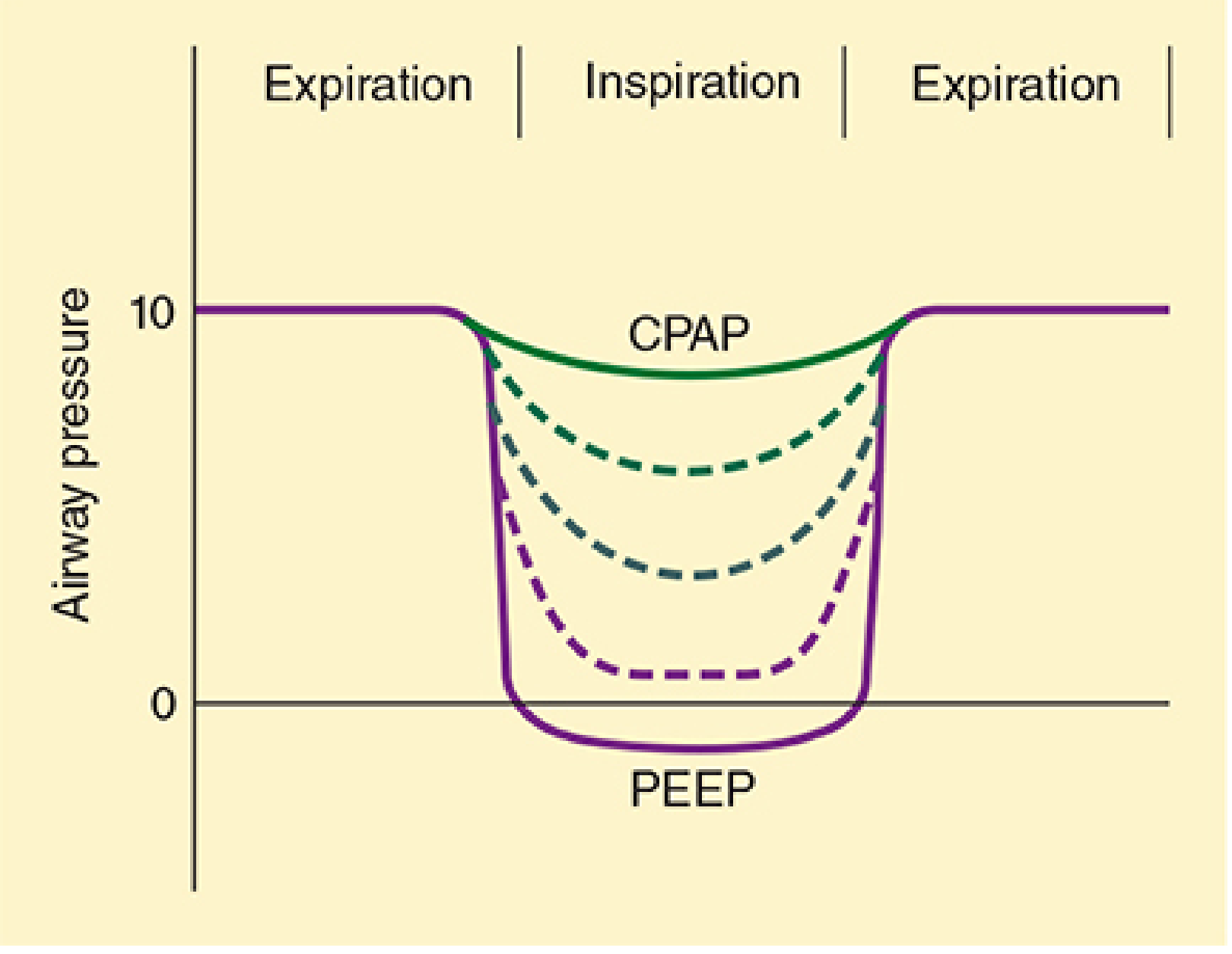
PEEP (Positive End-Expiratory Pressure) is the maintenance of positive airway pressure above atmospheric at the end of passive exhalation. The ventilator's PEEP valve creates a pressure threshold that only allows expiratory flow when airway pressure exceeds the set PEEP level. In its strictest sense, PEEP is applied during ventilator-cycled (controlled) breaths, while CPAP applies the same concept during spontaneous breathing - though clinically the terms are often used interchangeably.
The diagram below illustrates the continuum from PEEP to CPAP as inspiratory flow increases:
Beneficial Pulmonary Effects
1. Increases Functional Residual Capacity (FRC)
The primary action of PEEP is to increase end-expiratory lung volume. In disease states where FRC falls below closing capacity (as in ARDS, obesity, or post-op atelectasis), small airways close during tidal breathing, generating intrapulmonary shunting and hypoxemia. PEEP raises FRC back above closing capacity, preventing this. - Morgan and Mikhail's Clinical Anesthesiology, 7e
2. Alveolar Recruitment
PEEP recruits (re-expands) collapsed alveoli, particularly when set above the lower inflection point (LIP) of the pressure-volume curve - the pressure at which, with small increases in pressure, large increases in volume occur. Recruitment occurs through three mechanisms:
- Distention of patent alveolar units
- Recruitment of previously collapsed alveolar units
- Redistribution of fluid within the lung (from alveolar to perivascular spaces)
The decrease in venous admixture with PEEP is proportional to alveolar recruitment - it was once thought that PEEP improved PaO2 mainly by reducing cardiac output (and therefore mixed venous oxygen content), but this view has been shown to be erroneous. - Fishman's Pulmonary Diseases and Disorders
3. Improves Compliance and Reduces Work of Breathing
In acute lung injury, tidal breathing occurs on the low, flat portion of the pressure-volume curve. PEEP shifts tidal breathing to a more compliant portion of the curve, reducing the work of breathing. In patients with auto-PEEP (intrinsic PEEP), external PEEP can counteract the inspiratory threshold load, making it easier to trigger the ventilator. - Fishman's Pulmonary Diseases and Disorders
4. Reduces Atelectrauma and Ventilator-Induced Lung Injury (VILI)
Repeated alveolar collapse and re-expansion ("atelectrauma") generates shear forces at the junction of open and collapsed units that contribute to VILI. PEEP prevents cyclic collapse, reducing this mechanism of injury. This is distinct from but complementary to the harm reduction from low tidal volumes. - Murray & Nadel's Textbook of Respiratory Medicine
5. Edema Fluid Redistribution
Though PEEP does not reduce total extravascular lung water (and can actually increase it - see adverse effects below), it redistributes alveolar fluid into perivascular cuffs. This redistribution is the major mechanism for improved PaO2 in pulmonary edema, separate from the recruitment effect. - Fishman's Pulmonary Diseases and Disorders
Adverse Effects
Hemodynamic Compromise
PEEP increases intrathoracic and pleural pressure (Ppl). The proportion of applied PEEP transmitted to the pleural space depends on the relative compliances of lung and chest wall:
- In a healthy person (equal lung and chest wall compliance), ~50% of PEEP is transmitted to Ppl. For 10 cmH2O PEEP, Ppl rises ~5 cmH2O.
- In a patient with severe ARDS (stiff lung, normal chest wall), very little PEEP is transmitted to Ppl.
- In a patient with emphysema + kyphoscoliosis (compliant lung, stiff chest wall), a greater proportion is transmitted.
Consequences of increased Ppl:
- Reduced venous return - increased pericardial pressure reduces right heart filling and cardiac output
- Right ventricular afterload - PEEP raises pulmonary vascular resistance by compressing alveolar vessels, which increases RV afterload and can precipitate or worsen RV failure. This is particularly important in patients with pre-existing pulmonary arterial hypertension.
- Left ventricular effects - Paradoxically, positive pressure can benefit left-sided heart failure by reducing LV preload and afterload.
- Spurious pressure readings - increased central venous pressure and pulmonary artery occlusion pressure from PEEP, if not accounted for, can lead to errors in assessing intravascular volume status.
- Harrison's Principles of Internal Medicine 22E; Murray & Nadel's
Barotrauma
High PEEP or sustained high plateau pressures (>30 cmH2O) can cause lung overdistention leading to pneumothorax, pneumomediastinum, pneumoperitoneum, and worsening acute lung injury. In heterogeneous diseases like ARDS or lobar pneumonia, PEEP may overdistend well-aerated regions while failing to recruit consolidated regions - potentially worsening V/Q mismatch in those areas. - Rosen's Emergency Medicine; Harrison's
Increased Lung Water
Counterintuitively, PEEP can increase pulmonary edema. As alveoli expand, interstitial pressure in the extra-alveolar space decreases, lowering perivascular pressure and increasing transmural filtration pressure. If intravascular pressures are maintained (e.g., with IV fluids), PEEP increases lung water. It is only when PEEP reduces cardiac output (and therefore pulmonary capillary pressures) that lung water does not increase. - Fishman's Pulmonary Diseases and Disorders
Cerebral Venous Hypertension
Decreased venous return from PEEP can raise cerebral venous pressure - important in patients with traumatic brain injury or raised intracranial pressure. The PEEP level that optimizes oxygenation may be harmful for cerebral venous drainage. - Roberts and Hedges' Clinical Procedures in Emergency Medicine
Auto-PEEP (Intrinsic PEEP)
Auto-PEEP (iPEEP) develops when insufficient expiratory time allows complete exhalation before the next breath begins - air traps, creating occult positive alveolar pressure at end-expiration. It differs from applied (extrinsic) PEEP in that it is unintentional and can be difficult to detect with standard ventilator monitoring.
-
Most common in patients with reduced lung elastic recoil (COPD, elderly, emphysema)
-
Increases as I:E ratio increases (shorter expiratory time)
-
During one-lung ventilation, auto-PEEP averages 4-6 cmH2O in COPD patients
-
Total PEEP = set PEEP + intrinsic PEEP (measured during an expiratory hold)
-
When external PEEP is applied in the presence of auto-PEEP, the net effect is complex: patients with low auto-PEEP (<2 cmH2O) experience a greater increase in total PEEP from external PEEP than those with high auto-PEEP (>10 cmH2O)
-
Miller's Anesthesia 10e
PEEP Titration Strategies
Selecting the "best PEEP" for an individual patient is one of the more challenging problems in critical care. Several strategies exist:
| Strategy | Method | Notes |
|---|---|---|
| ARDSnet PEEP-FiO2 tables | Empirical paired tables of PEEP and FiO2 | Minimum 5 cmH2O recommended; widely used |
| Lower inflection point | Set PEEP just above LIP on pressure-volume curve | Maximizes compliance; technically demanding |
| Esophageal manometry | Titrate PEEP to maintain positive end-expiratory transpulmonary pressure | Especially useful in obesity, stiff chest wall; randomized trials have not shown outcome benefit vs. empirical high PEEP |
| Decremental PEEP trial | Inflate to high PEEP (20-25 cmH2O) after recruitment maneuver, then step down to PEEP that maximizes compliance | Promising physiology but largest RCT did not show mortality benefit |
| Driving pressure minimization | Titrate PEEP to minimize driving pressure (plateau - PEEP) | Recommended approach during one-lung ventilation |
- Harrison's 22E; Miller's Anesthesia 10e
No consensus currently exists on the optimal PEEP titration method. The ARDSnet landmark trial showed 31% vs 40% 28-day mortality with low VT (6 mL/kg) + PEEP ≥5 cmH2O - the mortality benefit came from low tidal volumes; multiple subsequent trials comparing lower vs. higher PEEP protocols have not demonstrated additional survival benefit despite improved oxygenation. - Harrison's Principles of Internal Medicine 22E
Key Clinical Scenarios
| Condition | PEEP Strategy | Rationale |
|---|---|---|
| ARDS | 5-20+ cmH2O, titrated | Diffuse collapse; high PEEP recruits; avoid overdistention |
| Cardiogenic pulmonary edema | Moderate PEEP/CPAP | Redistributes alveolar fluid; reduces LV afterload |
| Focal pneumonia | Low PEEP | High PEEP overdistends normal lung, worsens V/Q |
| COPD/auto-PEEP | External PEEP ≤ auto-PEEP | Reduces trigger work; avoid stacking |
| Severe RV failure/PAH | Minimize PEEP | PEEP increases RV afterload and may cause RV decompensation |
| TBI | Use cautiously | Increased Ppl may raise ICP via venous hypertension |
| Obese patients | Higher PEEP often needed | Increased abdominal pressure compresses lung; esophageal manometry helpful |
Summary
PEEP is indispensable in positive pressure ventilation because it prevents the cycle of alveolar collapse and re-expansion that both impairs oxygenation and injures lung tissue. Its beneficial effects are well-established: improved FRC, alveolar recruitment, better compliance, and reduced atelectrauma. The harms - hemodynamic compromise from reduced venous return and increased RV afterload, overdistention barotrauma, and increased lung water - arise primarily from excessive PEEP or its inappropriate application in patients whose physiology is poorly suited to it. Matching the level and titration strategy to the underlying pathophysiology and lung mechanics is the practical challenge.
Sources: Morgan and Mikhail's Clinical Anesthesiology 7e; Fishman's Pulmonary Diseases and Disorders; Murray & Nadel's Textbook of Respiratory Medicine; Harrison's Principles of Internal Medicine 22E; Miller's Anesthesia 10e; Rosen's Emergency Medicine; Roberts and Hedges' Clinical Procedures in Emergency Medicine.
This is a shared conversation. Sign in to Orris to start your own chat.