
Agressive treament for IBS type C
I'll start by reading the medical library skill, then search for IBS-C treatment information in parallel.
Searching sources...
Reading File
Now I'll run parallel searches across the library and PubMed:
Finding Sources
Searching PubMed
"irritable bowel syndrome" AND constipation AND treatment
Good hits. Now let me read the key treatment sections in parallel:
Reading File
Reading File
Reading File
Excellent material. Let me get the Harrison's neuromodulators section and fetch the IBS-C treatment algorithm image:
Reading File
Reading File
I have thorough content now. Let me fetch the IBS-C treatment algorithm image and check the neuromodulator text:
Loading Image
Reading File
I now have everything needed for a thorough answer. Here is the complete, evidence-based guide to aggressive treatment of IBS-C:
Aggressive Treatment of IBS with Constipation (IBS-C)
"Aggressive" treatment applies to moderate-to-severe IBS-C - cases that significantly impair quality of life, have failed basic measures, or coexist with significant psychological distress. Treatment is escalating and typically combines multiple drug classes simultaneously.
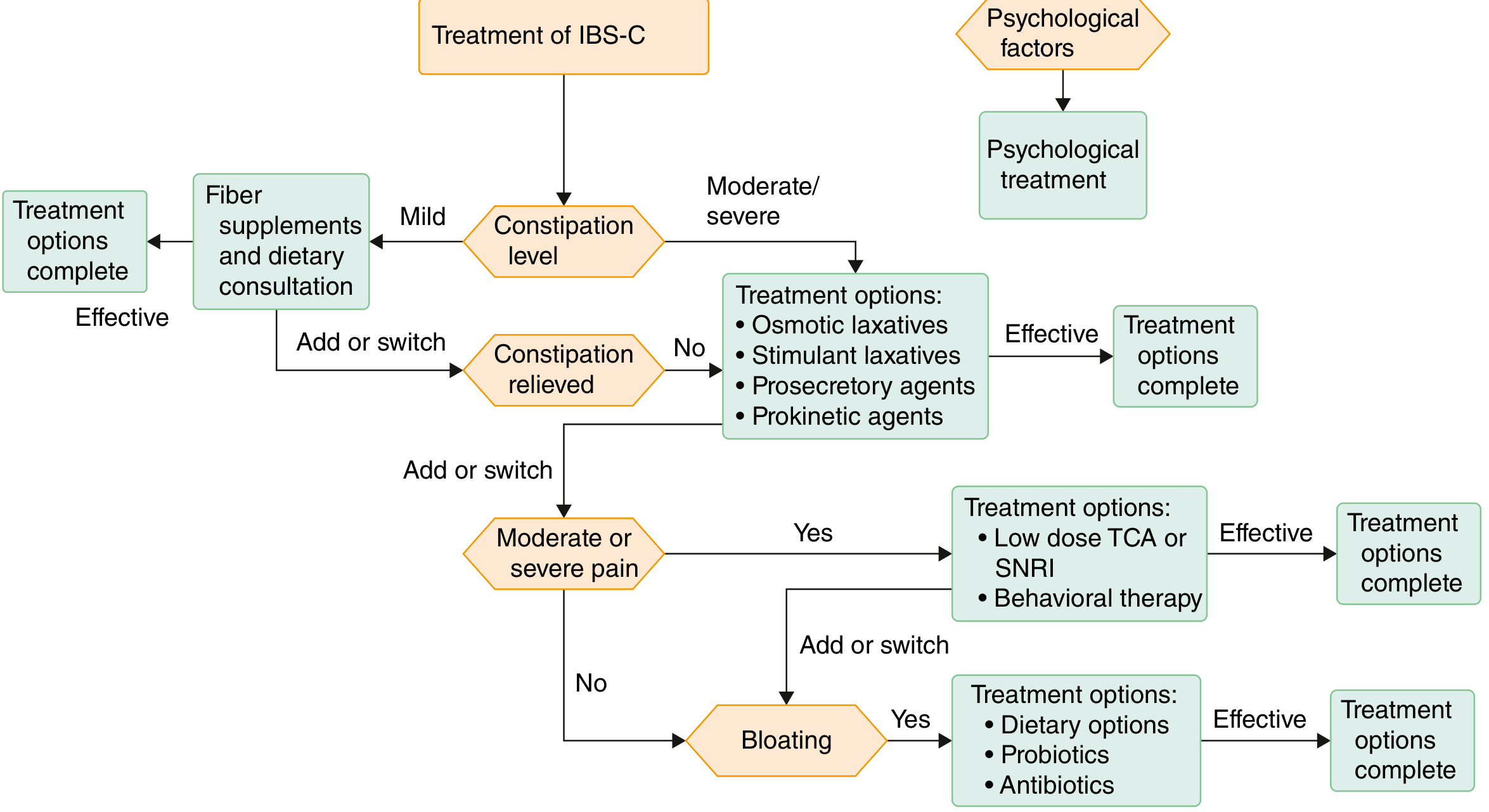
Step 1: Foundation (Do Not Skip Even in Severe Disease)
Diet
- Low-FODMAP diet - reduces fermentable carbohydrates, improves global IBS symptoms including bloating, abdominal pain, and abnormal bowel habits. Best managed with a trained dietitian.
- Soluble fiber (psyllium/ispaghula) - 25 to 35 g/day, titrated slowly upward. Recommended over insoluble fiber (wheat bran). Improves stool form and frequency. - Goldman-Cecil Medicine
Step 2: First-Line Pharmacotherapy for Constipation Relief
Osmotic Laxatives
| Drug | Dose | Notes |
|---|---|---|
| Polyethylene glycol (PEG) 3350 | 17 g in 125 mL water daily | Improves stool frequency; does NOT reliably reduce abdominal pain in IBS-C |
| Lactulose | 10-40 g/day | Effective but causes gas/bloating - limits use |
| Magnesium-based | Varies | Avoid in renal impairment (hypermagnesemia risk) |
Antispasmodics (for Pain/Spasm)
- Peppermint oil - 180-200 mg 3x/day before meals. NNT = 3 for global symptoms and abdominal pain. Best-tolerated option; novel small intestinal-release formulation available.
- Hyoscyamine - 0.125 mg 3-4x/day PRN
- Dicyclomine - 10 mg 3-4x/day PRN
- Non-anticholinergic options (otilonium, pinaverium) are available outside the USA and appear efficacious.
Source: Sleisenger and Fordtran's Gastrointestinal and Liver Disease
Step 3: Secretagogues (FDA-Approved, First-Line for Moderate-Severe IBS-C)
These are the backbone of aggressive IBS-C treatment. They act on the intestinal epithelium to drive fluid secretion, relieving both constipation AND pain.
| Drug | Mechanism | Dose | NNT | Key Notes |
|---|---|---|---|---|
| Linaclotide | GC-C agonist (guanylate cyclase-C) | 290 mcg once daily | 7-8 | FDA-approved for IBS-C; reduces pain AND constipation; major SE = diarrhea (<5%) |
| Plecanatide | GC-C agonist | 3 mg once daily | 8-14 | FDA-approved; similar mechanism to linaclotide; SE = diarrhea |
| Lubiprostone | Type-2 chloride channel activator | 8 mcg twice daily (IBS-C dose; lower than chronic constipation dose) | Modest benefit | FDA-approved for women with IBS-C; SE = nausea, diarrhea |
| Tenapanor | NHE3 inhibitor (sodium-hydrogen exchanger) | 50 mg twice daily | - | FDA-approved; newest agent; SE = diarrhea, bloating |
Both linaclotide and plecanatide are minimally absorbed peptides - very safe systemically. Diarrhea is the main dose-limiting side effect. - Harrison's Principles of Internal Medicine 22E (2025)
Step 4: Prokinetics
- Tegaserod (5-HT4 agonist) - 6 mg twice daily - approved for women under age 65 without a history of cardiovascular ischemic events. Improves abdominal discomfort, constipation, and bloating. Diarrhea is the main side effect. (Restricted indication due to prior cardiovascular signal.)
Step 5: Central Brain-Gut Neuromodulators (for Moderate-Severe Pain or Refractory Cases)
These agents are used for their visceral analgesic effects - independent of any antidepressant effect. They work faster and at lower doses than when used for psychiatric indications.
SSRIs (preferred in IBS-C - pro-motility effect)
| Drug | Dose |
|---|---|
| Fluoxetine | 20-40 mg daily |
| Paroxetine | 10-50 mg daily |
| Sertraline | 25-150 mg daily |
| Citalopram | 5-20 mg daily |
SSRIs have a mild prokinetic effect making them preferable over TCAs in IBS-C (TCAs can worsen constipation).
SNRIs
- Duloxetine or venlafaxine - used when both pain modulation and mood/anxiety comorbidity are present.
TCAs (use cautiously in IBS-C due to constipating effect)
- Desipramine or nortriptyline are better tolerated than amitriptyline for IBS-C (less anticholinergic/constipating)
- Start at 10-25 mg at bedtime, titrate to up to 100 mg at bedtime
- Most useful when pain is the dominant symptom and other agents have failed
Source: Goldman-Cecil Medicine; Harrison's Principles
Step 6: Gut Microbiome Modulation (Add-On for Bloating/Global Symptoms)
- Rifaximin - primarily IBS-D, but non-absorbed oral antibiotic has shown benefit in IBS patients with predominant bloating. Not standard of care for IBS-C but considered in refractory cases.
- Probiotics - combination products reduce global IBS symptoms by ~20%. Most useful when bloating dominates. Evidence is mixed.
Step 7: Psychological/Behavioral Therapies (for Severe/Refractory IBS-C)
Mandatory in patients with psychological comorbidity, severe symptoms, or multiple treatment failures:
- Cognitive behavioral therapy (CBT) - strongest evidence
- Gut-directed hypnotherapy
- Mindfulness-based therapy
These have durable effects and complement pharmacotherapy.
Summary: Aggressive Combination Protocol for Severe IBS-C
For a patient with severe IBS-C that has failed basic measures, a reasonable aggressive strategy is:
- Low-FODMAP diet + soluble fiber (ongoing foundation)
- Linaclotide 290 mcg daily (or plecanatide 3 mg daily) as the primary agent
- Peppermint oil or antispasmodic PRN for pain/spasm
- If pain persists: Add SSRI (e.g., sertraline 25-50 mg) for visceral analgesia
- If bloating dominates: Add probiotics or trial of rifaximin
- If cardiovascular risk is low (women <65): Consider adding tegaserod 6 mg BID
- Concurrent CBT or gut-directed hypnotherapy
Recent evidence update: A 2026 meta-analysis (PMID 40471839) reviewing the safety of IBS pharmacotherapy confirms the secretagogues (linaclotide, plecanatide, tenapanor) have favorable safety profiles, with diarrhea being the predominant and self-limiting adverse effect in most patients.
Note: "Aggressive" treatment does not mean using all agents simultaneously. The approach is stepwise escalation, with combination therapy introduced when individual agents provide incomplete relief.
This is a shared conversation. Sign in to Orris to start your own chat.