
Pre Anaesthesic check up definition according to ASA and standard Anaesthesia textbook
I'll start by reading the medical library skill, then search for pre-anaesthetic checkup definitions simultaneously.
Reading File
Now let me search the library and web simultaneously for pre-anaesthetic checkup definitions.
Finding Sources
Finding Sources
Searching the Web
pre anaesthetic checkup definition ASA American Society of Anesthesiologists
Let me search the library with broader terms and extract the ACS article simultaneously.
Finding Sources
Finding Sources
Reading Web Page
https://www.facs.org/for-medical-professionals/news-publicat…
Excellent! I found key content in Sabiston and Miller's. Let me now read the detailed sections from these textbooks simultaneously.
Reading File
Reading File
Finding Sources
Excellent! Found detailed sections in Barash Clinical Anesthesia. Let me read those sections now.
Reading File
Finding Sources
The Barash section I found was for neonatal/pediatric — let me search for the main preanesthetic evaluation chapter in Barash and also Morgan & Mikhail which is a classic standard anesthesia textbook.
Finding Sources
Reading File
Let me also read the main preanesthetic evaluation section from Barash block 7 (the primary chapter on this topic - before block 14 which was neonatal), and look for Morgan & Mikhail content.
Reading File
Finding Sources
Now let me read the main definition/overview section of the Barash chapter and the Morgan & Mikhail pre-op section.
Reading File
Finding Sources
Now let me read the Miller's "Goals and Benefits of Pre-Anesthesia Evaluation" section which is the most relevant.
Reading File
I now have rich, authoritative content from multiple standard anaesthesia textbooks. Let me also fetch the flowchart image from Miller's.
Loading Image
I now have comprehensive content from all the key sources. Let me compile the full, authoritative answer.
Pre-Anaesthetic Check-Up (PAC): Definition and Standards
ASA Basic Standards for Preanesthetic Care
The American Society of Anesthesiologists (ASA) has established basic standards that define the minimum requirements for preanesthetic care. According to these standards:
"An anesthesiologist is required to evaluate the medical status of the patient, derive a plan for anesthetic care, and discuss the plan with the patient."
- Sabiston Textbook of Surgery, 7th ed., p. 338
The Joint Commission on Accreditation of Healthcare Organizations (JCAHO/The Joint Commission) additionally mandates that all patients receiving anesthesia must undergo a preanesthetic evaluation before any procedure. The ASA has further published a detailed Practice Advisory for Preanesthesia Evaluation containing evidence-supported recommendations, accessible via the ASA guidelines portal.
Definition from Standard Anaesthesia Textbooks
1. Barash, Cullen & Stoelting's Clinical Anesthesia (9th ed.) - A Standard Anaesthesia Textbook
"The goals of a preoperative evaluation are to reduce patient risk and morbidity associated with surgery and anesthesia, prepare the patient medically and psychologically, and promote efficiency and cost-consciousness."
The preoperative evaluation is described as a multi-component process that includes:
- Review of the medical record
- A focused history and physical examination pertinent to the patient and planned procedure
- Ordering appropriate diagnostic tests and preoperative consultations
- Determination of how best to optimize the patient's condition prior to surgery
- Development of an appropriate anesthetic care plan
- Patient education about anesthesia and the perioperative period
- Answering all questions and obtaining informed consent
The evaluation is conducted on the premise that it will modify patient care and improve outcomes by allowing the anesthesiologist to prepare the patient and formulate an anesthetic plan that avoids dangers inherent in various disease states. It also reduces costs and surgery cancellation rates.
- Barash Clinical Anesthesia, 9th ed., p. 1742
2. Miller's Anesthesia (10th ed.) - The Reference Standard Textbook
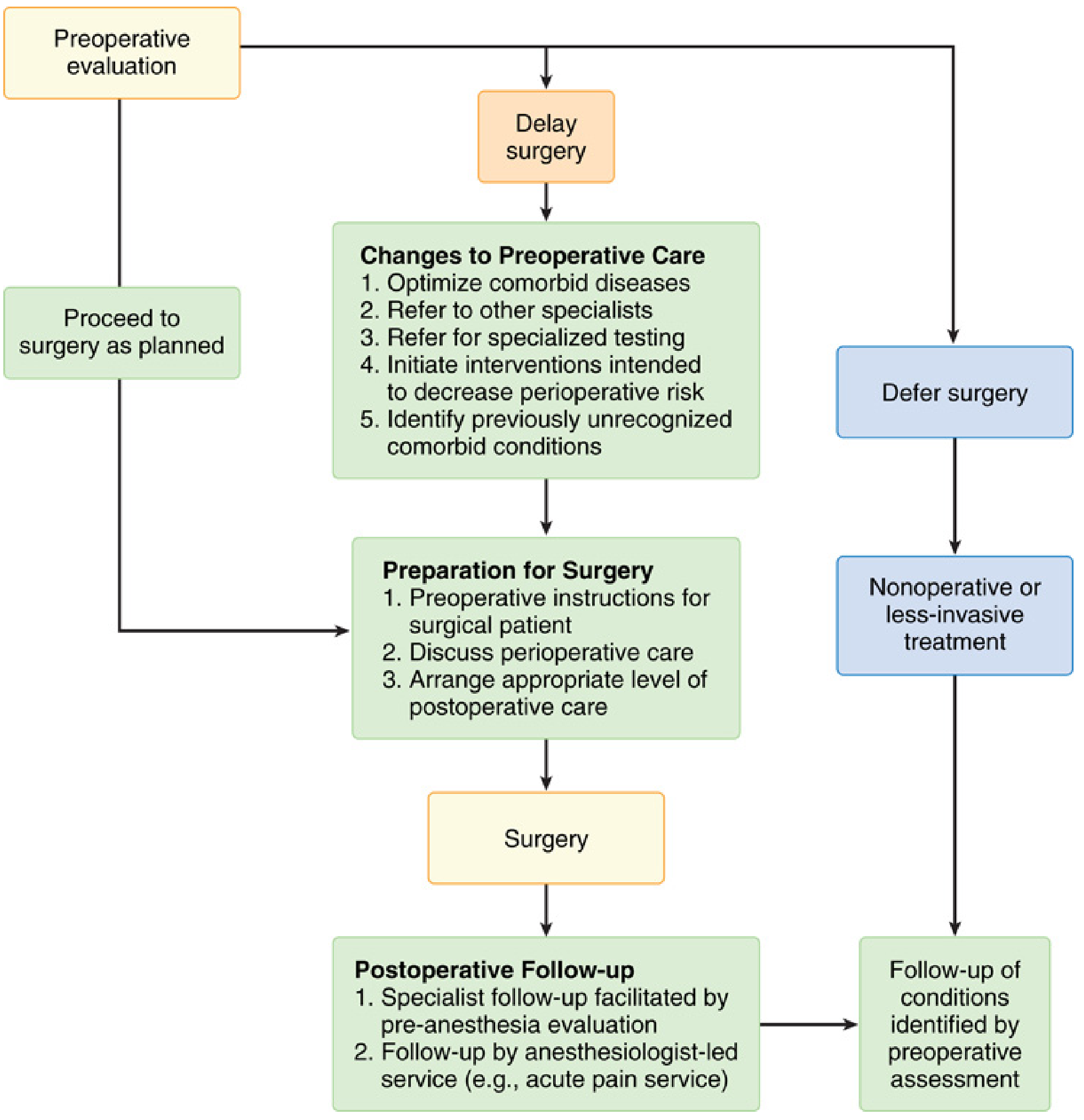
Goals and Benefits of Pre-Anesthesia Evaluation (Miller's, Ch. 28):
"The overarching goals of pre-anesthesia evaluation are to (1) ensure that the patient can safely tolerate anesthesia for the planned surgery and (2) mitigate perioperative risks such as pulmonary or cardiovascular complications."
Miller's describes that in pursuit of these goals, the pre-anesthesia evaluation offers opportunities to:
- Perform focused clinical examinations
- Better document comorbid illness
- Reduce the patient's (and family's) anxiety through education
- Optimize preexisting medical conditions
- Make selective referrals to medical specialists (e.g., cardiologists)
- Order specialized investigations (e.g., cardiac stress tests)
- Initiate interventions intended to decrease risk
- Discuss aspects of perioperative care (e.g., anticipated risks, fasting guidelines)
- Arrange appropriate levels of postoperative care (e.g., ICU)
- Identify previously unrecognized medical conditions (e.g., hypertension)
Anesthesiologist-led preoperative evaluation is associated with: more selective ordering of laboratory tests, reduced anxiety, improved acceptance of regional anesthesia, fewer day-of-surgery cancellations, shorter hospital stay, and lower costs.
- Miller's Anesthesia, 10th ed., p. 3826-3827
Flowchart from Miller's showing how PAC influences perioperative care:
3. Sabiston Textbook of Surgery (Anesthesiology Perspectives)
"The anesthesia preoperative evaluation serves multiple purposes. First, it allows the patient an opportunity to speak to an anesthesiologist and discuss the expected impact of anesthesia, including the patient's fears and concerns... Second, the preanesthetic interview focuses on the type of surgery, the underlying conditions necessitating surgery, any history of previous anesthetics, and the presence of coexisting diseases."
The evaluation determines whether additional medical evaluation or treatment is needed before surgery, through a focused history, physical examination, and, if indicated, laboratory evaluation. Current medications must be reviewed, and instructions regarding oral intake, medication changes, and other preoperative issues are communicated.
- Sabiston Textbook of Surgery, p. 338
Components of PAC (Barash Table 23-1 Preanesthetic Evaluation Screen)
| Domain | Key Points Assessed |
|---|---|
| Administrative | Diagnosis/procedure, age, sex, advance directives |
| Vitals | Height, weight, vital signs, NPO status |
| Medications | All drugs including OTCs, herbals, illicit substances |
| Allergies | Adverse drug reactions, latex allergy |
| Anaesthetic/surgical history | Prior anaesthetics, malignant hyperthermia (MH), airway difficulty |
| Airway | Mallampati class, mouth opening, neck mobility, OSA history |
| Pulmonary | URTI, asthma, COPD, tobacco use, OSA, CPAP settings |
| Cardiovascular | CAD, hypertension, valvular disease, CHF, dysrhythmias, pacemaker |
| CNS | Stroke, seizures, raised ICP, psychiatric disorders, neuromuscular disease |
| GI/Hepatic | Liver disease, reflux, bowel obstruction, alcohol use |
- Barash Clinical Anesthesia, 9th ed., p. 1746
Timing
According to the American College of Surgeons (2024), citing ASA guidelines: a preanesthesia assessment should be conducted within 48 hours of the day of surgery. High-risk patients may require in-person evaluation weeks in advance for optimization; low-risk patients scheduled for elective, low-risk procedures may be interviewed by telephone or virtually.
Summary
The Pre-Anaesthetic Check-Up (PAC) is a structured, anesthesiologist-led clinical evaluation mandated by both the ASA and The Joint Commission before any procedure requiring anaesthesia. Its core purpose is to:
- Assess the patient's medical fitness for anaesthesia and surgery
- Identify and optimize comorbidities
- Formulate a safe anaesthetic plan
- Educate the patient and obtain informed consent
- Reduce perioperative morbidity, mortality, and costs
This is a shared conversation. Sign in to Orris to start your own chat.