
Types of vaccine pharmacology
Reading File
Vaccines fall into several broad categories - live attenuated, inactivated, subunit/protein, toxoid, and nucleic acid-based (mRNA/DNA). Each type works through different mechanisms to prime the immune system.
Searching sources...
Finding Sources
Searching PubMed
vaccine types immunology mechanisms
Finding Sources
Finding Sources
Reading File
Finding Sources
Reading File
Finding Sources
Reading File
Finding Sources
Reading File
Reading File
Reading File
Reading File
Reading File
Reading File
I now have comprehensive content from multiple authoritative textbooks. Let me fetch the vaccine timeline image from Harrison's for visual context.
Loading Image
Loading Image
I now have all the content needed for a thorough, well-illustrated answer. Here is the complete response:
Types of Vaccines - Pharmacology
Vaccines are defined as inactivated or attenuated pathogens, or components of a pathogen (nucleic acid, protein), that when administered to the host stimulate a protective immune response. Adjuvants may be added to boost these responses non-specifically.
- Harrison's Principles of Internal Medicine 22E, p. 1040
Major conceptual and technological advances in vaccinology:
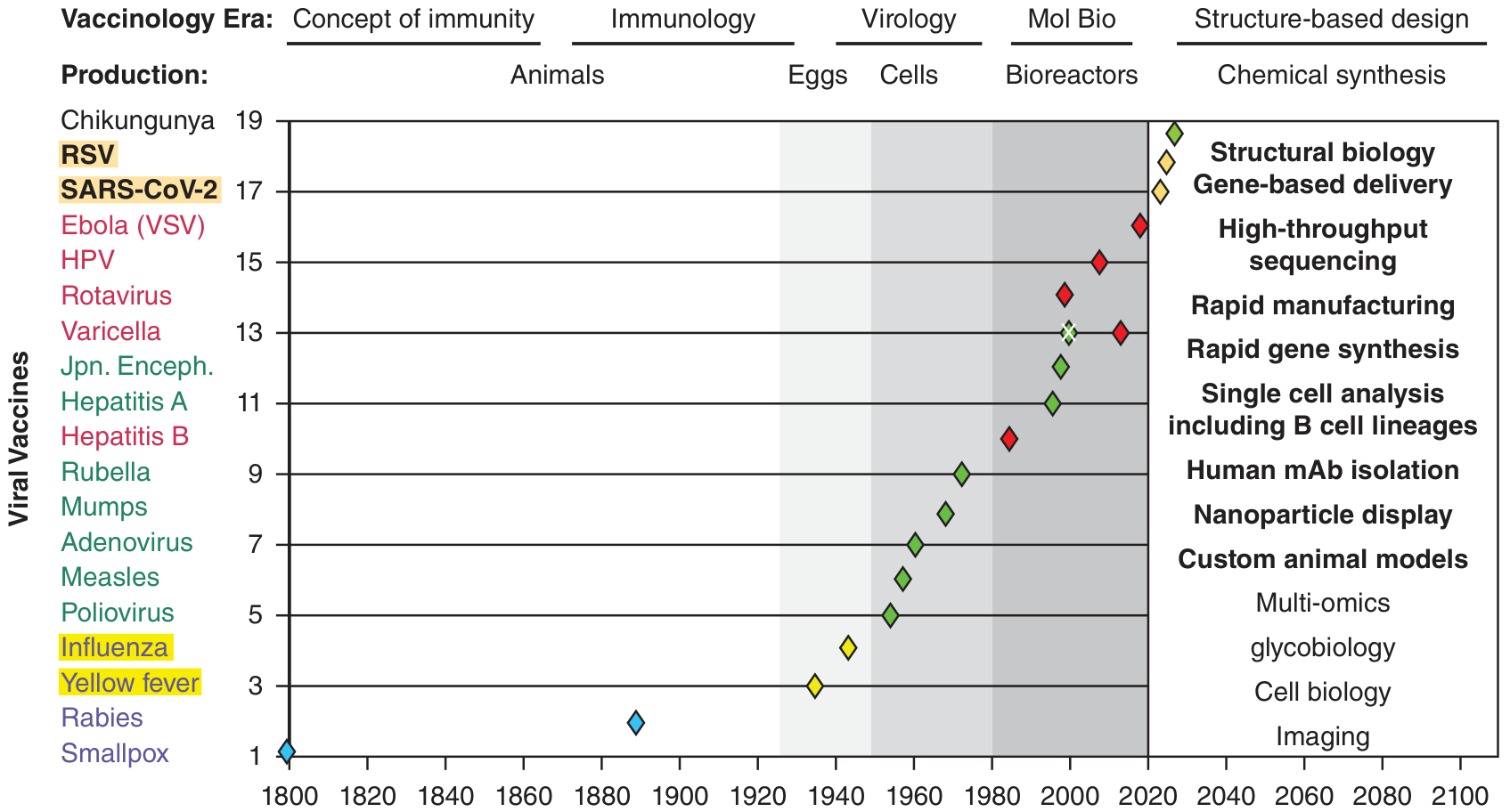
1. Live Attenuated Vaccines
Mechanism: The pathogen is repeatedly passaged in unnatural hosts, selecting for avirulent (weakened) strains that retain antigenicity but lose pathogenicity. They undergo limited replication in the host, closely mimicking natural infection.
Immune response generated:
- Strong and durable humoral (antibody) and cell-mediated (CTL) responses
- Generally require only 1-2 doses
- Stimulate mucosal, cellular, and memory responses
Examples: BCG (tuberculosis), MMR (measles/mumps/rubella), oral poliovirus vaccine (Sabin), yellow fever, varicella, rotavirus, intranasal influenza (LAIV)
Limitations: Risk of reversion to virulence (especially oral polio vaccine); contraindicated in immunocompromised patients and pregnancy.
- Cellular and Molecular Immunology (Abbas), p. 1089; Harrison's 22E, p. 1041
2. Inactivated (Killed) Vaccines
Mechanism: The pathogen is grown in culture then killed (by heat, formalin, or radiation). The killed organism retains surface antigens but cannot replicate.
Immune response generated:
- Primarily humoral (antibody) responses
- Generally require multiple doses and often need an adjuvant
- Do not produce potent CTL responses (since antigens enter the MHC class II, not class I, pathway)
- Protection is shorter-lived compared to live vaccines
Examples: Inactivated influenza vaccine (flu shot), inactivated polio vaccine (Salk/IPV), rabies, whole-cell pertussis, cholera
- Red Book 2021; Harrison's 22E, p. 1041
3. Subunit / Purified Antigen Vaccines
Mechanism: Only specific antigens (proteins, polysaccharides, or lipoproteins) purified from the pathogen are used, eliminating safety concerns of whole organisms. These are the "second-generation" vaccines.
a. Toxoid Vaccines
Bacterial toxins are detoxified (rendered harmless by formaldehyde or heat) without losing their immunogenicity. The resulting toxoid induces strong neutralizing antibody responses.
- Examples: Diphtheria toxoid, tetanus toxoid
b. Polysaccharide Vaccines
Composed of bacterial capsular polysaccharides. Because polysaccharides are T-independent antigens, they tend to produce low-affinity antibody, are poorly immunogenic in infants, and do not create strong memory.
- Examples: Pneumovax 23 (PPSV23), older meningococcal polysaccharide vaccines
c. Conjugate Vaccines
Polysaccharide antigens are covalently linked to a protein carrier (e.g., tetanus toxoid or diphtheria toxoid). This converts the T-independent response to a T-dependent one, recruiting T follicular helper (Tfh) cells into germinal center reactions, generating high-affinity IgG and memory B cells - even in infants.
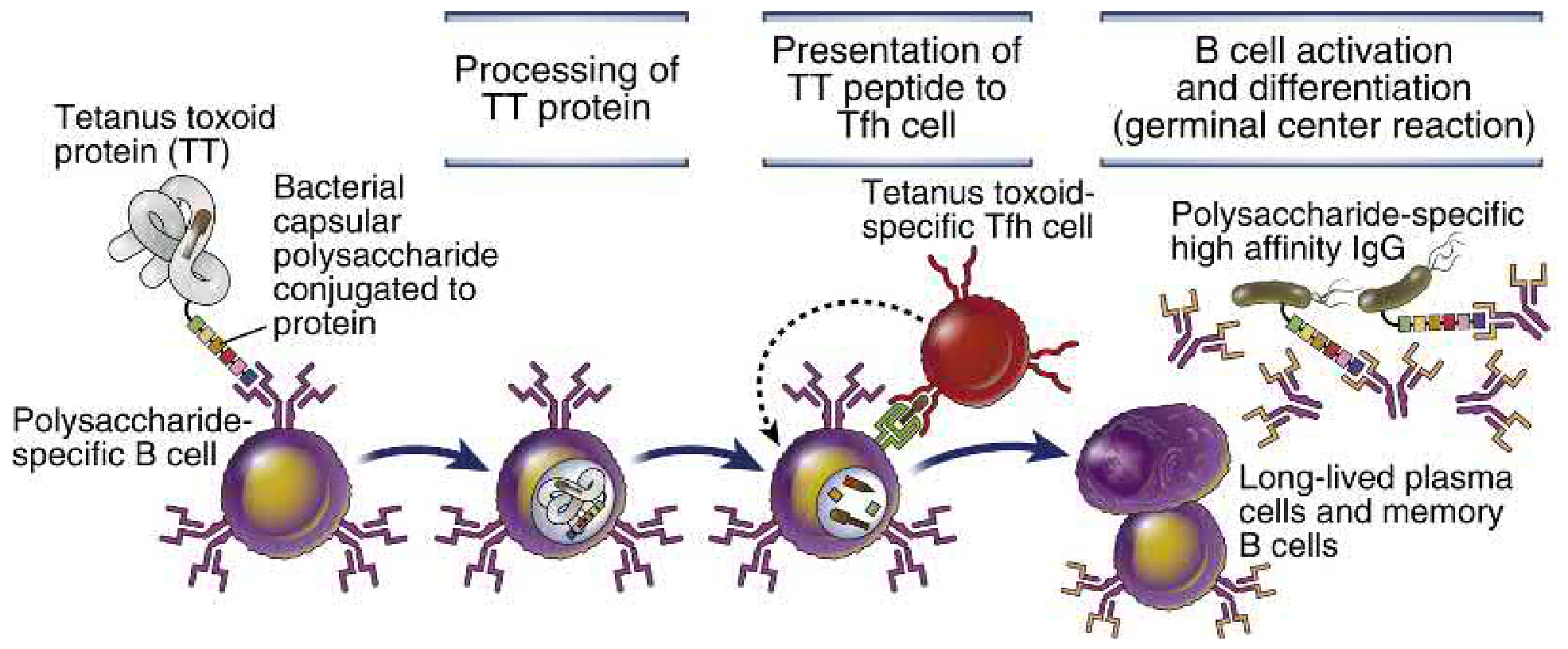
- Examples: Hib (H. influenzae type b), PCV13/15/20 (pneumococcal), meningococcal conjugate vaccines
d. Recombinant Protein Vaccines
Antigens are expressed in yeast or cell lines using recombinant DNA technology.
-
Examples: Hepatitis B vaccine (HBsAg expressed in yeast), HPV vaccine (VLP proteins from HPV 6, 11, 16, 18 expressed in yeast with adjuvant)
-
Cellular and Molecular Immunology (Abbas), p. 1090-1091; Harrison's 22E, p. 1041
4. Viral Vector Vaccines
Mechanism: A gene encoding a pathogen antigen is inserted into a non-pathogenic (often non-replicating) viral vector. The vector infects host cells, which express the foreign antigen, triggering both humoral and cell-mediated (CTL) immune responses - the full complement, similar to live vaccines. Adenovirus 26 and chimpanzee adenovirus vectors have been used because most people lack pre-existing antibodies to these serotypes.
Examples: Adenovirus-vectored COVID-19 vaccines (Johnson & Johnson, AstraZeneca/ChAdOx1), Ebola vaccine (rVSV-ZEBOV), Zika candidates
Limitations: Pre-existing immunity to the vector can reduce efficacy; potential for recombination with host sequences (theoretical).
- Cellular and Molecular Immunology (Abbas), p. 1093
5. DNA Vaccines
Mechanism: Plasmid DNA containing cDNA encoding a pathogen antigen is injected. Antigen-presenting cells (especially dendritic cells) are transfected; the cDNA is transcribed and translated into immunogenic protein. The bacterial plasmid itself is rich in unmethylated CpG nucleotides, recognized by TLR9 in DCs, eliciting an innate response that enhances adaptive immunity - meaning they may work even without adjuvants. DNA is also stable without refrigeration.
Examples: Mostly in clinical trials for HIV, influenza, Zika. Not yet widely approved for human use.
Limitations: First-generation DNA vaccines produced inadequate amounts of immunogen in humans.
- Cellular and Molecular Immunology (Abbas), p. 1093
6. mRNA Vaccines
Mechanism: Synthetic mRNA encoding the pathogen antigen (e.g., SARS-CoV-2 spike protein) is encapsulated in lipid nanoparticles (LNPs). After injection, LNPs are taken up by cells including dendritic cells, the mRNA is translated into antigen protein, and both humoral and cellular immune responses are triggered. The LNP itself also functions as an adjuvant. The mRNA is modified at multiple levels to improve stability:
- Synthetic 5' cap and long poly-A tail
- Modified 5' and 3' untranslated regions
- Codon optimization of coding sequences
Advantages:
- Rapid development (sequence of antigen can be uploaded and manufactured quickly)
- No need for large-scale antigen purification
- Multiple antigens can be combined in one vaccine
- Does not integrate into the host genome (unlike DNA vaccines)
Examples: Pfizer-BioNTech (BNT162b2), Moderna (mRNA-1273) COVID-19 vaccines. Both achieved ~95% efficacy in Phase 3 trials for symptomatic COVID-19.
A newer variant - self-amplifying mRNA (saRNA) - links the mRNA to a modified alphavirus RNA genome that allows self-replication, potentially allowing lower doses.
- Cellular and Molecular Immunology (Abbas), p. 1094; Goodman & Gilman's Pharmacological Basis of Therapeutics; Harrison's 22E, p. 1041
7. Adjuvants - Key Pharmacological Component
Adjuvants are substances added to vaccines to non-specifically enhance immune responses. They are particularly needed in inactivated and protein-based vaccines, while live-attenuated vaccines generally do not require them.
| Adjuvant | Mechanism | Used in |
|---|---|---|
| Alum (aluminum hydroxide/phosphate) | Promotes B cell (humoral) responses; >90 years of use | Most pediatric vaccines (DTaP, Hep B) |
| MF59 / AS03 (squalene oil-in-water emulsions) | Enhance innate and adaptive responses | Adjuvanted influenza vaccines |
| AS04 (MPL + alum) | TLR4 agonist + alum | HPV vaccine (Cervarix) |
| CpG (oligonucleotides) | TLR9 agonist; potent innate activation | Hepatitis B vaccine (Heplisav-B) |
| AS01B (MPL + QS-21 saponin) | Combined TLR4 and saponin stimulation | Shingrix (shingles), RTS,S (malaria) |
| Lipid nanoparticles | Facilitate mRNA cell uptake + innate activation | mRNA COVID-19 vaccines |
- Harrison's 22E, p. 1041; Cellular and Molecular Immunology (Abbas), p. 1095
Summary Table
| Type | Examples | Immune Response | Doses Needed | Adjuvant? |
|---|---|---|---|---|
| Live attenuated | MMR, BCG, OPV, yellow fever, varicella | Humoral + CMI + mucosal | 1-2 | No |
| Inactivated (killed) | IPV, influenza shot, rabies | Mainly humoral | Multiple | Often yes |
| Toxoid | Tetanus, diphtheria | Anti-toxin antibodies | Multiple | Yes |
| Polysaccharide | PPSV23 | Humoral (T-independent) | 1 | No (poor in infants) |
| Conjugate | Hib, PCV, MenACWY | High-affinity IgG + memory | Multiple | Often |
| Recombinant protein | Hep B, HPV, shingrix | Humoral + Th | Multiple | Yes |
| Viral vector | J&J COVID, AZ COVID, Ebola | Humoral + CTL | 1-2 | No |
| DNA | Experimental | Humoral + CTL | Multiple | No (CpG intrinsic) |
| mRNA | Pfizer/Moderna COVID | Humoral + CTL | 2 | LNP serves as adjuvant |
CMI = cell-mediated immunity; CTL = cytotoxic T lymphocytes; LNP = lipid nanoparticle
This is a shared conversation. Sign in to Orris to start your own chat.