
Triamcinolone indication and contraindications
triamcinolone indications contraindications
Triamcinolone - Indications and Contraindications
Indications
1. Dermatologic (Topical/Intralesional)
- Keloids and hypertrophic scars
- Hypertrophic lichen planus
- Alopecia areata
- Acne cysts / nodular acne
- Prurigo nodularis
- Chondrodermatitis nodularis chronica helicis
- Inflammatory dermatoses (eczema, psoriasis, contact dermatitis)
2. Allergic / Rhinologic (Nasal Spray)
- Seasonal and perennial allergic rhinitis (Nasacort - OTC, 55 mcg/actuation)
- Nonallergic rhinitis (fluticasone and triamcinolone both have this indication)
3. Musculoskeletal (Intra-articular / Soft Tissue Injection)
- Chronic arthritis (preferred over short-acting agents due to longer duration)
- Bursitis (subacute/chronic)
- Tendinitis
- Dupuytren's disease - intralesional injection softens palmar nodules
- General intra-articular inflammation
4. Ophthalmic (Sub-Tenon's / Intravitreal)
- Uveitis (noninfectious, posterior segment)
- Ocular inflammation and post-surgical inflammation
- Macular edema associated with retinal vein occlusion
- Used as vitreous stain during vitrectomy
- Alternative to anti-VEGF agents (e.g., in pregnancy or when anti-VEGF is contraindicated)
5. General Anti-inflammatory / Immunosuppressive (Systemic)
- Broad anti-inflammatory suppression - goal is to control disease activity at the minimum effective dose
- Part of the corticosteroid class used for: rheumatic disease, asthma, IBD, autoimmune conditions, and replacement therapy post-adrenalectomy
6. Oral Mucosal
- Dental paste (0.1%) for inflammatory/ulcerative oral mucosal lesions (aphthous ulcers, oral lichen planus)
Contraindications
Absolute Contraindications
| Condition | Rationale |
|---|---|
| Systemic fungal infections | Immunosuppression worsens disseminated fungal disease |
| Hypersensitivity to triamcinolone or any component (including benzyl alcohol in injectable forms) | Risk of anaphylaxis (reported with injectable forms) |
| Active untreated infections (topical ear use) | Steroid immunosuppression can exacerbate infection |
| Herpetic corneal ulcers (ophthalmic use) | Corticosteroid eye drops are absolutely contraindicated - can worsen herpes simplex keratitis |
| IV administration of injectable forms | Not indicated; injectable forms are designed for IM, intra-articular, or intralesional use only |
| Infection at injection site / systemic infection (for epidural/joint injections) | Direct risk of seeding infection |
Relative Contraindications / Use with Caution
- Thyroid dysfunction
- Respiratory tuberculosis (active)
- Ocular herpes simplex
- Peptic ulcer disease (steroids impair mucosal protection)
- Osteoporosis (steroids accelerate bone loss)
- Hypertension (fluid and sodium retention)
- Congestive heart failure (CHF)
- Myasthenia gravis
- Ulcerative colitis
- Renal dysfunction (dose adjustment may be needed)
- Hepatic failure with systemic use (dose adjustment may be necessary; triamcinolone is a CYP3A4 substrate - enzyme inhibitors increase side effect risk)
- Bleeding disorders (for injection procedures)
- Diabetes mellitus (steroids cause hyperglycemia; epidural injections are relatively contraindicated in uncontrolled DM)
- Osteochondral fracture at injection site (absolute contraindication for intra-articular injection)
Pregnancy
- Topical/nasal: generally acceptable
- Systemic/injectable use: pregnancy category D if used in the first trimester
Key Drug Interaction Note
Alopecia areata patient having can you tell me the pathophysiology and naturopathy and ayurvedic treatment too
alopecia areata Ayurvedic naturopathic treatment evidence 2024
"alopecia areata" AND pathophysiology
alopecia areata Ayurvedic naturopathic treatment herbs
alopecia areata naturopathic treatment onion juice rosemary oil essential oils clinical evidence
Alopecia Areata - Pathophysiology, Naturopathic & Ayurvedic Treatment
1. Pathophysiology
Core Concept: Collapse of Immune Privilege
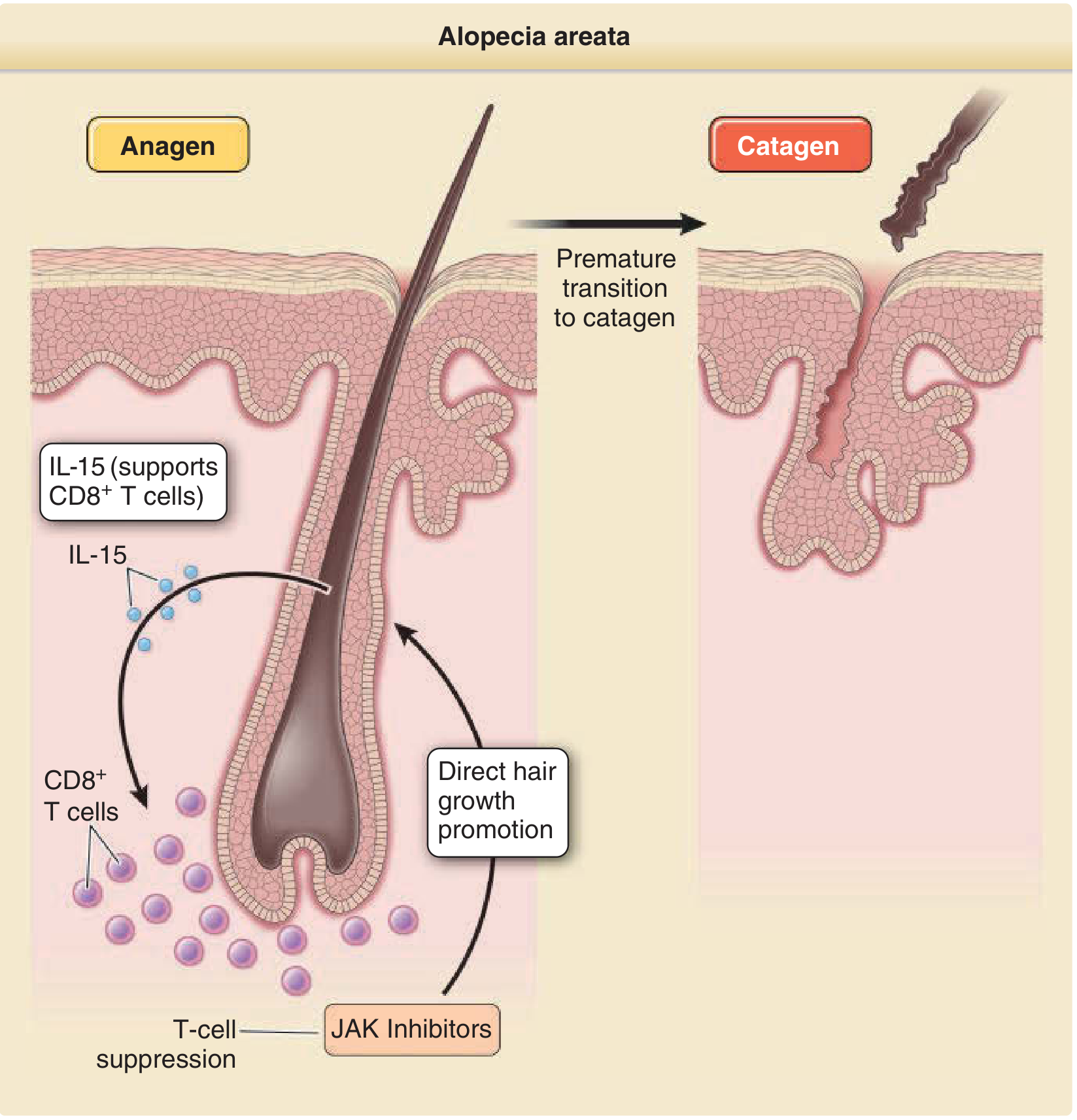
Step-by-Step Pathophysiology
- ~25% of patients have a positive family history
- GWAS studies identify SNPs in genes for T cell regulation: CTLA4, ICOS, IL2/IL21, IL2RA and antigen presentation: HLA-DR/DQ (dominant susceptibility locus)
- HLA DR4, DR11, DQ7 are specifically associated with early-onset, severe, familial AA
- Under normal conditions, HF keratinocytes express low MHC Class I/II and produce local immunosuppressive factors
- An unknown trigger (possibly stress, infection, or genetic predisposition) causes upregulation of MHC expression and loss of local immune suppression
- Follicular melanocytes act as autoantigens
- CD8+ NKG2D+ cytotoxic T cells are the primary effectors, gathering in a "swarm of bees" peribulbar infiltrate around the hair bulb (anagen follicle)
- IL-15 produced locally supports and induces these CD8+ T cells
- CD4+ helper T cells promote disease progression; CD4+CD25+ regulatory T cells (T-regs) protect against it - T-reg deficiency is a key permissive factor
- Key cytokines: IL-2, IFN-γ, TNF-α
- IFN-γ activates the JAK1/JAK2-STAT pathway, which drives follicular inflammation
- IL-15 sustains the CD8+ T cell response
- CD8+ T cell attack forces the anagen follicle into premature catagen (regression phase)
- The hair shaft tapers at the base, producing the characteristic "exclamation point hair" (wider at top, narrow near scalp)
- Follicles miniaturize; dystrophic anagen hairs appear high in the dermis
- Fibrous tract remnants persist - containing lymphoid cells, eosinophils, and melanin pigment
- Damage targets the bulb (matrix cells), NOT the bulge (stem cell reservoir)
- Stem cells remain intact, which is why spontaneous regrowth is possible
Key Associations
- Atopic dermatitis, Down syndrome, thyroiditis, SLE, diabetes mellitus, myasthenia gravis, vitiligo
- Nail involvement (pitting, trachyonychia, red lunulae) in ~10% - especially in long-standing cases
2. Naturopathic Treatments
A. Topical Botanical Agents
1. Onion Juice (Allium cepa)
- In a single-blind placebo-controlled trial (n=62, 8 weeks), twice-daily topical crude onion juice produced hair regrowth in 73.9% by week 4 and additional patients by week 6
- Males responded better (93.7%) than females (71.4%)
- Proposed mechanism: induction of mild contact dermatitis / antigenic competition, sulfur donation enhancing keratin synthesis, improved scalp microcirculation
- Adverse effects: mild erythema in ~60% of patients; odor is a deterrent
- Caveat: This 2002 trial remains largely unreplicated and is excluded from major AA guidelines
2. Garlic Gel (Allium sativum)
- In a double-blind RCT (n=40), 5% garlic gel added to betamethasone valerate 0.1% cream was significantly superior to betamethasone alone in stimulating terminal hair growth
- Organosulfur compounds provide anti-inflammatory and antimicrobial effects; also enhances cutaneous capillary perfusion
3. Aromatherapy - Essential Oils
- Cedarwood + Lavender + Thyme + Rosemary oils in a jojoba/grapeseed carrier ...showed significant reduction in areas of hair loss at 3- and 7-month assessments vs. vehicle control (p=0.008)
- Rosemary oil specifically promotes scalp circulation and has anti-inflammatory properties; shows non-inferiority to 2% minoxidil in androgenetic alopecia (though AA-specific data is more limited)
4. Korean Red Ginseng (KRG)
- Ginsenosides have anti-allergic and anti-inflammatory effects
- In a comparison trial, AA patients taking KRG alongside corticosteroid intralesional injection showed significantly better improvement at 12 weeks vs. corticosteroid alone (score 3.6 ± 0.6 vs. 3.1 ± 0.5)
5. Urginea maritima (White Squill) & Salvia miltiorrhiza radix
- Network pharmacology analysis implicates these in key protein pathways in AA: FGF-2 (hair follicle growth), glycerophospholipid and choline metabolism, RAS signaling
- Early evidence only; no clinical trials yet
B. Physical / Mind-Body Approaches
| Modality | Evidence |
|---|---|
| Acupuncture | Some case reports and small trials showing hair regrowth; proposed mechanism via local immunomodulation |
| Hypnosis / Mindfulness-based therapy | Stress is a known trigger and exacerbator of AA; psychotherapy improves quality of life and may reduce relapse |
| Scalp massage | Improves blood circulation to follicles; used as a carrier method for essential oil application |
| Cryotherapy | Limited evidence; may stimulate local immune response |
C. Nutritional / Dietary
- Zinc supplementation: supports immune regulation; deficiency linked to hair loss
- Vitamin D: deficiency associated with AA; supplementation may help
- Iron: correct deficiency if present (ferritin < 30 ng/mL)
- Antioxidant-rich diet (polyphenols, omega-3 fatty acids): reduces oxidative stress contributing to follicular damage
- Avoiding gluten is sometimes tried if celiac antibodies are elevated; no strong AA-specific evidence
3. Ayurvedic Treatment
Ayurvedic Classification
- Vataja Indralupta - Vata predominant (dry scalp, brittle hair)
- Pittaja Indralupta - Pitta predominant (inflammation, burning)
- Kaphaja Indralupta - Kapha predominant (oily scalp, thick patches)
Shodhana Chikitsa (Purification Therapy)
| Procedure | Description |
|---|---|
| Snehapana | Internal oleation with Panchatikta Ghruta (medicated ghee) to loosen aggravated doshas |
| Sarvanga Abhyanga | Full-body oil massage with Jatyadi Taila (anti-inflammatory medicated oil) |
| Sarvanga Bashpa Svedana | Full-body steam with Nirgundi leaves (anti-inflammatory) to open channels |
| Vamana | Medicated emesis - expels Kapha dosha from upper channels |
| Virechana | Medicated purgation - expels Pitta from GI tract and blood |
| Niruha Basti | Medicated enema with decoction (Kashaya Basti) to pacify Vata |
| Matra Basti | Oil enema with Bala Taila (40 mL) on alternate days |
| Nasya | Nasal administration of Yavani Dhuma (medicated smoke) to clear nasal and cerebral channels |
| Raktamokshana | Bloodletting to cleanse Rakta dhatu (used selectively) |
Shamana Chikitsa (Pacification Therapy - given after Shodhana)
| Treatment | Details |
|---|---|
| Shirobasti | Retaining medicated oil on the scalp (Bhringraja Taila) for 30 sittings daily - the primary scalp treatment in AA |
| Shiroabhyanga | Regular scalp massage with medicated oils |
| Shatavari Kshirpaka | Shatavari (Asparagus racemosus) boiled in milk - 100 mL twice daily on empty stomach; immunomodulatory and Rasayana herb |
Key Ayurvedic Herbs for Indralupta
| Herb (Sanskrit) | Botanical Name | Action |
|---|---|---|
| Bhringraja | Eclipta alba | Premier hair growth herb; promotes anagen; anti-inflammatory; used in Shirobasti oils |
| Ashwagandha | Withania somnifera | Adaptogen; reduces stress-triggered immune dysregulation |
| Brahmi | Bacopa monnieri | Nervine tonic; reduces stress; improves scalp circulation |
| Amalaki (Amla) | Phyllanthus emblica | Antioxidant; Rasayana; strengthens Rakta dhatu; a 2024 RCT showed benefit in alopecia |
| Haritaki | Terminalia chebula | Tridoshic; supports Vata-Pitta balance |
| Nirgundi | Vitex negundo | Anti-inflammatory; used in steam therapy |
| Shatavari | Asparagus racemosus | Immunomodulatory; nourishes dhatus |
| Panchatikta Ghruta | Multi-herb formulation | Ghee with 5 bitter herbs; used in Snehapana for blood purification |
| Jatyadi Taila | Multi-herb medicated oil | Anti-inflammatory topical; used in Abhyanga |
Dietary (Pathya) and Lifestyle Advice in Ayurveda
- Eat: bitter foods (Tikta Rasa), fresh green vegetables, cow's ghee, cow's milk, barley, old rice
- Avoid: excessive spicy/sour/salty food, alcohol, excess sun exposure, anger, grief (psychological Pitta aggravators)
- Yoga: Sirsasana (headstand), Sarvangasana (shoulder stand) - increases blood flow to scalp
- Daily routine: Shiroabhyanga (head oil massage) with Bhringraja or Brahmi oil before bathing
Important Clinical Note
- Mild-to-moderate patchy AA
- Patients who prefer to avoid systemic immunosuppressants
- Long-term maintenance alongside conventional treatment
Kaphaja Indralupta - Kapha predominant (oily scalp, thick patche can we interlink with alopecia areata or not if yes then give me proper treatment accordingly to Ayurveda and naturopathy too
Kaphaja Indralupta alopecia areata Ayurvedic treatment Kapha dosha hair loss
Kaphaja Indralupta treatment Kapha dosha alopecia areata Ayurveda
Kaphaja Indralupta samprapti Kapha Rakta channel obstruction romkoopa treatment Ayurveda
Kaphaja Indralupta treatment Kapha dosha samprapti herbs Pracchana lepa formulation
"alopecia areata" AND "seborrheic" AND scalp
Kapha reducing herbs scalp treatment Triphala Neem Bibhitaki lepa oily scalp Ayurveda
Kaphaja Indralupta - Interlinking with Alopecia Areata + Complete Treatment Protocol
Can Kaphaja Indralupta Be Interlinked with Alopecia Areata?
Samprapti (Pathogenesis) of Indralupta - The Kapha Connection
Nidana Sevana (causative factors)
        ↓
Pitta associated with Vata gets lodged in Romakupa (hair follicle pores)
        ↓
Vitiated Pitta + Vata causes Kesha Pata (hair fall) - PHASE 1
        ↓
Aggravated KAPHA along with vitiated RAKTA (blood)
obstructs the channel of Romakupa (Srotas)
        ↓
Stoppage of regeneration of hair = INDRALUPTA - PHASE 2
How Kaphaja Indralupta Maps to Alopecia Areata
| Kaphaja Indralupta Feature | Modern AA Correlation |
|---|---|
| Kapha + Rakta obstruct Romakupa | Persistent peribulbar T-cell infiltrate blocks anagen re-entry of follicles |
| Oily scalp, thick secretions | Sebum excess and possible Malassezia colonization at patch edges |
| Heavy, congested scalp | Chronic follicular miniaturization with dense fibrous tract remnants |
| Sluggish or no regrowth | Prolonged telogen / kenogen (empty follicle) phase - follicle alive but dormant |
| Thick, crusted, whitish patches | Accumulated scale and sebum within bald patches |
| Slow-onset type | AA with long disease duration and treatment resistance (chronic patchy AA) |
| Associated digestive sluggishness (Mandagni) | Gut-immune axis dysregulation now recognized in autoimmune alopecia |
| Body constitution (Kapha Prakriti) | Dense hair with oily scalp at baseline - matches Kaphaja Prakriti profile |
Dosha Involvement Summary in Kaphaja Indralupta
| Dosha/Dushya | Role |
|---|---|
| Vata | Initiates hair fall; causes dryness in hair matrix |
| Pitta | Primary inflammatory force; attacks Romakupa |
| Kapha (dominant) | Obstructs follicular channels post-fall; prevents regrowth; causes oiliness and heaviness |
| Rakta (blood) | Co-dushya with Kapha; stagnation and toxin accumulation in scalp vessels |
| Rasa + Asthi Dhatu | Weakened nourishment to hair (Asthi is the parent tissue of hair - Kesha = upadhatu of Asthi) |
Ayurvedic Treatment for Kaphaja-Dominant Indralupta (AA)
- Kapha-Rakta Shodhana - break the channel obstruction and cleanse the blood
- Romakupa Unmochana - mechanically and pharmacologically reopen follicular pores to allow regrowth
SHODHANA CHIKITSA (Purification - Primary for Kaphaja Type)
1. Snehapana (Internal Oleation - Pre-Shodhana)
- Panchatikta Ghruta (ghee with five bitter herbs - Nimba, Patola, Vasa, Guduchi, Kantakari) - specifically indicated for Rakta-Pitta-Kapha conditions
- Dose: start 30 mL, increase by 10 mL/day for 5-7 days until Samyak Snigdha Lakshana (proper oleation signs) appear
- Purpose: loosens deep-seated Kapha and Ama (toxins) from Romakupa
2. Sarvanga Swedana (Full-body steam)
- Nirgundi Patrena Pinda Sweda (steam with Nirgundi/Vitex negundo leaves) - Kapha-liquefying, channel-opening
- Prepares for Virechana by dilating channels
3. Virechana (Medicated Purgation) - KEY for Kaphaja-Rakta
- Trivrut Leha (Operculina turpethum preparation) - classical Virechana drug for Kapha-Pitta
- Or Triphala Churna with warm water for milder cases
- Clears vitiated Pitta and Kapha from Rakta dhatu (blood purification)
4. Raktamokshana (Bloodletting) - Most Specific for Kapha-Rakta in Scalp
- Jalauka Karma (Leech Therapy) - A published case report (JCRMHS 2023) documented successful recovery in an 18-year-old female with patchy AA using Jalauka applied to the scalp patch periphery. Leeches selectively remove vitiated Rakta + Kapha from the local channel obstruction without damaging the tissue, directly unblocking Romakupa
- Pracchana Karma (Superficial scratching/scarification) - Multiple case reports confirm this technique. The scalp patch is superficially scratched (Gharshana) using Parijata (Nyctanthes arbortristis) leaves or a sterile instrument, followed immediately by Lepa application. This mechanically opens blocked Romakupa, stimulates local circulation (Bhrajaka Pitta), and enables herb penetration
SHAMANA CHIKITSA (Palliative/Pacification Therapy)
EXTERNAL (Sthanika) Treatments
| Lepa (Paste) | Ingredients | Kapha-specific Action |
|---|---|---|
| Bakuchi Lepa | Psoralea corylifolia powder + Gomutra Arka (cow urine distillate) | Kapha-Rakta cleansing, antimicrobial, follicle-stimulating; photosensitizing - enhances local immunity |
| Bibhitaki Lepa | Terminalia bellerica + water/gomutra | Kapha-specific herb (Bibhitaki is primarily Kapha-hara); astringent, antifungal, blood purifying |
| Neem + Triphala Lepa | Neem powder + Triphala churna + coconut/neem oil | Kapha-reducing, antifungal (addresses Malassezia), anti-inflammatory, unblocks pores |
| Gunjadi Taila | Multi-herb medicated oil for scalp | Stimulates Romakupa, Kapha-Vata hara |
- Retain Kapha-hara medicated oils on the scalp for 30-45 minutes using a leather/dough cap
- Recommended oils for Kaphaja type:
- Nilibhringadi Taila (Indigofera + Bhringraja base) - preferred for Kapha-predominant AA; lighter, astringent base
- Bhringraja Taila (if mild Kapha) - promotes Kesha growth
- Avoid heavy sesame oils in pure Kaphaja cases - they may increase Kapha further
- Use dry/semi-dry massage technique (Ruksha Abhyanga) rather than heavy oil massage - Kapha type needs stimulation, not added heaviness
- Neem oil or Rosemary-infused oil are ideal - both Kapha-reducing, circulation-enhancing
- Shodhan Nasya with Vacha (Acorus calamus) oil or Anu Taila - clears the channels from Shiras (head) downward
- In Kaphaja conditions, Pradhamana Nasya (dry powder blown into nostrils) with Vacha churna or Pippali churna is more appropriate to liquefy and expel Kapha
INTERNAL (Abhyantara) Medications for Kaphaja Indralupta
| Formulation | Composition | Action |
|---|---|---|
| Manjistadi Kashaya | Manjistha (Rubia cordifolia) + multiple herbs | Premier Rakta-Shodhaka (blood purifier); specific for Kapha-Rakta skin and scalp conditions |
| Krimikuthara Rasa | Classical Rasa preparation | Kapha-Krimi (microorganism) eliminating; used when Krimiroga (fungal/microbial) involvement suspected |
| Vidangarista | Fermented preparation with Vidanga (Embelia ribes) | Kapha-Krimi hara; anti-parasitic; purifies Rasa + Rakta dhatu |
| Triphala Churna | Haritaki + Bibhitaki + Amalaki | Tridoshic; primary Kapha reducer; gut-microbiome regulator (Mandagni correction) |
| Punarnava Mandoora | Iron + Punarnava (Boerhavia diffusa) | Rakta dhatu builder + Kapha-excess reducer; corrects Rakta dushti |
| Guduchi Satva / Kashaya | Tinospora cordifolia | Immunomodulator; Rasayana; specific for autoimmune Rakta vitiation |
| Sarivadyasava | Anantamool-based fermented preparation | Rakta shodhana; skin and scalp blood purification |
DIETARY PROTOCOL (Pathya Ahara) - Kaphaja Specific
- Bitter + pungent + astringent tastes (Tikta, Katu, Kashaya Rasa)
- Old barley (Yava), old rice, mung dal (green gram), red lentils
- Ginger, garlic, turmeric, black pepper, fenugreek seeds
- Pomegranate, amla (Indian gooseberry), papaya
- Warm, light, easily digestible meals
- Warm water with lemon and ginger throughout the day
- Excessive sweet, sour, salty foods (Madhura, Amla, Lavana Rasa)
- Dairy (especially curd/yogurt, cheese, cold milk)
- Maida (refined flour), fried foods, bakery products
- Cold drinks and cold foods
- Excessive salt - Charaka specifically identifies excess Lavana (salt) intake as a direct cause of Indralupta
- Incompatible food combinations (Viruddha Ahara) - particularly salt + milk simultaneously
- Curry leaves (Murraya koenigii) in daily cooking - support hair growth and blood purification
- Fenugreek seeds (Methi) soaked overnight, consumed morning - Kapha-reducing, follicle-nourishing
LIFESTYLE (Pathya Vihara) - Kaphaja Specific
| Practice | Reason |
|---|---|
| Early waking (before 6 AM) | Kapha dominates early morning - sleeping late increases Kapha |
| Daily dry brushing (Garshana) of scalp | Stimulates circulation, opens Romakupa, reduces Kapha congestion |
| Regular vigorous exercise | Kapha type needs intense movement to counteract heaviness and improve scalp circulation |
| Yoga - Sirsasana, Sarvangasana | Directly increases blood flow to scalp; endorsed in Ayurvedic hair literature |
| Avoid daytime sleeping | Divaswapna greatly increases Kapha - prohibited in Kaphaja conditions |
| Minimize screen/sedentary work | Reduces Kapha stagnation |
| Stress management | Kapha types have emotional suppression patterns; grief and suppressed emotion worsen Kapha obstruction |
Naturopathic Treatment for Kaphaja-Type AA (Oily Scalp Pattern)
Topical Naturopathic Applications
1. Onion Juice (best for Kaphaja type)
- Rich in organosulfur compounds - directly antimicrobial against scalp bacteria and Malassezia (the oily scalp fungus that thrives in Kapha-type presentations)
- Applied twice daily, plain raw onion juice showed 73.9% hair regrowth by week 4 in a controlled trial
- The mild irritant/antigenic competition effect is especially suited to Kapha-predominant AA where immune stimulation (not suppression) of the local area is needed
2. Garlic Gel (5%)
- Combined with betamethasone showed superior results vs. steroid alone in a double-blind RCT
- Kapha-hara by nature in Ayurvedic terms - pungent, hot, penetrating; directly dissolves Kapha channel obstruction
- Apply as gel or freshly crushed garlic diluted in coconut oil for 20 minutes, then wash off
3. Essential Oil Blend (Aromatherapy Protocol)
- Thyme 2 drops (most Kapha-reducing - hot, antimicrobial)
- Rosemary 3 drops (improves scalp circulation, DHT-inhibiting, antimicrobial)
- Lavender 3 drops (anti-inflammatory, promotes anagen phase)
- Cedarwood 2 drops (astringent, scalp-toning, Kapha-reducing)
- Mixed in: 20 mL jojoba oil + 20 mL grapeseed oil (lighter carrier - appropriate for oily/Kaphaja scalp)
- Massage into scalp for 5-7 minutes nightly. Leave on and cover with a warm towel
4. Tea Tree Oil Scalp Treatment
- 2-3 drops in carrier oil applied to patches 2x/week
- Specifically addresses Malassezia overgrowth common in oily scalp AA co-presentations
- Anti-inflammatory, pore-clearing - directly reduces Kapha channel obstruction
5. Apple Cider Vinegar Rinse
- Diluted 1:4 with water as a scalp rinse after shampooing
- Astringent, pH-balancing, antifungal - reduces excess sebum and scalp congestion
- Matches Kashaya (astringent) rasa needed to reduce Kapha
Internal Naturopathic Supplements for Kaphaja AA
| Supplement | Dose | Rationale |
|---|---|---|
| Zinc | 30-40 mg/day | Immune modulation; specifically depleted in AA; reduces sebum overproduction |
| Vitamin D3 | 2000-4000 IU/day | Deficiency strongly associated with AA; immune T-reg support |
| Omega-3 (Fish/Flaxseed oil) | 2-3 g/day | Anti-inflammatory; reduces scalp Kapha-type inflammation |
| Probiotics (Lactobacillus + Bifidobacterium) | Multi-strain | Gut-immune axis support; corrects Mandagni (digestive fire) |
| Biotin | 5000 mcg/day | Keratin synthesis support; Asthi-Kesha nourishment |
| Selenium | 100-200 mcg/day | Antioxidant; reduces Rakta oxidative damage; supports thyroid (common AA comorbidity) |
| Quercetin / Green tea extract | 500 mg/day | Anti-inflammatory; reduces T-cell hyperactivation; specifically Kapha-Pitta modulating |
Mind-Body / Naturopathic Lifestyle
- Scalp cold water rinse (not ice cold) after warm water wash - tightens pores, stimulates circulation, reduces Kapha congestion
- Dietary elimination trial - remove dairy, gluten, and refined sugar for 8-12 weeks (all major Kapha-aggravating and inflammatory foods)
- Stress reduction via biofeedback, mindfulness, or CBT - stress is both a conventional trigger and an Ayurvedic Pitta/Kapha aggravator
- Regular aerobic exercise - most critical lifestyle intervention for Kapha type; improves lymphatic and scalp circulation
Summary Treatment Grid for Kaphaja Indralupta (AA)
| Phase | Ayurveda | Naturopathy |
|---|---|---|
| Purification | Virechana (Trivrut Leha), Raktamokshana (Jalauka / Pracchana) | Elimination diet, probiotic gut reset |
| Local Scalp | Pracchana + Bakuchi/Bibhitaki Lepa, Shirobasti (Nilibhringadi Taila) | Onion juice, garlic gel, cedarwood-rosemary-thyme-lavender essential oil blend |
| Internal Herbs | Manjistadi Kashaya, Triphala, Krimikuthara Rasa, Guduchi | Zinc, Vitamin D3, Omega-3, Quercetin, Probiotics |
| Diet | Tikta-Katu-Kashaya Rasa, avoid Lavana + dairy | Anti-inflammatory, dairy-free, low-glycemic |
| Lifestyle | Early waking, vigorous exercise, no daytime sleep, Garshana | Cold rinse, aerobic exercise, stress reduction |
| Yoga/Mind | Sirsasana, Sarvangasana, Pranayama (Kapalabhati - Kapha clearing) | Mindfulness, biofeedback, acupuncture |