
Dysgerminoma treatment
I'll start with a quick overview while consulting the medical library.
Dysgerminoma is the most common malignant germ cell tumor of the ovary. Key treatment points: surgical staging/resection (fertility-sparing when possible), high sensitivity to platinum-based chemotherapy (BEP: bleomycin, etoposide, cisplatin), and radiation (though now rarely used due to chemo efficacy). Prognosis is excellent even for advanced disease.
Searching sources...
Reading File
Now let me search the library and PubMed in parallel.
Finding Sources
Searching PubMed
dysgerminoma treatment chemotherapy
Reading File
Finding Sources
Reading File
Reading File
I have the full treatment section. Let me read the chemotherapy details and surveillance content.
Reading File
I now have comprehensive information. Let me fetch the management algorithm image as well.
Loading Image
Excellent - I have everything I need for a comprehensive answer.
Dysgerminoma - Treatment
Dysgerminoma is the most common malignant ovarian germ cell tumor (~30-40% of all germ cell malignancies), occurring predominantly in women aged 10-30 years. It is the ovarian counterpart of testicular seminoma and shares its excellent chemosensitivity.
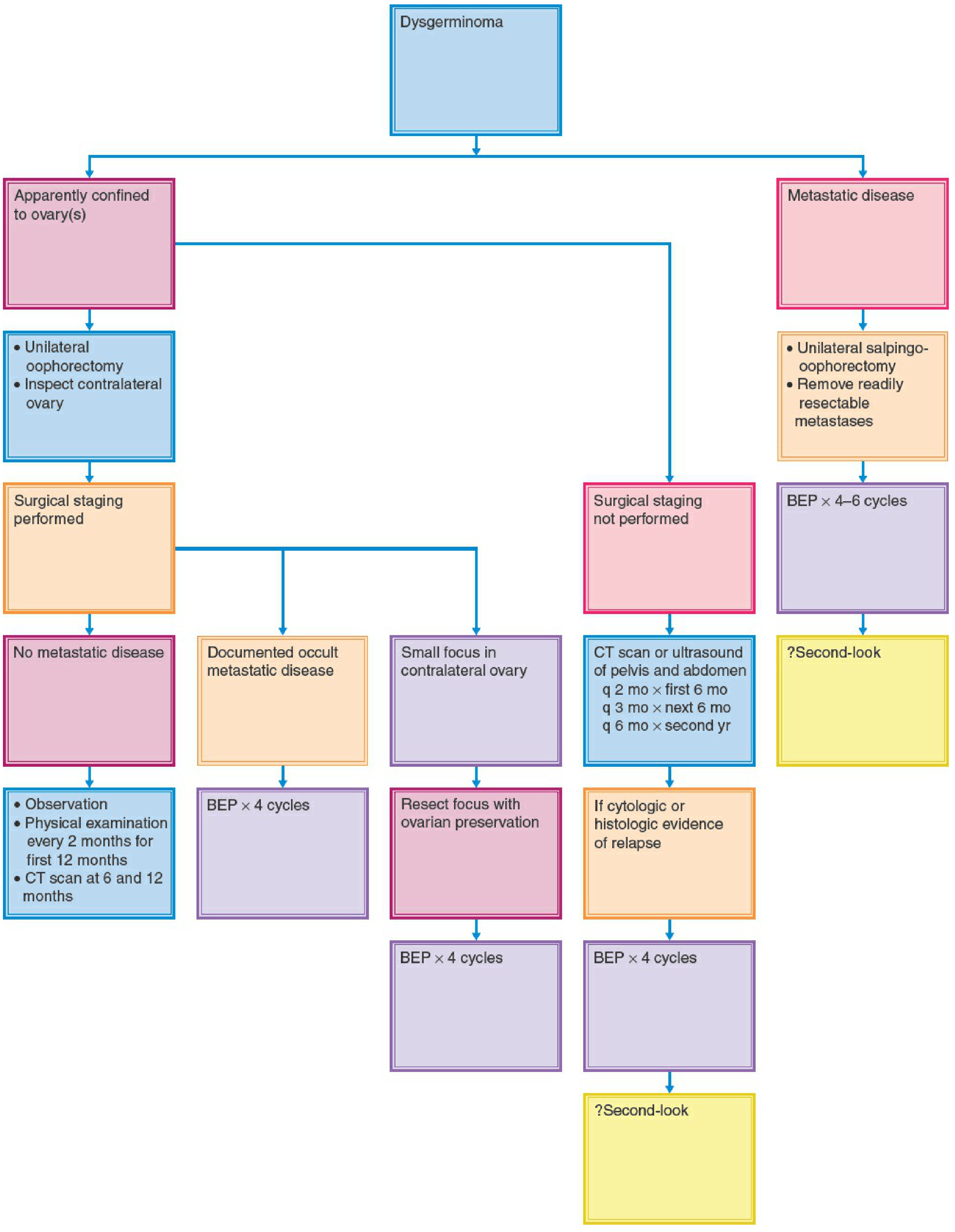
Management Algorithm
1. Surgery
Surgery is the primary treatment and serves two purposes: resection and staging.
Minimum Operation
- Unilateral oophorectomy (or salpingo-oophorectomy) - fertility-sparing surgery is the standard because the tumor primarily affects young women.
- The contralateral ovary, fallopian tube, and uterus should be preserved even in the presence of metastatic disease, given the excellent chemosensitivity.
Staging Procedure
A careful surgical staging should include:
- Inspection and palpation of all peritoneal surfaces
- Biopsy of any suspicious lesions
- Unilateral pelvic lymphadenectomy + para-aortic node sampling (para-aortic spread to the renal vessel level is characteristic)
- Inspection of the contralateral ovary - dysgerminoma is the only germ cell tumor with significant bilateral rates (10-15%)
Special Considerations
- Gonadal dysgenesis / Y chromosome: Both gonads must be removed (>50% risk of malignancy in gonadoblastomas left in situ), but the uterus can be preserved for future embryo transfer.
- Bulky resectable disease (e.g., omental cake): Cytoreductive resection is reasonable even if of unproven survival benefit.
2. Stage I Disease - Observation vs. Adjuvant Therapy
About 65% of dysgerminomas are Stage I at diagnosis.
| Situation | Approach |
|---|---|
| Stage I, fully staged, no adverse features | Observation (physical exam q2 months × 12 months; CT at 6 and 12 months) |
| Stage I, surgical staging NOT performed | Close surveillance with CT/US pelvis+abdomen q2mo × 6mo, q3mo × 6mo, q6mo × year 2 - then BEP if relapse |
| Capsular rupture or higher stage | Adjuvant chemotherapy |
| Small contralateral ovarian focus | Resect with ovarian preservation, then BEP ×4 |
Stage I dysgerminoma does not require adjuvant chemotherapy when properly staged and there are no adverse features.
3. Chemotherapy
Platinum-based chemotherapy is the treatment of choice for metastatic or high-risk disease, with the major advantage of preserving fertility (unlike radiation).
Standard Regimen: BEP
| Drug | Dose/Schedule |
|---|---|
| Bleomycin | 30,000 IU on days 1, 8, 15 every 3 weeks |
| Etoposide | 100 mg/m²/day × 5 days every 3 weeks |
| Cisplatin | 20 mg/m²/day × 5 days (or 100 mg/m²/day × 1 day) every 3 weeks |
- Stage I (occult metastases): BEP × 3-4 cycles
- Advanced disease (Stages III-IV): BEP × 4-6 cycles
Outcomes with BEP
20 evaluable patients with Stages III-IV dysgerminoma treated in GOG protocols: 19/20 alive and disease-free at 6-68 months follow-up. This confirms that even advanced-stage, incompletely resected dysgerminoma has an excellent prognosis with EP-based chemotherapy.
Alternative Regimens
- EP (etoposide + cisplatin) - used when bleomycin toxicity is a concern
- EC (etoposide + carboplatin) - alternative, used in select settings
- VBP (vinblastine, bleomycin, cisplatin) - older regimen, rarely used now
- VAC (vincristine, actinomycin D, cyclophosphamide) - historical; VAC consolidation after BEP is no longer used
4. Radiation Therapy
- Dysgerminomas are exquisitely radiation-sensitive (doses of 2,500-3,500 cGy can cure even gross metastatic disease).
- However, radiation almost always causes permanent infertility and is rarely used as first-line treatment in the modern era.
- BEP chemotherapy is at least as effective without the fertility cost.
- Radiation may still be considered in recurrent/refractory disease after chemotherapy failure.
5. Tumor Markers
Monitor throughout treatment and follow-up:
- LDH - most useful marker for pure dysgerminoma
- beta-hCG - elevated when syncytiotrophoblastic giant cells are present (~10-15% of cases)
- AFP - should be normal in pure dysgerminoma; elevation suggests mixed germ cell tumor (EST component), which changes management
- CA-125 - less specific
6. Recurrent Disease
- Recurrence after surgery alone responds well to BEP
- Recurrence after BEP: use salvage regimens (TIP - paclitaxel/ifosfamide/cisplatin, or high-dose chemotherapy with stem cell rescue)
- Second-look surgery: its role is uncertain (?second-look noted in advanced disease, but not standard)
7. Prognosis
| Stage | 5-Year Survival |
|---|---|
| Stage I | >95% |
| Stage II-III | 85-95% with BEP |
| Stage IV | ~75-85% with BEP |
Overall, dysgerminoma has the best prognosis of all malignant ovarian germ cell tumors, and even advanced disease is potentially curable.
Sources:
- Berek & Novak's Gynecology, pp. 2381-2387
- Harrison's Principles of Internal Medicine, 22E, p. 2171
Recent Literature Note: A 2026 systematic review (PMID 41317609) addresses post-treatment hormone replacement therapy and fertility preservation in Swyer syndrome with dysgerminoma - relevant for the subset of patients with gonadal dysgenesis requiring bilateral gonadectomy.
This is a shared conversation. Sign in to Orris to start your own chat.