
Explain typhoid
Reading File
Now I'll search the medical library for typhoid content across multiple angles in parallel.
Finding Sources
Finding Sources
Searching PubMed
typhoid fever Salmonella typhi
Excellent findings. Now let me pull full content from the best sources in parallel - Harrison's (most comprehensive), Robbins Pathology, Park's (epidemiology/prevention), and Tintinalli's (emergency management).
Reading File
Reading File
Reading File
Reading File
Now let me get Harrison's full pathogenesis and clinical details, plus the Sleisenger GI textbook section and the Widal/diagnosis section.
Reading File
Reading File
I now have rich, comprehensive content from multiple authoritative textbooks. Let me also fetch the rose spots image for visual context.
Loading Image
I now have comprehensive content from Harrison's, Robbins Pathology, Park's, Tintinalli's, and Bailey & Love's. Here is the complete explanation:
Typhoid Fever (Enteric Fever)
Definition
Typhoid fever, also called enteric fever, is a systemic illness caused by Salmonella enterica serotype Typhi (S. Typhi) or, less commonly, S. Paratyphi (A, B, C). It is characterized by prolonged fever, abdominal pain, and multi-organ involvement. The name "typhoid" was coined because of its early clinical resemblance to typhus; the alternate term "enteric fever" was introduced in 1869 to reflect the anatomical site of infection. - Harrison's Principles of Internal Medicine 22E, p.1359
Etiology and Microbiology
- Causative organism: Salmonella typhi - a Gram-negative, motile, non-spore-forming, facultative anaerobic rod (family Enterobacteriaceae)
- Humans are the sole reservoir - there is no animal host for S. Typhi or S. Paratyphi
- Key virulence features: Vi antigen (capsular polysaccharide), lipopolysaccharide (O antigen), flagellar (H) antigen, and the ability to survive and multiply within macrophages - Park's Textbook of Preventive and Social Medicine
Epidemiology
- 9.2-21 million cases of typhoid fever and 110,000-280,000 deaths occur worldwide each year, predominantly in children and adolescents
- Highest burden in South Asia (India, Pakistan, Bangladesh, Nepal), Eastern Mediterranean, and sub-Saharan Africa - incidence can exceed 1,000 cases/100,000 children in urban areas
- In developed countries, most cases are travel-acquired
- Peak incidence in endemic areas: July-September (rainy season, increased fly population)
- Risk factors: contaminated drinking water, street food, raw vegetables grown in sewage-fertilized fields, open-air defecation, lack of hand washing, H. pylori co-infection (due to reduced gastric acidity) - Harrison's 22E, p.1359
A 2025 Lancet Infectious Diseases systematic review updated global typhoid incidence estimates (PMID: 40753988), and a 2026 meta-analysis documented the growing burden of antimicrobial resistance in S. Typhi isolates from India (PMID: 41990105).
Pathogenesis
- Ingestion - organism enters via the fecal-oral route (contaminated food/water/milk); a dose of ~10^3-10^6 organisms is needed
- Gastric barrier - gastric acidity kills most organisms; surviving bacteria reach the small intestine
- M-cell entry - S. Typhi is taken up by M cells overlying Peyer's patches in the terminal ileum, then engulfed by submucosal mononuclear phagocytes
- Peyer's patch hyperplasia - Peyer's patches enlarge into plateau-like elevations up to 8 cm in diameter; mucosal shedding creates oval ulcers oriented along the long axis of the ileum
- Lymphatic/hematogenous spread - unlike non-typhoidal Salmonella, S. Typhi escapes into lymphatics and the bloodstream - causing primary bacteremia
- Reticuloendothelial seeding - organisms multiply within macrophages in the liver, spleen, bone marrow, and lymph nodes. Red pulp of the spleen expands due to phagocyte hyperplasia. Scattered foci of parenchymal necrosis with macrophage aggregates - called "typhoid nodules" - form in liver, bone marrow, and lymph nodes
- Secondary bacteremia - re-entry into the bloodstream after intracellular multiplication drives the sustained febrile illness - Robbins & Kumar Basic Pathology, p.529-531
Clinical Features (Week-by-Week Progression)
| Week | Features |
|---|---|
| Week 1 | Gradual onset of fever (step-ladder pattern), headache (80%), malaise, dry cough (30%), relative bradycardia |
| Week 2 | High sustained fever (38.8-40.5°C), rose spots, hepatosplenomegaly, abdominal distension, constipation OR diarrhea |
| Week 3 | Toxemic state; risk of intestinal perforation and GI bleeding |
| Week 4 | Resolution or complications; possible relapse |
Incubation period: 10-14 days (range 5-21 days, depending on inoculum and host status)
Key symptoms (from Harrison's prospective series of 669 patients):
- Fever (>75%), headache (80%), chills (35-45%), cough (30%), anorexia (55%), abdominal pain (30-40%), nausea (18-24%), diarrhea (22-28%)
- Notably, 30% present with constipation rather than diarrhea
Classic signs:
- Relative bradycardia (Faget's sign) - pulse slower than expected for the degree of fever
- Rose spots - faint salmon-colored, blanching maculopapular rash on the trunk and chest; present in ~30% of patients at end of week 1; resolves in 2-5 days; difficult to see in dark-skinned individuals
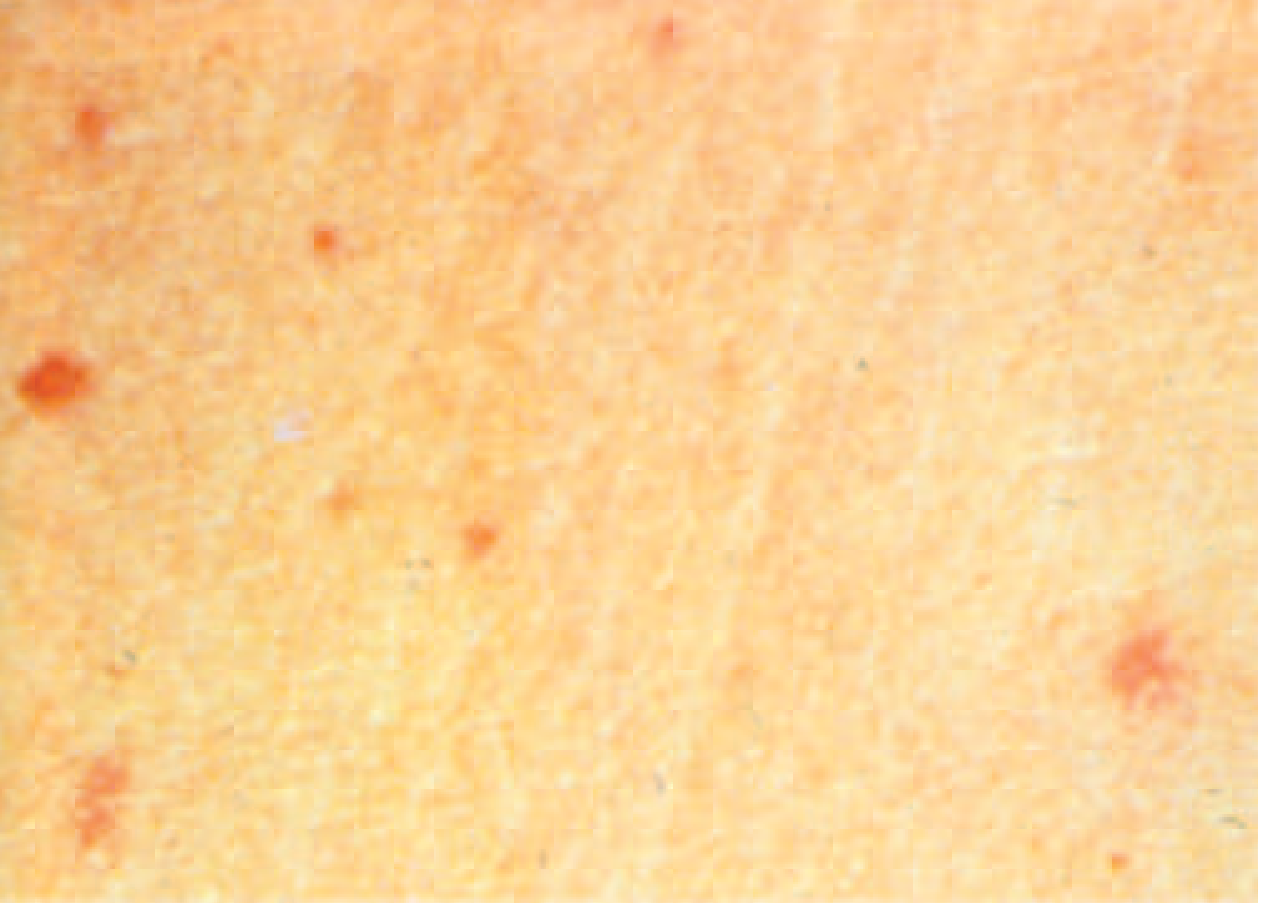
- Coated tongue (51-56%)
- Splenomegaly (develops over 2nd week)
Complications (~27% of hospitalized patients)
GI (most common):
- Intestinal perforation (1%) - 3rd/4th week, from ulceration of Peyer's patches; life-threatening, requires surgery
- GI bleeding (6%) - also 3rd/4th week
- Hepatitis, cholecystitis
Neurological (2-40%):
- Meningitis, Guillain-Barre syndrome, neuritis, neuropsychiatric symptoms ("typhoid psychosis"), ataxia, seizures, deafness
Cardiovascular:
- Myocarditis, endocarditis, mycotic aneurysm
Others:
- Pneumonia, disseminated intravascular coagulopathy (DIC), septic arthritis, renal failure, hemolytic anemia
Carrier state: ~1-5% of recovered patients become chronic biliary carriers (especially women and those with gallstones), shedding S. Typhi in stool for >1 year. - Tintinalli's Emergency Medicine, p.3383
Diagnosis
Gold standard: Culture
- Blood culture: Positive in ~90% of cases during the febrile phase (weeks 1-2); most sensitive early
- Bone marrow culture: Most sensitive overall; remains positive even after antibiotic treatment
- Stool/urine culture: More useful in week 2-3
- Rose spot biopsy: S. Typhi can be cultured from punch biopsies
Serology:
- Widal test (agglutination of H and O antigens): Widely used in developing countries, but limited specificity; false positives occur with prior vaccination, other Salmonella infections, and malaria. A 4-fold rise in titer is more meaningful than a single reading
- Rapid antigen tests: Available but variable sensitivity/specificity
Labs (non-specific):
- Leukopenia (relatively uncommon but classic), elevated liver enzymes, anemia, elevated inflammatory markers
- Thrombocytopenia in complicated cases
Treatment
Current treatment is guided by antibiotic susceptibility, given widespread resistance:
| Drug | Notes |
|---|---|
| Azithromycin | Drug of choice for uncomplicated typhoid in most guidelines; oral, well-tolerated |
| Ceftriaxone | First-line for severe/hospitalized disease; IV; active against MDR strains |
| Cefixime | Oral; used in uncomplicated disease |
| Ciprofloxacin | Formerly first-line; now limited by widespread fluoroquinolone resistance, especially in South/Southeast Asia |
| Chloramphenicol, ampicillin, co-trimoxazole | Unreliable due to multidrug-resistance (MDR); not recommended empirically |
For severe typhoid (shock, meningitis/encephalitis): Add dexamethasone to antibiotics (reduces mortality)
Supportive care: IV fluids, nutritional support, blood transfusion if needed for GI bleeding
Surgical management: Required for intestinal perforation (laparotomy, bowel resection, peritoneal lavage)
Relapse: Can occur in 5-10% of patients after apparent clinical recovery - Tintinalli's 22E, Harrison's 22E
Antimicrobial Resistance - A Growing Problem
- MDR S. Typhi (resistant to chloramphenicol, ampicillin, co-trimoxazole) emerged in the 1980s in Asia
- Decreased susceptibility to ciprofloxacin (DSC) strains emerged in the 1990s in the Indian subcontinent
- Extensively drug-resistant (XDR) S. Typhi: First identified in Pakistan in 2016; resistant to all first-line agents plus fluoroquinolones and third-generation cephalosporins; only azithromycin and carbapenems remain active
- MDR typhoid is associated with more severe illness, higher complication rates, and 10-fold higher carrier rates - Park's Textbook; Harrison's 22E
Prevention
Individual level
- Safe drinking water and food (avoid street food, raw vegetables, ice in endemic areas)
- Hand hygiene
- Vaccination before travel to endemic areas
Vaccines
| Vaccine | Type | Route | Duration |
|---|---|---|---|
| Ty21a (Vivotif) | Live attenuated oral | Oral (4 capsules) | ~5 years |
| Vi polysaccharide (ViPS) | Subunit | IM single dose | ~2-3 years |
| Typhoid Conjugate Vaccine (TCV, Typbar-TCV) | Vi conjugated to carrier protein | IM single dose | Longer-lasting; recommended by WHO for children |
Vaccines provide only partial immunity (~60-70%); vaccinated individuals should still practice food/water precautions. TCV is now preferred by WHO as it is immunogenic even in children <2 years and provides longer protection. - Goodman & Gilman's; Harrison's 22E
Public health (most effective long-term control)
- Safe water supply and sewage treatment
- Food safety regulations
- Identification and treatment of chronic carriers (especially food handlers)
- Typhoid fever is an index of general sanitation in a community - Park's Textbook of Preventive and Social Medicine
Summary at a Glance
| Feature | Details |
|---|---|
| Causative organism | Salmonella typhi (Gram-negative rod) |
| Reservoir | Humans only |
| Transmission | Fecal-oral (contaminated water/food) |
| Incubation | 10-14 days (range 5-21) |
| Classic triad | Sustained fever + relative bradycardia + rose spots |
| Diagnostic gold standard | Blood culture (90% positive in febrile phase) |
| Treatment (uncomplicated) | Azithromycin or cefixime |
| Treatment (severe) | IV ceftriaxone ± dexamethasone |
| Mortality (untreated) | 10-20% |
| Mortality (treated) | <1% |
This is a shared conversation. Sign in to Orris to start your own chat.