
Tell me in detail about teriperatode
Teriparatide is a synthetic form of parathyroid hormone (PTH 1-34) used primarily to treat osteoporosis. It works as an anabolic agent - meaning it actually builds new bone rather than just preventing bone loss (unlike bisphosphonates). It's given as a daily subcutaneous injection, typically for up to 24 months.
Searching sources...
Reading File
Now let me search the medical library and PubMed in parallel for comprehensive teriparatide coverage.
Finding Sources
Searching PubMed
teriparatide osteoporosis
Searching Images
teriparatide parathyroid hormone bone anabolic mechanism osteoporosis
Good results. Now let me read the key textbook sections in parallel.
Reading File
Reading File
Reading File
Excellent data. Let me fetch the fracture-risk graphs and also read the Katzung pharmacology section for mechanism details.
Reading File
Loading Image
Loading Image
I now have rich, comprehensive data from Harrison's, Goldman-Cecil, Goodman & Gilman, and Katzung, plus the clinical trial fracture-reduction graphs and recent PubMed meta-analyses. Here is the full detailed response:
Teriparatide - A Comprehensive Overview
1. What Is It?
Teriparatide (brand name: Forteo) is a recombinant human parathyroid hormone analogue consisting of the first 34 amino acids of endogenous PTH [PTH(1-34)]. It was the first approved anabolic (bone-building) agent for osteoporosis - unlike bisphosphonates or denosumab, which only slow bone loss, teriparatide actively stimulates new bone formation.
2. Mechanism of Action
Endogenous PTH is an 84-amino-acid peptide that regulates calcium homeostasis. When present chronically (as in hyperparathyroidism), PTH causes bone loss - particularly at cortical sites. However, when PTH(1-34) is administered intermittently (once daily subcutaneous injection), it exerts a net anabolic effect on bone.
The molecular mechanisms include:
- Acts via PTH1 receptor (PTH1R), a G protein-coupled receptor (Gs-coupled)
- Stimulates bone turnover - increases both formation and resorption, but formation predominates with intermittent dosing
- Increases RANKL - upregulates osteoclast activity (bone resorption), but bone formation still outpaces resorption
- Decreases sclerostin - sclerostin normally inhibits Wnt signaling (which drives osteoblast activity); PTH suppresses sclerostin, releasing the "brake" on bone formation
- Increases 1,25(OH)₂D production - enhances calcium absorption
- Enhances renal calcium reabsorption - conserves calcium for bone
- Net effect: substantial increases in trabecular bone mass (spine, femoral neck), improvements in cancellous connectivity and cortical width
(Katzung Basic and Clinical Pharmacology, 16th ed.)
3. Dosing and Administration
| Parameter | Details |
|---|---|
| Dose | 20 mcg once daily subcutaneous injection |
| Injection sites | Thigh or abdominal wall |
| Duration | Maximum 24 months lifetime total |
| Storage | Refrigerate (2-8°C); discard pen 28 days after first use |
- Available as a pre-filled multi-dose pen injector
- Patients self-administer at home
- A biosimilar (same 20 mcg dose) is also available
(Goldman-Cecil Medicine; Harrison's 22E)
4. Approved Indications
- Postmenopausal women with osteoporosis at high fracture risk
- Men with primary or hypogonadal osteoporosis at high fracture risk
- Men and women with glucocorticoid-induced osteoporosis at high fracture risk (per FDA; also supported by recent 2024 meta-analysis on glucocorticoid-induced osteoporosis - PMID 38313307)
- Patients who have failed or are intolerant of other antifracture therapies
It is second-line in most guidelines (after bisphosphonates or denosumab) unless osteoporosis is severe (very low BMD, multiple fractures, or high FRAX score).
5. Clinical Efficacy - Fracture Reduction
The pivotal randomized controlled trial (Neer et al., 2001) randomized postmenopausal women to placebo, TPTD 20 mcg, or TPTD 40 mcg (median 19 months):
A. Vertebral fracture reduction (TPTD 20 mcg vs. placebo):
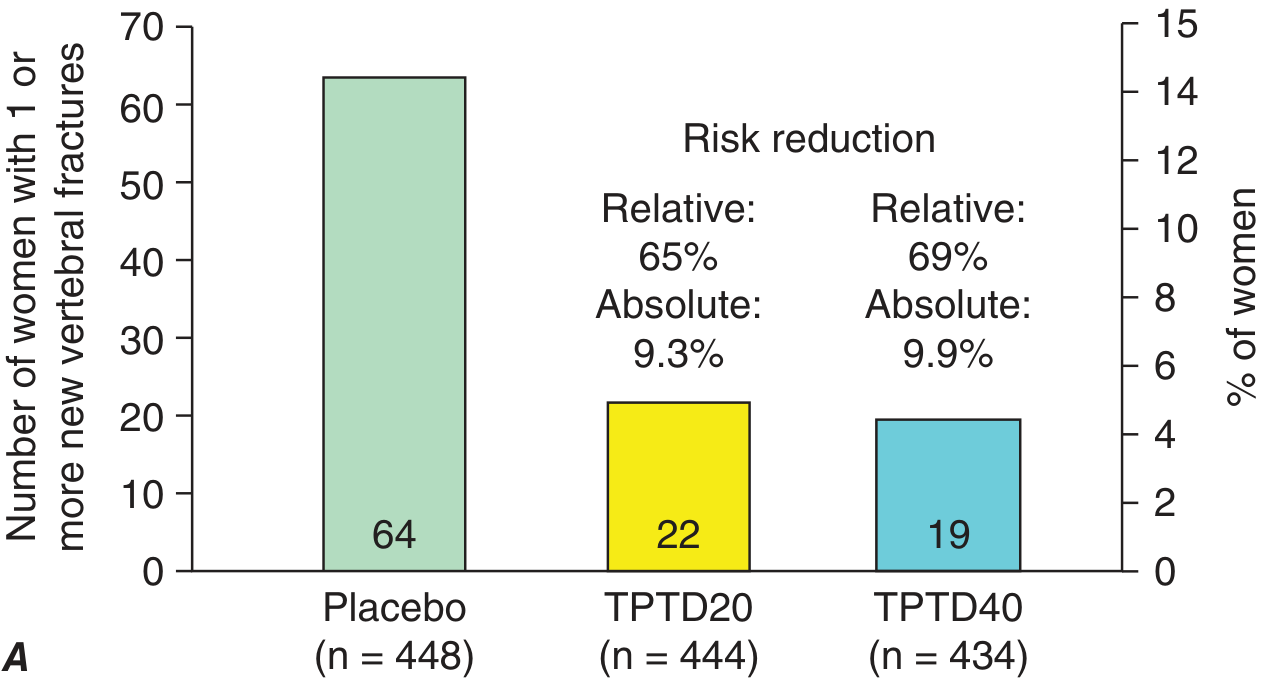
- 64 women in placebo vs. 22 with TPTD 20 mcg developed new vertebral fractures
- 65% relative risk reduction (absolute: 9.3%)
B. Nonvertebral fragility fracture reduction (TPTD 20 mcg vs. placebo):
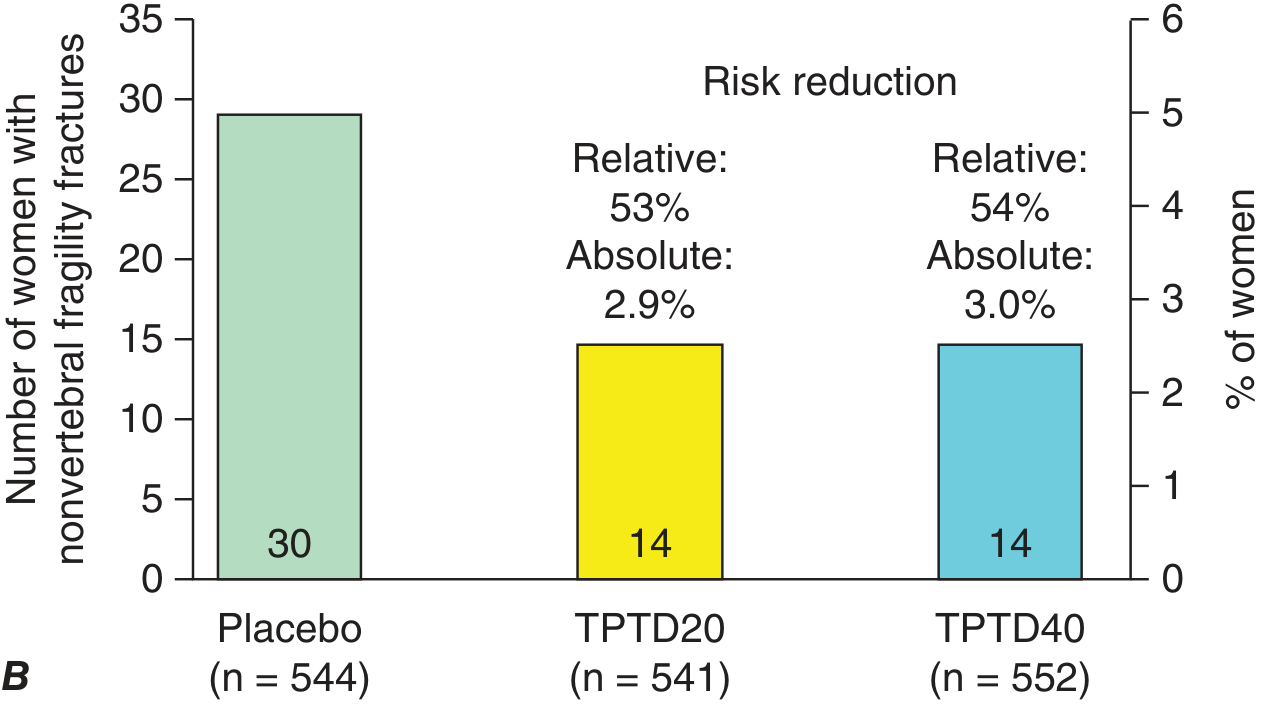
- 53% relative risk reduction (absolute: 2.9%)
BMD effects (Harrison's 22E):
- Lumbar spine BMD: increases ~10% over 2 years
- Femoral neck: increases significantly
- Effects are primarily on trabecular bone; less effect on cortical sites
- Rapid and robust increases in bone formation markers (e.g., P1NP) within weeks
(Harrison's Principles of Internal Medicine 22E, 2025)
6. BMD Effects When Switching From Antiresorptives
An important clinical consideration:
- When switching from bisphosphonates to teriparatide, the BMD gains at the hip are blunted, possibly proportional to the potency of the previous antiresorptive
- When switching from denosumab to teriparatide, there may be transient bone loss - particularly problematic. Teriparatide should NOT be used after denosumab, as this sequence leads to proven decreases in BMD. If switching off denosumab is needed, a bisphosphonate bridge is recommended
- Conversely, patients not previously treated benefit the most from teriparatide
7. Combination and Sequential Therapy
| Strategy | Evidence |
|---|---|
| Teriparatide + alendronate | No added BMD benefit; alendronate blunts the anabolic effect of teriparatide |
| Teriparatide + denosumab | May have synergistic effect on BMD (additive), but fracture reduction data are inconclusive |
| Sequential: teriparatide → bisphosphonate | Recommended to preserve BMD gains after stopping teriparatide |
| Sequential: teriparatide → denosumab | Evidence supports greater vertebral BMD gains than sequential bisphosphonate |
A 2025 systematic review (PMID 40469971) found that teriparatide combined with bisphosphonates or denosumab did not consistently outperform teriparatide monotherapy for fracture outcomes.
A 2024 meta-analysis (PMID 37944971) specifically on teriparatide + denosumab combination in postmenopausal osteoporosis found enhanced BMD increases compared to either agent alone.
Why sequential antiresorptive therapy is mandatory after stopping teriparatide: Because bone resorption increases alongside bone formation during treatment, bone loss occurs rapidly after stopping teriparatide. An antiresorptive agent must be initiated after completing the 24-month course to preserve the gains. (Goldman-Cecil Medicine)
8. Adverse Effects
| Adverse Effect | Notes |
|---|---|
| Injection site pain | Most common |
| Nausea | Common |
| Headache | Common |
| Leg cramps | Common |
| Dizziness | Common |
| Hypercalcemia | Rare; more likely if undiagnosed primary hyperparathyroidism coexists |
| Hypercalciuria | Can exacerbate nephrolithiasis |
| Elevated serum uric acid | Monitor in gout-prone patients |
| Osteosarcoma (theoretical) | Seen in rats receiving very high doses for their entire lifetime; no confirmed human cases in registry data |
(Goodman & Gilman's Pharmacological Basis of Therapeutics; Goldman-Cecil Medicine)
9. Contraindications
- Paget's disease of bone (elevated baseline osteosarcoma risk)
- Prior therapeutic radiation to the skeleton
- Open epiphyses (growing children/adolescents)
- Pre-existing bone malignancy or skeletal metastases
- Hypercalcemia (pre-existing)
- Lifetime limit: 24 months total use (this limit was originally imposed based on rodent data; registry data confirm no increased osteosarcoma risk in humans, but the 24-month lifetime cap remains in most regulatory guidelines)
10. Duration Limit - Update
The FDA previously restricted teriparatide to 2 years in a lifetime. Harrison's 22E (2025) notes that registry data confirm no increased risk of osteosarcoma in humans, and some guidelines have been revisited. However, the 24-month lifetime cap remains the regulatory standard in most countries.
11. Place in Therapy - Clinical Decision Guide
Severe osteoporosis (T-score ≤ -2.5 + fragility fracture, or T-score ≤ -3.0)?
             ↓ YES
Contraindications to antiresorptives? Or failed prior antiresorptive?
             ↓ YES
       → TERIPARATIDE x 24 months
             ↓
       → Follow with antiresorptive (bisphosphonate or denosumab)
             to consolidate BMD gains
Note: Romosozumab (sclerostin antibody) is now an alternative anabolic option with a similar or slightly broader effect on both cortical and trabecular bone.
12. Comparison to Abaloparatide
Abaloparatide (PTHrP analogue) shares the same PTH1R but binds preferentially to the R0 conformation, causing more bone formation with less bone resorption stimulation compared to teriparatide. This may explain why abaloparatide has a lower incidence of hypercalcemia at its 80 mcg dose. Both are approved for the same indications. (Goodman & Gilman's)
Summary Table
| Property | Teriparatide |
|---|---|
| Class | Recombinant human PTH(1-34) - anabolic bone agent |
| Mechanism | PTH1R agonist → ↑ bone formation > resorption (intermittent dosing) |
| Dose | 20 mcg SC once daily |
| Duration | Maximum 24 months lifetime |
| BMD benefit | Spine +10%, femoral neck significant (mainly trabecular) |
| Vertebral fracture RRR | 65% |
| Nonvertebral fracture RRR | 53% |
| Must follow with | Antiresorptive (bisphosphonate or denosumab) |
| Key contraindication | Paget's, prior radiotherapy, open epiphyses, hypercalcemia |
| Key concern | Theoretical osteosarcoma (no confirmed human cases) |
This is a shared conversation. Sign in to Orris to start your own chat.