
Motor function of stomach
Reading File
Finding Sources
Searching the Web
stomach motor function gastric motility physiology
Finding Sources
Finding Sources
Reading File
Finding Sources
Reading File
Reading File
Finding Sources
Reading File
Reading File
Now let me get the regulation of gastric emptying section from Guyton and the image:
Finding Sources
Loading Image
Now let me get the regulation section from Guyton (it continues in the next block):
Finding Sources
Finding Sources
Reading File
I now have comprehensive information to provide a thorough answer. Let me compile it.
Motor Functions of the Stomach
(Guyton & Hall Medical Physiology; Costanzo Physiology 7th Ed.)
Physiological Anatomy
The stomach is functionally divided into two regions:
- Orad portion (proximal ~two-thirds of the body + fundus): primarily a reservoir; undergoes tonic, sustained contractions
- Caudad portion (distal body + antrum + pylorus): primarily peristaltic, mixing and pumping food toward the duodenum
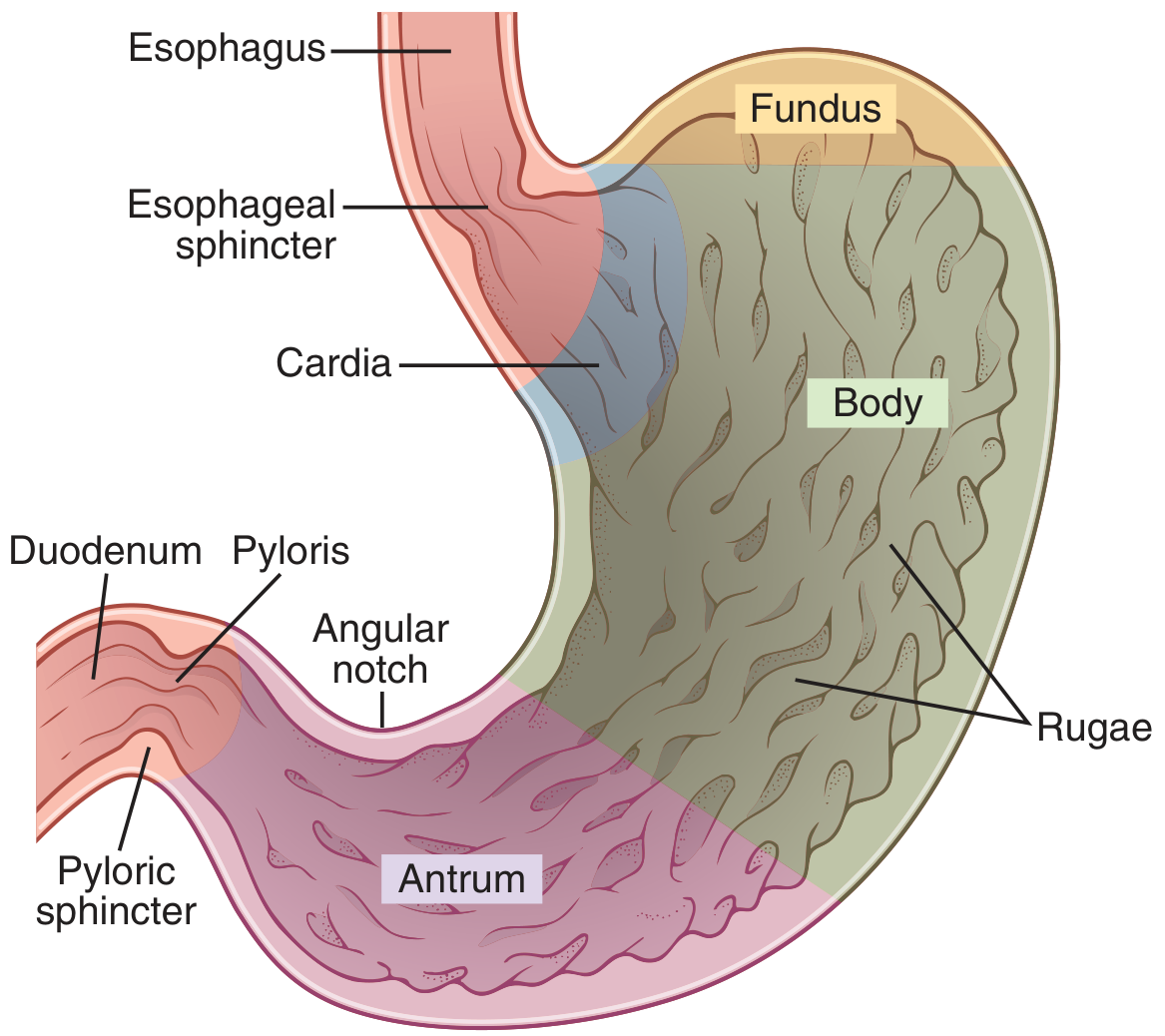
Figure: Physiological anatomy of the stomach — Guyton & Hall
Three Motor Functions
The motor functions of the stomach are threefold:
- Storage of large quantities of food until it can be processed
- Mixing food with gastric secretions to form chyme (a semifluid paste)
- Slow, regulated emptying of chyme into the small intestine at a rate suitable for digestion and absorption
1. Storage Function
- Food entering the stomach forms concentric circles, with the newest food closest to the esophageal opening and oldest food nearest the outer wall.
- Stretching of the stomach wall triggers a vagovagal reflex (stomach → brain stem → stomach) that reduces muscle tone in the body wall, allowing progressive outward bulging.
- The relaxed stomach accommodates 0.8 to 1.5 liters with minimal rise in intraluminal pressure — this is called receptive relaxation.
2. Mixing Function — Basic Electrical Rhythm
- Slow waves (basic electrical rhythm) are generated spontaneously in the stomach wall by the interstitial cells of Cajal (ICC), at a rate of 3 per minute.
- These drive weak peristaltic mixing waves that begin in the mid-to-upper stomach and travel toward the antrum every 15–20 seconds.
- As waves move into the antrum, they intensify into tight constrictor rings, forcing antral contents toward the pylorus.
- Because the pylorus is nearly closed, most antral contents are squeezed upstream — this is called retroulsion, an essential mixing mechanism.
- The result is a thoroughly mixed chyme.
Hunger Contractions
- When the stomach has been empty for several hours, rhythmic peristaltic hunger contractions occur in the body of the stomach.
- In prolonged starvation, these may fuse into a tetanic contraction lasting 2–3 minutes, causing "hunger pangs" (felt ~12–24 hours after the last meal).
3. Stomach Emptying
Pyloric Pump
- About 20% of the time while food is in the stomach, contractions become intense peristaltic rings starting in the mid-stomach, creating pressures of 50–70 cm H₂O (~6× the usual mixing waves).
- These drive the pyloric pump, forcing a few milliliters of chyme into the duodenum with each wave.
Role of the Pylorus
- The pyloric sphincter's circular muscle is 50–100% thicker than the rest of the antrum and remains slightly tonically contracted.
- Water and fluids pass freely; solid particles must be ground to near-fluid consistency (< 1 mm³) before passing.
- Pyloric tone is modulated by nervous and hormonal signals.
Regulation of Gastric Emptying
Gastric Factors Promoting Emptying
- Increased food volume → stretches the stomach wall → local myenteric reflexes → activates the pyloric pump and relaxes the pyloric sphincter.
Duodenal Factors Inhibiting Emptying
1. Enterogastric Nervous Reflexes
When food enters the duodenum, inhibitory reflexes are triggered via three routes:
- Directly through the enteric (myenteric) nervous system
- Via extrinsic nerves → prevertebral sympathetic ganglia → inhibitory sympathetic fibers to the stomach
- Via the vagus nerve → brain stem → suppression of vagal excitatory output
These reflexes inhibit the pyloric pump and increase pyloric sphincter tone.
Triggers include:
| Stimulus | Mechanism |
|---|---|
| Duodenal distension | Direct stretch reflex |
| Mucosal irritation | Local reflex |
| Acid (pH < 3.5–4) | Strong inhibition within 30 seconds |
| Hyper/hypotonic chyme | Osmoreceptor reflex |
| Protein breakdown products | Slow emptying for adequate digestion |
2. Hormonal Feedback
- Fats and acids in the duodenum trigger release of intestinal hormones (notably cholecystokinin [CCK] and secretin) from the duodenal mucosa.
- These hormones act directly on the stomach to inhibit antral peristaltic contractions and increase pyloric resistance.
- CCK release is proportional to fat content, ensuring adequate time for fat digestion and absorption.
Migrating Motor Complex (MMC) — Fasting State
- During fasting, the stomach undergoes cyclical migrating motor complexes (MMC) every 90–120 minutes.
- The MMC serves to clear indigested debris and residue from the stomach and intestine ("intestinal housekeeper").
- It consists of 4 phases, with Phase III being the most intense (action potential–driven contractions).
Summary Table
| Function | Region | Mechanism |
|---|---|---|
| Receptive relaxation / storage | Fundus/body (orad) | Vagovagal reflex, tonic relaxation |
| Mixing | Antrum (caudad) | Slow waves → peristalsis, retroulsion |
| Emptying | Antrum + pylorus | Pyloric pump, regulated by enterogastric reflexes + CCK |
| Fasting motility | Whole stomach | Migrating motor complex (MMC) |
Sources:
- Guyton and Hall Textbook of Medical Physiology, pp. 790–792
- Costanzo Physiology, 7th Ed., p. 357–358
This is a shared conversation. Sign in to Orris to start your own chat.