
Syphillis diagnosis
I'll check the medical library skill first, then pull the relevant content.
Reading File
Now I'll search the library in parallel for syphilis diagnosis content.
Finding Sources
Searching PubMed
"syphilis"[MeSH Terms] AND "diagnosis"[MeSH Terms]
Good. Now let me read the key diagnostic sections in parallel.
Reading File
Reading File
Finding Sources
Good coverage. Let me now read the Harrison's and Washington Manual sections for the most up-to-date clinical detail, and Fitzpatrick's serology section.
Reading File
Reading File
Reading File
Excellent. Let me get the rest of the Fitzpatrick's serology section (treponemal tests, reverse sequence, false positives) and the Dermatology textbook's microscopy section.
Reading File
Reading File
I now have comprehensive content to write a thorough answer. Let me also fetch the serologic reactivity graph from Fitzpatrick's for visual clarity.
Loading Image
Here is a comprehensive breakdown of syphilis diagnosis, drawn from multiple authoritative textbooks.
Syphilis: Diagnosis
Overview
Diagnosis of syphilis rests on three pillars: clinical recognition by stage, direct detection of the organism, and serologic testing. No single test is sufficient on its own - accurate diagnosis requires combining laboratory results with clinical history and signs.
All patients diagnosed with syphilis should also be tested for HIV infection. - Washington Manual of Medical Therapeutics
1. Clinical Diagnosis by Stage
Recognizing the stage guides which tests to prioritize:
| Stage | Timing | Key Features |
|---|---|---|
| Primary | Weeks after exposure | Painless, indurated, superficial ulcer (chancre); usually single; regional lymphadenopathy |
| Secondary | 2-10 weeks after chancre resolves | Copper-red maculopapular rash (classically involves palms and soles), condylomata lata, mucous patches, constitutional symptoms, diffuse lymphadenopathy |
| Latent (early) | Serologically positive < 1 year, no symptoms | No clinical signs; purely serologic diagnosis |
| Latent (late/unknown duration) | Serologically positive > 1 year | No clinical signs; serologic diagnosis |
| Tertiary | 1-20 years after infection | Gummas, cardiovascular syphilis (aortitis, aortic aneurysm), neurosyphilis |
| Neurosyphilis | Any stage | General paresis, tabes dorsalis, meningovascular disease, ocular syphilis, otosyphilis |
| Congenital | Vertical transmission | Stillbirth, rash, hepatomegaly, "snuffles," saber shins, Hutchinson teeth, 8th nerve deafness |
Secondary syphilis rashes are characteristically non-pruritic and symmetrically distributed. - Symptom to Diagnosis, 4th Edition
2. Direct Detection Methods
Darkfield Microscopy
- Permits definitive diagnosis in primary and secondary syphilis by visual identification of motile spirochetes from lesion exudate (serous fluid, free of red blood cells)
- Spirochetes show characteristic corkscrew morphology and episodic movements
- Limited utility for oral lesions due to presence of saprophytic spirochetes; indirect fluorescent antibody (IFA) test with fluorescein-labeled anti-T. pallidum antibodies is preferred for oral sites
- A negative result warrants repeat testing - Dermatology 2-Volume Set 5e
Polymerase Chain Reaction (PCR)
- Detects T. pallidum DNA; increasingly being employed even for classic presentations
- Particularly useful in: neurosyphilis, congenital syphilis, extra-genital primary syphilis
- In neonates, detection of spirochetemia by PCR can improve sensitivity of congenital syphilis diagnosis
- T. pallidum cannot be routinely cultured in vitro
Histopathology
- Gummas: granulomas with central acellular necrosis + endarteritis obliterans + plasma cell infiltrates
- Warthin-Starry silver stain or immunohistochemistry can identify organisms in tissue
3. Serologic Testing (Most Important in Practice)
Serologic diagnosis requires both non-treponemal AND treponemal tests.
Non-Treponemal Tests (NTTs)
Detect IgG and IgM antibodies against cardiolipin-cholesterol-lecithin antigen (lipoidal material released from damaged host cells and T. pallidum).
| Test | Notes |
|---|---|
| RPR (Rapid Plasma Reagin) | Most common; flocculation test; used for screening and monitoring |
| VDRL (Venereal Disease Research Laboratory) | Standard; used for CSF testing in neurosyphilis |
| USR, RST, TRUST | Less commonly used variants |
Key properties of NTTs:
- Become reactive ~4-5 weeks after infection; 100% sensitivity by ~12 weeks
- Results reported as titers (1:2, 1:4, 1:8...); RPR and VDRL titers cannot be directly compared
- Revert to non-reactive in 25-30% of untreated late latent syphilis cases
- A fourfold (two-dilution) decline in titer = successful treatment
- A fourfold increase in titer = relapse or reinfection
- A day-of-treatment titer must be obtained before starting therapy to allow future comparison
- False positives occur (see below)
Treponemal Tests (TTs)
Detect antibodies specific to T. pallidum antigens.
| Test | Notes |
|---|---|
| FTA-ABS (Fluorescent Treponemal Antibody Absorbed) | Highly sensitive; earliest to become reactive |
| TPPA (T. pallidum Particle Agglutination) | Widely used confirmation test |
| TPHA / MHA-TP | Detect antibodies to surface proteins of T. pallidum |
| TP-EIA / Multiplex Flow Immunoassay | Used in reverse sequence screening algorithms |
Key properties of TTs:
- More specific than NTTs; false positives are rare
- IgM and IgG antibodies usually detectable by end of week 4
- Remain positive indefinitely after treatment (serofast) - except in very early syphilis
- Cannot differentiate active from past treated infection
- Sensitivity by stage: 70-100% (primary), 100% (secondary and latent), ~95% (late)
- 90% of patients are TPHA-positive at the time they present with a chancre
Serologic Reactivity Over Time
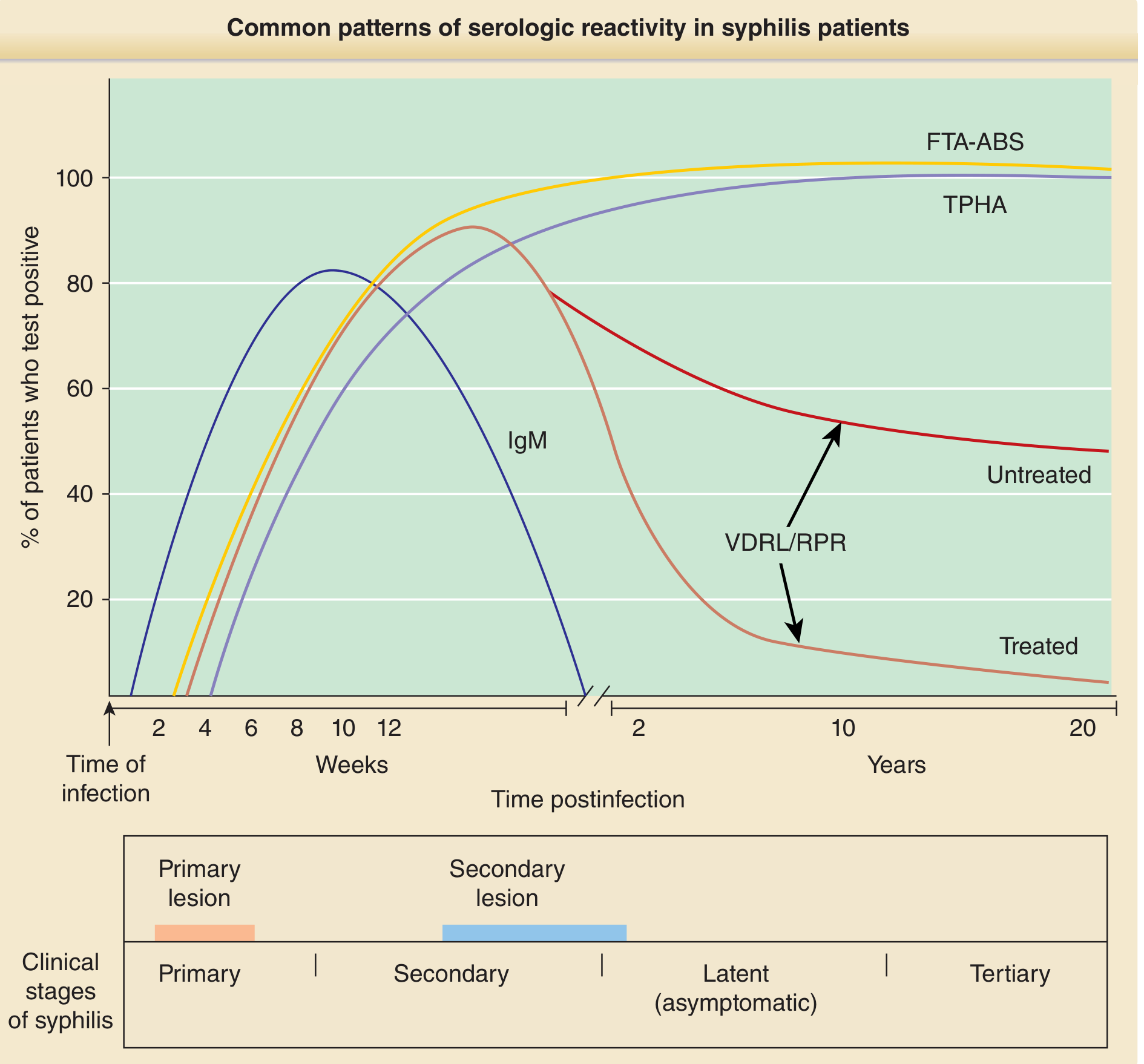
4. Testing Algorithms
Traditional (Forward) Algorithm
- Screening: NTT (RPR or VDRL)
- Confirmation if positive: Treponemal test (FTA-ABS, TPPA)
Reverse Sequence Algorithm (Increasingly Used)
- Screening: Treponemal EIA or multiplex flow immunoassay
- If reactive: quantitative RPR/VDRL
- If reactive on both: confirms syphilis
- If only treponemal reactive: T. pallidum particle agglutination (TPPA) as a second treponemal test to resolve discordance; ~3% of cases fall into this discordant category
Advantage of reverse sequence: May detect early primary syphilis that NTTs would miss (NTTs can be seronegative in very early primary syphilis). - Washington Manual; Fitzpatrick's Dermatology
5. Neurosyphilis Diagnosis
- Indication for LP: All patients with neurologic, ophthalmic, or otologic symptoms
- CSF VDRL: Highly specific but low sensitivity (a negative VDRL does NOT rule out neurosyphilis)
- CSF abnormalities: elevated protein, pleocytosis (WBC > 5/mm³)
- Some experts recommend LP in HIV+ patients with tertiary disease, treatment failure, or late latent syphilis, though evidence for improved outcomes is limited
6. Congenital Syphilis Diagnosis
- Maternal serology: reactive treponemal and non-treponemal tests
- Infant testing: Quantitative NTT on infant serum (not cord blood - cord blood may give false positives from maternal contamination)
- Treponemal tests in infants are difficult to interpret due to transplacental transfer of maternal IgG
- Additional workup: darkfield/PCR of lesions, CSF VDRL + cell count + protein, long-bone X-rays (periostitis), LFTs, ophthalmologic and auditory brainstem response testing
Stigmata of late congenital syphilis (Hutchinson's triad):
- Hutchinson teeth (notched, peg-shaped incisors)
- Interstitial keratitis
- Eighth-nerve deafness
7. False Positives in Non-Treponemal Tests
Causes of biologic false-positive RPR/VDRL include:
| Acute (< 6 months) | Chronic (> 6 months) |
|---|---|
| Viral infections (EBV, HIV, hepatitis) | SLE and other autoimmune diseases |
| Bacterial infections | Antiphospholipid syndrome |
| Malaria | Chronic liver disease |
| Pregnancy | Aging |
| Recent immunization | Intravenous drug use |
- Treponemal tests have very high specificity; biologic false positives rarely occur with them
- Concurrent positive NTT and TT confirms syphilis; discordant results require clinical judgment
8. Treatment Monitoring
- Repeat nontreponemal tests (RPR) at 3, 6, and 12 months after treatment
- In HIV+ patients: every 3 months for 1 year
- Inadequate response = failure to achieve fourfold decline in titer by 12 months (primary/secondary/early latent) or 24 months (late latent/unknown duration)
- Treponemal tests are not used for monitoring - they remain positive regardless
Sources:
- Dermatology 2-Volume Set 5e (Bolognia), pp. 1753-1754
- Fitzpatrick's Dermatology, pp. 3191-3192
- Washington Manual of Medical Therapeutics, p. 624
- Symptom to Diagnosis: An Evidence-Based Guide, 4th ed., p. 527
This is a shared conversation. Sign in to Orris to start your own chat.