
C/o breathlessness& sweating Bp-215/140 Spo2-86% Pr-84 Rs-b/l crepts + Ecg - gross changes St elevation Trop i-0.1 Ckmb-34 Provisional diagnosis made- pulmonary edema? MI? Case study discussion
Reading File
Now I'll run parallel searches across the medical library for this complex case involving acute MI with pulmonary edema.
Finding Sources
Finding Sources
Finding Sources
Searching PubMed
STEMI pulmonary edema management cardiogenic shock
Finding Sources
Finding Sources
Finding Sources
Reading File
Finding Sources
Finding Sources
Reading File
Reading File
Loading Image
Reading File
I now have comprehensive data to provide a thorough case discussion. Let me compile the full response.
Case Study Discussion: STEMI with Acute Pulmonary Edema (Killip Class III/IV)
CLINICAL SUMMARY
| Parameter | Value | Interpretation |
|---|---|---|
| BP | 215/140 mmHg | Hypertensive emergency |
| SpO2 | 86% | Severe hypoxia |
| PR | 84 bpm | Normal range |
| RS | B/L crepts | Pulmonary congestion / edema |
| ECG | ST elevation | STEMI pattern |
| Troponin I | 0.1 (elevated) | Myocardial necrosis confirmed |
| CK-MB | 34 (elevated) | Myocardial necrosis confirmed |
DIAGNOSIS: STEMI WITH ACUTE CARDIOGENIC PULMONARY EDEMA
This is NOT a "either/or" scenario - these two diagnoses are directly linked. The most likely sequence:
STEMI → LV dysfunction → Back-pressure elevation → Acute Pulmonary Edema
The patient has Killip Class III STEMI (pulmonary edema without cardiogenic shock - BP is actually very high, indicating preserved - even elevated - systemic vascular resistance with severely impaired forward cardiac output causing hydrostatic pulmonary flooding).
Why the BP is 215/140?
Counter-intuitively, a very high BP in acute MI does NOT mean the heart is working well. It reflects:
- Massive catecholamine surge from myocardial ischemia
- Compensatory vasoconstriction due to reduced cardiac output
- Possible pre-existing hypertension (likely hypertensive heart disease)
- High afterload is worsening LV failure - a vicious cycle
Troponin & CK-MB Interpretation
- Troponin I 0.1 - even a borderline rise is significant; serial troponins are needed (rises over 3-6 hrs)
- CK-MB 34 - elevated; confirms active myocardial injury
- Both together with ECG ST elevation clinch STEMI diagnosis
PATHOPHYSIOLOGY: THE VICIOUS CYCLE
Coronary artery occlusion (thrombus)
        ↓
Myocardial ischemia → LV systolic dysfunction
        ↓
↑ LV end-diastolic pressure (LVEDP)
        ↓
↑ Pulmonary capillary wedge pressure (>25 mmHg)
        ↓
Hydrostatic leak of fluid into alveoli
        ↓
Pulmonary edema → ↓SpO2 → Hypoxia → Worsens ischemia
        ↓
Catecholamine surge → ↑BP, ↑HR → ↑O2 demand → More ischemia
IMMEDIATE MANAGEMENT PRIORITIES
1. AIRWAY & OXYGENATION - FIRST AND FASTEST
- Target SpO2 ≥ 94% - oxygen is indicated because this patient has SpO2 86% (respiratory compromise present)
- High-flow O2 via non-rebreather mask at 10-15 L/min
- If not improving → BiPAP/CPAP (non-invasive positive pressure ventilation) - reduces preload, recruits alveoli, reduces work of breathing, may avoid intubation
- If deteriorating consciousness or exhaustion → Intubation + mechanical ventilation
- Note: Routine O2 in ACS patients with normal SpO2 has been shown to worsen outcomes (AVOID trial). But this patient has SpO2 of 86%, so oxygen is unambiguously indicated - Rosen's Emergency Medicine
2. IV ACCESS + MONITORING
- Two large-bore IVs
- Continuous ECG monitoring
- Pulse oximetry
- Arterial line (for BP monitoring + ABG sampling)
- Foley catheter (monitor urine output)
3. SIMULTANEOUSLY: REDUCE PRELOAD & AFTERLOAD
| Drug | Dose | Rationale |
|---|---|---|
| IV Nitroglycerin | Start 10 μg/min, titrate up every 5 min | Reduces preload (venodilation), mild afterload reduction, relieves pulmonary congestion, controls BP. Target: reduce MAP by 20-30% if hypertensive |
| IV Furosemide | 40-80 mg IV | Reduces preload (venodilation within minutes before diuresis begins); promotes diuresis |
| Morphine | 2-4 mg IV (cautiously) | Reduces anxiety, lowers catecholamine surge, reduces preload. CAUTION: can cause hypotension and may mask ischemic symptoms |
CAUTION with NTG: despite very high BP now, if the patient has an inferior/posterior STEMI with RV involvement, NTG can cause precipitous hypotension. Check right-sided leads (V3R-V4R). - Washington Manual of Medical Therapeutics
4. ANTIPLATELET THERAPY (IMMEDIATE - DO NOT DELAY)
- Aspirin 300 mg oral (chewed/crushed) - give immediately
- P2Y12 inhibitor:
- If going for Primary PCI: Ticagrelor 180 mg or Prasugrel 60 mg (preferred)
- If going for fibrinolysis: Clopidogrel 300 mg (75 mg if >75 years)
5. ANTICOAGULATION
- UFH (Unfractionated Heparin): IV bolus 60 U/kg (max 4000 U), then infusion 12 U/kg/hr - suitable for both PCI and fibrinolysis pathways
- Enoxaparin alternative if PCI not immediately planned (1 mg/kg SC bid; with 30 mg IV bolus for STEMI)
- Washington Manual of Medical Therapeutics, p.154
THE KEY DECISION: REPERFUSION STRATEGY
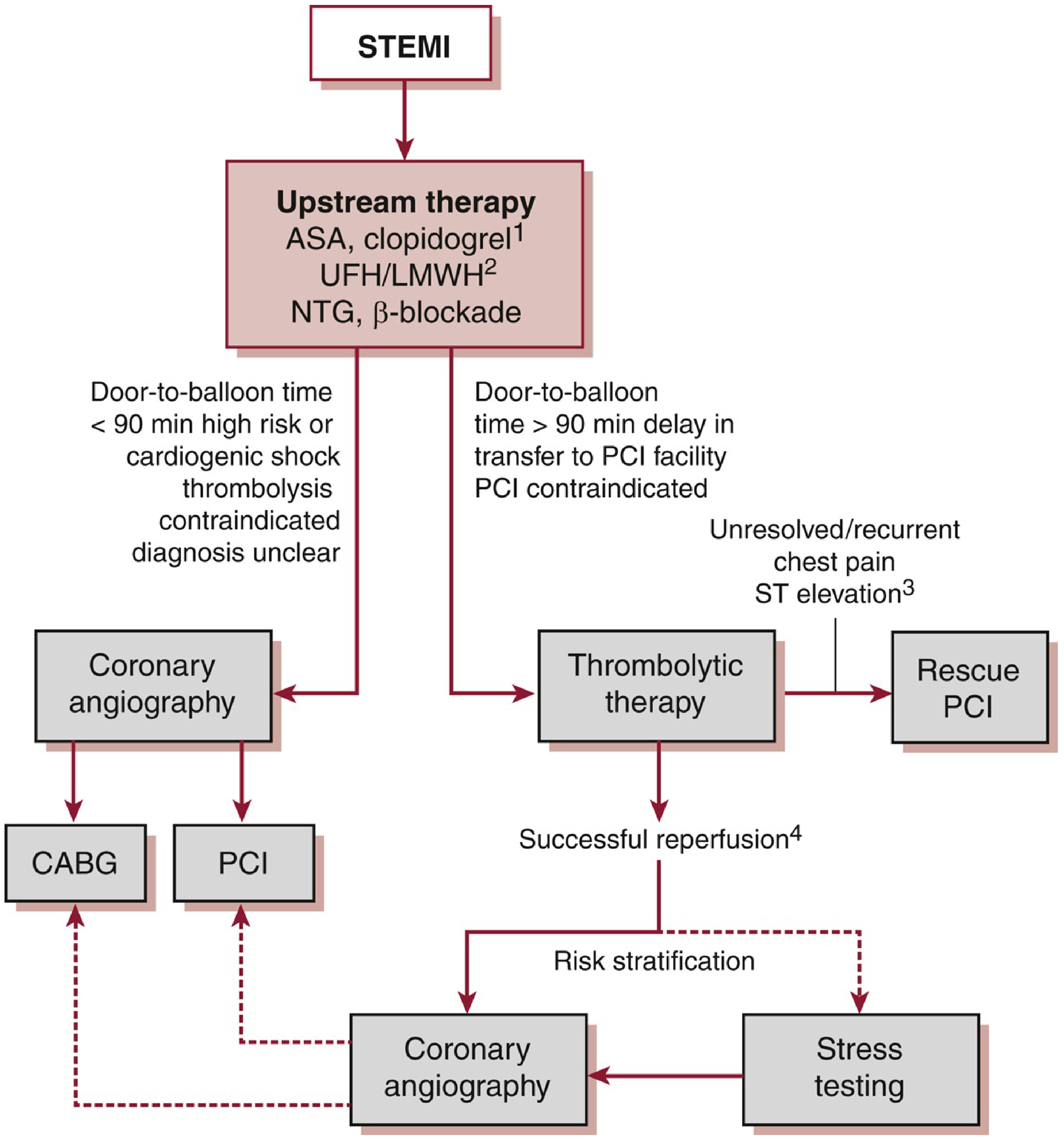
STEMI reperfusion strategy decision flowchart - Washington Manual of Medical Therapeutics
Primary PCI (PREFERRED if available)
- Door-to-balloon time < 90 minutes from first medical contact
- Superior to fibrinolysis: better vessel patency, less reinfarction, less intracranial hemorrhage, better survival
- Preferred especially in Killip class III/IV (pulmonary edema) - high-risk patients benefit most from PCI
- This patient's high BP and pulmonary edema make them high-risk - PCI is strongly preferred
- Washington Manual of Medical Therapeutics, p.155
Fibrinolytic Therapy (if PCI not available within 90-120 min)
- Use if door-to-balloon > 120 min AND no contraindications
- Agents: Tenecteplase (weight-based, single bolus - most convenient), Alteplase, Reteplase
- Contraindications to fibrinolysis include:
- Prior hemorrhagic stroke at any time
- Ischemic stroke within 3 months
- Active internal bleeding
- Suspected aortic dissection
- Severe uncontrolled hypertension (relative contraindication - BP 215/140 is a concern)
- Head trauma/intracranial neoplasm
- Note: BP of 215/140 is a relative contraindication to fibrinolysis (severe uncontrolled hypertension). Attempts should be made to lower BP before fibrinolysis, or primary PCI should be pursued.
After Fibrinolysis - Signs of Successful Reperfusion:
- Chest pain relief
- ≥50% reduction in ST elevation at 60-90 minutes
- Reperfusion arrhythmia (accelerated idioventricular rhythm)
- Peak troponin earlier than expected (washout)
If these signs absent → Rescue PCI immediately.
ADDITIONAL INPATIENT MANAGEMENT
Beta-blockers
- Oral metoprolol 25-50 mg - start within 24 hours IF:
- No pulmonary edema / HF signs at that time (wait until edema clears)
- No cardiogenic shock
- SBP > 120, HR 60-110
- No advanced heart block
- IV beta-blockers are CONTRAINDICATED in Killip class II+ (HF present) - increases mortality
- This patient currently has pulmonary edema (Killip III) → delay oral beta-blockers until euvolemic
ACE Inhibitors
- Start within 24-48 hours after hemodynamic stabilization
- Especially important in anterior STEMI and reduced EF
- Ramipril 2.5 mg or captopril 6.25 mg initially
Statins
- High-intensity statin immediately: Atorvastatin 80 mg or Rosuvastatin 40 mg
- Pleiotropic effects beyond LDL lowering in acute STEMI
MONITORING & DANGER SIGNS
| Finding | Action |
|---|---|
| SpO2 not improving on high-flow O2 | Consider BiPAP/intubation |
| BP dropping < 90 systolic | STOP diuretics/nitrates, suspect cardiogenic shock, IABP/inotropes |
| New hypotension + JVP elevation + clear lungs | Right ventricular infarction - needs IV fluids, NOT diuretics |
| Arrhythmia (VT/VF) | Defibrillation immediately |
| Persistent ST elevation at 90 min post-lysis | Rescue PCI |
| Deteriorating despite treatment | Mechanical support (IABP, Impella) |
DIFFERENTIAL DIAGNOSES TO KEEP IN MIND
- Aortic dissection - chest pain radiating to back, BP differential between arms, check CXR for widened mediastinum. Thrombolytics are LETHAL if this is the diagnosis.
- Hypertensive emergency with pulmonary edema (non-ischemic) - troponin may be mildly elevated from demand ischemia (type 2 MI). But ST elevation here strongly points to STEMI.
- Acute severe mitral regurgitation - can cause flash pulmonary edema; echo will clarify.
- PE with RV strain - can cause ST changes but usually right heart strain pattern on ECG.
SUMMARY: IMMEDIATE ACTION SEQUENCE
1. Sit up / high-flow O2 / SpO2 monitoring
2. Aspirin 300 mg (chewed) + P2Y12 inhibitor STAT
3. IV nitroglycerin infusion (titrate to BP reduction)
4. IV furosemide 40-80 mg
5. UFH bolus + infusion
6. STEMI alert → Activate cath lab (Primary PCI target < 90 min)
7. Morphine 2-4 mg IV cautiously
8. BiPAP if SpO2 not improving
9. Serial ECG, ABG, echo at bedside
10. Continuous monitoring for RV infarction / cardiogenic shock
This patient is critically ill - Killip Class III STEMI carries significantly higher mortality (~20%) than uncomplicated STEMI (~5%). Every minute of delay to reperfusion increases infarct size and mortality. The priority is opening the artery while simultaneously stabilizing the pulmonary edema.
Sources: Washington Manual of Medical Therapeutics (Acute Coronary Reperfusion, p.154-156); Rosen's Emergency Medicine (ACS Management, Table 64.8); Berek & Novak's Gynecology (Cardiogenic Pulmonary Edema management principles); Katzung's Basic and Clinical Pharmacology (Thrombolytics)
This is a shared conversation. Sign in to Orris to start your own chat.