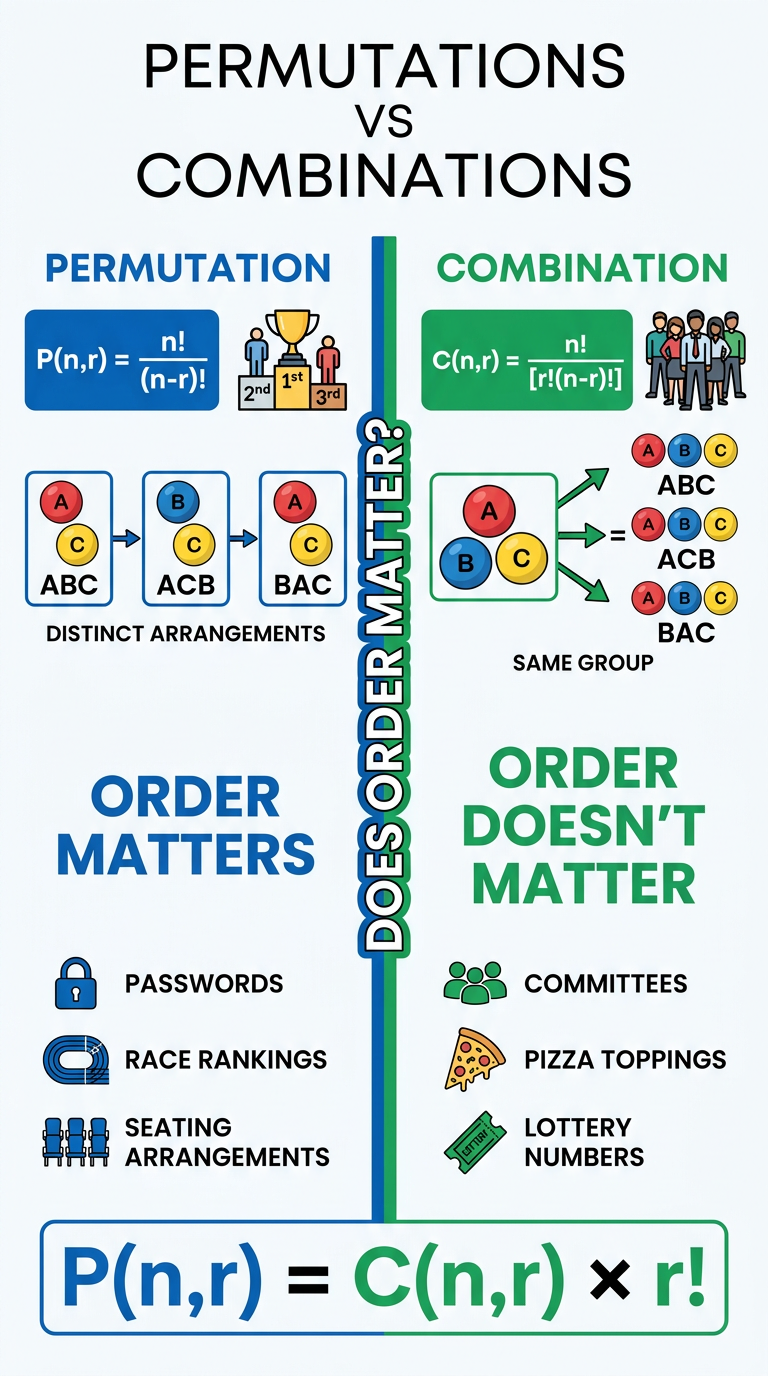
Permutations & Combinations — Complete Guide
Let me break this down from scratch, building up the intuition before the formulas.
🔑 The Core Idea
Both deal with selecting items from a group, but they differ on one thing:
Does ORDER matter?
- Yes → Permutation
- No → Combination
Part 1: The Fundamental Counting Principle
Before anything else, you need this:
If you have m ways to do Task 1 and n ways to do Task 2, you have m × n total ways.
Example: 3 shirts × 4 pants = 12 outfits
Part 2: Factorials
The symbol n! (n factorial) means multiply all integers from n down to 1.
| n | n! |
|---|
| 1 | 1 |
| 2 | 2×1 = 2 |
| 3 | 3×2×1 = 6 |
| 4 | 4×3×2×1 = 24 |
| 5 | 5×4×3×2×1 = 120 |
Special rule: 0! = 1 (by definition)
Part 3: Permutations (Order MATTERS)
Intuition First
You have 5 people. How many ways to assign them to 3 ranked positions (Gold, Silver, Bronze)?
- 5 choices for Gold
- 4 remaining for Silver
- 3 remaining for Bronze
- Total = 5 × 4 × 3 = 60
The Formula
$$P(n, r) = \frac{n!}{(n-r)!}$$
Where:
- n = total items
- r = items being arranged/selected
Same example: P(5, 3) = 5! / (5−3)! = 120 / 2 = 60 ✓
More Examples
| Problem | Setup | Answer |
|---|
| Arrange 4 books on a shelf | P(4,4) = 4!/0! | 24 |
| Pick & arrange 2 letters from {A,B,C,D} | P(4,2) = 4!/2! | 12 |
| 8 runners, how many ways for Top 3? | P(8,3) = 8!/5! | 336 |
Part 4: Combinations (Order DOESN'T Matter)
Intuition First
Same 5 people, but now pick 3 for a committee (no ranks, just members).
From permutations we got 60 arrangements. But in a committee, {Alice, Bob, Carol} is the same group regardless of order. Each group of 3 can be arranged in 3! = 6 ways, so we're overcounting by 6.
Answer = 60 / 6 = 10
The Formula
$$C(n, r) = \binom{n}{r} = \frac{n!}{r!(n-r)!}$$
Same example: C(5,3) = 5! / (3! × 2!) = 120 / (6×2) = 10 ✓
More Examples
| Problem | Setup | Answer |
|---|
| Choose 2 toppings from 5 | C(5,2) = 5!/(2!×3!) | 10 |
| Pick 4 cards from a 52-card deck | C(52,4) | 270,725 |
| Select a team of 3 from 7 players | C(7,3) | 35 |
Part 5: The Key Relationship
$$P(n,r) = C(n,r) \times r!$$
Permutation = Combination × (ways to arrange the selected items)
This makes perfect sense: once you pick the group (combination), you can arrange them in r! ways to get permutations.
Part 6: Special Properties of Combinations
These are worth memorizing:
| Property | Formula | Why |
|---|
| Choosing none | C(n, 0) = 1 | Only one way to pick nothing |
| Choosing all | C(n, n) = 1 | Only one way to pick everything |
| Symmetry | C(n, r) = C(n, n−r) | Picking 2 from 5 = leaving out 3 from 5 |
Symmetry example: C(10, 3) = C(10, 7) = 120
Part 7: How to Tell Them Apart (The Big Test)
Ask yourself: "Does swapping the order give a different outcome?"
| Scenario | Order Matters? | Use |
|---|
| Lock combination (1-2-3 ≠ 3-2-1) | ✅ Yes | Permutation |
| Choosing a committee | ❌ No | Combination |
| Race finishing positions | ✅ Yes | Permutation |
| Choosing pizza toppings | ❌ No | Combination |
| Arranging books on shelf | ✅ Yes | Permutation |
| Picking lottery numbers | ❌ No | Combination |
| Assigning President/VP roles | ✅ Yes | Permutation |
| Selecting 5 cards from a deck | ❌ No | Combination |
Part 8: Step-by-Step Problem Solving
Q: A class of 10 students. Find: (a) # of ways to elect a President & VP. (b) # of ways to pick a 2-person study group.
(a) President & VP → roles are different → ORDER MATTERS → Permutation
P(10, 2) = 10! / 8! = 10 × 9 = 90
(b) Study group → no roles → ORDER DOESN'T MATTER → Combination
C(10, 2) = 10! / (2! × 8!) = 90/2 = 45
Notice: The combination answer is exactly half the permutation answer here (since r=2, and 2! = 2).
Quick Reference Card
$$\boxed{P(n,r) = \frac{n!}{(n-r)!}} \qquad \boxed{C(n,r) = \frac{n!}{r!(n-r)!}}$$
| Permutation | Combination |
|---|
| Order | Matters | Doesn't matter |
| Formula | n!/(n−r)! | n!/[r!(n−r)!] |
| Always larger | ✅ (or equal when r=1 or 0) | |
| Real-world | Rankings, passwords, seating | Teams, groups, selections |
The single most common mistake is confusing the two. Just keep asking: "If I rearranged my selection, would it be considered different?" If yes → permutation. If no → combination.
Want me to walk through any specific problem types (repetition allowed, circular permutations, mixed problems)?