
Diarrhoea
Reading File
The query "Diarrhoea" is quite broad. Let me clarify the scope before proceeding.
Asking for Preferences
What aspect of diarrhoea are you looking for?
Searching sources...
Finding Sources
Searching the Web
diarrhoea causes types pathophysiology overview
The best sources are Sleisenger & Fordtran's (block7) and Costanzo Physiology. Let me read those in parallel.
Reading File
Reading File
The Costanzo block was from an HIV/AIDS chapter. Let me now read the main diarrhea chapter from Sleisenger & Fordtran's (block3), and also fetch the Cl-secretion diagram.
Reading File
Loading Image
Excellent content loaded. Now I have comprehensive material from Sleisenger & Fordtran's dedicated diarrhea chapter and Costanzo Physiology. Let me compile the full answer.
Diarrhoea - Overview: Causes, Types & Pathophysiology
Definition
Diarrhoea is a symptom, not a disease. Most patients consider increased fluidity of stool to be its essential characteristic. Formally, it is defined as:
- Stool weight > 200 g/day (the clinical gold standard)
- OR passage of 3 or more loose/watery stools per day
- Acute diarrhoea: lasts < 14 days
- Persistent diarrhoea: lasts 14-30 days
- Chronic diarrhoea: lasts > 4 weeks (affects ~6.6% of the population)
The word itself derives from Greek meaning "to run through."
Normal Intestinal Fluid Balance (Background)
The gut handles enormous fluid volumes daily. Of roughly 9 L of fluid entering the small intestine (from diet + secretions), over 98% is normally absorbed. Diarrhoea results when this balance tips toward net secretion or reduced absorption.
Pathophysiology - The Four Core Mechanisms
1. Osmotic Diarrhoea
Caused by non-absorbable solutes in the intestinal lumen that retain water osmotically.
How it works:
- When solutes that cannot be absorbed remain in the gut lumen, they exert an osmotic force that draws water into the lumen
- This overwhelms the absorptive capacity of the colon
Key features:
- Stops with fasting or stopping the offending agent
- Stool osmotic gap is high (> 125 mOsm/kg)
- Stool osmotic gap = 290 - 2 × (stool [Na+] + stool [K+])
Causes:
| Cause | Example |
|---|---|
| Disaccharidase deficiency | Lactase deficiency (lactose intolerance) - undigested lactose retained in lumen; colonic bacteria further ferment it into more osmotically active particles |
| Malabsorption syndromes | Coeliac disease, short bowel syndrome |
| Osmotic laxatives | Magnesium salts, lactulose, polyethylene glycol |
| Sugar alcohols | Sorbitol, mannitol (in "sugar-free" products) |
2. Secretory Diarrhoea
Caused by excessive active secretion of ions and water by intestinal crypt cells, or failure of villous absorption.
How it works (molecular mechanism):
The diagram below illustrates the key pathway using cholera as the prototype:
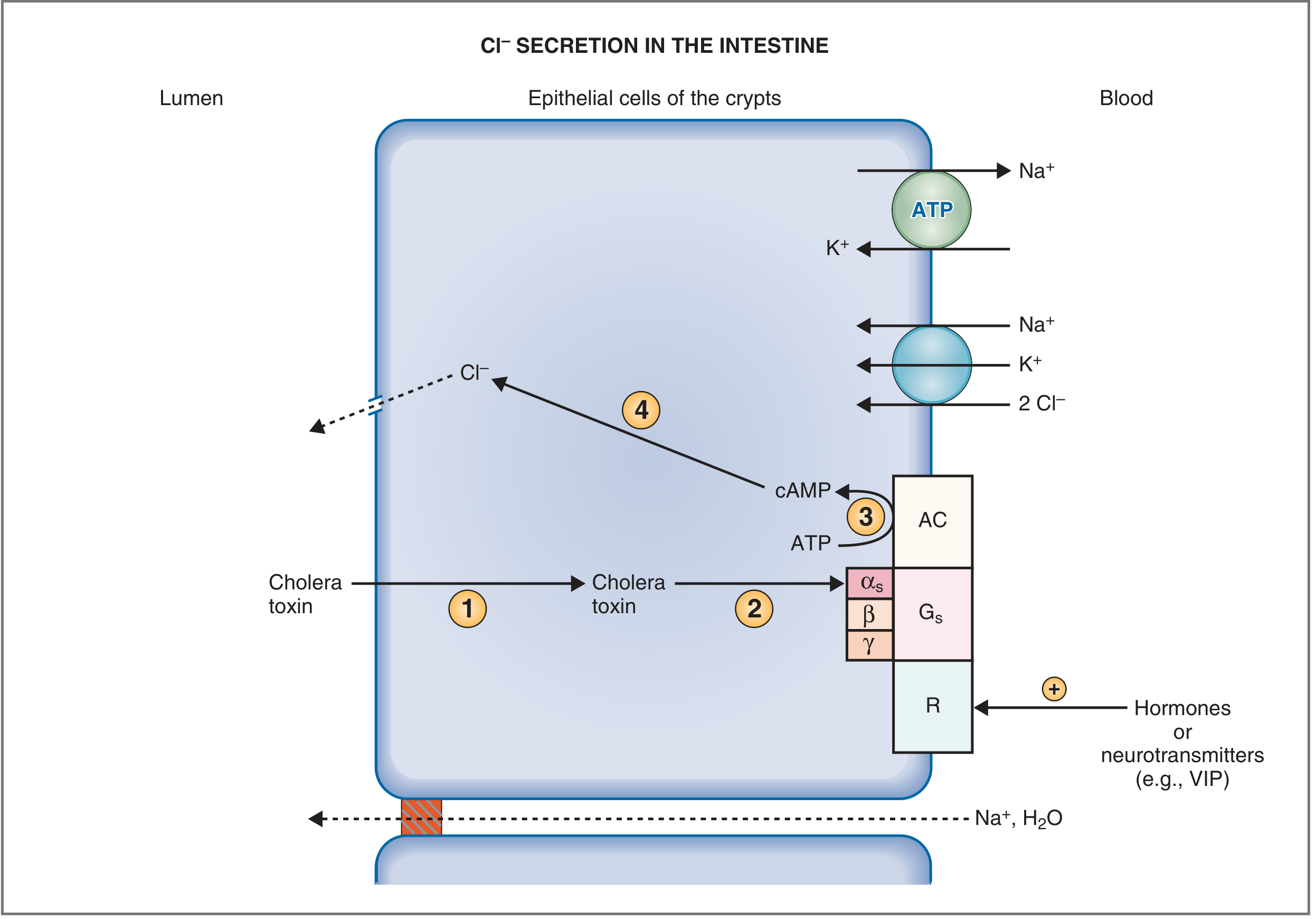
Fig: Mechanism of Cl- and fluid secretion by intestinal crypt epithelial cells (Costanzo Physiology)
Steps:
- Cholera toxin enters crypt cells via the apical membrane
- The A-subunit activates the Gs protein (α-subunit)
- This permanently activates adenylyl cyclase (AC), massively increasing intracellular cAMP
- Elevated cAMP opens CFTR Cl- channels in the apical membrane → Cl- pours into the lumen
- Na+ and water follow passively (paracellularly) → profuse watery diarrhoea
Other secretagogues (VIP, prostaglandins, bile acids) use similar cAMP/cGMP/Ca2+ second-messenger pathways.
Key features:
- Persists with fasting (unlike osmotic diarrhoea)
- Large volumes (may be > 1 L/day)
- Stool osmotic gap is low (< 50 mOsm/kg) - stool electrolytes account for most osmolality
- Isotonic stool
Causes:
| Category | Examples |
|---|---|
| Bacterial toxins | Vibrio cholerae, enterotoxigenic E. coli (ETEC), Staph. aureus |
| Hormone-secreting tumours | VIPoma (Verner-Morrison), carcinoid (serotonin), gastrinoma (Zollinger-Ellison), medullary thyroid carcinoma (calcitonin) |
| Bile acid malabsorption | Terminal ileal disease/resection → bile acids reach colon → stimulate secretion |
| Microscopic colitis | Collagenous/lymphocytic colitis |
| Congenital | Congenital chloridorrhoea (defective Cl-/HCO3- exchanger) |
3. Inflammatory / Exudative Diarrhoea
Caused by mucosal damage and inflammation, leading to protein, blood, and pus loss into the lumen.
How it works:
- Destruction of villous absorptive cells → reduced absorption
- Release of prostaglandins and cytokines → stimulate secretion
- Mucosal ulceration → exudation of protein-rich fluid, RBCs, WBCs
Key features:
- Stool contains blood, mucus, or pus (dysentery pattern)
- Fever and systemic inflammatory signs common
- Fecal leukocytes positive
- Small-volume, frequent stools (if colonic involvement)
Causes:
| Category | Examples |
|---|---|
| Invasive bacteria | Shigella, Salmonella, Campylobacter, C. difficile, EIEC, E. coli O157:H7 |
| Parasites | Entamoeba histolytica |
| IBD | Crohn's disease, ulcerative colitis |
| Ischaemic colitis | |
| Radiation enteritis |
4. Motility-Related Diarrhoea (Decreased Absorptive Contact Time)
Caused by reduced transit time through the gut, preventing adequate absorption.
How it works:
- Rapid transit means luminal contents do not have sufficient contact with the absorptive mucosa
- Can also result from surgical reduction of absorptive surface area
Causes:
| Cause | Example |
|---|---|
| Surgical | Post-gastrectomy (dumping), bowel resection, vagotomy (postvagotomy diarrhoea) |
| Functional | IBS-diarrhoea predominant (IBS-D) |
| Hyperthyroidism | Increased GI motility |
| Diabetic autonomic neuropathy | Disrupted neural control |
| Drugs | Prokinetics, magnesium antacids |
Metabolic Consequences of Diarrhoea
Diarrhoeal fluid is rich in specific electrolytes, so large losses cause predictable disturbances:
| Electrolyte/Fluid | Loss | Consequence |
|---|---|---|
| Water + Na+ | Isotonic ECF loss | Hypovolaemia, hypotension, circulatory collapse |
| HCO3- | High in intestinal secretions | Hyperchloraemic normal anion gap metabolic acidosis |
| K+ | Flow-rate-dependent colonic K+ secretion | Hypokalaemia |
Clinical Classification Summary
| Feature | Osmotic | Secretory | Inflammatory |
|---|---|---|---|
| Volume | Moderate | Large | Small |
| Blood/mucus | No | No | Yes |
| Fasting effect | Stops | Persists | Persists |
| Osmotic gap | High (>125) | Low (<50) | Variable |
| Examples | Lactose intolerance | Cholera, VIPoma | Shigellosis, IBD |
Common Causes by Duration
Acute (< 14 days) - usually infectious:
- Viral: Norovirus, Rotavirus (most common globally in children)
- Bacterial: Salmonella, Campylobacter, Shigella, ETEC, C. difficile
- Parasitic: Giardia lamblia, Cryptosporidium
Chronic (> 4 weeks):
- IBD (Crohn's disease, ulcerative colitis)
- IBS-D (functional)
- Malabsorption (coeliac disease, pancreatic exocrine insufficiency)
- Microscopic colitis
- Endocrine (hyperthyroidism, Addison's, VIPoma, carcinoid)
- Medications (metformin, antibiotics, PPIs, SSRIs)
- Post-surgical (short bowel syndrome, bile acid diarrhoea)
Sources: Sleisenger and Fordtran's Gastrointestinal and Liver Disease, Chapter on Diarrhea; Costanzo Physiology 7th Edition, pp. 392-393
This is a shared conversation. Sign in to Orris to start your own chat.