
Urea cycle
Reading File
Finding Sources
Searching the Web
urea cycle biochemistry steps enzymes overview
The two best sources are Lippincott Biochemistry and Basic Medical Biochemistry. Let me read both in parallel.
Reading File
Reading File
I have excellent content from both sources. Let me fetch the Lippincott urea cycle diagram and read more of the Basic Medical Biochemistry content for regulation/disorders.
Loading Image
Reading File
Reading File
I now have comprehensive content. Let me compile a thorough answer.
The Urea Cycle (Ornithine Cycle)
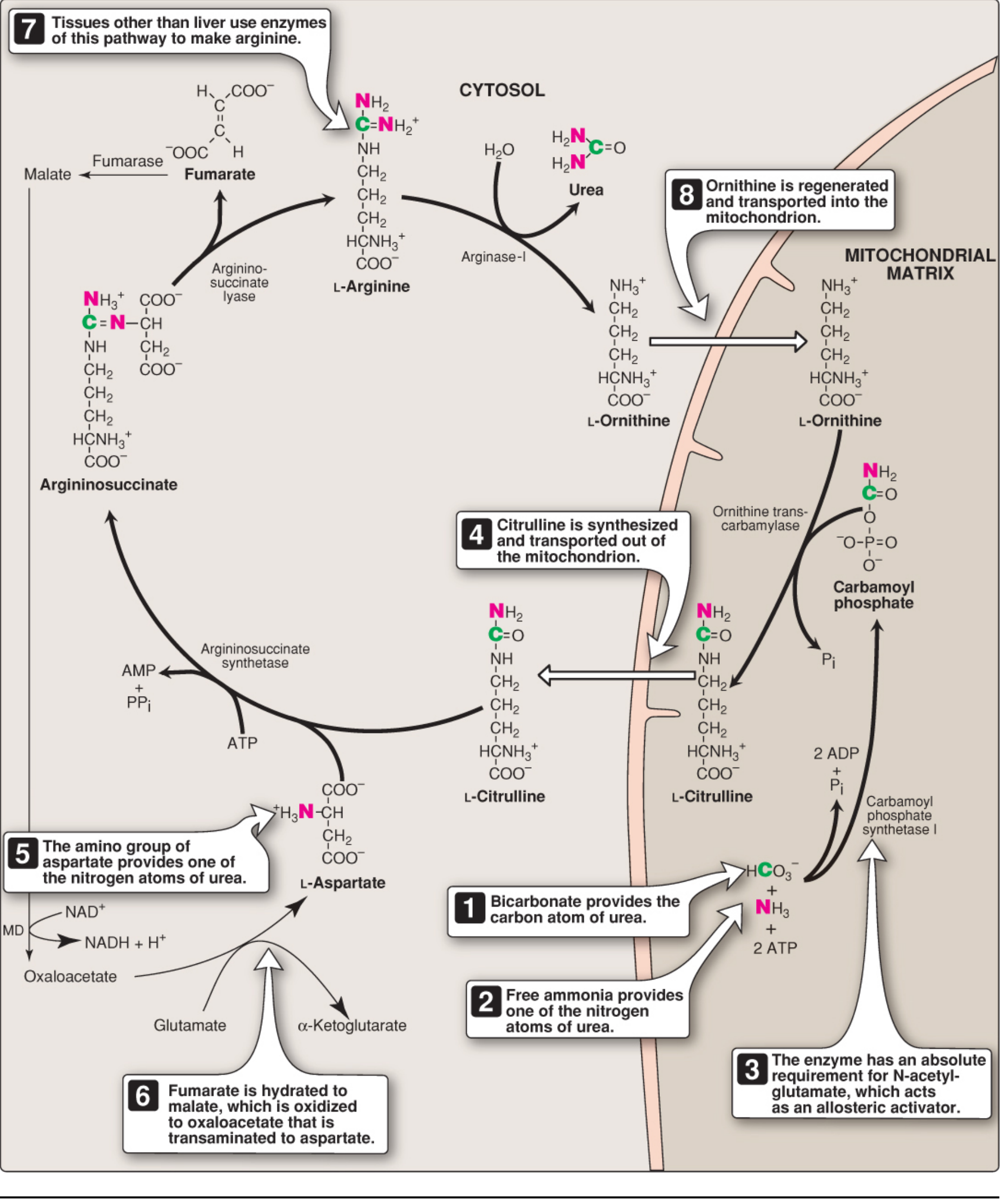
Overview
The urea cycle is the primary pathway for disposing of nitrogen from amino acid catabolism. Urea (H₂N-CO-NH₂) accounts for ~90% of the nitrogen-containing components of urine. It was first described in 1932 by Hans Krebs and Kurt Henseleit - hence the original name, the Krebs-Henseleit cycle.
- One nitrogen comes from free NH₃ (ammonia)
- The other nitrogen comes from aspartate
- The carbon and oxygen come from CO₂ (as HCO₃⁻)
- The cycle occurs in hepatocytes of the liver
- Steps 1-2 occur in the mitochondrial matrix; steps 3-5 occur in the cytosol
Urea is released into the blood (measured as BUN - blood urea nitrogen) and excreted by the kidneys.
The 5 Reactions
Step 1 - Carbamoyl Phosphate Synthesis (Mitochondria)
Enzyme: Carbamoyl phosphate synthetase I (CPS I)
NH₃ + HCO₃⁻ + 2 ATP → Carbamoyl phosphate + 2 ADP + Pi
- Requires cleavage of 2 ATP
- Requires N-acetylglutamate (NAG) as an obligatory allosteric activator
- This is the rate-limiting, committed step
- Note: CPS II (cytosolic) is a different enzyme that participates in pyrimidine synthesis; it uses glutamine as nitrogen source and does not require NAG
Step 2 - Citrulline Formation (Mitochondria)
Enzyme: Ornithine transcarbamylase (OTC)
Carbamoyl phosphate + Ornithine → Citrulline + Pi
- The carbamoyl group is transferred to ornithine
- Citrulline exits the mitochondria via an antiporter (exchanges with ornithine)
- OTC deficiency is the most common urea cycle disorder (X-linked)
Step 3 - Argininosuccinate Formation (Cytosol)
Enzyme: Argininosuccinate synthetase (ASS)
Citrulline + Aspartate + ATP → Argininosuccinate + AMP + PPi
- This step introduces the second nitrogen (from aspartate)
- Requires ATP hydrolysis to AMP + PPi (equivalent to 2 ATP)
Step 4 - Cleavage of Argininosuccinate (Cytosol)
Enzyme: Argininosuccinate lyase (ASL)
Argininosuccinate → Arginine + Fumarate
- Arginine retains both nitrogens
- Fumarate is released - it enters the TCA cycle (connects urea cycle to TCA), eventually being converted back to oxaloacetate → aspartate via transamination (the "aspartate-argininosuccinate shunt")
Step 5 - Urea Release (Cytosol)
Enzyme: Arginase I
Arginine + H₂O → Urea + Ornithine
- Urea is released and excreted
- Ornithine is regenerated and transported back into the mitochondria to restart the cycle (analogous to oxaloacetate in the TCA cycle)
Energy Cost
| Step | ATP equivalent used |
|---|---|
| CPS I (Step 1) | 2 ATP → 2 ADP + Pi |
| ASS (Step 3) | ATP → AMP + PPi (= 2 ATP equivalent) |
| Total | 4 ATP per urea molecule |
Regulation
The key regulatory enzyme is CPS I, controlled by:
- N-acetylglutamate (NAG) - obligatory allosteric activator
- NAG is synthesized from acetyl-CoA + glutamate by NAG synthase
- Arginine activates NAG synthase - so when arginine (and therefore protein load) is high, the cycle speeds up
- High protein intake and prolonged fasting both increase urea cycle enzyme expression
Link to the TCA Cycle
The fumarate released in Step 4 connects to the TCA cycle:
Fumarate → Malate (fumarase) → Oxaloacetate (malate dehydrogenase) → Aspartate (transamination with glutamate)
This regenerates aspartate for Step 3, creating a cyclic interplay between the urea cycle and TCA cycle.
Nitrogen Sources - How NH₃ and Aspartate Are Generated
- Glutamate dehydrogenase (GDH): Glutamate → α-ketoglutarate + NH₃ (feeds Step 1)
- Aspartate aminotransferase (AST): Oxaloacetate + Glutamate → Aspartate + α-ketoglutarate (feeds Step 3)
- Glutamate is therefore the immediate precursor of both nitrogen atoms in urea
Hyperammonemia
Normal blood ammonia: 5-35 μmol/L (some sources give 30-60 μM). When liver function is compromised, levels can exceed 1,000 μmol/L.
Symptoms: Tremors, slurred speech, somnolence, vomiting, cerebral edema, coma, and death.
Causes:
- Acquired - liver disease (viral hepatitis, alcohol-induced cirrhosis, portal-systemic shunting bypasses hepatic urea synthesis)
- Inherited (urea cycle disorders):
| Disorder | Deficient Enzyme | Key Features |
|---|---|---|
| CPS I deficiency | Carbamoyl phosphate synthetase I | ↑ NH₃, no orotic acid |
| OTC deficiency | Ornithine transcarbamylase | Most common; X-linked; ↑ orotic acid (carbamoyl-P diverted to pyrimidine synthesis) |
| Citrullinemia | Argininosuccinate synthetase | ↑ citrulline |
| Argininosuccinic aciduria | Argininosuccinate lyase | ↑ argininosuccinate |
| Arginase deficiency | Arginase I | ↑ arginine; spastic diplegia |
| NAGS deficiency | N-acetylglutamate synthase | ↑ NH₃; treated with N-carbamylglutamate |
Key distinguishing point: OTC deficiency produces elevated orotic acid in urine (excess carbamoyl phosphate in the cytosol is shunted into the pyrimidine synthesis pathway), while CPS I deficiency does not.
Treatment of Hyperammonemia
- Nitrogen scavengers: Sodium benzoate (conjugates glycine → hippurate, excreted) and sodium phenylbutyrate (→ phenylacetate → conjugates glutamine → phenylacetylglutamine, excreted) - both allow nitrogen excretion without urea
- Dietary protein restriction and essential amino acid supplementation
- Arginine supplementation (except in arginase deficiency) - arginine becomes essential when the cycle is blocked
- Liver transplant for severe defects
- N-carbamylglutamate (a NAG analog) for NAGS deficiency - activates residual CPS I
Sources: Biochemistry, 8th ed. Lippincott Illustrated Reviews, p. 712-722; Basic Medical Biochemistry - A Clinical Approach, 6e, p. 1321-1326
This is a shared conversation. Sign in to Orris to start your own chat.