
Steroid resistant nephritic syndrome caused by mutation in gene encoding.
I'll check the medical library skill first, then search for the answer.
Reading File
Now let me search the medical library and PubMed in parallel.
Finding Sources
Searching PubMed
steroid resistant nephrotic syndrome gene mutation
Good results. Let me now read the key textbook sections for detailed gene information.
Reading File
Reading File
Finding Sources
Excellent. Now let me get the comprehensive gene table and detailed descriptions from the nephrology textbook.
Reading File
Finding Sources
I have very rich data. Let me also fetch the gene distribution pie chart image to include in the answer.
Loading Image
Loading Image
I now have comprehensive data from the textbooks and charts. Here is the complete answer:
Steroid-Resistant Nephrotic Syndrome (SRNS): Gene Mutations
SRNS is defined as failure to achieve complete remission after 4-8 weeks of full-dose corticosteroid therapy. Over 63 monogenic causes have been identified, most involving genes highly expressed in glomerular podocytes - the primary site of injury in NS.
A monogenic cause is found in 10-30% of SRNS cases. Genetic detection rate is highest (up to 69%) in neonates (0-3 months) and decreases with older age.
Key Pathophysiology
All the major SRNS genes encode proteins critical to the podocyte slit diaphragm or podocyte cytoskeletal integrity. Mutations disrupt the filtration barrier, causing massive proteinuria that does not respond to steroids.
Major Genes Causing SRNS
1. NPHS2 - Podocin (Most Common in Children)
| Feature | Detail |
|---|---|
| Protein | Podocin - intracellular membrane-bound protein |
| Inheritance | Autosomal Recessive (AR) |
| Location | Slit diaphragm / lipid rafts |
| Clinical | Childhood-onset SRNS; FSGS on biopsy |
| Key mutation | R138Q (early childhood onset) |
| Notes | Most common monogenic cause in children 1-6 years; ~18% of familial SRNS have recessive NPHS2 mutations. Podocin interacts directly with nephrin in cholesterol-rich membrane microdomains. |
2. NPHS1 - Nephrin
| Feature | Detail |
|---|---|
| Protein | Nephrin - major transmembrane protein of slit diaphragm |
| Inheritance | Autosomal Recessive |
| Clinical | Congenital nephrotic syndrome of the Finnish type (onset 0-3 months); highest prevalence at birth |
| Notes | Truncating mutations (non-sense) cause severe congenital NS; non-truncating mutations at p.1160 cause a milder form that may respond to steroids. North African populations have characteristic NPHS1 mutations. |
3. PLCE1 - Phospholipase C Epsilon 1
| Feature | Detail |
|---|---|
| Protein | Phospholipase C epsilon 1 |
| Inheritance | Autosomal Recessive |
| Clinical | Early-childhood onset SRNS; FSGS or diffuse mesangial sclerosis |
| Notes | Rarely seen in patients over 6 years old; 3.7% of WES-positive SRNS families |
4. WT1 - Wilms Tumor Suppressor Gene
| Feature | Detail |
|---|---|
| Protein | WT1 transcription factor |
| Inheritance | Autosomal Dominant |
| Clinical | Biphasic onset: first peak at 4-12 months, second peak >18 years |
| Syndromes | Denys-Drash syndrome (DDS), Frasier syndrome, WAGR syndrome |
| Notes | Associated with genitourinary anomalies and Wilms tumor risk |
5. INF2 - Inverted Formin 2
| Feature | Detail |
|---|---|
| Protein | Inverted formin 2 - actin polymerization regulator |
| Inheritance | Autosomal Dominant |
| Clinical | Early adult onset; FSGS; most common dominant cause in adults |
| Notes | Some variants also cause Charcot-Marie-Tooth neuropathy |
6. TRPC6 - Transient Receptor Potential Cation Channel C6
| Feature | Detail |
|---|---|
| Protein | TRPC6 - calcium channel in podocytes |
| Inheritance | Autosomal Dominant |
| Clinical | Adult-onset FSGS (typically 20s-40s) |
| Notes | Gain-of-function mutations lead to excess calcium influx in podocytes |
7. ACTN4 - Alpha-Actinin-4
| Feature | Detail |
|---|---|
| Protein | Alpha-actinin-4 - actin cross-linking protein |
| Inheritance | Autosomal Dominant |
| Clinical | Adult-onset FSGS |
| Notes | Mutations cause protein aggregation and podocyte injury |
8. LAMB2 - Laminin Beta-2
| Feature | Detail |
|---|---|
| Protein | Laminin beta-2 - GBM component |
| Inheritance | Autosomal Recessive |
| Clinical | Congenital/infantile onset; Pierson syndrome (NS + microcoria) |
| Notes | Early-onset only; rarely seen after 6 years |
9. COQ-Pathway Genes (Mitochondrial/CoQ10 Deficiency)
| Gene | Protein | Notes |
|---|---|---|
| COQ2 | Polyprenyl transferase | SRNS + encephalopathy |
| COQ6 | Coenzyme Q6 monooxygenase | SRNS + sensorineural deafness |
| ADCK4 | Aaryl-CoQ kinase 4 | SRNS; importantly, responds to CoQ10 supplementation |
| PDSS2 | Decaprenyl-diphosphate synthase subunit 2 | SRNS |
Clinical pearl: CoQ10 pathway mutations are among the very few genetic causes of SRNS where specific therapy (CoQ10 supplementation) may be effective.
10. Nucleoporin Genes (Nuclear Pore Complex)
| Gene | Notes |
|---|---|
| NUP93 | Recessive SRNS; nuclear pore complex |
| NUP205 | Recessive SRNS |
| NUP107 | Homozygous mutation leads to microcephaly + SRNS |
| XPO5 | Exportin 5; SRNS |
11. SMARCAL1
| Feature | Detail |
|---|---|
| Protein | SWI/SNF-related DNA helicase |
| Clinical | Schimke immunoosseous dysplasia: SRNS + spondyloepiphyseal dysplasia + T-cell immunodeficiency |
| Inheritance | Autosomal Recessive |
| WES frequency | 2.7% of solved SRNS cases |
12. ARHGDIA - Rho-GDP Dissociation Inhibitor alpha
- Encodes RhoGDIα, which modulates signaling through Rho GTPases and regulates cell motility
- Recessive SRNS; disrupts podocyte actin cytoskeleton
13. MYO1E - Myosin IE
- Non-muscle myosin involved in podocyte cytoskeletal organization
- Recessive SRNS; FSGS
Gene Distribution (from WES of 300 Families)
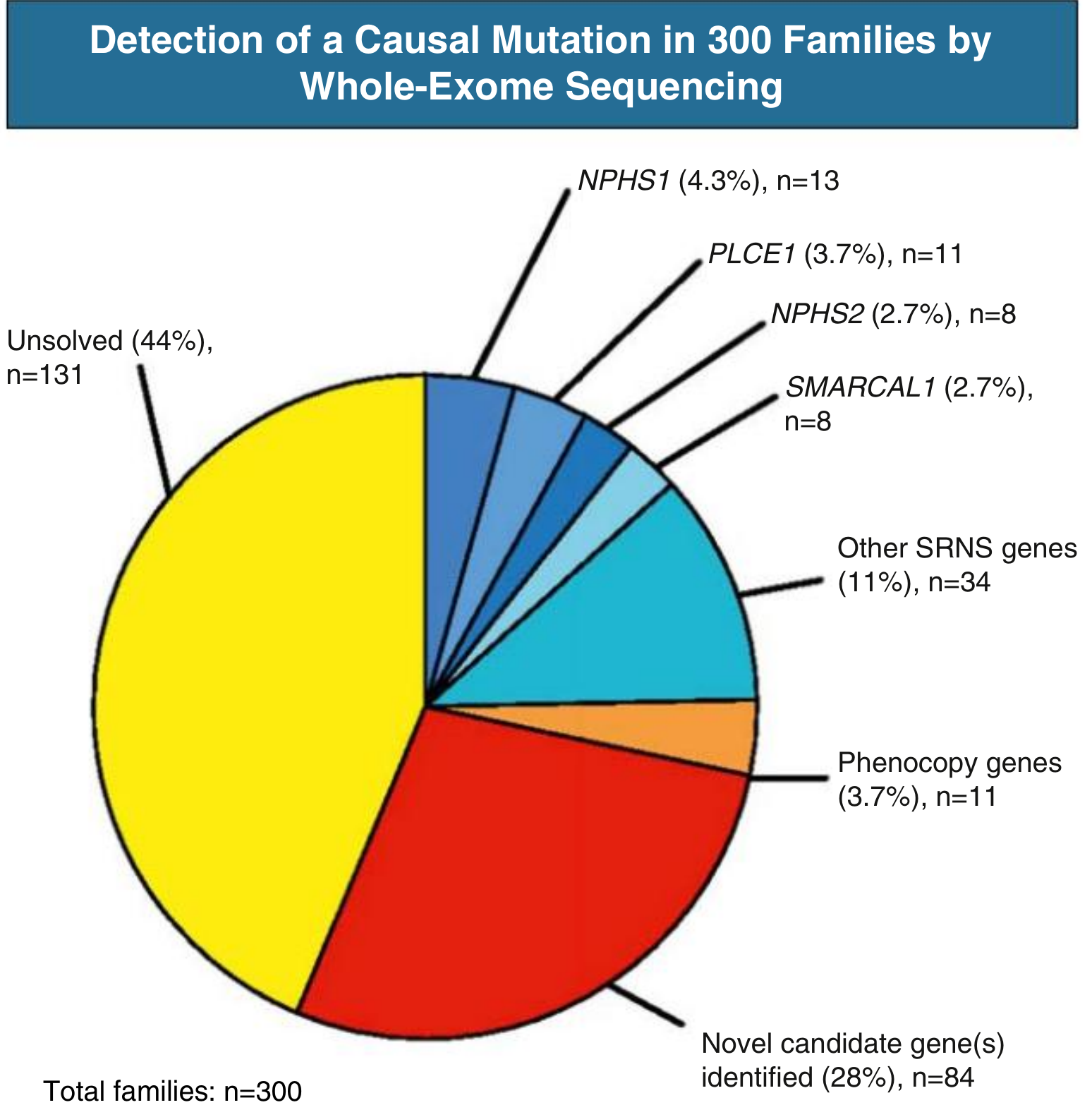
In 25% of families a causal mutation was found. The top genes: NPHS1 (4.3%), PLCE1 (3.7%), NPHS2 (2.7%), SMARCAL1 (2.7%), with other SRNS genes accounting for 11%.
Gene Distribution by Age of Onset
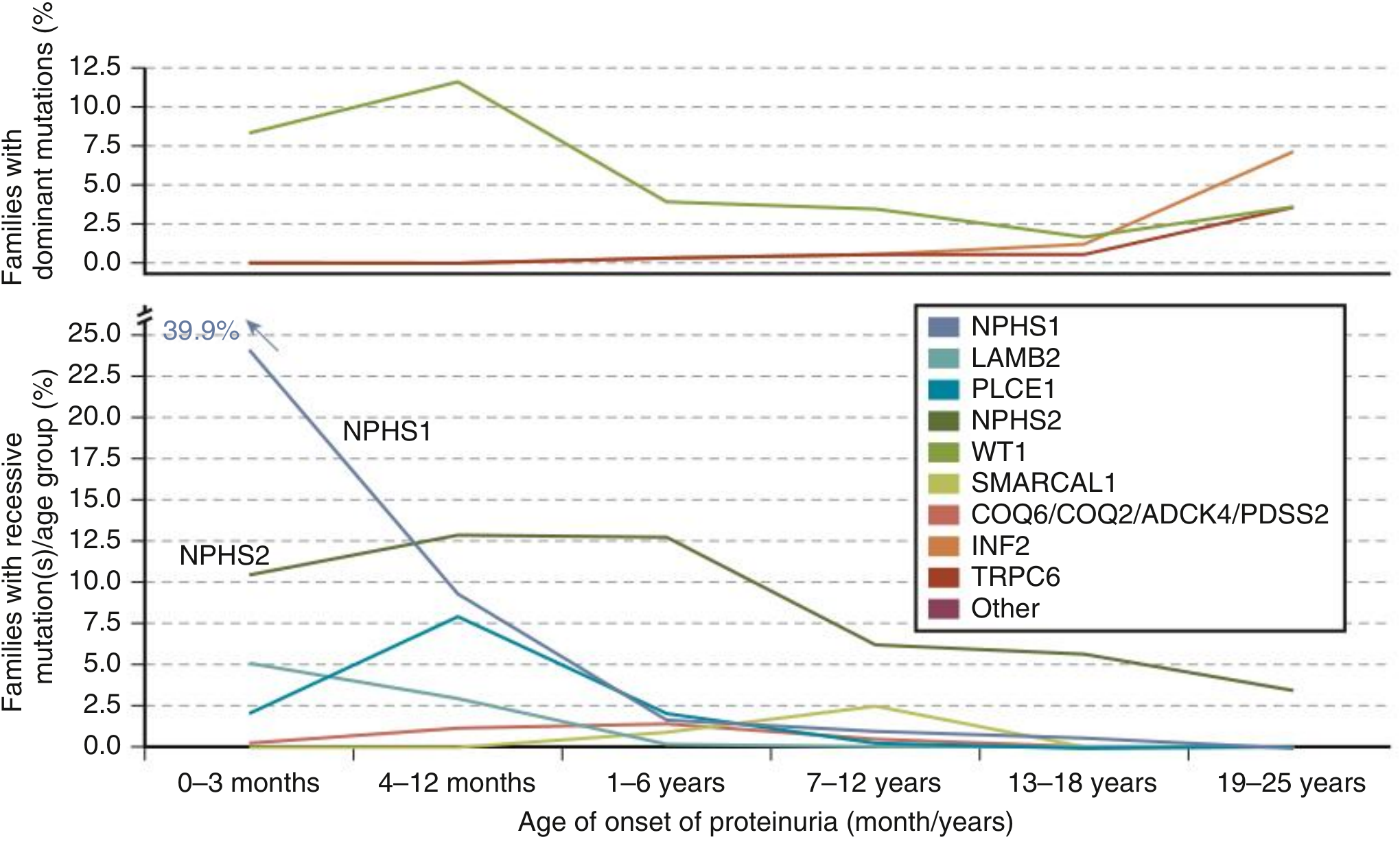
| Age Group | Predominant Gene(s) |
|---|---|
| 0-3 months (congenital) | NPHS1 (39.9%), LAMB2 |
| 4-12 months (infantile) | NPHS1 (declining), NPHS2, PLCE1 (peaks) |
| 1-6 years | NPHS2 (dominant), PLCE1 |
| 7-25 years | NPHS2 (persists), WT1, SMARCAL1, CoQ genes |
| Adult (>18 years) | INF2, TRPC6, WT1 (second peak) |
Key principle: Recessive mutations predominate in early-onset disease; dominant mutations cause more adult-onset disease.
Summary Table: Functional Groups
| Functional Category | Genes |
|---|---|
| Slit diaphragm proteins | NPHS1 (nephrin), NPHS2 (podocin), CD2AP, KIRREL |
| Actin cytoskeleton | ACTN4, MYO1E, INF2, ARHGDIA |
| GBM/ECM proteins | LAMB2 |
| Transcription factors | WT1 |
| Ion channels/signaling | TRPC6, PLCE1 |
| Mitochondrial/CoQ10 | COQ2, COQ6, ADCK4, PDSS2 |
| Nuclear pore complex | NUP93, NUP107, NUP205, XPO5 |
| DNA repair | SMARCAL1 |
Clinical Implications
- Genetic testing is now recommended in all children with SRNS and in adults with familial or early-onset FSGS
- Genetic SRNS does not respond to immunosuppression - these patients should NOT receive cyclophosphamide, rituximab, or prolonged CNI therapy
- Exception: ADCK4 mutations may respond to CoQ10; some PLCE1 mutations can respond to steroids
- Recurrence post-transplant is rare in genetic SRNS (unlike idiopathic SRNS where circulating permeability factors cause recurrence)
- Genetic diagnosis avoids unnecessary immunosuppression and guides family counseling/prenatal diagnosis
Sources: Comprehensive Clinical Nephrology, 7th Ed. (pp. 285-290); Brenner and Rector's The Kidney, 2-Vol Set. Recent review: Nucleoporin-associated SRNS review (Pediatr Nephrol, 2025) and WT1-related disorders review (Pediatr Nephrol, 2024).
This is a shared conversation. Sign in to Orris to start your own chat.