

6d3fde84-3050-49dd-92d5-b3bc7ec36fb5.jpeg
Nucleic acid chapter
Reading File
The image shows a syllabus for a Nucleic Acids chapter covering: definition, purine/pyrimidine bases, nucleosides and nucleotides with examples, and structure of DNA (Watson and Crick model), RNA and their functions. Let me search the medical library for comprehensive content on all these topics simultaneously.
Finding Sources
Finding Sources
Finding Sources
Finding Sources
Finding Sources
Reading File
Excellent - I found the core biochemistry content in Lippincott's. Let me read more of this section to get the DNA/RNA structure content.
Reading File
Finding Sources
Finding Sources
Finding Sources
Finding Sources
Finding Sources
Reading File
Reading File
Reading File
Reading File
Reading File
Reading File
I now have all the core content needed. Let me also fetch the key images from the textbook to include in the answer.
Loading Image
Loading Image
I now have all the content needed to write a complete, well-structured notes on the Nucleic Acids chapter. Here is the full study guide:
Nucleic Acids - Complete Chapter Notes
Sources: Biochemistry 8th ed. (Lippincott Illustrated Reviews), Harper's Illustrated Biochemistry 32nd Ed.
1. Definition
Nucleic acids are biological macromolecules (polymers of nucleotides) that store, transmit, and express genetic information. They are named "acids" because the phosphate groups carry a negative charge at physiological pH, making DNA and RNA strongly acidic molecules. There are two types:
- DNA (Deoxyribonucleic acid) - stores genetic information
- RNA (Ribonucleic acid) - expresses genetic information
2. Components of Nucleic Acids
A nucleic acid is built from three basic components:
- A nitrogenous base (purine or pyrimidine)
- A pentose sugar (ribose or deoxyribose)
- One or more phosphate groups
3. Purine and Pyrimidine Bases
Purines (double-ring structures)
Both DNA and RNA contain:
- Adenine (A)
- Guanine (G)
Pyrimidines (single-ring structures)
Both DNA and RNA contain:
- Cytosine (C)
They differ in their second pyrimidine:
- DNA contains Thymine (T) - has a methyl group on carbon-5
- RNA contains Uracil (U) - lacks the methyl group
Key difference between T and U: Only thymine has a methyl (-CH₃) group at position 5.
Unusual/modified bases are occasionally found in some viral DNA and transfer RNA (tRNA). Modifications include methylation, glycosylation, and acetylation. These help specific enzymes recognize a nucleotide sequence or protect it from nuclease degradation.
Summary Table
| Base | Type | Found in |
|---|---|---|
| Adenine | Purine | DNA & RNA |
| Guanine | Purine | DNA & RNA |
| Cytosine | Pyrimidine | DNA & RNA |
| Thymine | Pyrimidine | DNA only |
| Uracil | Pyrimidine | RNA only |
4. Nucleosides
A nucleoside = nitrogenous base + pentose sugar, joined by an N-glycosidic bond.
- Base + ribose → ribonucleoside
- Base + 2'-deoxyribose → deoxyribonucleoside
The carbons of the pentose are numbered 1' to 5' (prime notation) to distinguish them from the ring atoms of the base.
Nucleoside Names
| Base | Ribonucleoside | Deoxyribonucleoside |
|---|---|---|
| Adenine | Adenosine | Deoxyadenosine |
| Guanine | Guanosine | Deoxyguanosine |
| Cytosine | Cytidine | Deoxycytidine |
| Thymine | - | Thymidine (deoxy- assumed) |
| Uracil | Uridine | - |
Note: Thymidine is so exclusively associated with DNA that the "deoxy-" prefix is usually dropped.
5. Nucleotides
A nucleotide = nucleoside + one or more phosphate groups.
The phosphate group is attached via an ester linkage to the 5'-OH of the pentose, forming a 5'-nucleotide.
- 1 phosphate → Nucleoside monophosphate (e.g., AMP - adenosine monophosphate)
- 2 phosphates → Nucleoside diphosphate (e.g., ADP - adenosine diphosphate)
- 3 phosphates → Nucleoside triphosphate (e.g., ATP - adenosine triphosphate)
The second and third phosphate groups are connected by high-energy bonds (large negative ΔG of hydrolysis).
Examples of Important Nucleotides
| Nucleotide | Abbreviation | Function |
|---|---|---|
| Adenosine triphosphate | ATP | Universal energy currency |
| Adenosine monophosphate | AMP | Building block, signaling |
| Cyclic AMP | cAMP | Second messenger |
| NAD⁺, FAD | - | Coenzymes in redox reactions |
| dATP, dGTP, dCTP, dTTP | dNTPs | DNA synthesis |
6. Structure of DNA - Watson and Crick Model (1953)
DNA is a polymer of deoxyribonucleoside monophosphates (dNMPs) linked by 3'-to-5' phosphodiester bonds.
6a. Phosphodiester Bonds (Primary Structure)
Each bond joins the 3'-OH of one deoxyribose to the 5'-OH of the next, through a phosphoryl group. The resulting chain has polarity - a 5' end (free phosphate) and a 3' end (free hydroxyl). By convention, base sequences are always written 5' → 3'.
6b. The Double Helix (Secondary Structure)
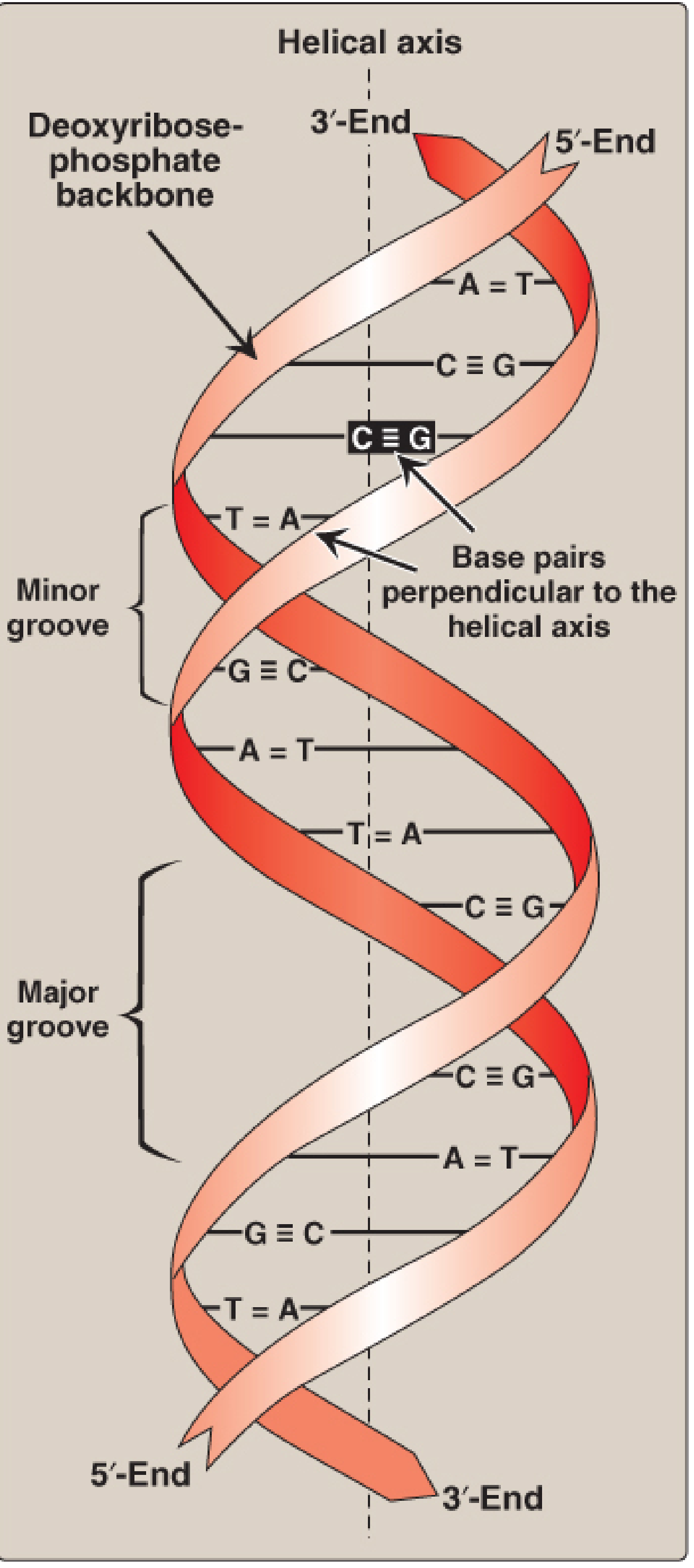
Key features of the Watson-Crick (B-form) DNA model:
- Two antiparallel strands coiled around a common helical axis (one strand runs 5'→3', the other runs 3'→5')
- Hydrophilic backbone on the outside: The deoxyribose-phosphate backbone faces outward (toward the aqueous environment)
- Hydrophobic bases on the inside: Base pairs are stacked in the interior, perpendicular to the helical axis
- Right-handed helix (B-form, the most common physiological form)
- Major groove (wide) and Minor groove (narrow) are created by the spatial relationship of the two strands - regulatory proteins and some drugs bind here
- ~10 base pairs per helical turn, with a rise of 3.4 Å per base pair
6c. Base Pairing - Chargaff's Rules
- A pairs with T (2 hydrogen bonds)
- G pairs with C (3 hydrogen bonds)
This gives rise to Chargaff's rule: In any sample of double-stranded DNA, the amount of A = T and G = C, and total purines = total pyrimidines.
The double helix is stabilized by:
- Hydrogen bonds between complementary base pairs
- Hydrophobic (stacking) interactions between parallel bases
6d. DNA Denaturation (Melting)
When DNA is heated, the hydrogen bonds break and strands separate - this is called denaturation. The temperature at which 50% of DNA is single-stranded is the melting temperature (Tm). Because G-C pairs have 3 hydrogen bonds (vs. 2 for A-T), G-C-rich DNA has a higher Tm and is harder to denature. Denaturation is reversible - upon cooling, complementary strands re-anneal (renaturation).
6e. DNA Forms
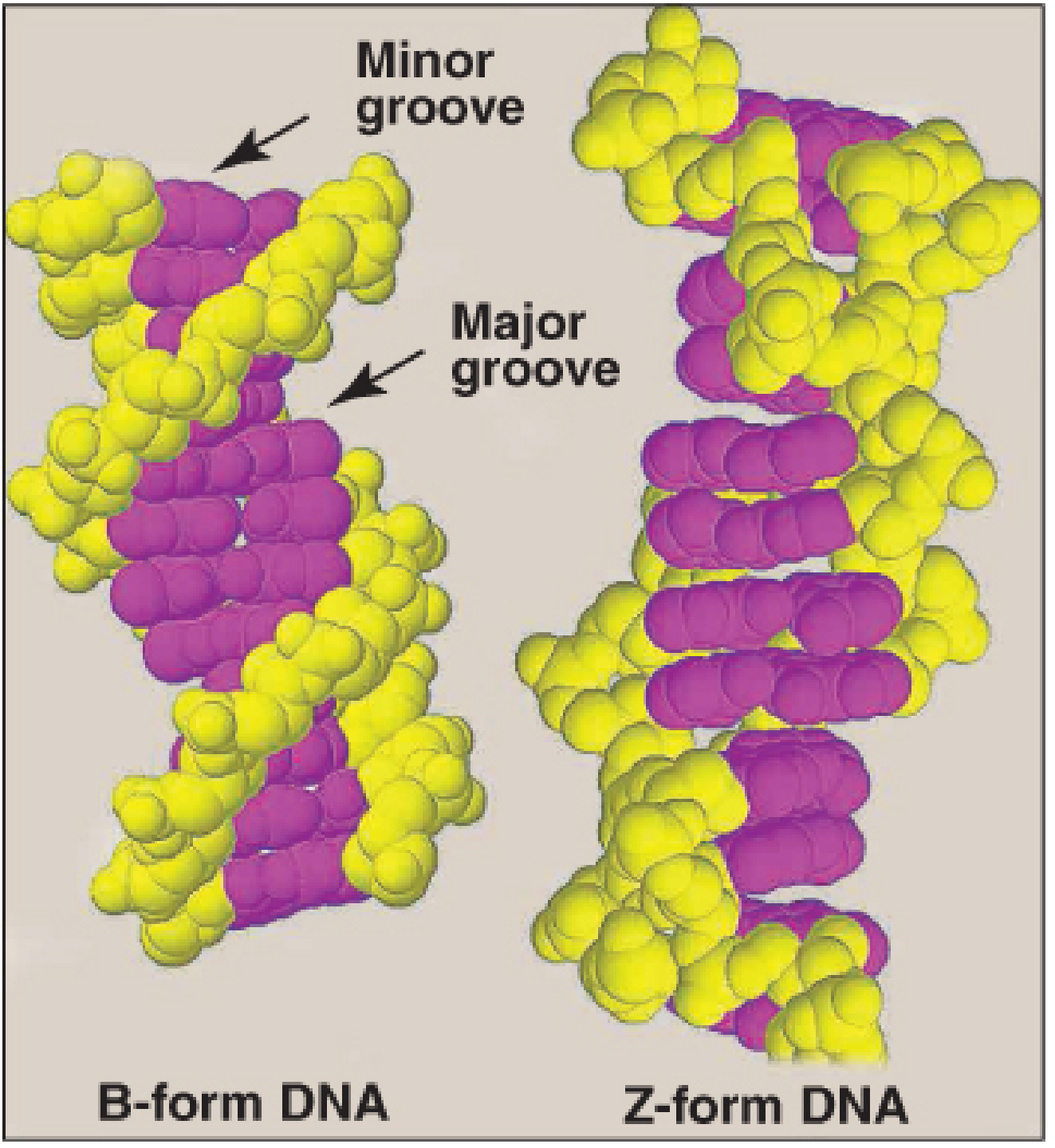
| Form | Helix direction | Features |
|---|---|---|
| B-DNA | Right-handed | Most common; physiological form |
| A-DNA | Right-handed | Found in dehydrated conditions; RNA-DNA hybrids |
| Z-DNA | Left-handed | Zigzag backbone; found in GC-rich regions; possible role in regulation |
7. Structure and Types of RNA
RNA is a polymer of ribonucleoside monophosphates (NMPs) linked by 3'-to-5' phosphodiester bonds. Unlike DNA, RNA is usually single-stranded and contains ribose (not deoxyribose) and uracil (not thymine).
There are four main classes of RNA:
7a. Messenger RNA (mRNA)
- Carries the genetic code from DNA to ribosomes for protein synthesis
- Most heterogeneous in size and abundance
- In eukaryotes:
- Has a 5' cap (7-methylguanosine triphosphate) - protects from 5' exonucleases and helps translation
- Has a 3' poly-A tail (~20-250 adenylate residues) - protects from 3' exonucleases and stabilizes mRNA
- Represents 2-5% of total cellular RNA
7b. Transfer RNA (tRNA)
- Adapter molecule - carries amino acids to the ribosome during translation
- Each tRNA is specific for one amino acid
- Has an anticodon loop that base-pairs with the mRNA codon
- Has a 3'-CCA terminus where the amino acid is attached
- Highly modified bases (unusual bases like dihydrouridine, pseudouridine)
- Folds into a characteristic cloverleaf secondary structure and L-shaped tertiary structure
- Smallest RNA (~73-93 nucleotides)
7c. Ribosomal RNA (rRNA)
- Structural and catalytic component of ribosomes
- Most abundant RNA (~80% of total RNA)
- Performs peptidyl transferase activity (the 28S/23S rRNA is a ribozyme)
Ribosome composition:
| Subunit | Eukaryote | Prokaryote |
|---|---|---|
| Small | 40S (18S rRNA + 33 proteins) | 30S (16S rRNA) |
| Large | 60S (28S + 5.8S + 5S rRNA + 50 proteins) | 50S (23S + 5S rRNA) |
| Complete ribosome | 80S | 70S |
7d. Small Nuclear RNA (snRNA) / Small RNAs
- snRNA - involved in RNA splicing (removal of introns from pre-mRNA)
- miRNA (microRNA) - small, ~22 nucleotide non-coding RNA; regulates gene expression by binding mRNA and causing degradation or translational repression
- siRNA (small interfering RNA) - generated from dsRNA; causes sequence-specific mRNA degradation (RNA interference, RNAi)
- lncRNA (long non-coding RNA) - >300 nucleotides; roles in gene regulation
8. Summary Comparison: DNA vs. RNA
| Feature | DNA | RNA |
|---|---|---|
| Sugar | 2'-Deoxyribose | Ribose |
| Bases | A, G, C, T | A, G, C, U |
| Strands | Double-stranded (usually) | Single-stranded (usually) |
| Location | Nucleus (primarily) | Nucleus + Cytoplasm |
| Function | Stores genetic information | Expresses genetic information |
| Stability | More stable (no 2'-OH) | Less stable (2'-OH susceptible to alkali) |
| Helix | Right-handed B-form | Does not form classic double helix |
9. Functions of Nucleic Acids - Overview
- DNA: Long-term storage of genetic information; template for its own replication and for RNA synthesis (transcription)
- mRNA: Carries instructions for protein synthesis; functions as template in translation
- tRNA: Decodes the genetic code; transports specific amino acids to ribosome
- rRNA: Forms the structural and catalytic core of ribosomes
- Regulatory small RNAs (miRNA, siRNA, lncRNA): Fine-tune gene expression at post-transcriptional level
The flow of information follows the Central Dogma:
DNA → (Transcription) → RNA → (Translation) → Protein
Sources: Biochemistry 8th ed. (Lippincott Illustrated Reviews), p. 822-825, 1136-1142 | Harper's Illustrated Biochemistry 32nd Ed., p. 366-370
This is a shared conversation. Sign in to Orris to start your own chat.