
A 9 year old girl vitally stable and active but she is having little puffy face since 3 days. What is the cause and treatment
Reading File
A 9-year-old girl with a puffy face for 3 days, vitally stable and active - the most likely diagnosis is Nephrotic Syndrome, specifically Minimal Change Disease (MCD), which is the most common cause in school-age children. Puffiness starting around the eyes (periorbital edema) is the classic early presentation.
Searching sources...
Finding Sources
Finding Sources
Reading File
Finding Sources
Finding Sources
Finding Sources
Finding Sources
Searching PubMed
nephrotic syndrome children treatment
Reading File
Reading Article
PMID: 40254362
Reading File
Reading File
I now have excellent textbook content. Let me also fetch the MCD microscopy image to include in the answer.
Loading Image
Here is a thorough clinical answer based on authoritative sources:
Diagnosis: Nephrotic Syndrome - Most Likely Minimal Change Disease (MCD)
A 9-year-old girl presenting with a puffy face (periorbital/facial edema) for 3 days while remaining vitally stable and active is a classic presentation of Nephrotic Syndrome, with Minimal Change Disease as the most likely underlying cause at this age.
Why This Diagnosis?
Classic Nephrotic Syndrome Features
The "puffy face" is the first and most noticeable sign - periorbital edema is typically worse in the morning (as fluid redistributes from gravity-dependent areas during sleep). Parents often mistake it for allergy or insect bite initially.
The full tetrad of Nephrotic Syndrome:
| Feature | Mechanism |
|---|---|
| Massive proteinuria (>3.5 g/day in adults, >40 mg/m²/hr in children) | Damaged glomerular filtration barrier leaks protein |
| Hypoalbuminemia (<2.5 g/dL) | Urinary protein loss exceeds hepatic synthesis |
| Generalized edema (starting as periorbital puffiness) | Low oncotic pressure + sodium/water retention |
| Hyperlipidemia + Lipiduria | Compensatory hepatic lipoprotein synthesis |
Why Minimal Change Disease?
- MCD is the most common cause of nephrotic syndrome in children, especially between ages 1-7 years (though extends to school age)
- The child is vitally stable and active - renal function is usually preserved in MCD
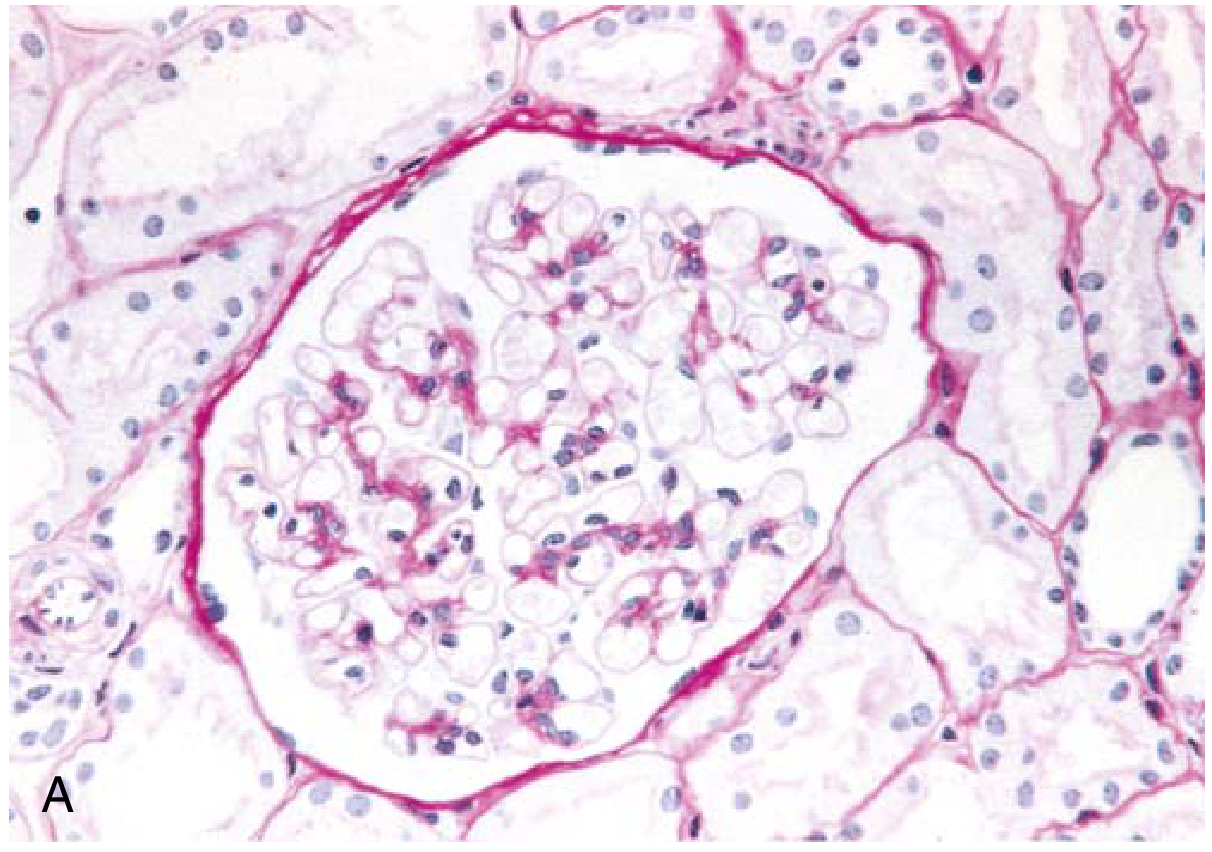
- The glomeruli appear histologically normal on light microscopy (hence "minimal change")
- The only abnormality is podocyte foot process effacement visible on electron microscopy
Pathogenesis
The leading hypothesis involves circulating factors (likely T-cell derived) that injure podocytes, causing foot process effacement and disruption of the slit diaphragm. This results in:
- Podocyte injury → slit diaphragm disruption
- Selective proteinuria (mainly albumin - smaller plasma proteins)
- Hypoalbuminemia → reduced plasma oncotic pressure
- Fluid shifts to interstitium → edema (starts periorbitally/face, then ascites, scrotal/labial edema, pleural effusion)
- Compensatory RAAS activation → sodium and water retention (worsening edema)
- Hepatic lipoprotein overproduction → hyperlipidemia
An immune mechanism is strongly suspected because the disease responds dramatically to steroids. - Robbins & Kumar Basic Pathology, p. 503
Workup to Confirm
| Investigation | Expected Finding |
|---|---|
| Urine dipstick | 3+ or 4+ protein (massive proteinuria) |
| Spot urine protein:creatinine ratio | >200 mg/mmol (>2 in adults) |
| 24-hr urine protein | >40 mg/m²/hr in children |
| Serum albumin | Low (<2.5 g/dL) |
| Serum cholesterol/triglycerides | Elevated |
| Serum creatinine/urea | Usually normal in MCD |
| CBC | May show hemoconcentration |
| Urine microscopy | Oval fat bodies, no RBC casts (nephrotic pattern) |
| Complement (C3, C4) | Normal in MCD |
| Renal biopsy | Usually NOT needed in a child with typical presentation; reserved for atypical cases |
Note: In a child aged 1-12 years with typical nephrotic syndrome and no atypical features (hypertension, hematuria, renal impairment, hypocomplementemia), biopsy is usually deferred and empiric steroid therapy is started - as >90% will have MCD and respond.
Treatment
1. First-Line: Oral Corticosteroids (Prednisolone)
The KDIGO 2025 guideline (the most current international standard) confirms corticosteroids as first-line therapy:
- Prednisolone: 60 mg/m²/day (or 2 mg/kg/day, max 60 mg) as a single morning dose for 4-6 weeks
- Then 40 mg/m² on alternate days for 4-6 weeks, then taper
- >90% of children with MCD achieve complete remission (proteinuria clears) within 2-4 weeks
The KDIGO 2025 Guideline now provides specific algorithms for when to perform kidney biopsy or genetic testing, and which steroid-sparing agent to choose if the child relapses.
2. Supportive Measures
| Measure | Details |
|---|---|
| Salt restriction | Low-sodium diet to reduce edema |
| Fluid restriction | If severe edema |
| Diuretics | Use cautiously (frusemide) only if significant edema/ascites - risk of hypovolemia |
| Albumin infusion | Only for severe symptomatic hypoalbuminemia + hypovolemia |
| Penicillin prophylaxis | Against Streptococcal infections - nephrotic children are at risk of peritonitis |
| Pneumococcal vaccine | Before starting steroids if possible |
3. Relapsing Disease
- Relapses occur in >2/3 of initial responders
- Frequently relapsing / Steroid-dependent: Add steroid-sparing agents:
- Levamisole (low-cost, well tolerated)
- Oral cyclophosphamide (for remission consolidation)
- Mycophenolate mofetil (MMF)
- Calcineurin inhibitors (tacrolimus, cyclosporine)
- Rituximab (for difficult steroid-dependent cases)
4. Biopsy Indications in This Age Group
Reserve renal biopsy for:
- Age <1 year or onset in infancy (congenital NS)
- Persistent hematuria / low complement
- Hypertension at presentation
- Renal impairment at presentation
- No response to steroids after 8 weeks (steroid-resistant NS)
Prognosis
- Excellent in MCD - does not cause kidney failure
- Most children enter remission with steroids and outgrow the disease by adolescence
- Significant steroid side effects (growth impairment, weight gain, hypertension, cataracts) are the main long-term concern with relapsing courses
Other Causes to Consider (if Atypical)
| Condition | Clue |
|---|---|
| FSGS | Steroid-resistant, hematuria, older children/adults |
| Post-streptococcal GN | Hematuria, hypertension, low C3, history of throat/skin infection |
| Allergic reaction | Acute onset, urticaria, exposure history |
| Hypothyroidism | Myxedema - but the child would not be vitally active |
| SLE nephritis | Older girls, rash, arthralgia, low complement |
Given this child's age, activity, vital stability, and 3-day course of facial puffiness with no other features described, Nephrotic Syndrome from MCD remains the overwhelming working diagnosis pending urine protein testing.
Sources: Robbins & Kumar Basic Pathology, p. 503-505; Tietz Textbook of Laboratory Medicine 7th Ed.; KDIGO 2025 Clinical Practice Guideline for Nephrotic Syndrome in Children [PMID: 40254362]
Dka management in casualty
Reading File
Finding Sources
Finding Sources
Searching PubMed
diabetic ketoacidosis treatment guideline
Searching the Web
2024 consensus report hyperglycemic crises adults diabetic ketoacidosis treatment PDF
Reading File
Reading Web Page
https://www.ccjm.org/content/92/3/152
Finding Sources
Searching the Web
ISPAD diabetic ketoacidosis children 2022 guideline fluid insulin potassium 0.1 units kg hour
DKA management in casualty / emergency department
Treat as an emergency. Call pediatric/medical senior, start continuous monitoring, and shift to a high-dependency/ICU setting if severe DKA, altered consciousness, shock, or suspected cerebral edema.
This is a pediatric approach if you are referring to the 9-year-old child. Pediatric DKA differs from adult DKA particularly in fluid administration and the risk of cerebral edema.
1. Immediate assessment: ABCDE
- Airway and breathing: Give oxygen only if hypoxemic or in shock. Look for Kussmaul breathing.
- Circulation: HR, BP, perfusion, capillary refill, pulses, urine output, body weight.
- Disability: GCS/mental status, headache, vomiting, abnormal behavior, seizures. These may signal cerebral edema.
- Establish 2 IV lines if possible. Cardiac monitor and strict input-output chart.
- Keep NPO initially if vomiting, drowsy, or severely unwell.
2. Confirm DKA and send initial investigations
DKA in children is generally:
- Glucose >200 mg/dL (>11 mmol/L)
- Blood beta-hydroxybutyrate ≥3 mmol/L, or urine ketones moderate/large
- Venous pH <7.30 or serum bicarbonate <18 mmol/L
Send:
- Bedside glucose and blood ketones
- VBG: pH, bicarbonate, pCO₂
- Electrolytes, urea, creatinine, calcium, magnesium, phosphate
- CBC, infection evaluation if clinically indicated
- ECG, especially if potassium abnormal
- Urinalysis and culture if infection suspected
- Calculate corrected sodium and anion gap
Look for a trigger: missed insulin, new-onset type 1 diabetes, infection, pump failure, gastroenteritis, medications.
3. Fluids: start before insulin
If shock or poor perfusion
- 0.9% saline 20 mL/kg IV rapidly, reassess after each bolus.
- Repeat only if necessary, with senior/PICU input.
If not in shock
- 0.9% saline 10-20 mL/kg over 20-30 minutes.
- Then replace the remaining maintenance plus estimated deficit gradually, usually over about 36-48 hours, according to the pediatric DKA protocol.
- Use isotonic fluid initially. Avoid excessive fluids.
Do not give hypotonic fluid initially. Do not use routine bicarbonate.
4. Potassium: check before starting insulin
Although serum potassium may initially be normal or high, total-body potassium is depleted. Insulin will lower serum potassium rapidly.
| Serum K+ | What to do |
|---|---|
| <3.0-3.5 mmol/L | Do not start insulin. Begin potassium replacement urgently with ECG monitoring until K+ is safe. |
| 3.5-5.0 mmol/L | Add potassium to IV fluids, commonly 40 mmol/L depending on local protocol and renal function. |
| >5.0-5.5 mmol/L | Do not add potassium initially. Recheck frequently and begin replacement once it falls and urine output is established. |
- Ensure urine output and renal function are assessed before substantial potassium replacement.
- Check potassium at baseline, around 2 hours after insulin begins, then at least every 4 hours. The adult consensus target is K+ 4-5 mmol/L, and pediatric protocols use frequent reassessment due to high risk of rapid decline. The 2024 consensus summary emphasizes delaying insulin if potassium is low.
5. Insulin infusion: begin only after initial fluids
After approximately 1 hour of IV fluids, and only when potassium is safe:
- Regular insulin IV infusion 0.05-0.1 units/kg/hour
- In many children, start 0.05 units/kg/hour for mild/moderate DKA and consider 0.1 units/kg/hour for severe DKA, following local pediatric protocol.
- Do not give an IV insulin bolus in children.
Aim for glucose to fall gradually, about 50-90 mg/dL/hour (3-5 mmol/L/hour). The key endpoint is clearance of ketosis/acidosis, not just normalization of glucose.
6. Add dextrose but continue insulin
When blood glucose falls to approximately 250-300 mg/dL (14-17 mmol/L):
- Add 5% dextrose to IV fluid.
- If glucose continues to fall but ketosis persists, increase to 10% dextrose as per protocol.
- Continue insulin infusion until ketoacidosis resolves.
Stopping insulin when glucose normalizes will allow ketone production to recur.
7. Monitoring
| Parameter | Frequency |
|---|---|
| Capillary glucose | Hourly |
| Neurologic status, vital signs, fluid balance | Hourly |
| Blood ketones, VBG, electrolytes | Every 2-4 hours |
| Potassium | Baseline, about 2 h after insulin starts, then every 4 h or more often if abnormal |
| ECG | Continuous if potassium abnormal or replacement is being given |
| Urine output | Hourly |
8. Cerebral edema: recognize and treat immediately
This is the major pediatric complication. Suspect it if there is:
- Headache, irritability, confusion, drowsiness
- Recurrent vomiting
- Bradycardia, rising BP
- Cranial nerve palsy, unequal pupils
- Seizure or reduced GCS
Do not wait for CT before treatment.
Actions:
- Call PICU/anesthesia immediately.
- Elevate head of bed to 30 degrees, keep neck neutral.
- Reduce IV fluid rate if appropriate, without stopping necessary resuscitation.
- Give either:
- Mannitol 0.5-1 g/kg IV over 10-15 min, or
- 3% hypertonic saline 2.5-5 mL/kg IV over 10-15 min
- Prepare for airway protection if consciousness is deteriorating.
9. Bicarbonate and phosphate
- Bicarbonate is not routinely indicated. Consider only in extreme acidosis, usually pH <6.9, with hemodynamic compromise or life-threatening hyperkalemia, after senior/PICU consultation.
- Do not routinely give phosphate. Replace if severe hypophosphatemia or if there is muscle weakness, respiratory failure, or cardiac dysfunction.
10. Resolution and transition to subcutaneous insulin
DKA is resolved when:
- Child is clinically improved and can eat/drink
- Venous pH ≥7.30 or bicarbonate ≥18 mmol/L
- Blood beta-hydroxybutyrate is low, ideally <0.6 mmol/L
Then:
- Give the first SC basal-bolus insulin dose.
- Overlap IV insulin for 30-60 minutes after rapid-acting SC insulin, or longer as required after basal insulin, according to the insulin regimen.
- Treat the precipitating cause and arrange diabetes education before discharge.
The current adult consensus also defines resolution by ketones <0.6 mmol/L plus pH ≥7.3 or bicarbonate ≥18 mmol/L, with glucose ideally <200 mg/dL; it cautions against using urine ketones or anion gap alone to judge resolution. See the ADA/EASD consensus report.
Quick casualty order
- ABCDE, monitors, two IV lines, weigh patient.
- Bedside glucose and ketones, VBG, electrolytes, ECG.
- 0.9% saline 10-20 mL/kg over 20-30 min. Give 20 mL/kg rapidly only if shock.
- Check potassium and add KCl as appropriate.
- Start IV regular insulin 0.05-0.1 U/kg/h after 1 hour of fluids, with no bolus.
- Add dextrose at glucose 250-300 mg/dL, continue insulin until ketones/acidosis resolve.
- Hourly glucose and neuro checks. Watch actively for cerebral edema.
Textbook support: Barash, Cullen, and Stoelting’s Clinical Anesthesia, 9e, p. 4059.
This is a shared conversation. Sign in to Orris to start your own chat.