
Different categories of anti tuberculosis therapy
antituberculosis drug classification treatment
WHO 2022 anti-tuberculosis drug classification groups first second line MDR-TB
Categories of Anti-Tuberculosis (Anti-TB) Therapy
1. First-Line Drugs (for Drug-Susceptible TB)
| Drug | Abbreviation | Mechanism | Daily Dose (adult) | Key Toxicities |
|---|---|---|---|---|
| Isoniazid | H (INH) | Inhibits mycolic acid synthesis (InhA) | 300 mg/day | Peripheral neuropathy, hepatitis, hypersensitivity |
| Rifampin (Rifampicin) | R (RIF) | Inhibits RNA polymerase (β-subunit) | 600 mg/day | Orange discoloration of secretions, hepatitis, drug interactions (CYP inducer) |
| Pyrazinamide | Z (PZA) | Disrupts membrane energy metabolism; active in acidic milieu | 25 mg/kg/day | Hyperuricemia, hepatotoxicity, arthralgias |
| Ethambutol | E (EMB) | Inhibits arabinosyltransferase (cell wall) | 15-25 mg/kg/day | Optic neuritis (dose-related, reversible) |
| Rifapentine | Rpt | Same as rifampin (RNA polymerase inhibitor) | 1200 mg/day (new 4-month regimen) | Similar to rifampin; rash, anemia |
| Rifabutin | Rfb | RNA polymerase inhibitor | 300 mg/day | Rash, leukopenia, uveitis; less CYP induction than rifampin |
| Moxifloxacin | Mfx | Inhibits DNA gyrase | 400 mg/day | QT prolongation, GI upset |
2. Second-Line Drugs
WHO Group A - Fluoroquinolones (highest priority)
- Levofloxacin (Lfx)
- Moxifloxacin (Mfx)
- Gatifloxacin (Gfx)
- Mechanism: Inhibit DNA gyrase/topoisomerase II
WHO Group B - Second-Line Injectable Agents
- Amikacin (Am)
- Capreomycin (Cm)
- Kanamycin (Km)
- Streptomycin (S) - used only if no other Group B agent is available
- Mechanism: Aminoglycosides inhibit protein synthesis at the 30S ribosomal subunit; capreomycin is a cyclic peptide with similar action
- Toxicities: Ototoxicity, nephrotoxicity
WHO Group C - Core Second-Line Agents
- Ethionamide / Prothionamide (Eto/Pto) - structural analog of isoniazid; inhibits mycolic acid synthesis
- Cycloserine / Terizidone (Cs/Trd) - inhibits cell wall peptidoglycan synthesis; neurotoxicity
- Linezolid (Lzd) - oxazolidinone; inhibits 50S ribosome; myelosuppression, neuropathy
- Clofazimine (Cfz) - riminophenazine dye; mechanism not fully established; skin discoloration
- Aminosalicylic acid (PAS) - inhibits folate synthesis/uptake; GI intolerance
3. New/Novel Agents (for MDR-TB and XDR-TB)
| Drug | Class | Mechanism | Key Feature |
|---|---|---|---|
| Bedaquiline (Bdq) | Diarylquinoline | Inhibits mycobacterial ATP synthase | Core drug in all MDR/RR-TB regimens; QT prolongation |
| Pretomanid (Pa) | Bicyclic nitroimidazole | (1) Inhibits mycolic acid synthesis (aerobic) and (2) generates toxic reactive nitrogen species (anaerobic) | FDA-approved for XDR/pre-XDR-TB |
| Delamanid (Dln) | Bicyclic nitroimidazole | Inhibits mycolic acid synthesis | Licensed in EU for MDR-TB |
| Linezolid (Lzd) | Oxazolidinone | 50S ribosomal inhibitor | Now classified as Group A in MDR-TB regimens |
4. Key Treatment Regimens by Drug Resistance Pattern
| TB Type | Preferred Regimen |
|---|---|
| Drug-susceptible (DS-TB) | 2HRZE / 4HR or 4-month rifapentine regimen |
| Isoniazid-resistant | 6 months Lfx + RZE |
| MDR/RR-TB | BPaLM: Bdq + Pa + Lzd + Mfx for 6 months (preferred) |
| Pre-XDR-TB / XDR-TB | BPaLM (drop Mfx if fluoroquinolone-resistant); or BPaL + extended linezolid |
| Latent TB (LTBI) | 3HP (3 months weekly isoniazid + rifapentine) or 6-9 months isoniazid |
5. Mnemonics
- RIPE - Rifampin, Isoniazid, Pyrazinamide, Ethambutol (standard 4-drug intensive phase)
- SHINE - Streptomycin, cycloserine, Highdose isoniazid, Injectables, Newer agents, Ethionamide (second-line memory aid)
Special Notes
- Pyridoxine (vitamin B6) is co-administered with isoniazid to prevent peripheral neuropathy, especially in at-risk groups (pregnant women, alcoholics, malnourished patients, diabetics).
- Streptomycin is contraindicated in pregnancy due to cranial nerve VIII damage in neonates.
- MDR-TB is defined as resistance to at least isoniazid AND rifampin. XDR-TB additionally requires resistance to a fluoroquinolone AND bedaquiline or linezolid.
- The WHO 2022 update established BPaLM as the preferred regimen for MDR/RR-TB, replacing older injectable-based regimens.
New updated drug regimen
WHO 2025 2026 updated tuberculosis treatment regimen new guidelines
tuberculosis treatment regimen updated 2024 2025
https://www.who.int/news/item/08-10-2025-who-releases-new-gu…
BPaLM bedaquiline pretomanid linezolid moxifloxacin MDR tuberculosis trial
PMID: 39813501
PMID: 37980911
TBAJ-876 ZeNix STREAM trial 2024 2025 tuberculosis new drug regimen update
https://pmc.ncbi.nlm.nih.gov/articles/PMC12582603
Updated and New Anti-Tuberculosis Drug Regimens (2022-2026)
1. Drug-Susceptible TB (DS-TB) - Active Disease
Traditional Standard Regimen (Still Widely Used)
- Intensive phase (2 months): Isoniazid (H) + Rifampin (R) + Pyrazinamide (Z) + Ethambutol (E)
- Continuation phase (4 months): Isoniazid + Rifampin
- Extended to 9 months (2HRZE/7HR) if: cavitary disease, delayed sputum culture conversion at 2 months, or incomplete pyrazinamide course
NEW: 4-Month Regimen (Study 31/A5349 Trial, 2020; CDC Interim Guidance 2022)
| Phase | Duration | Drugs |
|---|---|---|
| Intensive | 8 weeks | Rifapentine 1200 mg daily + Moxifloxacin 400 mg + Isoniazid 300 mg + Pyrazinamide |
| Continuation | 9 weeks | Rifapentine + Moxifloxacin + Isoniazid |
- Shown non-inferior to the 6-month HRZE regimen in a large multinational RCT (including HIV+ patients with CD4 >100)
- WHO conditional recommendation; CDC interim guidance issued 2022
- Not recommended in: pregnancy, children <12 years, weight <40 kg, severe extrapulmonary TB, fluoroquinolone resistance
- Levofloxacin may replace moxifloxacin in patients at risk of QT prolongation (emerging evidence, levofloxacin carries lower QT risk)
2. Latent TB Infection (LTBI) - Updated Preferred Regimens
| Regimen | Duration | Schedule | Notes |
|---|---|---|---|
| 3HP - Isoniazid + Rifapentine | 3 months | Weekly (12 doses) | Preferred for adults & children >2 yrs including HIV+ |
| 1HP - Isoniazid + Rifapentine | 1 month | Daily | Non-inferior to 9H in HIV+ patients (2020 WHO update); avoid drug interactions |
| 4R - Rifampin alone | 4 months | Daily | Preferred over 6-9H for many adults |
| 3HR - Isoniazid + Rifampin | 3 months | Daily | Acceptable alternative |
| 6H / 9H - Isoniazid alone | 6-9 months | Daily or twice-weekly | Oldest regimen; still used where rifamycins unavailable |
3. MDR/RR-TB - The BPaLM Era (WHO 2022 Update - Major Change)
NEW Preferred: 6-Month BPaLM Regimen
| Drug | Abbreviation | Dose |
|---|---|---|
| Bedaquiline | B (Bdq) | 400 mg/day x 2 weeks, then 200 mg 3x/week |
| Pretomanid | Pa | 200 mg/day |
| Linezolid | L (Lzd) | 600 mg/day (often reduced to 300 mg to minimize toxicity) |
| Moxifloxacin | M (Mfx) | 400 mg/day |
- Duration: 6 months total (no separate intensive/continuation phases)
- Evidence: TB-PRACTECAL RCT (Lancet Resp Med 2024) - BPaLM showed only 12% unfavorable outcomes vs 41% in standard care (NNT = 7); serious adverse events were also far fewer (23% vs 48%) - TB-PRACTECAL trial
- A 2025 systematic review (PMID 39813501) confirmed BPaLM is more effective and safer than standard of care
- Drop moxifloxacin (use BPaL) if fluoroquinolone resistance is confirmed
Alternative: 9-Month All-Oral Regimen (WHO 2022)
- Intensive phase (4-6 months): Bedaquiline + Levofloxacin or Moxifloxacin + Ethionamide + Ethambutol + Pyrazinamide + High-dose Isoniazid + Clofazimine
- Continuation phase (5 months): Levofloxacin or Moxifloxacin + Clofazimine + Pyrazinamide + Ethambutol
Extended Individualized Regimen (≥18 months - for XDR-TB / BPaLM failures)
- Group A (all 3 must be included): Levofloxacin/Moxifloxacin, Bedaquiline, Linezolid
- Group B (≥1 required): Clofazimine, Cycloserine/Terizidone
- Group C (add if needed): Ethambutol, Delamanid, Pyrazinamide, Imipenem, Amikacin, Ethionamide, PAS
4. Isoniazid-Resistant TB (Hr-TB)
- WHO 2022 recommendation; no isoniazid in this regimen
5. XDR-TB / Pre-XDR-TB
- FDA approved pretomanid specifically for XDR/pre-XDR-TB in combination with bedaquiline and linezolid
- ECG monitoring mandatory due to QT prolongation risk (bedaquiline + moxifloxacin)
- Routine liver enzyme monitoring for pretomanid
6. Drugs in the Pipeline (Phase 2-3 Trials, as of 2025-2026)
| Drug | Class | Status | Notes |
|---|---|---|---|
| Sorfequiline (TBAJ-876) | Diarylquinoline | Phase IIb | Next-gen bedaquiline; less QT prolongation |
| Ganfeborole (GSK-656) | DprE1 inhibitor | Phase 2 | |
| Sutezolid | Oxazolidinone | Phase 2 | Linezolid analog, potentially less myelosuppression |
| Delpazolid | Oxazolidinone | Phase 2 | |
| Telacebec (Q203) | Imidazopyridine | Phase 2 | Novel ATP synthase inhibitor |
| Sanfetrinem | Oral beta-lactam | Phase 2 | Repurposed; GSK/BMGF |
| Long-acting bedaquiline (LA-BDQ) | Injectable depot | Phase 3 | Monthly injection for adherence |
| TBAJ-587 | Diarylquinoline | Phase 1 | |
| BTZ-043 | DprE1 inhibitor | Phase 2b |
7. WHO 2025 Update - Nutrition
Summary Comparison Table
| TB Type | Old Regimen | New/Updated Regimen | Duration Saved |
|---|---|---|---|
| DS-TB (pulmonary) | 2HRZE/4HR | 2PaZMH/9wk PaMH | 2 months |
| LTBI | 9H or 6H | 3HP (weekly) or 1HP (daily, HIV+) | 6-8 months |
| MDR/RR-TB | 18-24 months injectable | 6-month BPaLM (all oral) | 12-18 months |
| XDR-TB | 24+ months | 6-month BPaL | 18+ months |
| Hr-TB | 6H + others | 6 months REZL | Same duration, better outcomes |
Create an image of normal chest xray and tb patient chest xray
Side-by-side medical chest X-ray comparison. Left panel labeled "Normal Chest X-Ray": PA view showing clear lung fields, sharp costophrenic angles, normal cardiac silhouette (cardiothoracic ratio less than 0.5), visible pulmonary vasculature, well-defined hilar shadows, normal trachea midline, no infiltrates or opacities. Right panel labeled "TB Patient Chest X-Ray": PA view showing upper lobe infiltrates and consolidation (predominantly right upper lobe), cavitation lesion in right upper lobe, patchy opacities, fibrotic streaking, hilar lymphadenopathy, possible pleural effusion, classic apical shadowing typical of pulmonary tuberculosis. Both panels on black background with white labels, realistic radiograph grayscale appearance, educational medical illustration style.
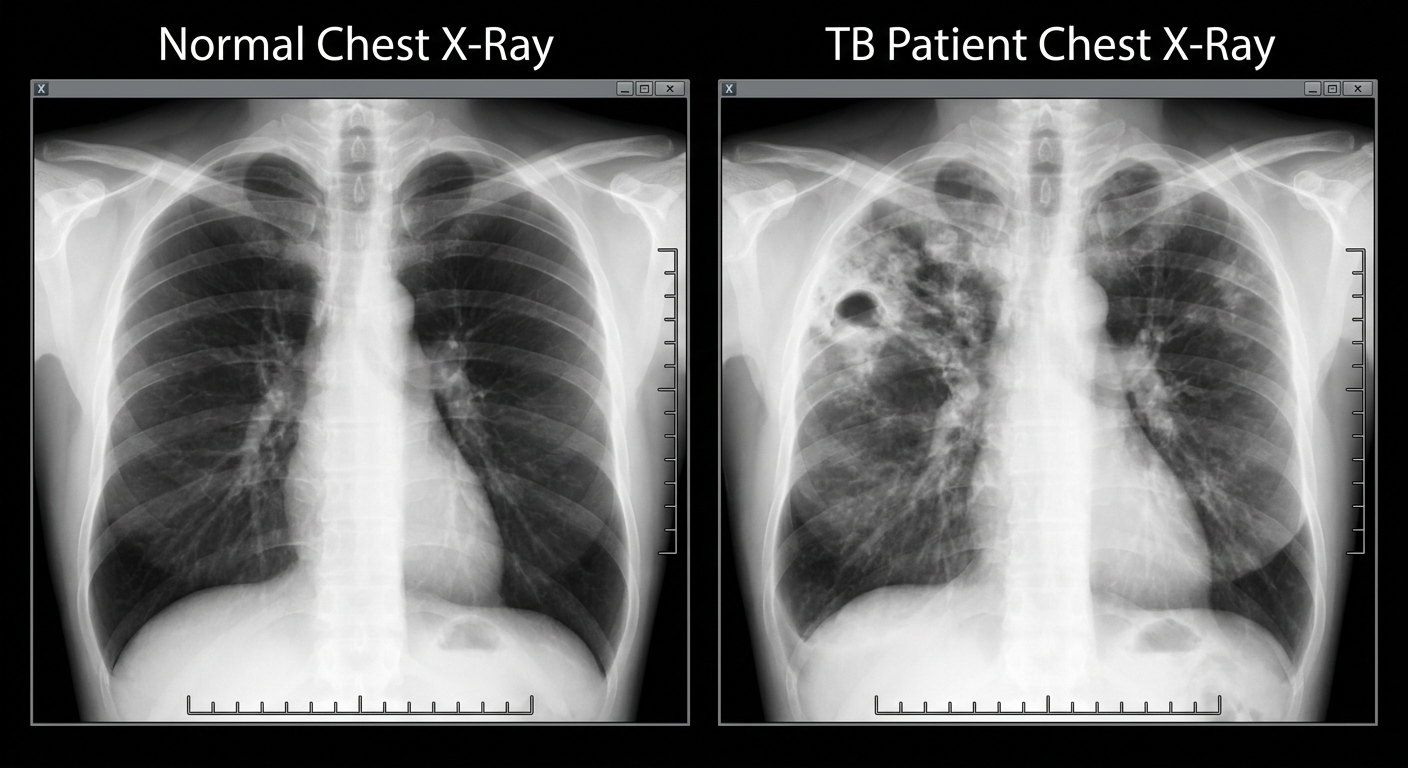
- Clear, black lung fields bilaterally
- Sharp costophrenic angles
- Normal cardiac silhouette (cardiothoracic ratio <0.5)
- Well-defined hilar shadows
- Midline trachea
- Visible pulmonary vasculature without congestion
- Upper lobe infiltrates (classically right > left) - TB preferentially affects the apical and posterior segments of the upper lobes due to higher oxygen tension
- Cavitation - a hallmark of active pulmonary TB, appearing as a lucent area within a consolidation
- Fibrotic streaking - indicates chronic or healing disease
- Hilar lymphadenopathy - commonly seen in primary TB
- Patchy consolidation - areas of airspace disease
- Possible pleural effusion - seen in up to 30% of TB cases
Mark the consolidation in image
ls /home/daytona/workspace/ && python3 -c "from PIL import Image; img = Image.open('/dev/stdin') if False else None; print('PIL available')" 2>&1; python3 -c "import PIL; print(PIL.__version__)"
Create a image of normal chest xray vs tb patient chest xray highlight and mention the abnormal findings
Medical educational poster: side-by-side chest X-ray comparison on dark background. LEFT PANEL - "NORMAL CHEST X-RAY" (white title text): Realistic PA chest radiograph showing perfectly clear bilateral lung fields (black), sharp well-defined costophrenic angles, normal cardiac silhouette with cardiothoracic ratio less than 0.5, symmetrical hilar shadows, midline trachea, normal pulmonary vasculature. Green checkmark labels pointing to: "Clear lung fields", "Sharp costophrenic angles", "Normal heart size", "Midline trachea". RIGHT PANEL - "TB PATIENT CHEST X-RAY" (white title text): Realistic PA chest radiograph showing classic pulmonary tuberculosis findings. Bright RED CIRCLE with arrow labeled "Cavitation" pointing to a thick-walled cavity in the right upper lobe. Bright YELLOW CIRCLE with arrow labeled "Upper lobe consolidation/Infiltrates" pointing to patchy white opacity in right upper zone. ORANGE CIRCLE with arrow labeled "Fibrotic streaking" pointing to linear opacities. PINK CIRCLE with arrow labeled "Hilar lymphadenopathy" pointing to enlarged hilar shadow. All labels in bold white text with colored backgrounds for readability. Radiograph grayscale appearance, realistic X-ray texture. Bottom caption: "Classic TB: Apical cavitation with upper lobe infiltrates"
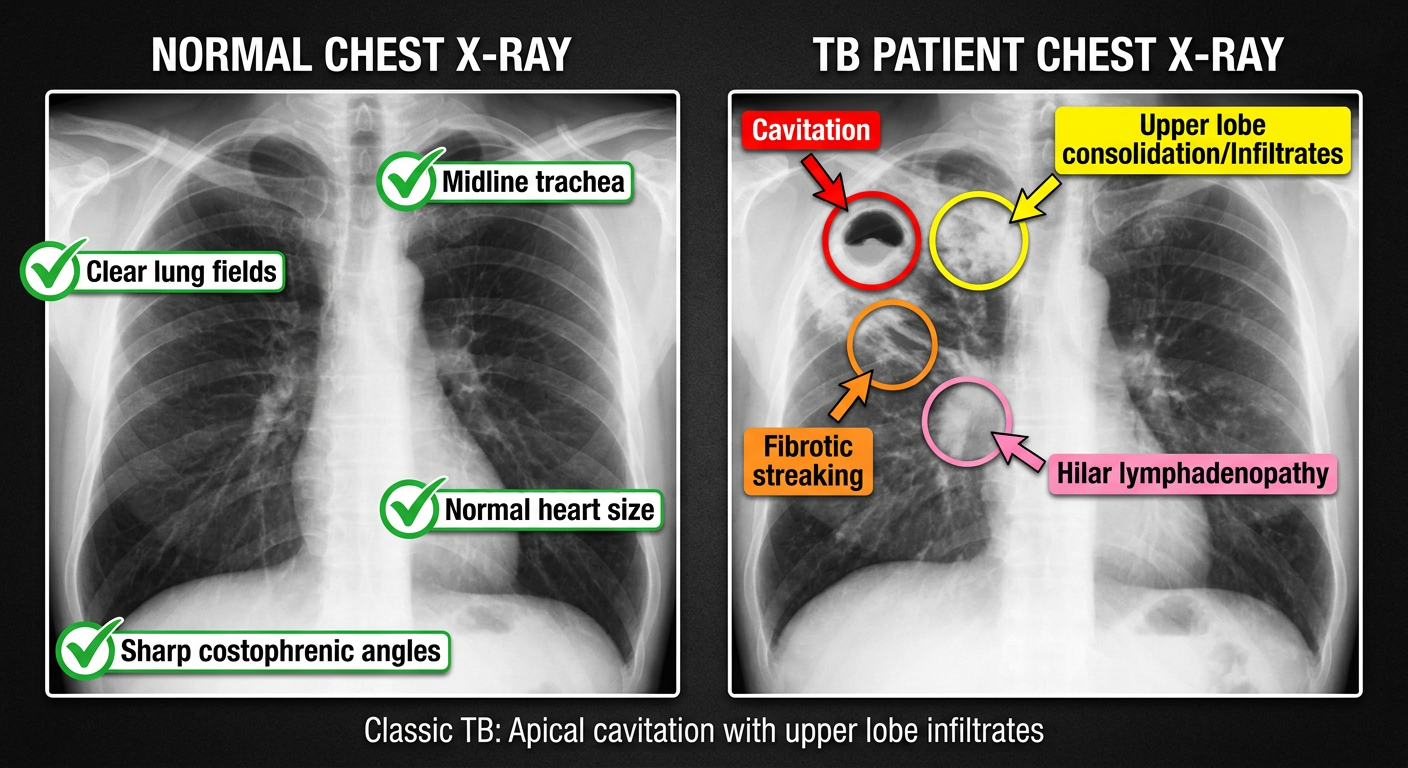
Abnormal Findings in TB - Explained
| Finding | Significance |
|---|---|
| Cavitation (red circle) | Thick-walled cavity in right upper lobe - hallmark of active/post-primary TB; forms when caseous necrosis liquefies and drains into bronchus |
| Upper lobe consolidation/Infiltrates (yellow) | Patchy airspace opacification - indicates active inflammation and pneumonitis; TB preferentially affects apical & posterior segments of upper lobes due to high O₂ tension |
| Fibrotic streaking (orange) | Linear/reticular opacities - sign of chronic or healing TB; fibrosis replaces destroyed lung tissue |
| Hilar lymphadenopathy (pink) | Enlarged hilar nodes - more common in primary TB (especially in children); the "Ghon complex" = peripheral lesion + hilar nodes |