
Hypertension
Reading File
The query is broad - "Hypertension" alone could mean many things. Let me clarify before diving in.
Asking for Preferences
What aspect of hypertension are you interested in?
Hypertension's major complications span the heart, brain, kidneys, eyes, and vasculature - each driven by sustained pressure overload and accelerated atherosclerosis. Let me pull authoritative textbook content now.
Searching sources...
Finding Sources
Finding Sources
Searching PubMed
"hypertension" AND "target organ damage"
Good initial results. Now let me pull the detailed textbook content on each organ system affected.
Finding Sources
Finding Sources
Finding Sources
Good - I have the key file paths. Now let me read the detailed content from Robbins and Fuster's Heart on hypertensive heart disease and other organ complications.
Reading File
Finding Sources
Finding Sources
Excellent content. Now let me get the retinopathy grading and renal/vascular complications detail.
Reading File
Reading File
Excellent - rich content from Comprehensive Clinical Nephrology and Robbins. Let me also get the vascular/aortic and stroke detail, plus the Robbins section on hypertensive nephrosclerosis.
Reading File
Finding Sources
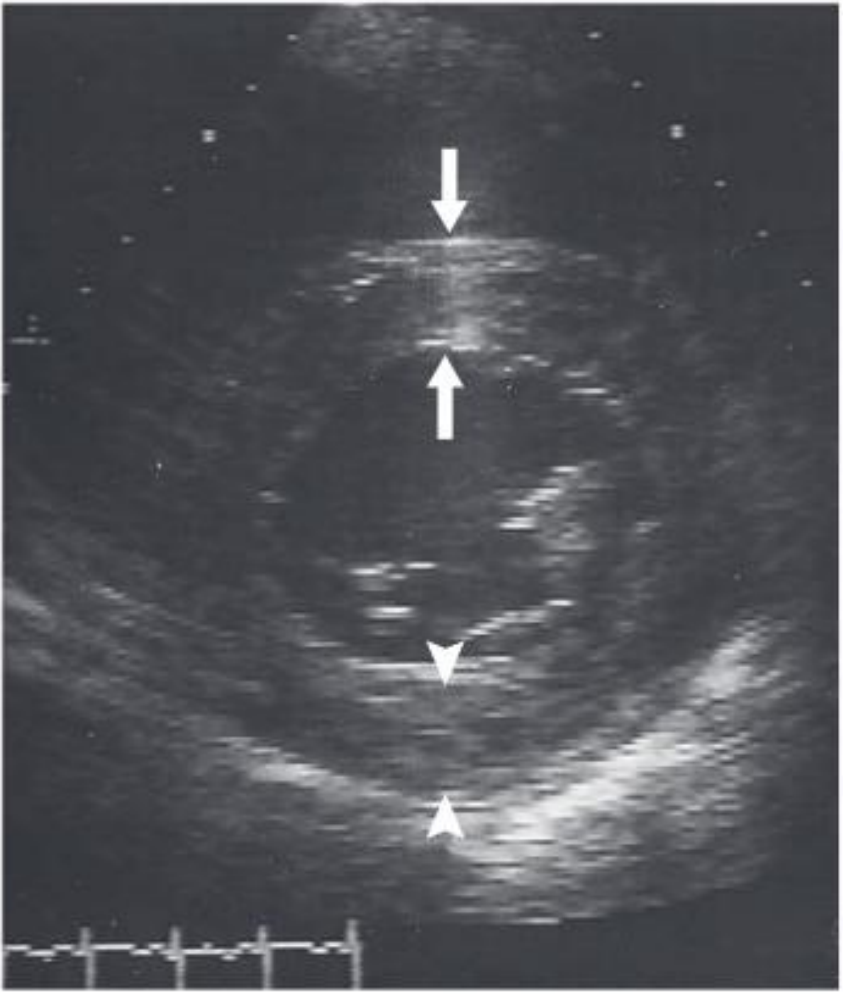
I now have comprehensive, authoritative content from multiple textbooks. Let me also fetch the echocardiogram image showing concentric LVH for visual illustration.
Loading Image
I now have all the material needed for a thorough, well-cited answer. Here is the full response:
Hypertension: Complications & Target Organ Damage
Hypertension is aptly called the "silent killer" - it can be entirely asymptomatic for years while progressively damaging multiple organ systems through two main mechanisms: (1) sustained mechanical pressure overload on vessel walls and cardiac muscle, and (2) accelerated atherosclerosis driven by endothelial injury. The organs most affected are the heart, brain, kidneys, eyes, and large vessels.
1. Heart
Left Ventricular Hypertrophy (LVH)
The heart responds to chronic pressure overload with concentric left ventricular hypertrophy (LVH) - an initially adaptive response that becomes maladaptive over time. The minimal diagnostic criteria for hypertensive heart disease (HHD) are:
- LVH (usually concentric) in the absence of other cardiovascular pathology
- Clinical history or pathologic evidence of hypertension in other organs
Morphology: The LV wall thickens (may exceed 2.0 cm), heart weight can exceed 500 g, and increased interstitial connective tissue makes the wall stiff, impairing diastolic filling. Microscopically, myocyte diameter increases with perivascular and interstitial fibrosis. The Framingham Study confirmed that even mild hypertension (if prolonged) induces LVH.
Downstream Cardiac Consequences
Once LVH is established, the patient faces a spectrum of outcomes:
| Complication | Mechanism |
|---|---|
| Heart Failure with preserved EF (HFpEF) | Subendocardial fibrosis → diastolic dysfunction → impaired filling. ~80-90% of HF patients have a history of hypertension |
| Ischemic Heart Disease (IHD) | Hypertension potentiates coronary atherosclerosis + increased O₂ demand from hypertrophic muscle |
| Atrial Fibrillation | Left atrial enlargement secondary to impaired LV filling |
| Sudden Cardiac Death (SCD) | End-stage HHD |
| Heart Failure with reduced EF (HFrEF) | Progression from compensated hypertrophy to decompensated dilation |
Effective BP control can prevent LVH and even cause its regression, reducing associated risks. - Robbins, Cotran & Kumar Pathologic Basis of Disease
2. Brain
Hypertension is the single most common cause of stroke. Several neurological complications arise:
Cerebrovascular Stroke
- Ischemic stroke: Hypertension accelerates large-vessel atherosclerosis and promotes lacunar infarcts (small vessel disease in the deep white matter and basal ganglia from lipohyalinosis)
- Hemorrhagic stroke (intracerebral hemorrhage): Direct rupture of small penetrating arteries weakened by hypertensive arteriolar changes - Charcot-Bouchard microaneurysms are classic
Hypertensive Encephalopathy
Occurs with severe acute BP elevation - characterized by:
- Global cerebral dysfunction
- Headache (classically occipital and pulsatile, especially with BP >160/100 mm Hg)
- Delirium / altered mental status
- Seizures
- Cerebral edema (visible on MRI as posterior reversible encephalopathy syndrome - PRES)
The mechanism is a failure of cerebral autoregulation - when BP exceeds the upper limit of autoregulation, forced vasodilation leads to breakthrough edema.
Vascular Dementia
Hypertension is a major risk factor for vascular dementia. Even childhood hypertension can be associated with impaired memory and mental performance. - Comprehensive Clinical Nephrology, 7th Ed.
3. Kidneys
Hypertensive Nephrosclerosis (Benign)
Primary hypertension causes arteriolosclerosis of the preglomerular afferent arteriole and interlobular artery (seen in ~90% of patients). The pathology involves:
- Replacement of smooth muscle cells in the media with connective tissue
- Hyaline material (plasma proteins) deposited in the subintima (hyalinosis)
- Glomerular and tubular ischemia → shrinkage of glomerular tuft, tubular atrophy, interstitial fibrosis
Result: Progressive loss of GFR and chronic kidney disease (CKD). Hypertension is one of the top causes of end-stage renal disease (ESRD), alongside diabetic nephropathy.
Malignant Hypertensive Nephropathy
In hypertensive emergency, a proliferative arteriolopathy develops with:
- Fibrinoid necrosis of arteriolar walls
- Onion-skin appearance (concentric layers of connective tissue) - can progress to total luminal obliteration
- Microangiopathic hemolytic anemia
- Rapidly progressive renal failure, hematuria, proteinuria
4. Eyes - Hypertensive Retinopathy
The retina is the only location where microvascular damage from hypertension can be directly visualized. The classic grading system (Scheie's classification):
Retinopathy Grade (vascular leakage changes):
| Grade | Finding |
|---|---|
| 1 | Generalized attenuation of retinal arterioles |
| 2 | More pronounced + focal arteriolar attenuation |
| 3 | Arteriolar attenuation + cotton-wool spots, retinal exudates, hemorrhages |
| 4 | Grade 3 changes + papilledema (indicates hypertensive emergency) |
Arteriolar Sclerosis Grade (separate scale):
| Grade | Finding |
|---|---|
| 1 | Broadening of arteriolar reflex, minimal AV crossing defects |
| 2 | Increased arteriolar light reflex + AV crossing changes |
| 3 | Copper wire arterioles + marked AV crossing changes |
| 4 | Silver wire arterioles + severe AV crossing changes |
- Textbook of Family Medicine, 9th Ed.
Grade 3-4 retinopathy with papilledema signals a hypertensive emergency and mandates urgent BP reduction to prevent irreversible vision loss and other end-organ damage.
5. Large Vessels
Sustained hypertension damages the aorta and large arteries through multiple mechanisms:
Aortic Aneurysm & Dissection
- Hypertension is present in 72% of patients with aortic dissection (the single most common risk factor)
- Mechanism: Chronic pressure stress causes medial degeneration, weakening the aortic wall
- Hypertension also promotes aortic aneurysm formation, especially abdominal aortic aneurysm (AAA)
- Risk is compounded when atherosclerosis co-exists (present in ~31% of dissection cases)
Peripheral Vascular Disease
- Accelerated atherosclerosis in the iliac and femoral arteries leads to lower limb ischemia
- Elevated systolic BP and elevated pulse pressure (from increased aortic stiffness) both independently increase stroke and cardiovascular risk
- Changes in collagen content stiffen vessel walls, raising pulse pressure
Hypertensive Emergency vs. Urgency
| Feature | Urgency | Emergency |
|---|---|---|
| BP | Severely elevated (e.g., >180/120) | Severely elevated |
| Target organ damage | Absent | Present (active, acute) |
| Management | Oral agents, gradual reduction | IV agents, controlled reduction within minutes-hours |
Acute target organ damage in hypertensive emergency includes: hypertensive encephalopathy, acute MI, acute LV failure with pulmonary edema, aortic dissection, hemorrhagic or ischemic stroke, acute kidney injury, and papilledema.
Summary: Organ-Complication Map
HYPERTENSION
│
├── HEART ──── LVH → HFpEF → HFrEF → SCD
│                └── IHD (atherosclerosis + O₂ demand)
│                └── Atrial fibrillation
│
├── BRAIN ──── Ischemic stroke (lacunar + large vessel)
│               └── Hemorrhagic stroke (Charcot-Bouchard)
│               └── Hypertensive encephalopathy (PRES)
│               └── Vascular dementia
│
├── KIDNEYS ── Benign nephrosclerosis → CKD → ESRD
│               └── Malignant: fibrinoid necrosis, onion-skin
│
├── EYES ────── Hypertensive retinopathy (Grades 1-4)
│               └── Grade 4 = papilledema = emergency
│
└── VESSELS ─── Aortic dissection (HTN in 72%)
                 └── Aortic aneurysm
                 └── Peripheral vascular disease
                 └── Increased pulse pressure / arterial stiffness
Recent evidence note (2025-2026): A 2026 systematic review (PMID 41949446, Blood Press) confirmed that nocturnal hypertension specifically carries significantly elevated cardiovascular complication risk, beyond that of daytime hypertension alone - reinforcing the value of 24-hour ambulatory BP monitoring in assessing true target organ damage risk.
Sources: Robbins, Cotran & Kumar Pathologic Basis of Disease | Comprehensive Clinical Nephrology, 7th Ed. | Textbook of Family Medicine, 9th Ed. | Fuster and Hurst's The Heart, 15th Ed. | Harrison's Principles of Internal Medicine, 22nd Ed.
This is a shared conversation. Sign in to Orris to start your own chat.