

Mnemonic to remember this
"Can Van Allen Play Music In The Ice"
| Letter | Word | Stain | Key Result |
|---|---|---|---|
| C | Can | Congo-red | Pink/red + apple-green birefringence (polarized) |
| V | Van | Van Gieson | Khaki color |
| A | Allen | Alcian blue | Blue color |
| P | Play | PAS (Periodic acid-Schiff) | Pink |
| M | Music | Methyl violet / Cresyl violet | Rose-pink (amyloid) vs blue (surrounding tissue) |
| I | In | Iodine solution | Mahogany brown → blue-violet with H₂SO₄ |
| T | The | Thioflavin T | Fluorescence under UV light |
| I | Ice | Immunohistochemistry | Best for AA & TTR amyloid types |
Quick Color Memory Tricks
- Congo-red = think "traffic light goes GREEN" under polarized light (apple-green birefringence) - the most classic/exam-favorite stain
- Van Gieson = "Khaki Van" - a van painted khaki
- Alcian BLUE = name has "blue," stains blue - self-explanatory
- PAS = "PAS-tel pink" - pastel = pink
- Methyl/Cresyl violet = paradoxical - violet stain gives ROSE-PINK to amyloid (metachromasia) - the tissue surrounding it turns blue
- Iodine = think of iodine on starch: brown first, then add acid → color changes (mahogany → blue-violet)
- Thioflavin T = "Thioflavin Twinkles" - it fluoresces (twinkles) under UV
- Immunohistochemistry = the "smart" stain - can tell you exactly which type of amyloid (AA vs TTR)

Chemical nature of Amylodosis from this attachment make it into flowchart
AMYLOID MATERIAL
|
┌──────────────┴──────────────┐
95% 5%
FIBRIL PROTEINS Non-fibril components
(Proteoglycans, Glycosaminoglycans,
Serum Amyloid P [SAP], etc.)
FIBRIL PROTEINS
|
┌──────────────┴──────────────┐
MAJOR FORMS (3) MINOR FORMS (>20)
| |
┌─────┴──────┐ ┌───────┴────────┐
AL AA TTR β₂-microglobulin
Aβ
MAJOR FORMS
┌─────────────────────────────────────────────────────────────────┐
│ MAJOR FORMS │
│ │
│ ┌─────────────────────────────────────────────────────────┐ │
│ │ 1. AL (Amyloid Light Chain) │ │
│ │ Source: Plasma cells │ │
│ │ Derived from: Complete Ig light chains (mostly λ) │ │
│ │ OR amino-terminal fragments │ │
│ │ OR both │ │
│ │ Associated with: Monoclonal B-cell proliferation │ │
│ │ (e.g., plasma cell tumors) │ │
│ └─────────────────────────────────────────────────────────┘ │
│ │
│ ┌─────────────────────────────────────────────────────────┐ │
│ │ 2. AA (Amyloid Associated) │ │
│ │ Source: Liver synthesis (NON-immunoglobulin) │ │
│ │ Precursor: SAA (Serum Amyloid Associated protein) │ │
│ │ Trigger: Cytokines (IL-6, IL-1) → inflammation │ │
│ │ ↓ SAA synthesis increases (acute phase) │ │
│ │ Associated with: CHRONIC INFLAMMATION │ │
│ │ = Secondary Amyloidosis │ │
│ └─────────────────────────────────────────────────────────┘ │
│ │
│ ┌─────────────────────────────────────────────────────────┐ │
│ │ 3. Aβ (Beta Amyloid) │ │
│ │ Precursor: APP (Amyloid Precursor Protein) │ │
│ │ [transmembrane glycoprotein] │ │
│ │ Derived by: PROTEOLYSIS of APP │ │
│ │ Location: Cerebral plaques + cerebral blood vessels │ │
│ │ Associated with: ALZHEIMER'S DISEASE │ │
│ └─────────────────────────────────────────────────────────┘ │
└─────────────────────────────────────────────────────────────────┘
MINOR FORMS
┌─────────────────────────────────────────────────────────────────┐
│ MINOR FORMS │
│ │
│ ┌─────────────────────────────────────────────────────────┐ │
│ │ 1. TTR (Transthyretin) │ │
│ │ Normal function: Transports thyroxine + retinol │ │
│ │ │ │
│ │ TWO VARIANTS: │ │
│ │ ┌─────────────────┐ ┌────────────────────────┐ │ │
│ │ │ MUTATED TTR │ │ UNMUTATED TTR │ │ │
│ │ │ Gene mutation → │ │ Deposited in HEART │ │ │
│ │ │ misfolding → │ │ of aged individuals │ │ │
│ │ │ Familial Amyloid│ │ = Senile Systemic │ │ │
│ │ │ Polyneuropathies│ │ Amyloidosis │ │ │
│ │ └─────────────────┘ └────────────────────────┘ │ │
│ └─────────────────────────────────────────────────────────┘ │
│ │
│ ┌─────────────────────────────────────────────────────────┐ │
│ │ 2. β₂-Microglobulin │ │
│ │ Normal function: Component of MHC Class I molecules │ │
│ │ Fibril subunit: Aβ₂m (derived from β₂-microglobulin)│ │
│ │ Location: Joints / soft tissues │ │
│ │ Associated with: LONG-TERM HEMODIALYSIS │ │
│ └─────────────────────────────────────────────────────────┘ │
└─────────────────────────────────────────────────────────────────┘
Quick Summary Table
| Type | Precursor | Source | Disease Association |
|---|---|---|---|
| AL | Ig light chains (λ) | Plasma cells | Plasma cell tumors (Primary) |
| AA | SAA protein | Liver (via IL-6/IL-1) | Chronic inflammation (Secondary) |
| Aβ | APP | Proteolysis | Alzheimer's disease |
| TTR (mutated) | Mutant TTR | Gene mutation | Familial polyneuropathies |
| TTR (normal) | Normal TTR | Aged heart | Senile systemic amyloidosis |
| β₂-microglobulin | β₂-m (MHC-I) | Normal serum protein | Long-term hemodialysis |


Morphology only for 3 marks from attachment point wose make i to image based flowchart
A clean medical education flowchart titled "Morphology of Amyloidosis - Major Organs Involved" for a 3-mark exam answer. The flowchart has a central top box "AMYLOIDOSIS MORPHOLOGY" with arrows branching down to 4 organ boxes: KIDNEY, SPLEEN, LIVER, HEART. Each organ box has two sub-boxes below it labeled "GROSS" and "MICROSCOPY" with bullet points of key findings. KIDNEY (most common, most serious): GROSS: Normal size early → Shrunken (advanced, due to ischemia from vessel narrowing) MICROSCOPY: Glomeruli - focal mesangial deposits → diffuse/nodular GBM thickening → capillary narrowing → obliteration → broad ribbons. Also peritubular interstitium, arteries, arterioles SPLEEN (two patterns): Pattern 1 - SAGO SPLEEN: Deposits limited to splenic follicles, tapioca-like granules, amyloid in arteriole walls of white pulp Pattern 2 - LARDACEOUS SPLEEN: Deposits in sinuses + connective tissue of red pulp, large map-like reddish areas on cut surface, resembles pig fat LIVER: GROSS: Not apparent OR moderate-marked enlargement → pale, gray, waxy (advanced) MICROSCOPY: First in Space of Disse → encroaches hepatic parenchymal cells + sinusoids → pressure atrophy → disappearance of liver cells. Liver function usually preserved HEART: GROSS: Usually no gross changes OR enlarged and firm. Subendocardial deposits = dew-drop appearance MICROSCOPY: Between muscle fibers → pressure atrophy of myocardial fibers → conduction system involvement → arrhythmias Use a white background, color-coded organ boxes (kidney=red, spleen=purple, liver=brown, heart=pink), clean arrows, medical textbook style, high clarity font, no decorative elements
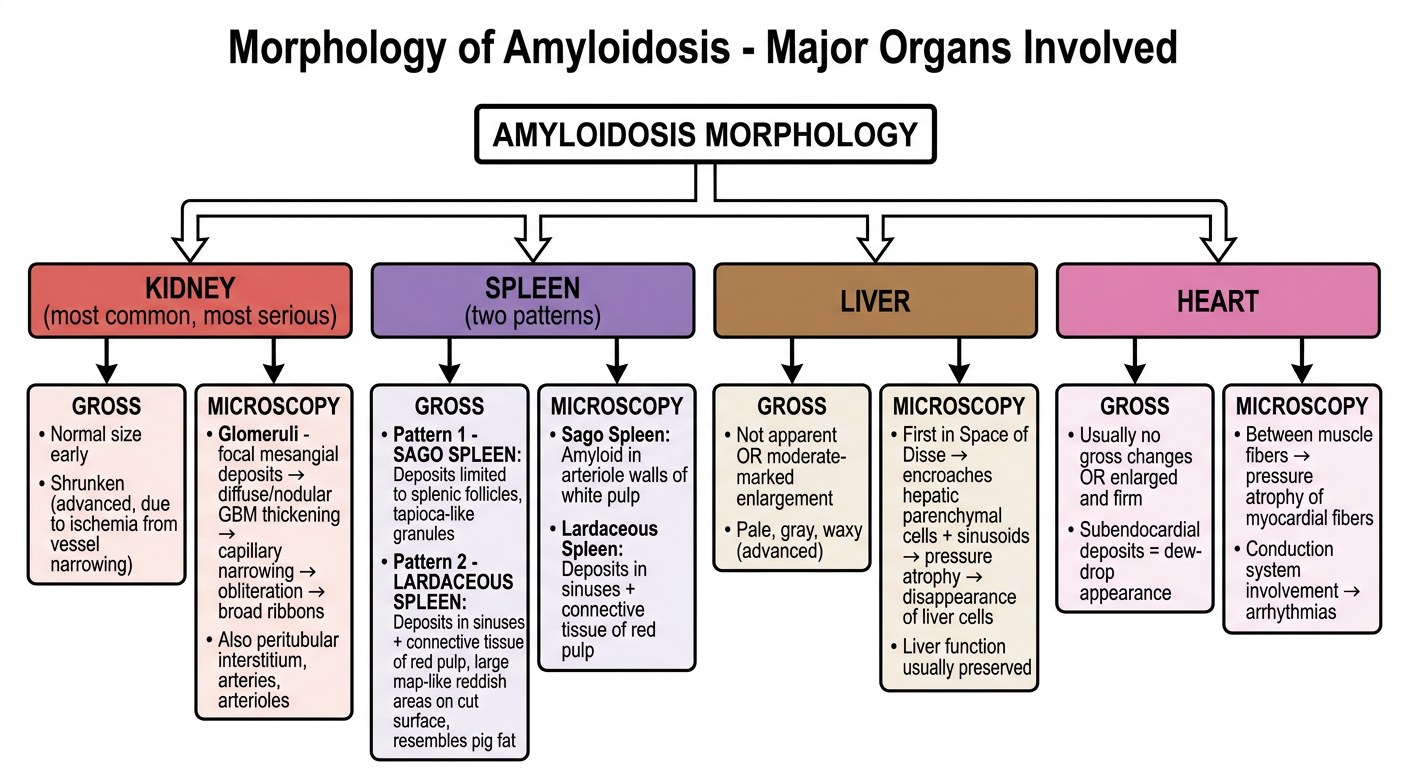
3-Mark Answer Structure
🔴 KIDNEY (Most common + most serious)
| Findings | |
|---|---|
| Gross | Normal size early → Shrunken in advanced stage (ischemia from vessel narrowing) |
| Micro | Glomeruli: mesangial deposits → GBM thickening → capillary narrowing → obliteration → broad ribbons of amyloid |
🟣 SPLEEN (Two patterns)
| Pattern | Gross | Micro |
|---|---|---|
| Sago spleen | Tapioca-like granules | Deposits in follicles + arteriole walls (white pulp) |
| Lardaceous spleen | Large map-like reddish areas, pig-fat appearance | Deposits in sinuses + red pulp connective tissue |
🟤 LIVER
| Findings | |
|---|---|
| Gross | May not be apparent OR pale, gray, waxy enlargement |
| Micro | Starts in Space of Disse → pressure atrophy of hepatocytes → liver function usually preserved |
🩷 HEART
| Findings | |
|---|---|
| Gross | Usually no change OR firm, enlarged; dew-drop subendocardial deposits |
| Micro | Between muscle fibers → pressure atrophy → conduction system involvement → arrhythmias |