
Laceration
Reading File
The query "Laceration" is quite broad. Let me clarify before diving in.
Asking for Preferences
What aspect of lacerations are you looking for? · What is your context?
Searching sources...
Finding Sources
Finding Sources
The Forensic Medicine textbook (Dikshit) and the Emergency Medicine text (Tintinalli's) look most relevant for definition and types. Let me pull those sections, along with the surgical and ophthalmology entries.
Reading File
Finding Sources
Excellent - the Parikh's Forensic Medicine text has a dedicated, comprehensive section on lacerations (lines 6450-6476) and the Essentials of Forensic Medicine (2026 edition) has another strong section. Let me read both.
Reading File
Reading File
I have rich content from both forensic medicine texts. Let me now read the characteristics section more completely, and also grab the Dikshit text for the broader laceration definition context.
Reading File
Reading File
I now have comprehensive material. Let me also get the remaining characteristics from the Parikh text and fetch one relevant image.
Reading File
Reading File
I now have all the material needed. Let me also fetch the avulsion image to include visually.
Loading Image
I now have everything needed to provide a thorough, exam-oriented answer on laceration definition and types.
Laceration - Definition and Types
Definition
A laceration is a wound in which the skin, mucous membranes, or underlying tissues are torn as a result of the application of blunt force. Unlike incised wounds (caused by sharp objects), lacerations result from crushing, stretching, or tearing forces that exceed the tensile strength and elasticity of the tissues.
Two key factors influence whether a laceration occurs:
- Underlying rigidity: Where bone lies just beneath thin skin (e.g., scalp, eyebrow, shin), blunt force readily produces a laceration - which may even simulate an incised wound.
- Underlying flexibility: Where tissue is soft (e.g., cheek, abdomen, limbs), the same force more often produces only a bruise or contusion.
When blunt force exceeds the tensile strength of an internal organ (e.g., liver, spleen) without an external surface tear, the result is an internal laceration.
Classification of Lacerations (by Mechanism)
1. Split Laceration
- Mechanism: Blunt, near-perpendicular impact compresses skin between the object and the underlying bone.
- Appearance: Linear split, often closely resembles an incised wound ("incised-looking laceration"). On close examination (with magnifying lens), hair follicles are crushed rather than cleanly cut, and tissue bridges are present - confirming its lacerated nature.
- Sites: Scalp, eyebrow, face, cheek bone, lower jaw, shin, iliac crest, perineum - areas where skin overlies bone with little subcutaneous fat.
- Medicolegal note: The most common type encountered and the one most likely to be confused with an incised wound.
2. Stretch Laceration (Tangential Laceration)
- Mechanism: A blunt, glancing or tangential impact causes the skin to overstretch until it tears, producing a skin flap.
- Appearance: A flap of skin partially detached from underlying bone or deep fascia. The direction of the flap indicates the direction of the applied force.
- Common causes: Head striking a vehicle windscreen, run-over injuries by motor vehicle, compound fracture (bone deformity tears overlying skin), glancing kicks.
- Foreign material may be found in the wound depth.
3. Avulsion (Shearing/Horizontal Laceration)
- Mechanism: A shearing/grinding force delivered at an acute horizontal angle detaches or tears off a portion of skin or tissue from its attachments.
- Appearance: Degloving of skin over a large area ("flaying"). Underlying muscles are crushed; bones may be fractured.
- Common causes: Lorry/truck wheel running over a limb, machinery injuries, hair caught in machinery (scalp avulsion).
- Special variant: In shearing injuries, the skin surface may appear intact while soft tissue is avulsed from underlying fascia, creating a pocket filled with blood (common on back of thighs in pedestrians struck by vehicles).
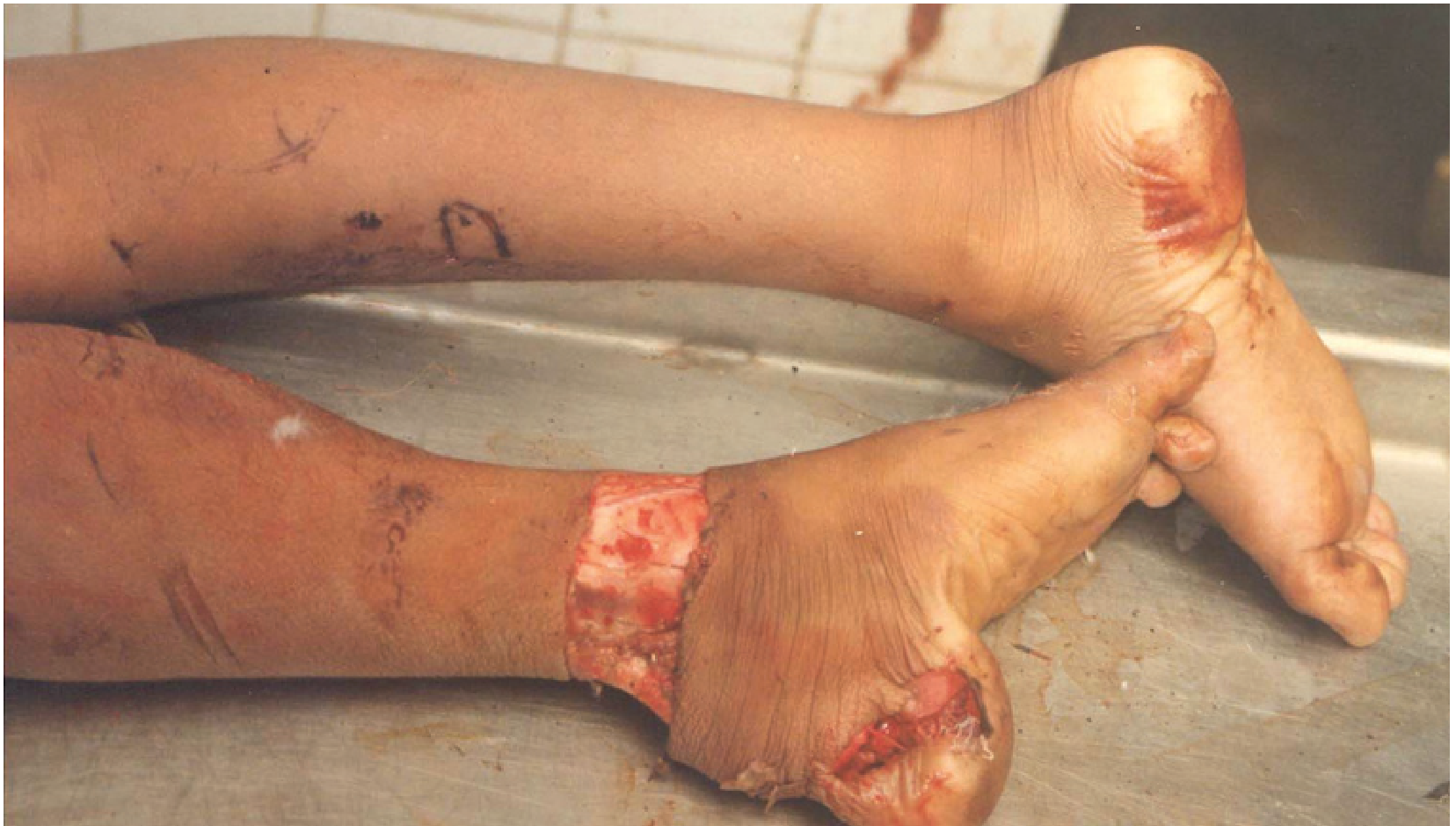
4. Tears (Irregular Laceration)
- Mechanism: Impact against irregular or sharp-edged blunt objects (e.g., motor car door handles, broken bottles, earthenware pots, falls on rough surfaces).
- Appearance: Irregular tearing of skin and deeper tissues. Foreign material in the wound may provide a clue to the causative object.
5. Cut Laceration
- Mechanism: Caused by a heavy, relatively sharp-edged instrument (axe, hatchet, chopper). Combines features of both laceration and incised wound.
- Appearance: Margins are abraded with surrounding bruising. This term is considered somewhat ambiguous and best avoided in formal reporting (Essentials of FMT, 2026).
6. Internal Laceration
- Mechanism: Blunt force exceeds the tensile strength of an internal organ without necessarily producing external injury.
- Causes of visceral laceration: (1) Direct injury by bone fragments, (2) traction/strain shears within viscera, (3) stretching of visceral attachments, (4) hydrostatic forces.
- Example: Liver laceration from blunt abdominal trauma; there may or may not be surface bruising/abrasion.
Sub-classification by Associated Features
| Term | Feature |
|---|---|
| Contused-laceration (bruised tear) | Margins bruised |
| Abraded laceration (scraped tear) | Margins abraded |
| Crushing injury | Extensive bruising + deep tissue laceration |
Characteristic Features of a Lacerated Wound
These are essential for distinguishing lacerations from incised wounds (a classic exam question):
| Feature | Laceration | Incised Wound |
|---|---|---|
| Margins | Ragged, irregular, uneven; ends blunt or pointed; minute tears at margins | Clean, well-defined, sharp |
| Bruising | Present around margins and in subcutaneous tissue | Absent |
| Abrasion | Often present around margins | Absent |
| Tissue bridges | Present (nerves, vessels, connective tissue cross the wound floor) | Absent |
| Hair follicles | Crushed | Cleanly cut |
| Hemorrhage | Less (vessels are crushed and clot readily) | More (vessels are cleanly divided, retract poorly) |
| Foreign material | Often present | Usually absent |
| Shape vs. weapon | Shape/size may NOT correspond to the weapon | May correspond |
| Scar | Conspicuous, irregular scar | Fine scar |
| Undermining | Present (side opposite to force direction) | Absent |
Key rule: The presence of tissue bridges at the base of the wound is pathognomonic of a laceration - they consist of nerves, blood vessels, and elastic/connective tissue fibers that have different tensile strengths and resist tearing.
Shape of Laceration and the Weapon
The shape of a laceration can sometimes suggest the causative object:
- Crescentic laceration - hammer head (blunt object with an edge)
- Stellate laceration - blunt round end (e.g., rod end)
- Linear with split/Y-end - stick or rod
- The convexity of the laceration curve points in the direction of force.
Medicolegal Importance
- A laceration is produced by blunt force - identifying the type helps reconstruct the weapon and direction of injury.
- Split lacerations on the scalp can mimic incised wounds - always examine carefully and shave hair around the wound.
- The flap direction in stretch lacerations and the undermined side in angulated impact both indicate direction of force, which is important in assault reconstruction.
- Internal lacerations (e.g., liver, spleen) can cause fatal hemorrhage with no external wound - important in medicolegal autopsies.
Sources:
- [Parikh's Textbook of Medical Jurisprudence, Forensic Medicine and Toxicology](Q.16.5, p. 253)
- [The Essentials of Forensic Medicine and Toxicology, 36th edition (2026)](Chapter 8, p. 195)
- [P.C. Dikshit Textbook of Forensic Medicine and Toxicology](Chapter 13)
This is a shared conversation. Sign in to Orris to start your own chat.