
What is 1st line of Drugs of treatment of Migrane
The first-line drugs for migraine treatment depend on whether you're treating an acute attack or preventing future ones. Here's a quick overview:
Acute (Abortive) Treatment:
- Triptans (e.g., sumatriptan) are the gold standard for moderate-to-severe migraines
- NSAIDs (ibuprofen, naproxen) and paracetamol for mild-to-moderate attacks
- Combination analgesics (aspirin + paracetamol + caffeine)
Prophylactic (Preventive) Treatment:
- Beta-blockers (propranolol, metoprolol)
- Topiramate, valproate
- Amitriptyline (TCAs)
Searching sources...
Reading File
Searching PubMed
"migraine" AND "first line treatment"
Now let me search the medical library for detailed migraine treatment content:
Finding Sources
Finding Sources
Excellent results. Now let me read the dedicated treatment sections for full detail:
Reading File
Reading File
Reading File
Now let me get the prophylaxis section and the Lippincott content on newer agents (CGRP antagonists, ditans):
Reading File
Reading File
I have rich, comprehensive content from multiple authoritative textbooks. Let me also fetch the treatment flowchart image for a visual summary:
Loading Image
I now have everything needed for a thorough, textbook-backed answer. Here is the complete response:
First-Line Drugs for Migraine Treatment
Migraine management is divided into two strategies: acute (abortive) treatment to stop an attack, and prophylactic treatment to prevent future attacks.
A. Acute (Abortive) Treatment
1. Mild-to-Moderate Migraine - First Line: NSAIDs / Analgesics
- Aspirin, ibuprofen, naproxen, paracetamol (acetaminophen) are first-line for mild-to-moderate attacks
- A popular OTC combination is aspirin + acetaminophen + caffeine (e.g., Excedrin)
- Try two or three NSAID preparations across successive attacks; moderately high doses may be needed
- Caution: overuse can cause "medication overuse headache" (rebound headache)
Adams and Victor's Principles of Neurology, 12th Ed. - "If the headaches are mild, aspirin, acetaminophen, or another NSAID will suffice and are considered first-line therapy."
2. Moderate-to-Severe Migraine - First Line: Triptans ✦
Triptans are the gold standard and definitive first-line therapy for moderate-to-severe migraine, effective in ~70% of patients.
| Triptan | Route | Notes |
|---|---|---|
| Sumatriptan (prototype) | SC, IN, oral | Fastest SC onset (~20 min); gold standard |
| Zolmitriptan | Oral, nasal | Also available as nasal spray |
| Rizatriptan | Oral | 5 or 10 mg, repeat in 2 h if needed |
| Naratriptan | Oral | Slower onset, fewer side effects |
| Frovatriptan | Oral | Longest half-life (>24 h); good for menstrual migraine |
| Almotriptan, eletriptan | Oral | Alternatives if first triptan fails |
Mechanism: 5-HT1B/1D receptor agonists - cause vasoconstriction of intracranial vessels + inhibit release of proinflammatory neuropeptides from the trigeminal nerve system.
Key points:
- Best given early (during aura or at headache onset); oral forms may be ineffective if given too late
- Subcutaneous sumatriptan: fastest onset, ideal when vomiting prevents oral intake
- If one triptan fails, try another or a different route
- Contraindicated in patients with cardiovascular disease, coronary artery disease, uncontrolled hypertension
Lippincott Illustrated Reviews: Pharmacology - "Sumatriptan was the first available triptan and is the prototype of this class. These agents are first-line agents in the treatment of acute migraine."
Visual Summary (from Lippincott Pharmacology):
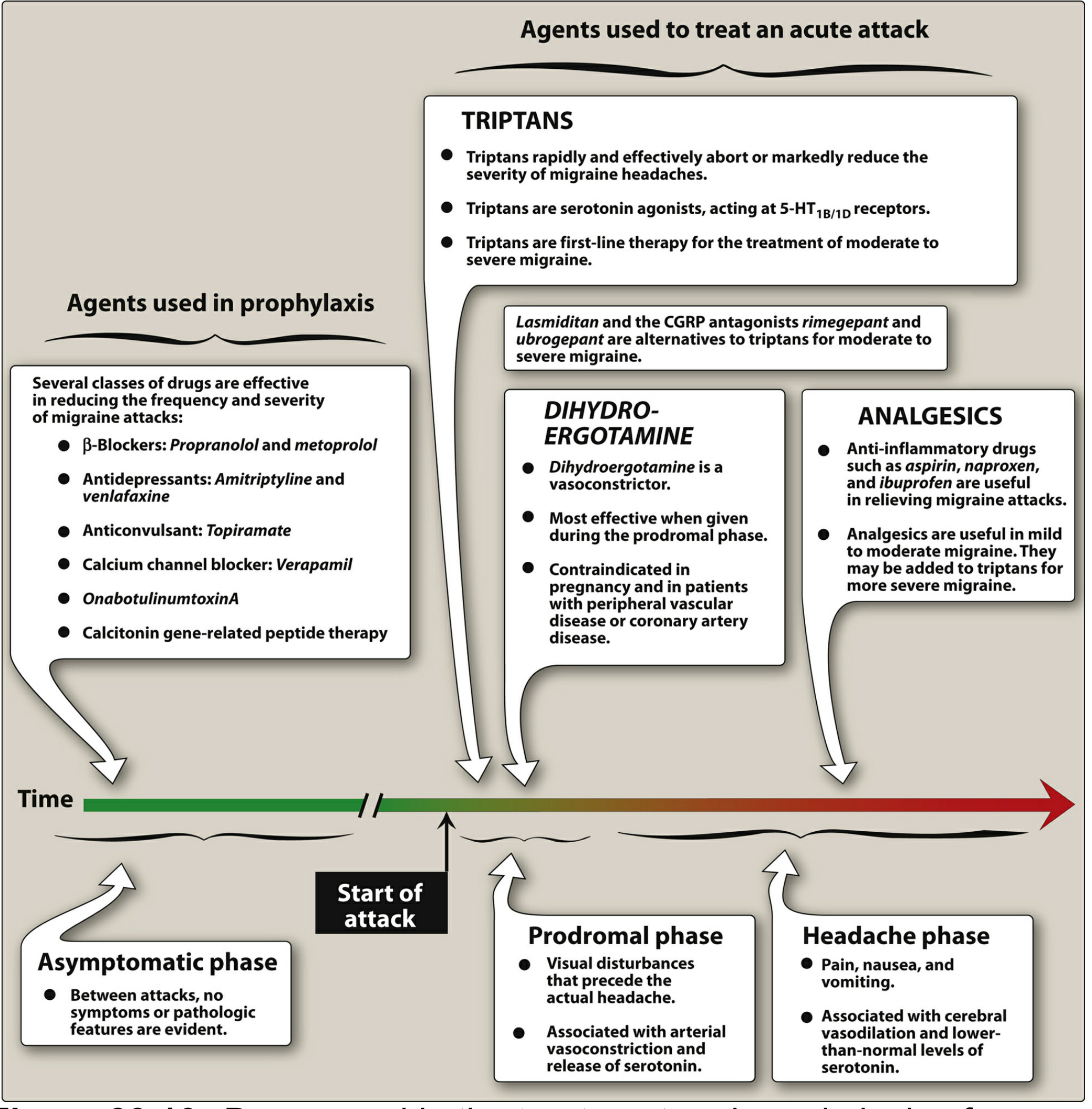
3. Second-Line Acute Agents
| Drug | Notes |
|---|---|
| Dihydroergotamine (DHE) | IV or intranasal; effective but vasoconstrictive side effects; contraindicated in pregnancy and vascular disease |
| Ergotamine tartrate | Sublingual/oral; older agent, risk of dependence and rebound |
| Lasmiditan (ditan) | Oral 5-HT1F agonist; no vasoconstriction; alternative if triptans are contraindicated; controlled substance (driving impairment risk) |
| Gepants (CGRP antagonists) - Rimegepant, Ubrogepant | Oral; for triptan-intolerant patients; no vasoconstriction |
Antiemetics (metoclopramide, prochlorperazine, domperidone) are often added as adjuncts to control nausea and enhance oral drug absorption.
Opioids/butalbital: NOT recommended for routine use.
Tintinalli's Emergency Medicine - "Opiates and barbiturate-containing compounds should not be used routinely for abortive migraine therapy unless other standard treatments fail."
B. Prophylactic (Preventive) Treatment
Indicated when: attacks occur ≥2 times/month, or are severe/disabling, or are complicated by neurologic signs.
First-Line Preventive Drugs
| Class | Drug | Notes |
|---|---|---|
| Beta-blockers (DOC) | Propranolol, metoprolol, timolol, atenolol | Drugs of choice; propranolol 10-20 mg TID, up to 240 mg/day |
| Anticonvulsants | Topiramate, valproate (divalproex) | Avoid valproate in pregnancy |
| Tricyclic antidepressants | Amitriptyline | 25-125 mg nightly; preferred if headaches are very frequent |
| SNRIs | Venlafaxine | Alternative antidepressant |
| Calcium channel blockers | Verapamil | 320-480 mg/day |
Newer Preventive Options
| Drug | Class | Route |
|---|---|---|
| Erenumab, Galcanezumab, Fremanezumab, Eptinezumab | Anti-CGRP monoclonal antibodies | Injectable |
| Rimegepant, Atogepant | Oral CGRP antagonists | Oral |
| OnabotulinumtoxinA | Botox | Injection (chronic migraine) |
Adams and Victor's Principles of Neurology - "The most used agents have been beta-adrenergic blockers, antiepileptic drugs, and tricyclic antidepressants. Often, comorbidities such as depression, hypertension, epilepsy, or coronary artery disease guide the choice among these three classes."
Quick Summary Table
| Situation | First-Line Drug |
|---|---|
| Mild-to-moderate migraine | NSAIDs (ibuprofen, naproxen, aspirin) |
| Moderate-to-severe migraine | Triptans (sumatriptan, rizatriptan, etc.) |
| Vomiting present | SC or intranasal sumatriptan |
| Triptan contraindicated | Lasmiditan or gepants (rimegepant/ubrogepant) |
| Prevention (1st line) | Propranolol or topiramate |
| Prevention + depression | Amitriptyline |
| Prevention + HTN | Propranolol or metoprolol |
| Chronic migraine prevention | OnabotulinumtoxinA |
Recent evidence note: A 2025 Practice Guideline from the French Headache Society (PMID 39406556) and 2025 Saudi CPG (PMID 40199542) are consistent with the above framework - triptans remain first-line for acute moderate-to-severe migraine, with gepants and ditans as alternatives for triptan-intolerant patients. A 2025 systematic review (PMID 39601097) specifically examined patients unsuitable for triptans, highlighting the growing role of CGRP-based therapies in this group.
This is a shared conversation. Sign in to Orris to start your own chat.