
My orris plain how to close
Checking Date & Time
It looks like your message may have a typo or is unclear. Could you clarify what you mean?
Asking for Preferences
What did you mean by 'My orris plain how to close'?
Reading File
Finding Sources
Finding Sources
Reading File
Reading File
Reading File
Loading Image
Reading File
Here is a comprehensive guide on wound/plain closure (suturing and wound closure methods):
Wound Closure — Methods & Techniques
1. Decision: What Method to Use
The choice of closure depends on wound location, size, shape, and contamination level:
| Method | Best Used When |
|---|---|
| Sutures | Most wounds; provides strongest closure |
| Staples | Linear lacerations through dermis with straight, aligned edges (not on face or feet) |
| Adhesive strips (Steri-strips) | Small, low-tension wounds |
| Tissue adhesive (e.g., Dermabond) | Small incisions, low tension; water-impermeable |
2. Suturing Techniques
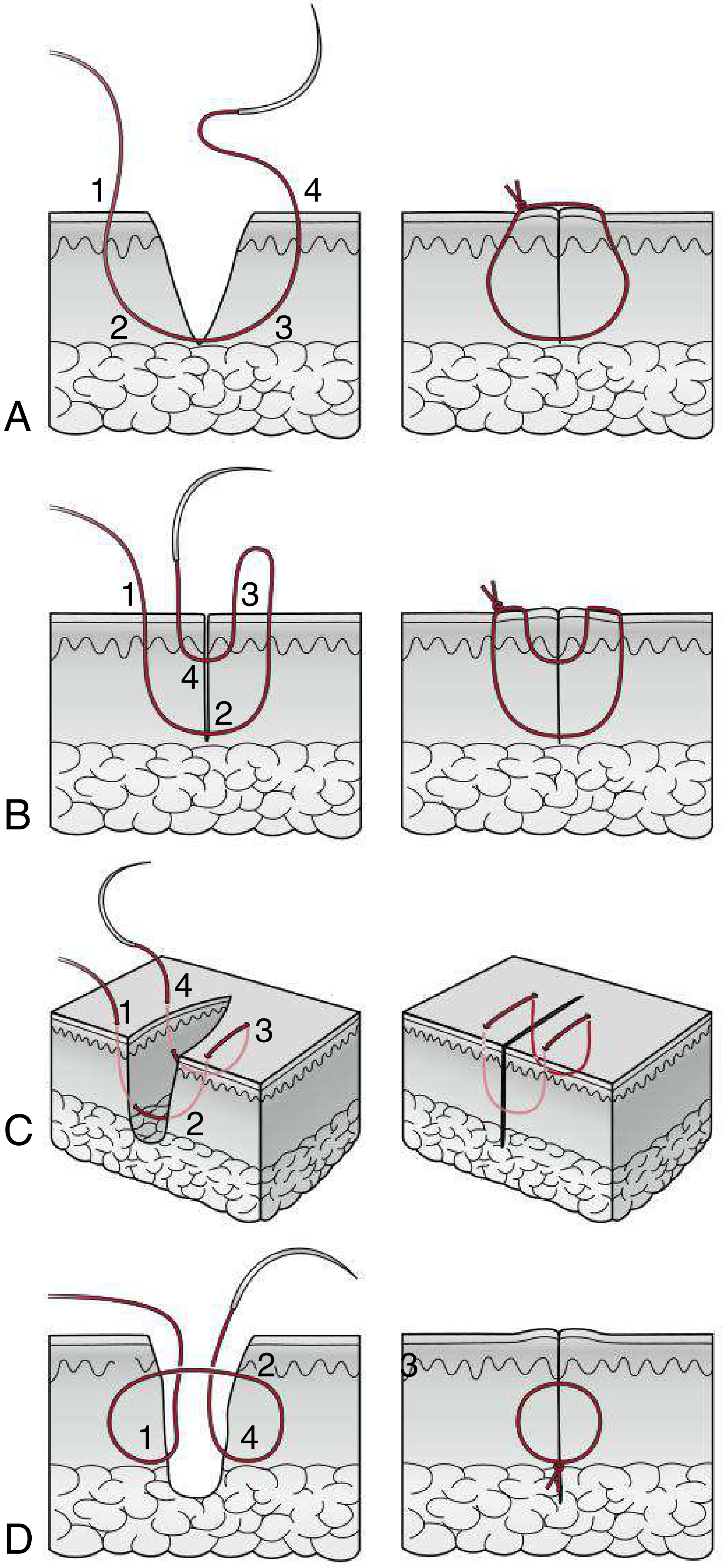
| Technique | Purpose |
|---|---|
| (A) Simple interrupted | Basic closure of most uncomplicated wounds |
| (B) Vertical mattress | Added strength in thick skin or areas of movement; everts wound edges |
| (C) Horizontal mattress | Everts wound edges; reduces tension |
| (D) Deep dermal (subcuticular) | Cosmetic closure; buried absorbable suture pulls deeper layers together |
| Running intradermal | Cosmetic closures |
3. Layered Closure
- Fascia: Closed with absorbable suture (running or interrupted)
- Subcutaneous fat: Do not suture — absorbable suture tears through fat
- Muscle fascia: Repair with absorbable suture if lacerated
- Skin/dermis: Closed last with nonabsorbable or absorbable suture
4. Suture Material & Size by Body Region
| Body Region | Nonabsorbable | Absorbable | Removal (Days) |
|---|---|---|---|
| Scalp | 5-0 or 4-0 | 4-0 | 5–7 |
| Face | 6-0 | 5-0 | 3–5 |
| Eyelid | 7-0 or 6-0 | — | 3–5 |
| Trunk | 5-0 or 4-0 | 3-0 | 5–7 |
| Extremities | 5-0 or 4-0 | 4-0 | 7–10 |
| Joint surface | 4-0 | — | 10–14 |
| Hand | 5-0 | 5-0 | 7 |
| Foot sole | 4-0 or 3-0 | 4-0 | 7–10 |
5. Common Suture Materials
Absorbable:
- Vicryl (braided) — subcutaneous closure, vessel ligature; absorbed in 8–10 weeks
- Monocryl (monofilament) — subcuticular; absorbed in 13–17 weeks
- Plain gut — subcutaneous; loses strength by 7–10 days
- Chromic gut — subcutaneous; holds slightly longer (~21–23 days)
Nonabsorbable (skin):
- Nylon (Ethilon, Dermalon) — monofilament; loses ~20% tensile strength/year; standard skin suture
- Prolene — monofilament polypropylene; minimal tissue reaction
6. Types of Wound Closure by Timing
| Type | Description |
|---|---|
| Primary closure | Wound closed immediately (clean/clean-contaminated wounds) |
| Delayed primary closure | Wound left open 2–5 days, then closed (contaminated wounds) |
| Secondary (open) intention | Wound left open to heal naturally; serial packing (heavily contaminated/dirty wounds) |
| Negative pressure wound therapy | Vacuum device applied to open wounds to facilitate closure |
7. Special Situations
- High-tension areas (knee, joint surfaces): Use horizontal mattress or vertical mattress sutures; consider splinting afterward
- Contaminated wounds: Delayed closure or leave open
- Lower extremity: Often requires multi-layer closure due to increased wound tension
- Face/lips/genitalia/periorbital: May need specialist consultation
Sources:
- The Harriet Lane Handbook (23rd ed.), B. Basic Laceration Repair
- Sabiston Textbook of Surgery, Wound Closure
- Tintinalli's Emergency Medicine, Wound Closure
This is a shared conversation. Sign in to Orris to start your own chat.