
Define pharmacology
Pharmacology is the scientific study of how drugs interact with biological systems - specifically, how drugs affect the body (pharmacodynamics) and how the body processes drugs (pharmacokinetics). It covers the mechanisms of drug action, therapeutic uses, side effects, and toxicity.
Searching sources...
Reading File
Finding Sources
Finding Sources
Reading File
Here is a thorough definition of pharmacology drawn directly from the authoritative source:
Pharmacology - Definition
Pharmacology is the scientific discipline that studies drugs and their interactions with living systems. The classic definition, as stated in the opening of the first edition of Goodman & Gilman's The Pharmacological Basis of Therapeutics (1941), remains the standard:
"The subject of pharmacology is a broad one and embraces the knowledge of the source, physical and chemical properties, compounding, physiological actions, absorption, fate, and excretion, and therapeutic uses of drugs. A drug may be broadly defined as any chemical agent that affects living protoplasm, and few substances would escape inclusion by this definition."
In practical terms, a chemical or biological agent is considered a legal drug only if approved by a national regulatory authority (e.g., the U.S. FDA or the European Medicines Agency).
The Two Core Branches
| Branch | What It Asks | Focus |
|---|---|---|
| Pharmacodynamics | What does the drug do to the body? | Mechanisms of drug action, receptor binding, effects |
| Pharmacokinetics | What does the body do to the drug? | Absorption, distribution, metabolism, excretion (ADME) |
Scope of the Field
Pharmacology covers:
- Source - Where drugs come from (plants, animals, synthesis, biotechnology)
- Physical & chemical properties - Solubility, molecular weight, stability
- Physiological actions - How drugs alter normal body function
- Absorption, fate & excretion - How the body handles the drug over time
- Therapeutic uses - Clinical applications in treating disease
- Toxicology - Harmful effects, dosing thresholds, poisoning
- Pharmacogenetics - How genetic variation affects drug response
- Drug development & regulation - From discovery through clinical trials to approval
Related Sub-disciplines
- Clinical pharmacology - Drug use in human patients
- Neuropharmacology - Drug effects on the nervous system
- Psychopharmacology - Drugs affecting mood, cognition, behavior
- Pharmacovigilance - Post-market drug safety monitoring
- Molecular pharmacology - Drug-receptor interactions at the molecular level
Source: Goodman & Gilman's The Pharmacological Basis of Therapeutics, Introduction (Chapter 1)
Drugs
Asking for Preferences
What would you like to know about drugs?
A drug is any chemical or biological agent that affects living systems. Drugs can be classified in multiple ways - by source, chemical structure, mechanism of action, or therapeutic use.
Searching sources...
Finding Sources
Finding Sources
Reading File
Finding Sources
Finding Sources
Finding Sources
Reading File
Finding Sources
Finding Sources
I have enough from the sources to give you a thorough answer. Here it is:
Drugs - Definition & Classification
What is a Drug?
A drug is any chemical or biological agent that affects living protoplasm (living tissue/cells). In the words of Goodman & Gilman's The Pharmacological Basis of Therapeutics:
"A drug may be broadly defined as any chemical agent that affects living protoplasm, and few substances would escape inclusion by this definition."
In practice, a substance is considered a legal/approved drug only if it has been authorized by a national regulatory authority such as the U.S. Food and Drug Administration (FDA) or the European Medicines Agency (EMA).
Classification of Drugs
Drugs can be classified in several ways:
1. By Source / Origin
| Category | Description | Examples |
|---|---|---|
| Plant-derived | Extracted from plant material | Morphine (poppy), Atropine (belladonna), Caffeine (coffee), Ephedrine (ma huang), Cocaine (coca leaves), Digoxin (foxglove) |
| Animal-derived | Obtained from animal tissue or secretions | Insulin (historically from pig/cow pancreas), heparin |
| Mineral/inorganic | Derived from mineral sources | Lithium, iron salts, magnesium |
| Synthetic | Chemically manufactured in a lab | Aspirin, paracetamol, most modern drugs |
| Semi-synthetic | Natural product chemically modified | Penicillin derivatives, cephalosporins |
| Biological/Biopharmaceutical | Produced by living cells (recombinant DNA, monoclonal antibodies) | Insulin (recombinant), adalimumab, mRNA vaccines |
"Today, only a fraction of new drugs are discovered in nature. Most drugs are not discovered but are totally new compounds, painstakingly optimized... In that sense, today's new drugs are more invented than discovered." - Goodman & Gilman
2. By Therapeutic Use (Pharmacotherapeutic Class)
| Class | Purpose | Examples |
|---|---|---|
| Analgesics | Pain relief | Morphine, ibuprofen, paracetamol |
| Antibiotics | Bacterial infection | Penicillin, amoxicillin, ciprofloxacin |
| Antihypertensives | High blood pressure | Amlodipine, enalapril, metoprolol |
| Antidiabetics | Diabetes mellitus | Insulin, metformin, glipizide |
| Antidepressants | Depression/anxiety | Sertraline, fluoxetine, amitriptyline |
| Antineoplastics | Cancer | Cyclophosphamide, imatinib, paclitaxel |
| Anticoagulants | Prevent blood clots | Warfarin, heparin, rivaroxaban |
3. By Mechanism of Action
| Mechanism | Examples |
|---|---|
| Receptor agonists (mimic natural ligands) | Morphine (opioid receptor), salbutamol (beta-2 agonist) |
| Receptor antagonists (block receptors) | Propranolol (beta blocker), atropine (muscarinic blocker) |
| Enzyme inhibitors | ACE inhibitors, statins (HMG-CoA reductase) |
| Ion channel modulators | Calcium channel blockers, local anesthetics |
| DNA/RNA-targeting agents | Cytotoxic chemotherapy, antivirals |
4. By Legal/Regulatory Status
| Category | Description |
|---|---|
| Prescription (Rx) | Requires a doctor's authorization |
| Over-the-counter (OTC) | Available without prescription |
| Controlled substances | Regulated due to abuse potential (e.g. opioids, benzodiazepines) |
| Investigational drugs | Under clinical trials, not yet approved |
5. By Chemical Nature
- Small molecules - most traditional oral drugs (aspirin, statins, antibiotics)
- Biologics - large protein-based molecules (monoclonal antibodies, hormones, vaccines)
- Nucleic acid-based - siRNA, mRNA therapies (e.g. mRNA COVID vaccines)
Key Properties That Define a Drug
- Efficacy - ability to produce the intended effect
- Potency - the dose required to produce the effect
- Selectivity - how specifically it acts on its target vs. other tissues
- Safety/Toxicity - the therapeutic window (gap between effective and toxic doses)
- Pharmacokinetics - how it is absorbed, distributed, metabolized, and excreted (ADME)
Sources: Goodman & Gilman's The Pharmacological Basis of Therapeutics (McGraw Hill, 2024); Lippincott Illustrated Reviews: Pharmacology
Drug dosage form
Drug dosage forms are the physical forms in which a drug is prepared and delivered to the patient - tablets, capsules, injections, syrups, patches, etc. Each form affects how the drug is absorbed and how quickly it acts.
Searching sources...
Finding Sources
Finding Sources
Finding Sources
Finding Sources
Reading File
Finding Sources
Reading File
Finding Sources
Reading File
Reading File
Now let me fetch the diagram image of routes of administration for a visual reference:
Loading Image
Loading Image
Here is a complete guide to drug dosage forms, drawn from Lippincott Illustrated Reviews: Pharmacology, Katzung's Basic and Clinical Pharmacology, and Goodman & Gilman's:
Drug Dosage Forms
A dosage form is the physical formulation in which a drug is presented for administration. The choice of dosage form determines the route of administration, onset of action, bioavailability, and patient compliance.
Overview of Routes of Administration

"The route of administration is determined by properties of the drug (e.g., water or lipid solubility, ionization) and by the therapeutic objectives (e.g., need for rapid onset, long-term treatment, or restriction to a local site)." - Lippincott
1. ENTERAL (via the GI tract)
A. Oral (PO) - Most Common Route
The most common, convenient, and economical method of drug administration.
| Sub-type | Description | Examples |
|---|---|---|
| Immediate-release (IR) | Plain uncoated tablet; rapid dissolution | Paracetamol, aspirin |
| Film-coated | Thin polymer coat for taste/stability | Many antibiotics |
| Sugar-coated | Sugar layer for palatability | Some vitamins |
| Enteric-coated (EC) | Resists stomach acid; dissolves in intestine | Omeprazole, aspirin EC |
| Extended-release (ER/XR/SR/CR/XL) | Slow, sustained drug release | Morphine SR, metformin XR |
| Chewable | Crushed before swallowing; for paediatrics/elderly | Antacids, some antibiotics |
| Dispersible | Dissolves in water before taking | Co-amoxiclav dispersible |
| Capsule (hard gelatin) | Powder/granules in hard shell | Amoxicillin, omeprazole |
| Capsule (soft gelatin) | Liquid or semi-solid fill | Vitamin E, cyclosporine |
| Sachet | Powder in a single-dose packet dissolved in water | ORS, some analgesics |
Advantages: Self-administered, safe, economical, overdose can be managed (activated charcoal).
Disadvantages: First-pass metabolism reduces bioavailability; gastric pH destroys some drugs; unsuitable for unconscious patients.
- Bioavailability: 5% to <100% (oral) - Katzung's Basic and Clinical Pharmacology
B. Oral Liquid Forms
| Form | Description |
|---|---|
| Syrup | Concentrated sugar solution with dissolved drug |
| Elixir | Hydroalcoholic sweetened solution |
| Suspension | Drug particles dispersed in liquid (shake before use) |
| Solution | Drug fully dissolved in liquid |
C. Sublingual (SL) / Buccal
- Sublingual: Drug placed under the tongue
- Buccal: Drug placed between cheek and gum
- Both bypass the GI tract and avoid first-pass metabolism
- Rapid absorption directly into bloodstream
- Examples: Glyceryl trinitrate (GTN) for angina, buprenorphine
D. Rectal (PR)
- Drug delivered as suppositories, enemas, or gels
- ~50% bypasses the portal circulation, reducing first-pass metabolism
- Useful when: patient is vomiting, unconscious, or cannot take oral drugs
- Bioavailability: 30 to <100%
- Absorption can be erratic and incomplete
- Examples: Diazepam rectal solution, paracetamol suppositories
2. PARENTERAL (injected - bypasses GI tract)
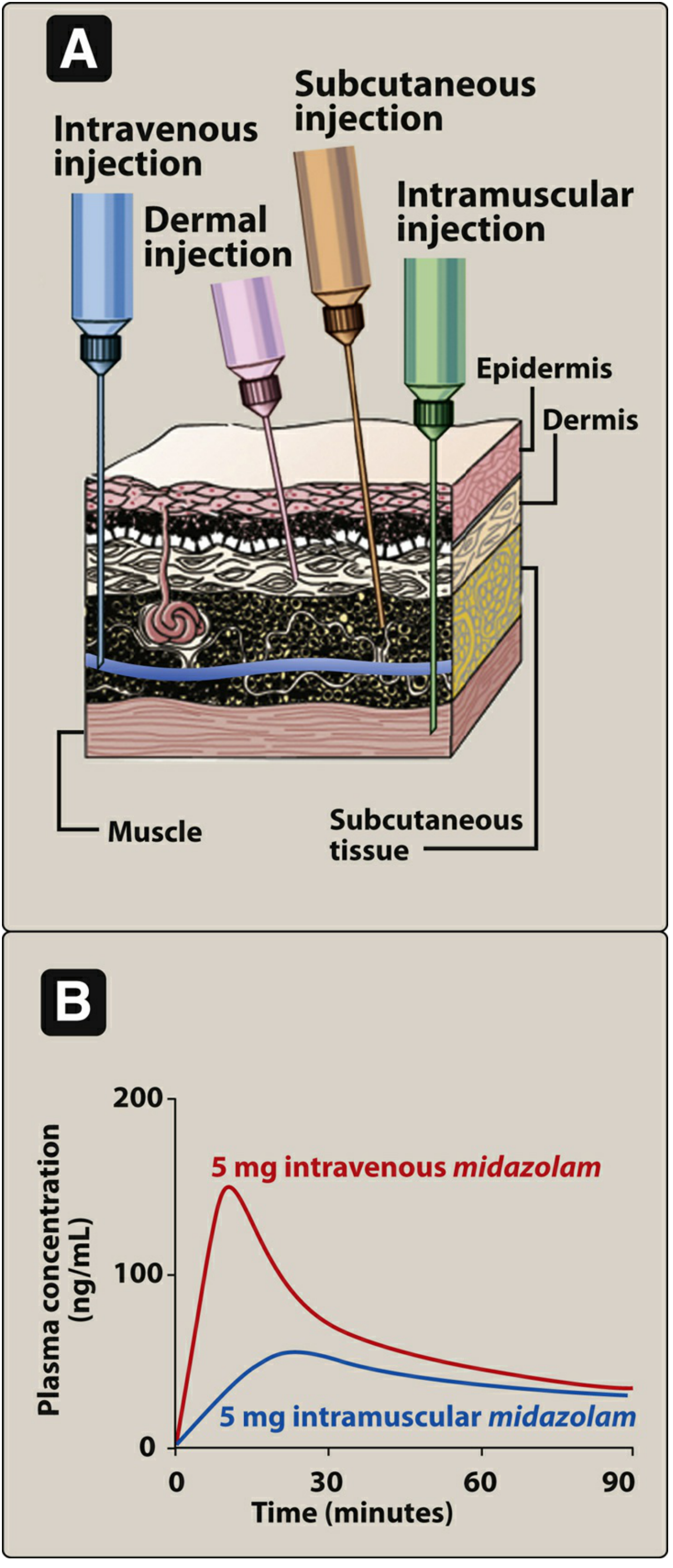
Used when drugs are poorly absorbed from GI tract, destroyed by GI enzymes, or when rapid onset is needed.
| Route | Bioavailability | Speed | Notes |
|---|---|---|---|
| Intravenous (IV) | 100% (by definition) | Most rapid | No absorption step; immediate effect; no first-pass metabolism |
| Intramuscular (IM) | 75 to ≤100% | Rapid | Larger volumes possible; may be painful |
| Subcutaneous (SC) | 75 to ≤100% | Slower than IM | Smaller volumes; good for insulin; avoid irritant drugs |
| Intradermal (ID) | Low, local | Very slow | Used for diagnostic tests, allergy desensitization |
| Intrathecal | Direct CNS delivery | Rapid (CNS) | Bypasses blood-brain barrier; used for spinal anaesthesia |
| Epidural | Local/spinal | Variable | Pain management, obstetric analgesia |
Special parenteral forms:
- Depot injection - Slow-release drug in oil or microparticles (e.g., long-acting antipsychotics, contraceptive implants)
- Liposomal/lipid complex - Drug encapsulated in liposomes for targeted delivery (e.g., liposomal amphotericin B)
3. INHALATION
- Drug delivered as aerosol, gas, dry powder, or nebulised liquid
- Rapid onset (nearly as fast as IV) due to large lung surface area
- Ideal for respiratory conditions (asthma, COPD) - drug acts directly at site of action, minimising systemic side effects
- Bioavailability: 5 to <100%
- Examples: Salbutamol inhaler (MDI), budesonide (DPI), anaesthetic gases (isoflurane, nitrous oxide)
4. TOPICAL & TRANSDERMAL
| Form | Route | Use | Examples |
|---|---|---|---|
| Ointment | Skin (topical) | Local effect; greasy base | Hydrocortisone ointment |
| Cream | Skin (topical) | Local; water-washable | Antifungal cream |
| Lotion | Skin (topical) | Thin application to large areas | Calamine lotion |
| Gel | Skin/mucosa | Local or systemic | Diclofenac gel, testosterone gel |
| Drops | Eye/ear/nose | Local effect | Antibiotic eye drops, nasal decongestants |
| Transdermal patch | Skin (systemic) | Slow, sustained release; avoids first-pass | Fentanyl patch, nicotine patch, GTN patch |
"The rate of absorption [of transdermal drugs] can vary markedly, depending on the physical characteristics of the skin at the site of application, as well as the lipid solubility of the drug." - Lippincott
Transdermal bioavailability: 80 to ≤100%; very slow absorption; prolonged duration of action.
5. NASAL & OCULAR
| Form | Description | Examples |
|---|---|---|
| Nasal spray/drops | Absorbed across nasal mucosa; can be local or systemic | Intranasal corticosteroids, desmopressin |
| Eye drops/ointment | Local ocular effect | Timolol (glaucoma), chloramphenicol eye drops |
Summary Comparison Table
| Dosage Form | Route | Onset | Bioavailability | First-Pass? |
|---|---|---|---|---|
| Tablet (IR) | Oral | 30-60 min | Variable | Yes |
| Enteric-coated tablet | Oral | Delayed | Variable | Yes |
| Extended-release tablet | Oral | Slow/prolonged | Variable | Yes |
| Sublingual tablet | Sublingual | 2-5 min | High | No |
| IV injection | Intravenous | Immediate | 100% | No |
| IM injection | Intramuscular | 10-30 min | 75-100% | No |
| SC injection | Subcutaneous | 15-30 min | 75-100% | No |
| Transdermal patch | Skin | Hours | 80-100% | No |
| Inhaler | Lungs | Minutes | 5-100% | No |
| Suppository | Rectal | 15-30 min | 30-100% | Partial |
Sources: Lippincott Illustrated Reviews: Pharmacology; Katzung's Basic and Clinical Pharmacology (16th ed.); Park's Textbook of Preventive and Social Medicine; Goodman & Gilman's The Pharmacological Basis of Therapeutics
This is a shared conversation. Sign in to Orris to start your own chat.