
Fibroadenoma histology pattern and cytology
I'll read the medical library skill first, then search for fibroadenoma histology and cytology content.
Reading File
Now I'll search the library for fibroadenoma histology and cytology in parallel.
Finding Sources
Finding Sources
The best sources are Robbins (pathology) and Bailey & Love (surgery). Let me read those in parallel, plus search for cytology specifically.
Reading File
Reading File
Finding Sources
Excellent content from Robbins. Let me now read a bit more from Robbins (for the complete morphology/subtypes) and also search specifically for cytology/FNAC patterns.
Reading File
Finding Sources
Finding Sources
Good. Now let me fetch the key histology images from Robbins and do a web search for fibroadenoma cytology FNAC features in parallel.
Loading Image
Searching the Web
fibroadenoma FNAC cytology features pericanalicular intracanalicular histology
I have comprehensive information. Now I can compile a thorough, well-structured answer.
Fibroadenoma - Histology and Cytology
Overview
Fibroadenoma is the most common benign stromal tumor of the female breast and the most common breast lump in women aged 15-25 years. It is a biphasic tumor - it contains both a glandular (epithelial) component and a specialized intralobular stromal component derived from the terminal ductal lobular unit (TDLU).
Molecular basis: Two-thirds harbor driver mutations in MED12 (subunit of the mediator transcriptional complex). Around one-third additionally carry RARA mutations (retinoic acid receptor alpha, an estrogen target gene).
Gross Pathology
- Well-circumscribed, rubbery, gray-white nodule
- Bulges above surrounding tissue on cut section
- Contains slit-like spaces lined by epithelium
- Size ranges from <1 cm to large tumors replacing most of the breast
Histological Patterns
The histology shows two recognized growth patterns, both of no independent clinical significance, and both may coexist in a single lesion:
1. Pericanalicular Pattern
- The intralobular stroma proliferates around the ducts, which retain their round/open lumens
- Ducts are surrounded (but not compressed) by expanded fibromyxoid stroma
- Glandular structures remain patent and circular in cross-section
2. Intracanalicular Pattern
- The proliferating stroma compresses and distorts the ductal elements
- Ducts are squeezed into curved, cleft-like, slit-shaped spaces (antler-horn or staghorn appearance)
- This is the dominant pattern in the classic histology image below
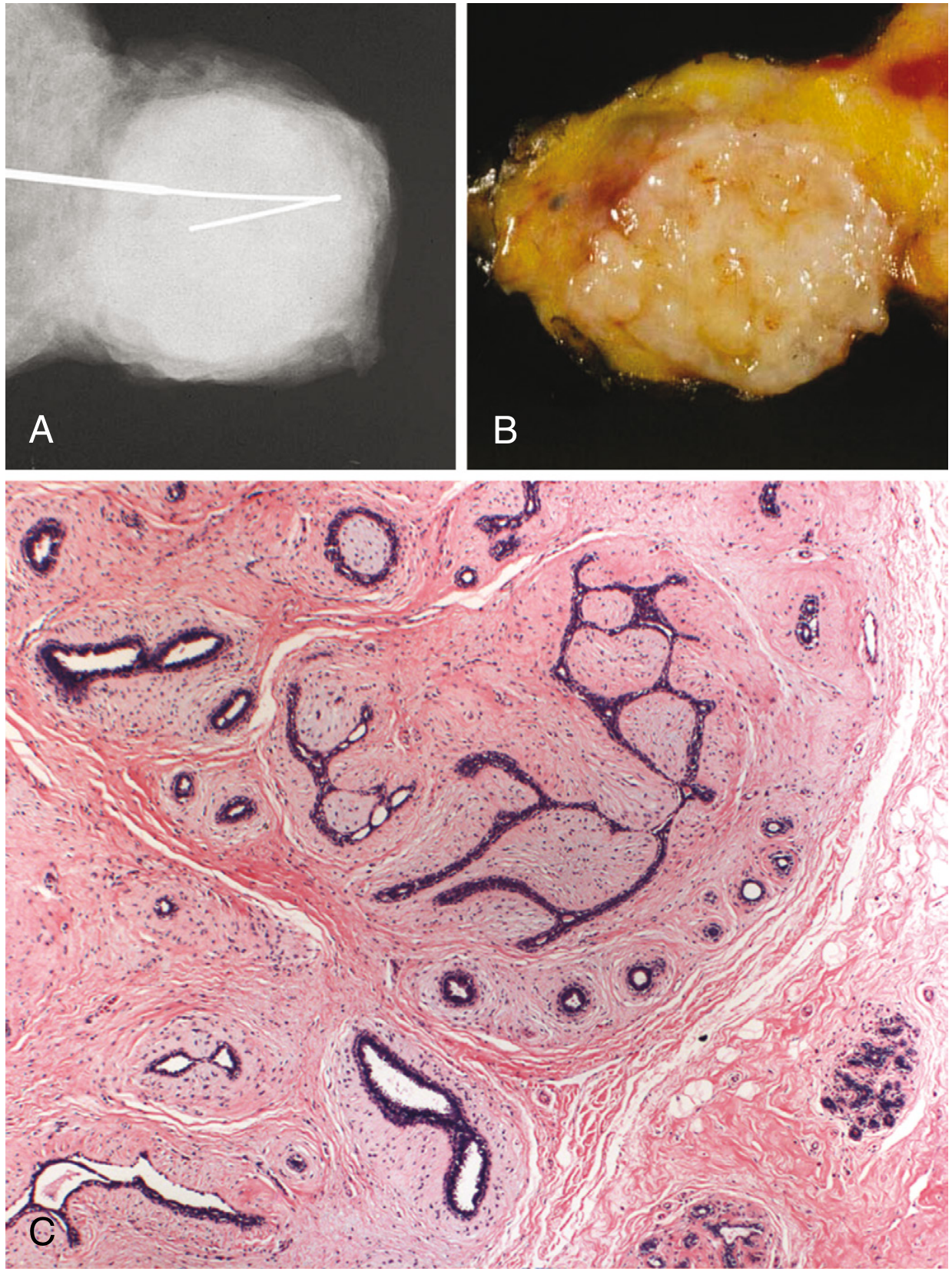
Stromal Features
- Stroma resembles normal intralobular stroma - often loose and myxoid in younger women
- In older women: stroma becomes densely hyalinized/collagenous and epithelium may be atrophic
- Stromal cellularity is generally uniform throughout the lesion (key distinction from phyllodes tumor)
- No significant stromal atypia or mitotic activity (in typical fibroadenoma)
Epithelial Features
- Lined by two cell layers: inner luminal epithelial cells + outer myoepithelial cells (intact myoepithelial layer is preserved)
- Usual-type ductal hyperplasia, apocrine metaplasia, cyst formation, or squamous metaplasia may be associated
- Rare mitotic figures in glandular component have no clinical significance
Subtypes with Special Histological Features
| Subtype | Histological Features | Clinical Notes |
|---|---|---|
| Simple (usual) | Pericanalicular or intracanalicular pattern; myxoid stroma | Most common |
| Complex fibroadenoma | Cysts >3 mm, sclerosing adenosis, epithelial calcifications, or papillary apocrine change | Slightly increased cancer risk (RR ~1.5-2) |
| Myxoid fibroadenoma | Prominent myxoid stroma | Can be sporadic or associated with Carney complex (PRKAR1A mutations) |
| Juvenile fibroadenoma | Increased stromal cellularity, gynecomastoid micropapillary epithelial hyperplasia, pericanalicular pattern | Occurs at puberty; may grow rapidly |
| Giant fibroadenoma | >5 cm | Occurs during puberty; may be enucleated |
| Cellular fibroadenoma | Increased stromal cellularity; overlapping features with phyllodes tumor | Needle biopsy specimens can be diagnostically difficult |
Cytology (FNAC Features)
FNAC of fibroadenoma classically yields a C2 (benign) category smear with the following features:
Smear Characteristics
- Moderately to highly cellular smear
- Biphasic pattern: epithelial clusters + stromal fragments + bare bipolar nuclei
Epithelial Component
- Large, cohesive branching/antler-horn ("staghorn") shaped epithelial sheets - characteristic
- Epithelial cells are large, elongated, and regularly arranged
- Variable nuclear crowding and overlapping within sheets
- Nuclei are mildly enlarged but uniform, with bland granular chromatin and one or two small nucleoli
- Myoepithelial cells are conspicuous within and around epithelial aggregates (key feature for benign diagnosis)
Stromal Component
- Bare bipolar nuclei scattered throughout the background - highly characteristic; these are naked myoepithelial/stromal cell nuclei
- Fragments of fibromyxoid stroma present in most (but not all) cases
- Metachromatic stroma on Giemsa stain
Background
- Clean background (no necrosis, no inflammatory exudate)
- Scattered single cells and bare nuclei
Key Diagnostic Points: Fibroadenoma vs. Phyllodes Tumor (Histology)
| Feature | Fibroadenoma | Phyllodes Tumor |
|---|---|---|
| Stromal cellularity | Uniform, low-moderate | Increased, variable, leaf-like |
| Stromal atypia | None | Present (borderline/malignant) |
| Mitoses (stroma) | Absent or very rare | Present (>4/10 HPF in borderline) |
| Border | Pushing, well-defined | May be infiltrative (malignant) |
| Stromal overgrowth | Absent | May be present |
| Age | 20s-30s | 40s-50s |
Summary of Key Histological Features
- Biphasic tumor - both epithelial and stromal elements
- Two growth patterns: pericanalicular (open ducts) and intracanalicular (compressed slit-like ducts)
- Stroma is myxoid/loose in young; hyalinized in older patients
- Intact two-cell layer (epithelium + myoepithelium) throughout
- No stromal atypia, no significant mitoses
FNAC hallmarks: staghorn epithelial clusters + bare bipolar nuclei in background + fibromyxoid stromal fragments = classic triad of fibroadenoma cytology.
Sources: Robbins, Cotran & Kumar Pathologic Basis of Disease, p. 984; Bailey and Love's Short Practice of Surgery 28th Ed.; Pathology Outlines - Fibroadenoma
This is a shared conversation. Sign in to Orris to start your own chat.