
ivp in detail
Reading File
IVP (Intravenous Pyelogram/Pyelography) is a radiological procedure used to evaluate the urinary tract using IV contrast dye. It assesses kidneys, ureters, and bladder morphology and function.
Searching sources...
Finding Sources
Finding Sources
Searching the Web
intravenous pyelogram IVP procedure radiology detailed
Reading File
Reading File
Finding Sources
Reading File
Reading File
Finding Sources
Finding Sources
Reading Web Page
https://www.ncbi.nlm.nih.gov/books/NBK559034
Reading File
Reading File
Reading File
Loading Image
Reading File
Reading File
Reading File
Finding Sources
I now have comprehensive information from multiple authoritative textbooks. Let me compile the full detailed answer.
Intravenous Pyelogram (IVP) - Comprehensive Overview
Also known as: Intravenous Urography (IVU) / Excretory Urography (EU)
Definition
IVP (Intravenous Pyelogram) is an X-ray-based diagnostic procedure that uses iodinated contrast material injected intravenously to visualize the kidneys, ureters, and urinary bladder. The contrast material is filtered by the glomeruli, concentrated in the tubules, and excreted into the collecting system, opacifying the urinary tract structures on sequential radiographs. This provides both anatomical and functional information simultaneously.
- National Kidney Foundation Primer on Kidney Diseases, 8e
Historical Context
IVP was a mainstay of urological imaging throughout the 20th century. It was the routine imaging choice for neoplasms, ureteral obstruction, anatomical anomalies, and urinary tuberculosis. Over the past few decades, CT, ultrasound, and MRI have largely replaced it. Today, CT urography is preferred because it is faster, more versatile, and offers far superior visualization of the renal parenchyma and adjacent abdominal organs.
- StatPearls; Smith and Tanagho's General Urology
Anatomy Assessed
The IVP evaluates:
- Kidneys - size, shape, position, cortical outline, nephrographic density
- Collecting system - calyces, infundibula, renal pelvis
- Ureters - course, caliber, filling defects, strictures
- Urinary bladder - outline, capacity, filling defects, post-void residual
IVP X-ray - 10-Minute Excretory Phase
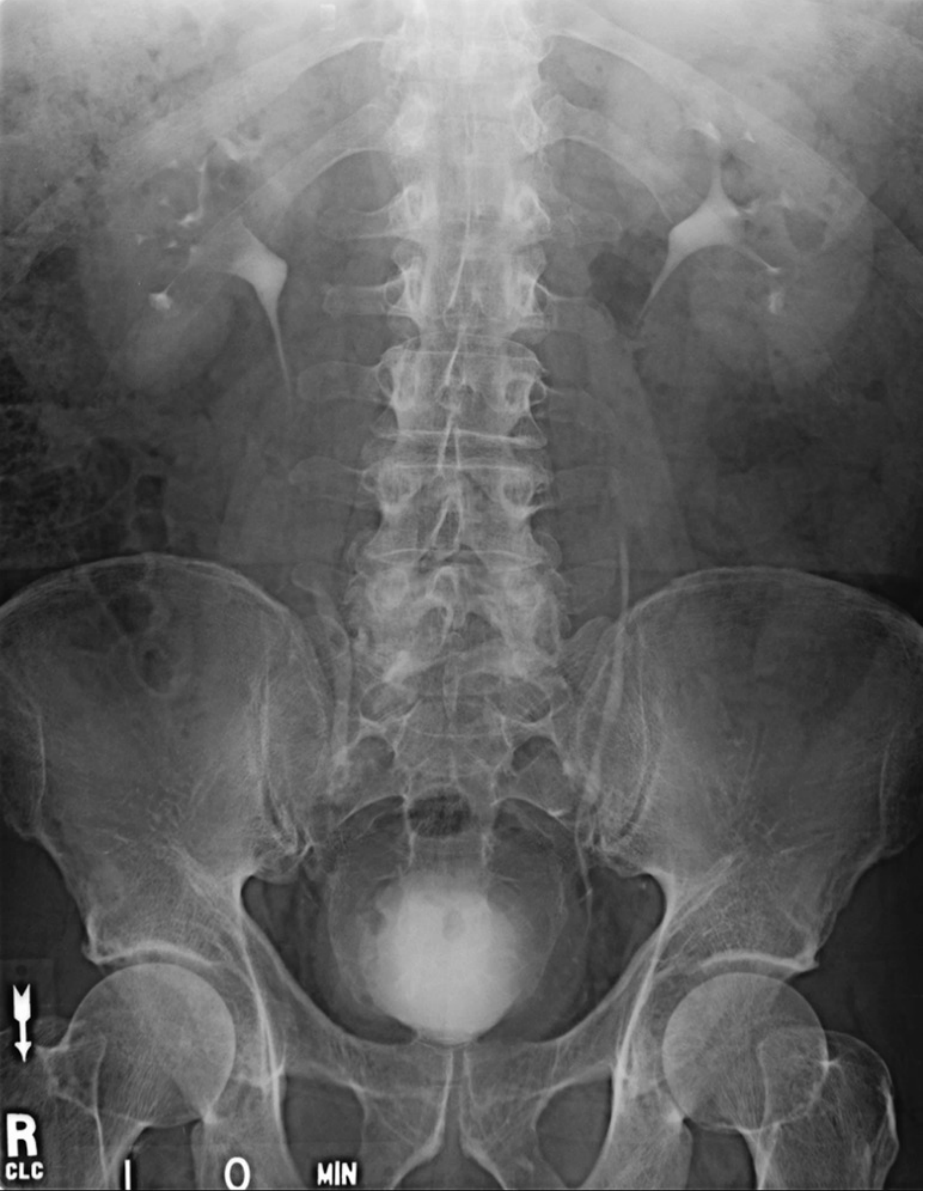
IVU excretory phase image at 10 minutes: contrast outlines the calyces, pelvis, ureters, and bladder (Brenner & Rector's The Kidney)
Indications
- Hematuria (gross or microscopic) - evaluating the source
- Flank or loin pain - suspected ureteral stone or obstruction
- Urinary calculi - especially when dynamic imaging of obstruction is needed; detects radiolucent stones as filling defects (sensitivity ~75%, specificity >90%)
- Congenital anomalies - horseshoe kidney, duplex collecting system, ectopic kidney, UPJ obstruction
- Urothelial tumors - uroepithelial neoplasms of the renal pelvis, ureter, and bladder
- Urinary tuberculosis - characteristic changes (see below)
- Renal scarring and pyelonephritis - papillary necrosis, cortical scarring
- Hydronephrosis and obstruction - when dynamic excretion data is required
- Medullary sponge kidney - characteristic medullary ectasia with staining
- Post-intervention follow-up - after ureteroscopy, nephrolithomy, or pyeloplasty
- Enlarged prostate - bladder indentation, post-void residual
- Urethral/ureteral strictures
- Campbell-Walsh-Wein Urology; Goldman-Cecil Medicine; Smith and Tanagho
Note: IVP remains relevant when CT with contrast is unavailable and when dynamic upper tract excretion/obstruction imaging is specifically needed. More than 70% of urinary stones are radio-opaque, so plain KUB can assist follow-up once a stone is identified.
Patient Preparation
- Bowel preparation: Mild laxative the evening before to reduce overlying bowel gas (controversial; based on preference)
- Fasting: Typically NPO after midnight (reduces bowel gas, but strict dehydration is no longer advocated)
- Avoid dehydration in: infants, elderly, debilitated patients, diabetics, renal failure, multiple myeloma, hyperuricemia (risk of contrast nephropathy)
- Allergy history: Ask specifically about prior reactions to iodinated contrast
- Renal function: Check serum creatinine before contrast administration
- Pregnancy: Contraindicated - radiation and contrast both pose risk
- Metformin: Withhold for 48 hours around iodinated contrast in diabetics with risk of renal impairment
- Smith and Tanagho's General Urology, 19th Edition
Standard Technique - Step-by-Step
Step 1: Scout Film (KUB - Kidneys, Ureters, Bladder)
A preliminary plain abdominal radiograph is taken before contrast injection. This:
- Identifies pre-existing radio-opaque calcifications (renal, ureteral stones, nephrocalcinosis, vascular calcifications)
- Establishes a baseline for comparison
- Shows psoas shadows, renal outlines, and bowel gas pattern
Step 2: Contrast Injection
- Iodinated contrast (ionic or non-ionic) is injected IV, typically into an antecubital vein
- Non-ionic low-osmolar contrast is preferred (fewer reactions)
- The contrast flows through the renal vasculature and is filtered into the collecting system, opacifying it on X-ray
Sensations to warn the patient about: transient flushing, metallic taste, warmth - these are normal
Step 3: Nephrogram Phase (Immediate / 1 min)
- Immediate film (taken right after bolus injection)
- Kidney parenchyma appears densely opaque = "nephrogram"
- Assesses renal size, shape, cortical outline, position
- Both kidneys should appear symmetrically within 1 minute
Step 4: Early Pyelogram Phase (5-10 min)
- Calyces, infundibula, and renal pelvis begin to fill
- Best phase for assessing the collecting system anatomy
- Calyceal details, filling defects, papillary necrosis visible here
- Ureteral peristalsis becomes visible
Step 5: Excretory/Urographic Phase (10-15 min)
- Full visualization of the ureters from renal pelvis to vesicoureteric junction
- Bladder begins to fill
- Oblique films may be taken to profile the ureters away from bony overlap
Step 6: Bladder Phase (15-20 min)
- Full bladder outline assessed
- Indentations (enlarged prostate, pelvic mass, tumor) detected
Step 7: Post-Void Film
- Patient voids, then a final film is taken
- Assesses post-void residual volume
- Detects bladder neck obstruction, residual ureteral contrast, or reflux
Modifications / Special Techniques
| Technique | Use |
|---|---|
| Tomography (nephrotomography) | Clarifies renal outlines obscured by bowel gas or bone |
| Ureteral compression device | Improves filling of collecting system by temporarily obstructing ureters |
| Delayed films (hours later) | Pinpoints level of obstruction when contrast excretion is slow |
| Prone positioning | Facilitates contrast flow in the sacral ureter during obstruction |
| Oblique views | Confirms position of calcifications, profiles ureters |
- Smith and Tanagho's General Urology; Brenner and Rector's The Kidney
Radiographic Interpretation - Systematic Assessment
Kidneys
- Size: Normal adult kidney = 11-14 cm pole-to-pole; each should be within 1.5 cm of the other
- Position: Upper pole at T12, lower pole at L3
- Outline: Smooth contour; lobulated (fetal lobulation) vs. scar indentation
- Nephrogram density: Symmetric and dense; asymmetry may indicate reduced function on one side
Collecting System
- Calyces: Sharp, cupped; blunting = early obstruction; clubbing = established hydronephrosis
- Papillary necrosis: "Signed ring" or "lobster claw" appearance at papillary tips
- Filling defects: Blood clot, tumor, radiolucent stone, fungal ball
Ureters
- Caliber: Should not exceed 5 mm (up to 7 mm at UVJ)
- Course: Medial deviation (retroperitoneal fibrosis), lateral deviation (lymph node mass)
- Filling defects: Stone, tumor, blood clot
- Stricture: Smooth tapered narrowing vs. irregular (malignancy)
Bladder
- Outline: Smooth, round; asymmetric indentation = prostatic impression, pelvic mass
- Filling defect: Tumor, stone, blood clot
- "Christmas tree" bladder: Neurogenic bladder
IVP Findings in Specific Conditions
Urinary Tuberculosis (classic IVP findings)
(from Comprehensive Clinical Nephrology, 7th Ed.)
- Minimal calyceal dilation and loss of sharpness (early change)
- Irregular, "moth-eaten" calyx
- Calyceal erosion and "phantom calyx"
- Upward-pointing "hiked-up" pelvis
- Kerr's kink sign - kinking of renal pelvis
- Corkscrew ureter - areas of stricture and dilation
- Pipestem ureter - diffusely thickened
- Distal ureteric narrowing at ureterovesical junction
- Thimble bladder - small capacity, thick-walled
Urinary Calculi
- Radio-opaque stones: calcium oxalate, calcium phosphate, struvite (magnesium ammonium phosphate), cystine
- Radiolucent stones: uric acid, xanthine, triamterene - seen as filling defects on IVP
- IVP sensitivity ~75%, specificity >90% for calculi
- Obstructing stones: delayed nephrogram, dilated collecting system proximal to stone
Renal Obstruction
- Delayed or dense nephrogram persisting >5 min = obstruction
- Dilated calyces and pelvis proximal to point of obstruction
- "Standing column" of contrast in ureter = no peristalsis = obstruction
Papillary Necrosis
- Ring shadow around necrotic papilla ("lobster claw" sign)
- Sloughed papilla = triangular filling defect in calyx
Medullary Sponge Kidney
- Linear "paintbrush" striations in the medullary pyramids
- Medullary calcifications clustered around calyces
Hydronephrosis
- Dilated calyces, pelvis, and ureter
- Cortical thinning with severe longstanding obstruction
Contraindications
| Type | Details |
|---|---|
| Absolute | Prior severe anaphylactic reaction to iodinated contrast; significant renal impairment (risk of contrast nephropathy) |
| Relative | Pregnancy, asthma, cardiac failure, multiple myeloma, sickle cell disease, dehydration, metformin use (hold 48 h before/after) |
Complications
-
Contrast reactions:
- Mild: urticaria, nausea, vomiting, flushing, metallic taste (most common)
- Moderate: bronchospasm, facial edema, hypertension/hypotension
- Severe: anaphylactic shock (rare, ~1 in 10,000-40,000)
- Pre-medication for known mild reactions: oral corticosteroid + antihistamine 12-13 hours before
-
Contrast nephropathy: Transient or permanent AKI, especially in pre-existing CKD, diabetes, dehydration
-
Extravasation: Local tissue irritation at injection site
-
Radiation exposure: More than a plain radiograph, less than a standard CT scan
IVP vs. Modern Alternatives
| Feature | IVP | Non-contrast CT | CT Urography | Ultrasound |
|---|---|---|---|---|
| Stone detection | 75% sensitivity | Gold standard | Excellent | Good (renal; poor ureter) |
| Renal function info | Yes (qualitative) | No | Yes | No |
| Soft tissue detail | Poor | Good | Excellent | Good |
| Radiation | Moderate | Low (low-dose protocol) | Higher | None |
| Contrast needed | Yes | No | Yes | No |
| Speed | Slow (45-60 min) | Fast | Moderate | Fast |
| Dynamic obstruction | Yes | No | Yes | Limited |
Current status: IVP has been largely replaced by CT urography for most indications. However, it retains value when:
- CT is unavailable or the patient cannot have CT contrast
- Dynamic excretion/obstruction imaging is specifically required
- Demonstrating small lesions: papillary necrosis, medullary sponge kidney, pyeloureteritis cystica, small urothelial tumors
- Resource-limited settings for urinary stones and TB (widely available, lower cost, lower radiation than CT)
- Campbell-Walsh-Wein Urology; Goldman-Cecil Medicine; Bailey and Love's Surgery
Summary
IVP remains a clinically relevant study despite being largely supplanted by CT. It provides simultaneous anatomic and functional assessment of the entire urinary tract in a single relatively simple examination. Its key advantage over non-contrast CT is the ability to demonstrate real-time excretion and obstruction dynamics. Its main limitations are radiation exposure, the requirement for iodinated contrast with associated risk, and inferior soft-tissue resolution compared to CT or MRI. Clinicians should understand its interpretation patterns - particularly for urinary TB, obstruction, and stone disease - as it continues to appear in resource-limited settings and in certain clinical scenarios where dynamic functional imaging is preferred.
This is a shared conversation. Sign in to Orris to start your own chat.