
Make presentation on syncope definition, pathophysiology,how it happens with detail information as well as diagnostic test and treatment and same with seizures and there co relation with each other there should be more text in the presentation with pictures according to emergency book
syncope pathophysiology vasovagal reflex mechanism
seizure classification types tonic clonic EEG brain activity
syncope vs seizure differential diagnosis comparison emergency
mkdir -p /home/daytona/workspace/syncope-seizure-pptx && ls /home/daytona/workspace/syncope-seizure-pptx/
~/syncope-seizure-pptx/build.js
const pptxgen = require("pptxgenjs");
const { execSync } = require("child_process");

// Fetch images as base64
const imageUrls = [
  "https://cdn.orris.care/cdss_images/d6ae0d5d0adadbdf1f5e1862c09b9b17713cecd2d6b3525a54241b52d2e0c413.png",  // Baroreflex diagram
  "https://cdn.orris.care/cdss_images/HARRISON_1763035824248_9e6b1553-b433-4a26-b061-97e0b5678ae8.png",  // Syncope causes table
  "https://cdn.orris.care/cdss_images/GLGCA_2899494_1763375738425_85ec7abc-6a5c-4a07-8742-99036dd2de9c.png",  // Syncope diagnostic flowchart
  "https://cdn.orris.care/cdss_images/pmc_clinical_VQA_c59061fcf0e36458ddfbcd323c3007eee515437c80a31825bd34794cc7e829e3.jpg",  // Seizure EEG GTCS
  "https://cdn.orris.care/cdss_images/pmc_clinical_VQA_9d9a55357635c89220a128b618d19d6931aee4a34d6571315715a2a78b0bf8fa.jpg",  // Ictal EEG focal
  "https://cdn.orris.care/cdss_images/HARRISON_1763032165161_b66e77b1-caba-47fc-aed1-40ddb7519e7c.png",  // Differential diagnosis table
  "https://cdn.orris.care/cdss_images/a5f72d0da35161a48c8c73a4670723beb69a4d32943f9121b6913b8be0be9976.png",  // Seizure evaluation flowchart
  "https://cdn.orris.care/cdss_images/pmc_clinical_VQA_a49c8aeb4b95f86fabb8ca9a727201730c57db6db5cfdc8828d8c9d391a3bf39.jpg",  // Brain scan vasovagal
];

console.log("Fetching images...");
let images;
try {
  const result = execSync(
    `node /home/daytona/skills/shared/scripts/fetch_images.js ${imageUrls.map(u => `"${u}"`).join(" ")}`,
    { maxBuffer: 50 * 1024 * 1024, timeout: 60000 }
  ).toString();
  images = JSON.parse(result);
} catch(e) {
  console.error("Image fetch error:", e.message);
  images = imageUrls.map(u => ({ url: u, base64: null, error: e.message }));
}

console.log("Images fetched:", images.map((img, i) => `${i}: ${img.error ? 'FAIL' : 'OK'}`).join(", "));

// Color palette - deep navy blue dominant, red accent (emergency medicine feel)
const NAVY    = "0A1628";
const NAVY2   = "0D1F3C";
const BLUE    = "1A3A6B";
const ACCENT  = "E63946";  // red accent
const TEAL    = "2EC4B6";
const LIGHT   = "EFF2F7";
const WHITE   = "FFFFFF";
const LGRAY   = "B0B8C8";
const YELLOW  = "F4C430";
const ORANGE  = "FF6B35";

let pres = new pptxgen();
pres.layout = "LAYOUT_WIDE";
pres.author = "Emergency Medicine";
pres.title = "Syncope & Seizures: Emergency Medicine";

// ─────────────────────────────────────────────
// Slide 1 — Title
// ─────────────────────────────────────────────
{
  let s = pres.addSlide();
  s.addShape(pres.ShapeType.rect, { x: 0, y: 0, w: 13.3, h: 7.5, fill: { color: NAVY } });
  // Red accent bar
  s.addShape(pres.ShapeType.rect, { x: 0, y: 0, w: 0.18, h: 7.5, fill: { color: ACCENT } });
  // Right accent
  s.addShape(pres.ShapeType.rect, { x: 9.2, y: 2.0, w: 3.8, h: 3.5, fill: { color: BLUE }, line: { color: TEAL, width: 2 } });

  s.addText("SYNCOPE &", { x: 0.5, y: 0.8, w: 8.5, h: 1.0, fontSize: 52, bold: true, color: WHITE, fontFace: "Calibri", charSpacing: 4 });
  s.addText("SEIZURES", { x: 0.5, y: 1.7, w: 8.5, h: 1.0, fontSize: 52, bold: true, color: ACCENT, fontFace: "Calibri", charSpacing: 4 });
  s.addText("Emergency Medicine", { x: 0.5, y: 2.75, w: 8.5, h: 0.5, fontSize: 22, color: TEAL, fontFace: "Calibri", italic: true });
  s.addText("Definition • Pathophysiology • Diagnosis • Treatment • Correlation", {
    x: 0.5, y: 3.3, w: 8.5, h: 0.5, fontSize: 15, color: LGRAY, fontFace: "Calibri"
  });

  s.addText([
    { text: "Based on:", options: { bold: true, color: YELLOW, breakLine: true } },
    { text: "• Rosen's Emergency Medicine, 9th Edition", options: { breakLine: true } },
    { text: "• Tintinalli's Emergency Medicine", options: { breakLine: true } },
    { text: "• Harrison's Principles of Internal Medicine 22E", options: { breakLine: true } },
    { text: "• Bradley & Daroff's Neurology in Clinical Practice", options: {} },
  ], { x: 9.4, y: 2.15, w: 3.5, h: 3.1, fontSize: 10.5, color: LGRAY, fontFace: "Calibri", valign: "top" });

  s.addText("Emergency Medicine Presentation | 2026", { x: 0.5, y: 6.9, w: 12.3, h: 0.4, fontSize: 10, color: LGRAY, align: "right" });
}

// Helper: section title slide
function addSectionSlide(pres, title, subtitle, color1) {
  let s = pres.addSlide();
  s.addShape(pres.ShapeType.rect, { x: 0, y: 0, w: 13.3, h: 7.5, fill: { color: NAVY2 } });
  s.addShape(pres.ShapeType.rect, { x: 0, y: 2.8, w: 13.3, h: 1.9, fill: { color: color1 } });
  s.addShape(pres.ShapeType.rect, { x: 0, y: 0, w: 13.3, h: 0.12, fill: { color: TEAL } });
  s.addText(title, { x: 0.5, y: 3.0, w: 12.3, h: 1.5, fontSize: 44, bold: true, color: WHITE, fontFace: "Calibri", align: "center", valign: "middle" });
  if (subtitle) {
    s.addText(subtitle, { x: 0.5, y: 4.6, w: 12.3, h: 0.6, fontSize: 18, color: TEAL, fontFace: "Calibri", align: "center", italic: true });
  }
  return s;
}

// Helper: content slide with left text, right image
function addContentImageSlide(pres, title, bullets, imgBase64, imgCaption) {
  let s = pres.addSlide();
  s.addShape(pres.ShapeType.rect, { x: 0, y: 0, w: 13.3, h: 7.5, fill: { color: NAVY } });
  // Header bar
  s.addShape(pres.ShapeType.rect, { x: 0, y: 0, w: 13.3, h: 0.85, fill: { color: BLUE } });
  s.addShape(pres.ShapeType.rect, { x: 0, y: 0, w: 0.18, h: 7.5, fill: { color: ACCENT } });
  s.addText(title, { x: 0.4, y: 0.1, w: 12.5, h: 0.65, fontSize: 22, bold: true, color: WHITE, fontFace: "Calibri", valign: "middle" });

  // Left text panel
  const textItems = bullets.map((b, i) => {
    if (b.startsWith("##")) {
      return { text: b.replace("## ", ""), options: { bold: true, color: TEAL, fontSize: 13, bullet: false, breakLine: true } };
    } else if (b.startsWith("--")) {
      return { text: "  " + b.replace("-- ", ""), options: { color: LGRAY, fontSize: 11, bullet: { code: "25E6", color: TEAL }, indent: 0.2, breakLine: true } };
    } else {
      return { text: b, options: { color: LIGHT, fontSize: 12, bullet: { code: "25A0", color: ACCENT }, breakLine: true } };
    }
  });
  s.addText(textItems, { x: 0.35, y: 1.0, w: 7.0, h: 6.2, fontFace: "Calibri", valign: "top" });

  // Right image panel
  if (imgBase64) {
    s.addShape(pres.ShapeType.rect, { x: 7.6, y: 0.95, w: 5.45, h: 5.6, fill: { color: NAVY2 }, line: { color: TEAL, width: 1.5 } });
    s.addImage({ data: imgBase64, x: 7.7, y: 1.05, w: 5.25, h: 5.0 });
    if (imgCaption) {
      s.addText(imgCaption, { x: 7.6, y: 6.1, w: 5.45, h: 0.45, fontSize: 9, color: LGRAY, align: "center", italic: true, fontFace: "Calibri" });
    }
  }
  s.addText("Emergency Medicine | Syncope & Seizures", { x: 0.3, y: 7.2, w: 12.7, h: 0.25, fontSize: 8, color: LGRAY, align: "right" });
  return s;
}

// Helper: full-width text slide (no image)
function addTextSlide(pres, title, columns) {
  let s = pres.addSlide();
  s.addShape(pres.ShapeType.rect, { x: 0, y: 0, w: 13.3, h: 7.5, fill: { color: NAVY } });
  s.addShape(pres.ShapeType.rect, { x: 0, y: 0, w: 13.3, h: 0.85, fill: { color: BLUE } });
  s.addShape(pres.ShapeType.rect, { x: 0, y: 0, w: 0.18, h: 7.5, fill: { color: ACCENT } });
  s.addText(title, { x: 0.4, y: 0.1, w: 12.5, h: 0.65, fontSize: 22, bold: true, color: WHITE, fontFace: "Calibri", valign: "middle" });

  const colW = columns.length === 1 ? 12.6 : (12.3 / columns.length);
  columns.forEach((col, ci) => {
    const xPos = 0.35 + ci * (colW + 0.15);
    if (col.header) {
      s.addShape(pres.ShapeType.rect, { x: xPos, y: 0.95, w: colW, h: 0.38, fill: { color: BLUE }, line: { color: TEAL, width: 1 } });
      s.addText(col.header, { x: xPos, y: 0.97, w: colW, h: 0.35, fontSize: 13, bold: true, color: YELLOW, align: "center", fontFace: "Calibri" });
    }
    const textItems = col.items.map(b => {
      if (b.startsWith("##")) {
        return { text: b.replace("## ", ""), options: { bold: true, color: TEAL, fontSize: 12, bullet: false, breakLine: true } };
      } else if (b.startsWith("--")) {
        return { text: "  " + b.replace("-- ", ""), options: { color: LGRAY, fontSize: 10.5, bullet: { code: "25E6", color: ORANGE }, indent: 0.15, breakLine: true } };
      } else {
        return { text: b, options: { color: LIGHT, fontSize: 11.5, bullet: { code: "25A0", color: ACCENT }, breakLine: true } };
      }
    });
    const yStart = col.header ? 1.4 : 1.0;
    s.addText(textItems, { x: xPos, y: yStart, w: colW, h: 5.8, fontFace: "Calibri", valign: "top" });
  });
  s.addText("Emergency Medicine | Syncope & Seizures", { x: 0.3, y: 7.2, w: 12.7, h: 0.25, fontSize: 8, color: LGRAY, align: "right" });
  return s;
}

// ─────────────────────────────────────────────
// SECTION 1: SYNCOPE
// ─────────────────────────────────────────────
addSectionSlide(pres, "PART I: SYNCOPE", "Definition · Pathophysiology · Classification · Diagnosis · Treatment", BLUE);

// Slide: Syncope Definition
addContentImageSlide(pres,
  "Syncope — Definition & Epidemiology",
  [
    "## DEFINITION",
    "Syncope is the abrupt, transient loss of consciousness (TLOC) and postural tone resulting from transient global cerebral hypoperfusion, followed by complete spontaneous recovery without any intervention.",
    "The onset is rapid, duration is brief (seconds to <5 min), and recovery is complete and spontaneous.",
    "## KEY DISTINGUISHING FEATURES",
    "Self-limited: recovery is spontaneous, not requiring external resuscitation",
    "Global cerebral hypoperfusion: must involve ALL of the cerebral hemispheres simultaneously",
    "No postictal confusion (unlike seizure) — patient rapidly returns to baseline",
    "## EPIDEMIOLOGY",
    "Syncope accounts for ~1-3% of all Emergency Department visits and up to 6% of hospital admissions",
    "Lifetime prevalence: up to 35% of the general population experience at least one syncopal episode",
    "Peaks occur in adolescents (vasovagal) and again in adults >70 years (orthostatic, cardiac)",
    "1% to 3% of pediatric emergency visits are for syncope; ~80% of pediatric fainting is neurocardiogenic",
    "## PROGNOSIS",
    "Non-cardiac syncope in young patients: excellent prognosis, normal life expectancy",
    "Cardiac syncope: associated with increased risk of sudden cardiac death — requires urgent workup",
  ],
  images[0] ? images[0].base64 : null,
  "Baroreflex pathway — Harrison's Internal Medicine"
);

// Slide: Syncope Pathophysiology
addContentImageSlide(pres,
  "Syncope — Pathophysiology",
  [
    "## CORE MECHANISM",
    "Standing results in pooling of 500–1000 mL of blood in the lower extremities, buttocks, and splanchnic circulation — reducing venous return, cardiac output, and blood pressure.",
    "Baroreceptors in the carotid sinus and aortic arch detect the fall → trigger compensatory ↑ sympathetic outflow + ↓ vagal activity.",
    "## CEREBRAL HYPOPERFUSION THRESHOLD",
    "Cerebral blood flow: 50–60 mL/min per 100 g of brain tissue normally",
    "Syncope occurs when CBF drops below ~30 mL/min per 100 g — the autoregulatory threshold",
    "Autoregulation has a 5-10 second latency — transient falls can cause syncope before adaptation",
    "## EEG CHANGES IN SYNCOPE",
    "'Slow-flat-slow' pattern: normal background → high-amplitude delta waves → sudden EEG flattening → return of slow waves → normal (marker of severe hypoperfusion)",
    "'Slow pattern': increasing/decreasing slow wave activity only (less severe).",
    "Despite myoclonic movements during syncope, NO EEG seizure discharges are detected — key distinguishing feature!",
    "## AUTOREGULATION FAILURE",
    "Myogenic factors, local metabolites, and autonomic neurovascular control maintain autoregulation",
    "Hypocarbia (from hyperventilation) → cerebral vasoconstriction → contributes to syncope",
    "Raised intrathoracic pressure → impairs venous return → situational syncopes (cough, valsalva)",
  ],
  images[7] ? images[7].base64 : null,
  "Brain MRI changes in vasovagal syncope — autonomic control centers (NTS, PAG)"
);

// Slide: Syncope Classification
addTextSlide(pres,
  "Syncope — Classification",
  [
    {
      header: "A. NEURALLY MEDIATED (REFLEX)",
      items: [
        "## Vasovagal (Common Faint)",
        "Most common type — triggered by emotion, pain, orthostatic stress, sight of blood",
        "Mechanism: parasympathetic ↑ + sympathoinhibition → bradycardia + vasodilation",
        "## Situational Reflex Syncope",
        "-- Pulmonary: cough syncope, Valsalva, weightlifter's syncope",
        "-- Urogenital: postmicturition, urogenital tract instrumentation",
        "-- Gastrointestinal: swallow, defecation, glossopharyngeal neuralgia",
        "-- Cardiac: Bezold-Jarisch reflex, outflow obstruction",
        "## Carotid Sinus Syndrome",
        "Pressure on neck → carotid sinus hypersensitivity → syncope",
        "## POTS (Postural Orthostatic Tachycardia)",
        "↑HR >30 bpm with standing; cerebral hypoperfusion without severe hypotension",
      ]
    },
    {
      header: "B. ORTHOSTATIC HYPOTENSION",
      items: [
        "BP drop: >20 mmHg systolic or >10 mmHg diastolic on standing",
        "## Primary Autonomic Failure",
        "-- Parkinson's disease, Lewy body dementia",
        "-- Multiple system atrophy (Shy-Drager syndrome)",
        "-- Pure autonomic failure",
        "## Secondary Autonomic Failure",
        "-- Diabetic neuropathy, amyloid neuropathy",
        "-- HIV neuropathy, Sjögren's syndrome",
        "-- Drug-induced (antihypertensives, alpha-blockers, diuretics)",
        "## Volume Depletion",
        "Hemorrhage, dehydration, Addison's disease",
      ]
    },
    {
      header: "C. CARDIAC SYNCOPE",
      items: [
        "## Arrhythmias (Most dangerous!)",
        "-- Sinus node dysfunction, AV block",
        "-- Supraventricular and ventricular tachycardia",
        "-- Inherited channelopathies (Long QT, Brugada)",
        "## Structural Heart Disease",
        "-- Valvular disease (aortic stenosis)",
        "-- Myocardial ischemia/infarction",
        "-- Hypertrophic obstructive cardiomyopathy (HOCM)",
        "-- Atrial myxoma, pericardial tamponade",
        "## Risk in Elderly",
        "Almost half of elderly with syncope have cardiac etiology",
        "Dysrhythmias, valvular disease, ACS, aortic dissection",
        "Polypharmacy is a major contributor in this age group",
      ]
    },
  ]
);

// Slide: Syncope Clinical Features
addTextSlide(pres,
  "Syncope — Clinical Features & Prodrome",
  [
    {
      header: "PREMONITORY SYMPTOMS (PRODROME)",
      items: [
        "Vasovagal syncope typically has a recognizable prodrome lasting seconds to minutes",
        "## Autonomic Prodromal Features",
        "-- Diaphoresis (sweating), pallor, feeling of warmth or cold",
        "-- Nausea, vomiting, abdominal discomfort",
        "-- Palpitations, hyperventilation, yawning",
        "-- Visual dimming, tunnel vision, graying of vision",
        "-- Lightheadedness, dizziness, weakness in limbs",
        "## During the Event",
        "Eyes typically remain OPEN and deviate upward",
        "Pupils usually dilated; roving eye movements may occur",
        "Myoclonic jerks (arrhythmic, multifocal) may occur — can mimic seizure",
        "Grunting, moaning, stertorous breathing may be present",
        "Urinary incontinence may occur; fecal incontinence very rare",
        "## After the Event (Postictal Phase)",
        "Recovery of consciousness is rapid — typically seconds to 1-2 minutes",
        "Confusion is rare (unlike seizure where postictal confusion is hallmark)",
        "Residual nausea, fatigue, and pallor may last for several hours",
        "Visual/auditory hallucinations and 'near-death' experiences occasionally reported",
      ]
    },
    {
      header: "RED FLAGS — HIGH RISK FEATURES",
      items: [
        "## Cardiac Warning Signs",
        "-- Syncope during exertion or exercise",
        "-- Syncope in supine position (highly suspicious for arrhythmia)",
        "-- Palpitations immediately preceding syncope",
        "-- Family history of sudden cardiac death",
        "-- Known structural heart disease",
        "## ECG Red Flags",
        "-- Prolonged QT >500 ms (Long QT syndrome)",
        "-- Brugada pattern (coved ST in V1-V3)",
        "-- Pre-excitation (WPW) pattern",
        "-- New bundle branch block; bi/trifascicular block",
        "-- Nonsustained ventricular tachycardia",
        "-- Persistent sinus bradycardia; repetitive SA block",
        "## Other High-Risk Features",
        "-- Age >45 years with new syncope",
        "-- Moderate-severe valvular disease",
        "-- No prodrome (sudden loss of consciousness)",
        "-- Syncope with chest pain (consider ACS, dissection)",
      ]
    },
  ]
);

// Slide: Syncope Diagnostic Tests
addContentImageSlide(pres,
  "Syncope — Diagnostic Evaluation",
  [
    "## INITIAL EVALUATION (ALL PATIENTS)",
    "Detailed history including prodrome, position, triggers, witnesses — most valuable diagnostic tool",
    "Physical examination: vitals, orthostatic BP measurement (lying, sitting, standing at 1 and 3 min)",
    "12-Lead ECG: mandatory in ALL patients with syncope",
    "Targeted blood tests: glucose (r/o hypoglycemia), CBC, BMP, troponin if cardiac suspected",
    "## ECG FINDINGS TO IDENTIFY",
    "QTc prolongation, Brugada pattern, delta waves (WPW), ischemia, arrhythmias, AV blocks",
    "## ECHOCARDIOGRAM",
    "Indicated when structural heart disease is suspected; evaluates valvular disease, EF, HOCM",
    "## TILT-TABLE TESTING",
    "Gold standard for diagnosing vasovagal/neurocardiogenic syncope",
    "Patient tilted 60-80° for 20-45 min; positive if syncope reproduced with hemodynamic changes",
    "## HOLTER / LONG-TERM CARDIAC MONITORING",
    "24-48 hour Holter if arrhythmia suspected; implantable loop recorder for recurrent unexplained syncope",
    "## CAROTID SINUS MASSAGE",
    "Performed under monitored conditions; positive if ≥3 sec asystole or >50 mmHg BP drop",
    "## CT/MRI BRAIN",
    "NOT routinely indicated; only if focal neurological deficit, head trauma, or seizure suspected",
    "## EEG",
    "Only if seizure is the primary differential; not useful for syncope evaluation alone",
  ],
  images[2] ? images[2].base64 : null,
  "Syncope diagnostic flowchart — stepwise evidence-based approach"
);

// Slide: Syncope Treatment
addTextSlide(pres,
  "Syncope — Treatment & Management",
  [
    {
      header: "NEURALLY MEDIATED SYNCOPE",
      items: [
        "## Lifestyle & Non-Pharmacological (First-Line)",
        "Patient education: recognize prodrome, avoid triggers (prolonged standing, heat, dehydration)",
        "Physical counterpressure maneuvers: leg crossing, abdominal tensing, handgrip + arm tensing — raise BP by increasing central blood volume and cardiac output",
        "Isometric counterpressure most effective when prodrome is recognized early — can abort episodes",
        "Adequate salt and fluid intake to expand plasma volume (2-3L fluid/day, extra salt unless contraindicated)",
        "Elevation of head of bed 10-20° (reduces nocturnal diuresis)",
        "## Pharmacological Treatment",
        "Midodrine (alpha-1 agonist): only agent proven in international multicenter RCTs; 2.5-10 mg TID",
        "Fludrocortisone: mineralocorticoid; increases plasma volume; 0.1-0.2 mg/day",
        "Beta-blockers: widely used by experts; evidence mixed; consider in high-HR patients",
        "## Pacing (Selected Patients Only)",
        "Dual-chamber pacemaker with closed-loop stimulation: proven in sham-controlled RCTs for cardioinhibitory syncope in patients >40 years with frequent recurrence",
      ]
    },
    {
      header: "CARDIAC & ORTHOSTATIC SYNCOPE",
      items: [
        "## Cardiac Arrhythmias",
        "Bradyarrhythmias: permanent pacemaker implantation",
        "Tachyarrhythmias: antiarrhythmic drugs, catheter ablation, or ICD",
        "Channelopathies (Long QT, Brugada): ICD, avoid QT-prolonging drugs",
        "## Structural Heart Disease",
        "Aortic stenosis: surgical valve replacement or TAVR",
        "HOCM: septal myomectomy, ethanol ablation, or ICD",
        "## Orthostatic Hypotension",
        "Identify and discontinue offending medications",
        "Compression stockings; abdominal binders; increased fluid/salt",
        "Midodrine: 2.5-10 mg TID; Droxidopa: for neurogenic OH",
        "Pyridostigmine: modest benefit in neurogenic OH",
        "## In the Emergency Department",
        "IV fluid bolus if volume depleted",
        "Cardiac monitoring and telemetry for high-risk patients",
        "Hospitalize per San Francisco Syncope Rule: abnormal ECG, dyspnea, Hct <30%, SBP <90, history of CHF",
        "Elderly patients with syncope and fall: imaging to r/o head trauma before discharge",
      ]
    },
  ]
);

// ─────────────────────────────────────────────
// SECTION 2: SEIZURES
// ─────────────────────────────────────────────
addSectionSlide(pres, "PART II: SEIZURES", "Definition · Pathophysiology · Classification · Diagnosis · Treatment", ACCENT);

// Slide: Seizure Definition
addTextSlide(pres,
  "Seizures — Definition & Pathophysiology",
  [
    {
      header: "DEFINITION",
      items: [
        "A seizure is a transient occurrence of signs and/or symptoms due to abnormal, excessive, or synchronous neuronal activity in the brain.",
        "Epilepsy: ≥2 unprovoked seizures occurring >24 hours apart, OR one unprovoked seizure with ≥60% risk of recurrence, OR a diagnosed epilepsy syndrome",
        "## Key Characteristics",
        "Ictal phase: the seizure itself — can be seconds to minutes",
        "Postictal phase: period after seizure — characterized by confusion, fatigue, focal weakness (Todd's paralysis) — lasting minutes to hours (key distinguishing feature from syncope!)",
        "Aura: subjective warning before seizure — actually a simple focal seizure itself",
        "Status epilepticus: seizure lasting >5 min OR two or more seizures without full recovery",
        "## Precipitating Factors",
        "-- Sleep deprivation, metabolic derangements (hyponatremia, hypoglycemia, hypocalcemia)",
        "-- CNS infection (meningitis, encephalitis), head trauma, stroke, tumor",
        "-- Drugs that lower seizure threshold (cocaine, tramadol, bupropion, isoniazid)",
        "-- Alcohol withdrawal (classic cause of new-onset seizures in ED)",
        "-- Fever (especially in children — febrile seizures)",
        "## Neurobiology of Seizures",
        "Imbalance between EXCITATORY (glutamate) and INHIBITORY (GABA) neurotransmission",
        "Abnormal synchronization of large neuronal populations → ictal discharge",
        "Seizure activity can increase brain metabolism by 300-400% — causing mismatch between oxygen delivery and demand, neuronal loss, and worsened neurologic outcome",
      ]
    },
    {
      header: "PATHOPHYSIOLOGY IN DETAIL",
      items: [
        "## Initiation",
        "Focal area of hyperexcitable neurons ('epileptic focus') — may be due to structural lesion, scar tissue, ion channel mutations, or metabolic derangements",
        "Abnormal depolarization shift: sustained depolarization with high-frequency action potential bursts",
        "Loss of inhibitory surround: normal GABA-mediated inhibition is overwhelmed",
        "## Propagation",
        "Ictal discharge spreads via synaptic connections and gap junctions",
        "Focal → bilateral (formerly 'secondary generalization'): discharge spreads to contralateral hemisphere via corpus callosum",
        "Generalized onset: simultaneous cortical and subcortical (thalamo-cortical) involvement from the start",
        "## Termination",
        "Active inhibitory mechanisms, neurotransmitter depletion, neuronal hyperpolarization",
        "Failure of termination → Status Epilepticus (medical emergency)",
        "## EEG Correlates",
        "Focal seizure: rhythmic, evolving discharge in one region; may spread",
        "GTCS: high-amplitude, high-frequency discharges during tonic phase; rhythmic spike-wave during clonic phase; postictal suppression (PGES) after event",
        "PGES (postictal generalized EEG suppression): associated with SUDEP risk",
      ]
    },
  ]
);

// Slide: Seizure Classification
addContentImageSlide(pres,
  "Seizure Classification (ILAE 2017)",
  [
    "## FOCAL ONSET SEIZURES (begin in one hemisphere)",
    "Focal aware (simple partial): consciousness preserved; motor, sensory, autonomic, or psychic features",
    "Focal impaired awareness (complex partial): consciousness impaired; automatisms common",
    "Focal to bilateral tonic-clonic: focal onset spreading to become bilateral (formerly 'secondary generalization')",
    "## GENERALIZED ONSET SEIZURES (bilateral from onset)",
    "Tonic-Clonic (Grand Mal): loss of consciousness, tonic stiffening then rhythmic clonic jerking; most recognized type; lasts 1-3 minutes; classic postictal confusion follows",
    "Absence (Petit Mal): brief (<20 sec) staring spell; immediate return to baseline; 3Hz spike-wave on EEG; no postictal state; common in children",
    "Myoclonic: brief, shock-like muscle jerks; consciousness usually preserved",
    "Tonic: sustained muscle stiffening; common in Lennox-Gastaut syndrome",
    "Atonic (Drop attacks): sudden loss of postural tone → falls; no loss of consciousness",
    "Clonic: rhythmic jerking without preceding tonic phase",
    "## UNKNOWN ONSET",
    "Epileptic spasms: flexion/extension of trunk; seen in infantile spasms (West syndrome)",
    "## SPECIAL TYPES IN EMERGENCY",
    "Status epilepticus (SE): >5 min seizure OR serial seizures without recovery — EMERGENCY",
    "Refractory SE: not responding to 2 adequate AED trials",
    "Non-convulsive SE (NCSE): altered consciousness with seizure activity only on EEG — easily missed",
  ],
  images[3] ? images[3].base64 : null,
  "EEG showing generalized tonic-clonic seizure → postictal EEG suppression (PGES)"
);

// Slide: Seizure Diagnostic Tests
addContentImageSlide(pres,
  "Seizures — Diagnostic Evaluation",
  [
    "## HISTORY (Most Important)",
    "Was there a prodrome/aura? (focal seizure feature)",
    "Motor activity: tonic, clonic, or both? Tongue biting (lateral, highly specific for seizure)?",
    "Duration of event; presence and duration of postictal confusion?",
    "Witnesses: what exactly happened before, during, after?",
    "Prior seizures, head trauma, CNS infection, family history of epilepsy",
    "## BLOOD TESTS (Mandatory in ED)",
    "Glucose, Na, K, Ca, Mg, BUN/Cr (exclude metabolic causes)",
    "CBC (infection), LFTs (hepatic encephalopathy), toxicology screen",
    "Prolactin level: elevated 10-20 min post-generalized seizure (supporting evidence; not definitive)",
    "AED levels if patient on antiepileptics",
    "## EEG (Electroencephalogram)",
    "Standard EEG: should be obtained in all first-time seizures; shows ictal and interictal patterns",
    "Continuous EEG monitoring: critical for suspected non-convulsive status epilepticus (NCSE)",
    "Interictal epileptiform discharges (IEDs): spikes, sharp waves — diagnostic of epileptiform disorder",
    "## NEUROIMAGING",
    "MRI brain (preferred): detects structural causes (tumors, cavernomas, cortical dysplasia, mesial temporal sclerosis)",
    "CT brain: used urgently to exclude hemorrhage, large stroke, or mass with herniation",
    "## LUMBAR PUNCTURE",
    "Mandatory if CNS infection (meningitis/encephalitis) is suspected — fever, headache, neck stiffness",
  ],
  images[6] ? images[6].base64 : null,
  "Evaluation algorithm for adult first seizure — Harrison's Internal Medicine"
);

// Slide: Seizure Treatment
addTextSlide(pres,
  "Seizures — Treatment & Emergency Management",
  [
    {
      header: "ACUTE SEIZURE MANAGEMENT (ED)",
      items: [
        "## Immediate Priorities (ABCDE)",
        "Airway positioning, supplemental O2, IV access, cardiac monitoring, pulse oximetry",
        "Check glucose STAT — treat hypoglycemia immediately (Dextrose 50% 50mL IV)",
        "Thiamine 100mg IV before glucose in alcoholic/malnourished patients (prevent Wernicke's)",
        "## First-Line: Benzodiazepines (proven most effective)",
        "IV Lorazepam: 0.1 mg/kg IV (max 4 mg) — FIRST CHOICE if IV access available; onset 2-3 min",
        "IV/IM Midazolam: 10 mg IM (adults); effective with rapid onset; preferred prehospital",
        "IV Diazepam: 5-10 mg IV; alternative; high lipid solubility, rapid onset",
        "If no IV access: Diazepam rectal (0.2-0.5 mg/kg), Midazolam intranasal/buccal",
        "## Second-Line (Benzodiazepine-Refractory)",
        "IV Levetiracetam: 60 mg/kg (max 4500 mg) — RCT proven equally efficacious, well tolerated",
        "IV Valproate: 40 mg/kg (max 3000 mg) — effective; avoid in pregnancy, liver disease",
        "IV Phenytoin/Fosphenytoin: 20 mg PE/kg (max 1500 mg PE) — monitor ECG for arrhythmia",
        "All three are equally efficacious as second-line per recent RCT evidence",
        "## Third-Line (Refractory Status Epilepticus)",
        "ICU admission; intubation if airway compromise",
        "IV Phenobarbital: 20 mg/kg; IV Midazolam infusion; IV Propofol; IV Ketamine",
        "Continuous EEG monitoring mandatory in refractory SE",
      ]
    },
    {
      header: "LONG-TERM ANTISEIZURE THERAPY",
      items: [
        "## When to Start AEDs",
        "First unprovoked seizure: consider if high recurrence risk (structural lesion, EEG abnormality, family history, nocturnal onset)",
        "After 2nd unprovoked seizure: treatment strongly recommended (>60% recurrence risk)",
        "## Antiseizure Drug Selection",
        "Focal seizures: Carbamazepine, Lacosamide, Oxcarbazepine, Lamotrigine, Levetiracetam",
        "Generalized tonic-clonic: Valproate (1st line; not in women of childbearing age), Lamotrigine, Levetiracetam",
        "Absence seizures: Ethosuximide (1st line), Valproate, Lamotrigine",
        "## Special Populations",
        "Women of childbearing age: avoid Valproate (teratogenic); prefer Lamotrigine or Levetiracetam",
        "Elderly: start low, go slow; monitor for drug interactions; prefer Lamotrigine, Levetiracetam",
        "## Non-Pharmacological Treatment",
        "Ketogenic diet: especially effective in drug-resistant childhood epilepsy",
        "Vagal nerve stimulation (VNS): adjunctive therapy for refractory epilepsy",
        "Responsive neurostimulation (RNS): closed-loop cortical stimulation",
        "Epilepsy surgery: temporal lobectomy for mesial temporal lobe epilepsy — potentially curative",
      ]
    },
  ]
);

// ─────────────────────────────────────────────
// SECTION 3: SYNCOPE vs SEIZURE CORRELATION
// ─────────────────────────────────────────────
addSectionSlide(pres, "PART III: SYNCOPE vs SEIZURE", "Correlation · Differential Diagnosis · Overlap Syndromes", TEAL);

// Slide: Differential Diagnosis comparison
addContentImageSlide(pres,
  "Syncope vs Seizure — Clinical Differentiation",
  [
    "## ONSET",
    "Syncope: gradual prodrome (pallor, sweating, dizziness) in majority; sudden in cardiac syncope",
    "Seizure: aura may precede (is part of seizure); OR no warning at all in generalized seizures",
    "## POSTURE AT ONSET",
    "Syncope: almost always UPRIGHT (standing/sitting) — lying down syncope = cardiac cause until proven otherwise",
    "Seizure: can occur in any position, including sleep",
    "## MOTOR ACTIVITY",
    "Syncope: rare brief myoclonic jerks (anoxic/convulsive syncope) — multifocal, arrhythmic, brief",
    "Seizure: sustained tonic stiffening followed by rhythmic clonic jerking (GTCS); automatisms in focal seizures",
    "## TONGUE BITE",
    "Syncope: tip of tongue (from jaw snap); rare",
    "Seizure: LATERAL tongue biting — highly specific (>95%) for generalized seizure",
    "## INCONTINENCE",
    "Syncope: urinary incontinence may occur; fecal incontinence very rare",
    "Seizure: urinary AND fecal incontinence both common",
    "## POSTICTAL STATE",
    "Syncope: rapid return to baseline (seconds-1 min); NO prolonged confusion",
    "Seizure: prolonged confusion, disorientation, fatigue for minutes to hours (postictal phase) — KEY FEATURE",
    "## DURATION",
    "Syncope: seconds to <2 minutes",
    "Seizure: typically 1-3 minutes for GTCS; can be shorter/longer",
  ],
  images[5] ? images[5].base64 : null,
  "Differential diagnosis of seizures including syncope — Harrison's"
);

// Slide: Correlation and overlap
addTextSlide(pres,
  "Syncope–Seizure Correlation & Overlap Syndromes",
  [
    {
      header: "WHERE THEY OVERLAP",
      items: [
        "## Convulsive Syncope (Anoxic Seizures)",
        "Syncope can CAUSE seizure-like motor activity — called 'convulsive syncope' or 'anoxic seizure'",
        "Mechanism: severe global cerebral hypoperfusion → cortical hyperexcitability → myoclonic jerks",
        "Features: brief, multifocal, arrhythmic myoclonus occurring within 10-15 seconds of loss of consciousness during syncope",
        "EEG: shows cerebral hypoperfusion pattern (slow-flat-slow) NOT epileptiform discharges",
        "Clinical impact: frequently MISDIAGNOSED as epilepsy — leads to unnecessary AED therapy",
        "## Epilepsy Causing Syncope",
        "Ictal asystole: focal seizure activity in temporal/frontal lobe → vagal activation → cardiac asystole → syncope",
        "Postictal sympathetic dysfunction → transient hemodynamic compromise → syncopal episode following seizure",
        "## Tilt-Table Testing in Epilepsy Patients",
        "~30% of patients diagnosed with 'epilepsy' who are drug-resistant may actually have neurocardiogenic syncope",
        "Tilt-table testing should be considered in seizure patients with orthostatic provocation or unexplained episodes",
        "## Shared Triggers",
        "Both can be triggered by hyperventilation, emotion, pain, sleep deprivation",
        "Both can cause transient focal neurological deficits (Todd's paralysis vs. postsyncopal weakness)",
      ]
    },
    {
      header: "DIAGNOSTIC PITFALLS",
      items: [
        "## Common Misdiagnosis Errors",
        "Myoclonic jerks during syncope → wrongly labeled as 'tonic-clonic seizure'",
        "Absence of postictal confusion in atonic or absence seizures → confused with syncope",
        "Cardiac syncope presenting without prodrome → mistaken for sudden seizure",
        "Psychogenic non-epileptic seizures (PNES) → can mimic both syncope and epilepsy",
        "## Key Differentiating Tests",
        "EEG during event: epileptiform discharges → seizure; hypoperfusion pattern → syncope",
        "Cardiac monitoring: arrhythmia detected → cardiac syncope",
        "Serum prolactin (drawn 10-20 min post-event): elevated in generalized seizure, normal in syncope",
        "Tilt-table testing: reproduces syncope → vasovagal; no response → seizure more likely",
        "Video-EEG monitoring: gold standard for differentiating events",
        "## Important Clinical Rule",
        "If a patient with known epilepsy develops syncope — search for cardiac cause!",
        "Sudden Unexpected Death in Epilepsy (SUDEP) may involve autonomic cardiac dysregulation",
        "PGES (postictal generalized EEG suppression) after GTCS is associated with SUDEP risk",
        "All patients with unexplained loss of consciousness need ECG as a minimum investigation",
      ]
    },
  ]
);

// Slide: Side-by-side table comparison
{
  let s = pres.addSlide();
  s.addShape(pres.ShapeType.rect, { x: 0, y: 0, w: 13.3, h: 7.5, fill: { color: NAVY } });
  s.addShape(pres.ShapeType.rect, { x: 0, y: 0, w: 13.3, h: 0.85, fill: { color: BLUE } });
  s.addShape(pres.ShapeType.rect, { x: 0, y: 0, w: 0.18, h: 7.5, fill: { color: TEAL } });
  s.addText("Syncope vs Seizure — Comparison Table", { x: 0.4, y: 0.1, w: 12.5, h: 0.65, fontSize: 22, bold: true, color: WHITE, fontFace: "Calibri", valign: "middle" });

  const rows = [
    [{ text: "Feature", options: { bold: true, color: YELLOW } }, { text: "SYNCOPE", options: { bold: true, color: TEAL } }, { text: "SEIZURE", options: { bold: true, color: ACCENT } }],
    [{ text: "Mechanism" }, { text: "Cerebral hypoperfusion" }, { text: "Abnormal neuronal discharge" }],
    [{ text: "Prodrome" }, { text: "Pallor, diaphoresis, nausea (vasovagal)" }, { text: "Aura (sensory/motor), or none" }],
    [{ text: "Posture" }, { text: "Usually upright" }, { text: "Any position; common in sleep" }],
    [{ text: "Duration" }, { text: "Seconds – <2 min" }, { text: "1-3 min (GTCS); variable" }],
    [{ text: "Motor activity" }, { text: "Brief multifocal myoclonus only" }, { text: "Sustained tonic-clonic, automatisms" }],
    [{ text: "Tongue bite" }, { text: "Tip (rare)" }, { text: "Lateral (specific, >95%)" }],
    [{ text: "Incontinence" }, { text: "Urinary only (occasional)" }, { text: "Urinary + fecal (common)" }],
    [{ text: "Postictal confusion" }, { text: "Absent or very brief" }, { text: "Prolonged (mins to hrs)" }],
    [{ text: "Eyes" }, { text: "Open, deviate upward" }, { text: "Open, deviate to side of focus" }],
    [{ text: "Skin color" }, { text: "Pale then flushed" }, { text: "Cyanotic during tonic phase" }],
    [{ text: "EEG" }, { text: "Slow-flat-slow (hypoperfusion)" }, { text: "Epileptiform discharges" }],
    [{ text: "Prolactin" }, { text: "Normal" }, { text: "Elevated (post-GTCS)" }],
    [{ text: "Recurrence risk" }, { text: "Variable (high if cardiac)" }, { text: ">60% if unprovoked x2" }],
  ];

  s.addTable(rows, {
    x: 0.35, y: 0.95, w: 12.6, h: 6.25,
    fontSize: 10.5, fontFace: "Calibri", color: LIGHT,
    rowH: 0.4,
    border: { pt: 0.5, color: BLUE },
    fill: NAVY2,
    align: "left", valign: "middle",
    colW: [2.8, 4.9, 4.9],
  });
  s.addText("Emergency Medicine | Syncope & Seizures", { x: 0.3, y: 7.2, w: 12.7, h: 0.25, fontSize: 8, color: LGRAY, align: "right" });
}

// Slide: EEG correlation
addContentImageSlide(pres,
  "EEG in Syncope & Seizures — Key Differences",
  [
    "## EEG IN SYNCOPE",
    "Pattern 1 — 'Slow-Flat-Slow': Normal background → High-amplitude delta waves → Complete EEG flattening (cortical silence) → Return of slow waves → Normal",
    "Pattern 2 — 'Slow Pattern': Progressive slowing without complete flattening; less severe hypoperfusion",
    "CRITICAL: Despite myoclonic motor activity in convulsive syncope, NO epileptiform discharges are detected on EEG",
    "EEG flattening is a marker of the SEVERITY of cerebral hypoperfusion",
    "## EEG IN SEIZURES",
    "Focal onset: rhythmic evolving discharge in one region — may spread to contralateral hemisphere",
    "GTCS (generalized tonic-clonic): high-amplitude, high-frequency discharges (tonic phase) → rhythmic spike-wave complexes (clonic phase)",
    "Postictal generalized EEG suppression (PGES): abrupt flattening after GTCS — associated with SUDEP risk",
    "Absence seizure: classic 3Hz generalized spike-wave during episode; abrupt onset and termination",
    "Non-convulsive status epilepticus (NCSE): subtle clinical signs but continuous ictal activity on EEG",
    "## CLINICAL APPLICATIONS",
    "Video-EEG: gold standard for event classification — especially for psychogenic non-epileptic seizures (PNES)",
    "Continuous EEG monitoring: mandatory for suspected NCSE in ICU patients",
    "Ambulatory EEG: helpful for infrequent events in outpatient setting",
    "Implantable EEG devices: used for very infrequent unexplained events",
  ],
  images[4] ? images[4].base64 : null,
  "Ictal EEG — focal onset evolving to bilateral tonic-clonic seizure"
);

// Slide: Summary Approach
addTextSlide(pres,
  "Emergency Approach — Summary & Key Takeaways",
  [
    {
      header: "APPROACH TO TLOC IN THE ED",
      items: [
        "## Step 1: History (Most Important Diagnostic Tool)",
        "Ask about: prodrome, position, triggers, motor activity, tongue bite, postictal state, duration of confusion, witness account, prior episodes, medications, cardiac history",
        "## Step 2: Mandatory Tests",
        "12-Lead ECG, blood glucose, orthostatic BP, CBC, BMP, troponin (if cardiac features)",
        "## Step 3: Risk Stratification",
        "High risk: cardiac features, abnormal ECG, no prodrome, exertional → ADMIT and monitor",
        "Low risk: typical vasovagal, clear triggers, normal ECG, young patient → Outpatient follow-up",
        "Uncertain: consider 24-48hr Holter, echocardiogram, tilt-table test",
        "## Step 4: Differentiate Syncope from Seizure",
        "Lateral tongue bite + prolonged postictal confusion = seizure until proven otherwise",
        "Classic prodrome + upright posture + rapid recovery = vasovagal syncope",
        "New cardiac risk factors + no prodrome + supine = cardiac syncope — urgent workup",
        "## Step 5: Treat Underlying Cause",
        "Vasovagal: education, avoid triggers, counterpressure maneuvers, midodrine",
        "Cardiac: pacemaker, ICD, ablation, or structural repair as indicated",
        "Seizure: benzodiazepine (acute), AED selection based on seizure type (chronic)",
      ]
    },
    {
      header: "KEY TAKEAWAYS",
      items: [
        "## Syncope",
        "Global cerebral hypoperfusion = the final common pathway for all types",
        "Cardiac syncope carries the highest mortality — always screen with ECG",
        "Convulsive syncope MIMICS seizure — do not start AEDs without EEG confirmation",
        "Midodrine is the only RCT-proven pharmacological agent for vasovagal syncope",
        "San Francisco Syncope Rule: any one of CHF, abnormal ECG, Hct <30%, dyspnea, SBP<90 → high risk",
        "## Seizures",
        "Lateral tongue bite and prolonged postictal confusion are the most specific clinical features",
        "Status epilepticus (>5 min) = EMERGENCY — treat with benzodiazepines immediately",
        "Levetiracetam, Valproate, and Fosphenytoin are equally effective second-line options (RCT evidence)",
        "NCSE is common post-cardiac arrest (12-24%) — requires continuous EEG to diagnose",
        "## Syncope-Seizure Interaction",
        "Syncope can cause convulsive movements — EEG is the key differentiator",
        "Epilepsy can cause ictal asystole → cardiac syncope — search for cardiac cause in all seizure patients",
        "Prolactin level elevated post-GTCS but not post-syncope — useful supporting evidence",
        "All unexplained TLOC requires 12-Lead ECG as absolute minimum",
      ]
    },
  ]
);

// Slide: References
{
  let s = pres.addSlide();
  s.addShape(pres.ShapeType.rect, { x: 0, y: 0, w: 13.3, h: 7.5, fill: { color: NAVY2 } });
  s.addShape(pres.ShapeType.rect, { x: 0, y: 0, w: 13.3, h: 0.85, fill: { color: BLUE } });
  s.addShape(pres.ShapeType.rect, { x: 0, y: 0, w: 0.18, h: 7.5, fill: { color: TEAL } });
  s.addText("References & Sources", { x: 0.4, y: 0.1, w: 12.5, h: 0.65, fontSize: 22, bold: true, color: WHITE, fontFace: "Calibri", valign: "middle" });

  s.addText([
    { text: "Medical Textbook Sources\n", options: { bold: true, color: TEAL, fontSize: 15, breakLine: true } },
    { text: "1. Walls RM, Hockberger RS, Gausche-Hill M. ", options: { bold: true, color: WHITE, fontSize: 12 } },
    { text: "Rosen's Emergency Medicine: Concepts and Clinical Practice, 9th Ed.", options: { italic: true, color: LGRAY, fontSize: 12, breakLine: true } },
    { text: "2. Tintinalli JE, et al. ", options: { bold: true, color: WHITE, fontSize: 12 } },
    { text: "Tintinalli's Emergency Medicine: A Comprehensive Study Guide, 9th Ed.", options: { italic: true, color: LGRAY, fontSize: 12, breakLine: true } },
    { text: "3. Fauci AS, et al. ", options: { bold: true, color: WHITE, fontSize: 12 } },
    { text: "Harrison's Principles of Internal Medicine, 22nd Edition (2025).", options: { italic: true, color: LGRAY, fontSize: 12, breakLine: true } },
    { text: "4. Daroff RB, et al. ", options: { bold: true, color: WHITE, fontSize: 12 } },
    { text: "Bradley and Daroff's Neurology in Clinical Practice, 8th Ed.", options: { italic: true, color: LGRAY, fontSize: 12, breakLine: true } },
    { text: "\nKey Clinical Points\n", options: { bold: true, color: TEAL, fontSize: 14, breakLine: true } },
    { text: "• Syncope: transient global cerebral hypoperfusion → rapid, complete, spontaneous recovery\n", options: { color: LIGHT, fontSize: 11, breakLine: true } },
    { text: "• Seizure: abnormal neuronal hyperactivity → postictal phase with confusion and fatigue\n", options: { color: LIGHT, fontSize: 11, breakLine: true } },
    { text: "• Differentiation: lateral tongue bite, postictal confusion, and EEG are the most reliable distinguishers\n", options: { color: LIGHT, fontSize: 11, breakLine: true } },
    { text: "• Convulsive syncope: myoclonus during syncope ≠ epilepsy — EEG shows hypoperfusion pattern\n", options: { color: LIGHT, fontSize: 11, breakLine: true } },
    { text: "• All unexplained TLOC requires 12-Lead ECG as minimum investigation\n", options: { color: LIGHT, fontSize: 11, breakLine: true } },
    { text: "• Status epilepticus (>5 min): emergency — treat with IV benzodiazepines immediately\n", options: { color: LIGHT, fontSize: 11, breakLine: true } },
  ], { x: 0.4, y: 0.95, w: 12.5, h: 6.2, fontFace: "Calibri", valign: "top" });
}

// Save
const outPath = "/home/daytona/workspace/syncope-seizure-pptx/Syncope_Seizures_Emergency_Medicine.pptx";
pres.writeFile({ fileName: outPath }).then(() => {
  console.log("Presentation saved to:", outPath);
}).catch(err => {
  console.error("Save error:", err);
  process.exit(1);
});
cd /home/daytona/workspace/syncope-seizure-pptx && node build.js 2>&1
Make a separate presentation on status epilepticus management protocols
Presentation on syncope and seizures
Syncope and Seizure presentation prepare
ls -lh /home/daytona/workspace/syncope-seizure-pptx/
Syncope Seizures Emergency Medicine
Presentation · PPTX
- Definition & Epidemiology (with baroreflex diagram)
- Pathophysiology (cerebral hypoperfusion, EEG patterns, autoregulation failure)
- Classification (Neurally Mediated / Orthostatic / Cardiac — 3-column layout)
- Clinical Features, Prodrome & Red Flags
- Diagnostic Evaluation (with syncope flowchart image)
- Treatment & Management
- Definition & Pathophysiology (excitation/inhibition imbalance, seizure propagation)
- ILAE 2017 Classification (with generalized tonic-clonic EEG image)
- Diagnostic Evaluation (with Harrison's evaluation algorithm image)
- Treatment & Emergency Management (benzodiazepines → second-line AEDs → refractory SE)
- Syncope vs Seizure — Clinical Differentiation (with differential diagnosis table)
- Full comparison table (14 features side-by-side)
- EEG differences (with ictal EEG image)
- Emergency Approach Summary & Key Takeaways
- References
In syncope what happened to afferent and efferent pathway
syncope vasovagal afferent efferent reflex arc baroreflex pathway diagram
Afferent & Efferent Pathways in Syncope
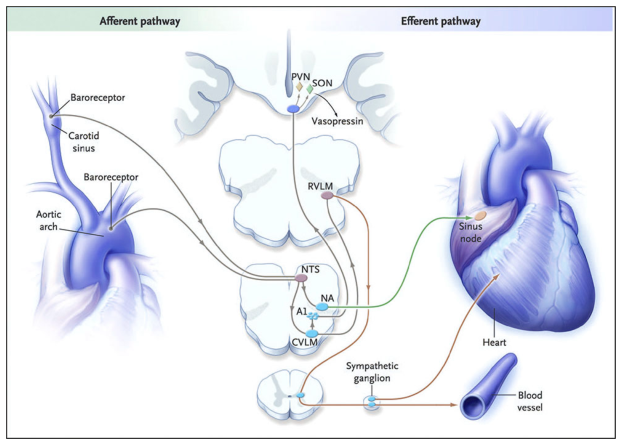
The Core Concept: A Reflex Arc
1. AFFERENT PATHWAY — "The Trigger Signal Going IN"
Primary Sensors: Baroreceptors
- Location: Carotid sinus and aortic arch
- Function: Mechanoreceptors (stretch receptors) that sense changes in arterial wall pressure/stretch
- When blood pools in the legs on standing → cardiac output falls → arterial pressure falls → baroreceptors are UNLOADED (less stretch = less firing)
Signal Transmission
- Afferent signals travel via cranial nerve IX (glossopharyngeal) from the carotid sinus and cranial nerve X (vagus) from the aortic arch
- These signals are relayed to the Nucleus Tractus Solitarius (NTS) in the dorsomedial medulla — the primary baroreceptor relay center
Other Afferent Triggers (Situational Syncopes)
| Trigger | Afferent Source |
|---|---|
| Orthostatic stress | Carotid/aortic baroreceptors |
| Carotid sinus pressure | CN IX from carotid sinus |
| Cough, Valsalva | Pulmonary stretch receptors |
| Micturition, defecation | Urogenital/GI afferents |
| Pain, fear, sight of blood | Cortical/limbic → hypothalamus → NTS |
| Cardiac outflow obstruction | Cardiac mechanoreceptors (Bezold-Jarisch) |
All these different afferent pathways converge on the Central Autonomic Network (CAN) in the medulla, which integrates all inputs and coordinates the final vasodepressor-bradycardic response.
2. CENTRAL INTEGRATION — "The Control Center"
| Nucleus | Role |
|---|---|
| NTS (Nucleus Tractus Solitarius) | Primary relay — receives all baroreceptor afferent input |
| NA (Nucleus Ambiguus) | Mediates parasympathetic (vagal) output to the sinus node → bradycardia |
| CVLM (Caudal Ventrolateral Medulla) | Excitatory pathway — intermediate relay in sympathetic control |
| RVLM (Rostral Ventrolateral Medulla) | Drives sympathetic outflow to heart and blood vessels; activated by disinhibition |
| PVN/SON (Hypothalamus) | Vasopressin release via A1 noradrenergic projections from CVLM |
- NTS → ↑ RVLM activity → ↑ sympathetic tone → vasoconstriction + ↑ heart rate → blood pressure maintained
- Something causes the NTS to trigger a paradoxical response — instead of sympathetic activation, there is sudden sympathoinhibition + parasympathetic surge
3. EFFERENT PATHWAY — "The Response Going OUT"
Efferent Branch 1 — PARASYMPATHETIC (via Vagus Nerve, CN X)
- NTS → NA → Vagus nerve → SA node of heart
- Result: Bradycardia (↓ heart rate, sometimes asystole)
- This is the cardioinhibitory component of vasovagal syncope
- In extreme cases: prolonged sinus pause/asystole → sudden LOC
Efferent Branch 2 — SYMPATHETIC
- NTS → CVLM → RVLM → Sympathetic ganglia → Blood vessels
- Normal: RVLM activates sympathetic ganglia → norepinephrine release → vasoconstriction
- In vasovagal syncope: sympathetic WITHDRAWAL (sympathoinhibition) → peripheral vasodilation
- Result: Vasodepression (↓ systemic vascular resistance, blood pools in periphery)
Three Efferent Subtypes Based on Which Branch Dominates:
| Subtype | Efferent Predominance | What Happens |
|---|---|---|
| Cardioinhibitory | Parasympathetic ↑ | Severe bradycardia or asystole; BP falls secondary |
| Vasodepressor | Sympathetic withdrawal | Peripheral vasodilation; HR may be normal; BP falls |
| Mixed | Both simultaneously | Both bradycardia AND vasodilation — most common type |
4. THE FINAL COMMON PATHWAY
↓ Cardiac Output + ↓ Systemic Vascular Resistance
           ↓
   ↓ Systemic Blood Pressure (SBP <50 mmHg)
           ↓
   ↓ Cerebral Blood Flow (<25 mL/min/100g)
           ↓
  Failure of Cerebral Autoregulation
           ↓
     LOSS OF CONSCIOUSNESS (Syncope)
- Cessation of cerebral blood flow for just 6–8 seconds is sufficient to cause loss of consciousness
- Cerebral autoregulation normally maintains CBF constant from 50–150 mmHg perfusion pressure, but has a 5–10 second latency — rapid BP drops bypass this protection
5. WHAT FAILS IN DIFFERENT TYPES
| Type of Syncope | Afferent Problem | Efferent Problem |
|---|---|---|
| Vasovagal | Paradoxical afferent activation (e.g., vigorous cardiac contractions in underfilled ventricle → Bezold-Jarisch) | Sudden sympathoinhibition + vagal surge |
| Orthostatic hypotension | Baroreceptors fire normally — afferent is intact | Efferent sympathetic fails chronically (autonomic neuropathy) |
| Carotid sinus syndrome | Carotid sinus hypersensitive → excessive afferent signal | Normal efferent → exaggerated bradycardia/vasodilation |
| Cough/micturition syncope | Afferent trigger from pulmonary/GI/GU systems → NTS | Same efferent vasodepressor-bradycardic response |
| Cardiac syncope (arrhythmia) | Afferent system is bypassed entirely | No reflex arc — direct ↓ cardiac output causes hypoperfusion |
Summary
- Afferent pathway: Baroreceptors (carotid sinus, aortic arch) → CN IX/X → NTS in medulla. Detects the hemodynamic stress and converges from multiple peripheral triggers into the central autonomic network.
- Efferent pathway: NTS → NA (vagal/parasympathetic → bradycardia) + NTS → CVLM → RVLM → sympathetic ganglia → blood vessels (normally vasoconstriction; in syncope this is WITHDRAWN causing vasodilation).
- In neurally mediated syncope, the efferent response is paradoxically reversed: instead of compensating for low BP, the nervous system causes further bradycardia + vasodilation → catastrophic BP fall → syncope.